Last updated 2026-07-25
TL;DR
Defensible space clearing means removing flammable vegetation and debris around a structure in defined zones, typically 0-5 ft, 5-30 ft, and 30-100 ft. California requires it out to 100 feet under Public Resources Code 4291, and a long-delayed Zone 0 (0-5 ft) ember-resistant rule is still pending final regulatory action, not yet enforceable statewide as of mid-2026.
what is defensible space clearing, exactly?
Defensible space clearing is the work of removing or reducing flammable vegetation, dead plant material, and debris around a home so a wildfire has less fuel to burn as it approaches, and so firefighters have a safer place to work if they show up. It's not the same as clear-cutting your yard. Done right, it's selective: you're removing ladder fuels (the stuff that lets a ground fire climb into tree canopies), thinning dense brush, and creating gaps between plants so fire can't run continuously toward your walls. California's core defensible space law, Public Resources Code Section 4291, requires homeowners in State Responsibility Areas and some local Very High Fire Hazard Severity Zones to maintain defensible space up to 100 feet from structures, or to the property line, whichever is less [1]. The statute breaks that 100 feet into two working zones with different rules for each, which we cover below. The point isn't to turn your lot into gravel. CAL FIRE is explicit that "the goal of defensible space is to reduce wildfire threats and to provide firefighters a safe area in which to work", not to eliminate all landscaping. A well-designed, spaced-out yard with irrigated, low-fuel plants can pass inspection and still look like a yard.
what are the defensible space zones (0-5, 5-30, 30-100 feet)?
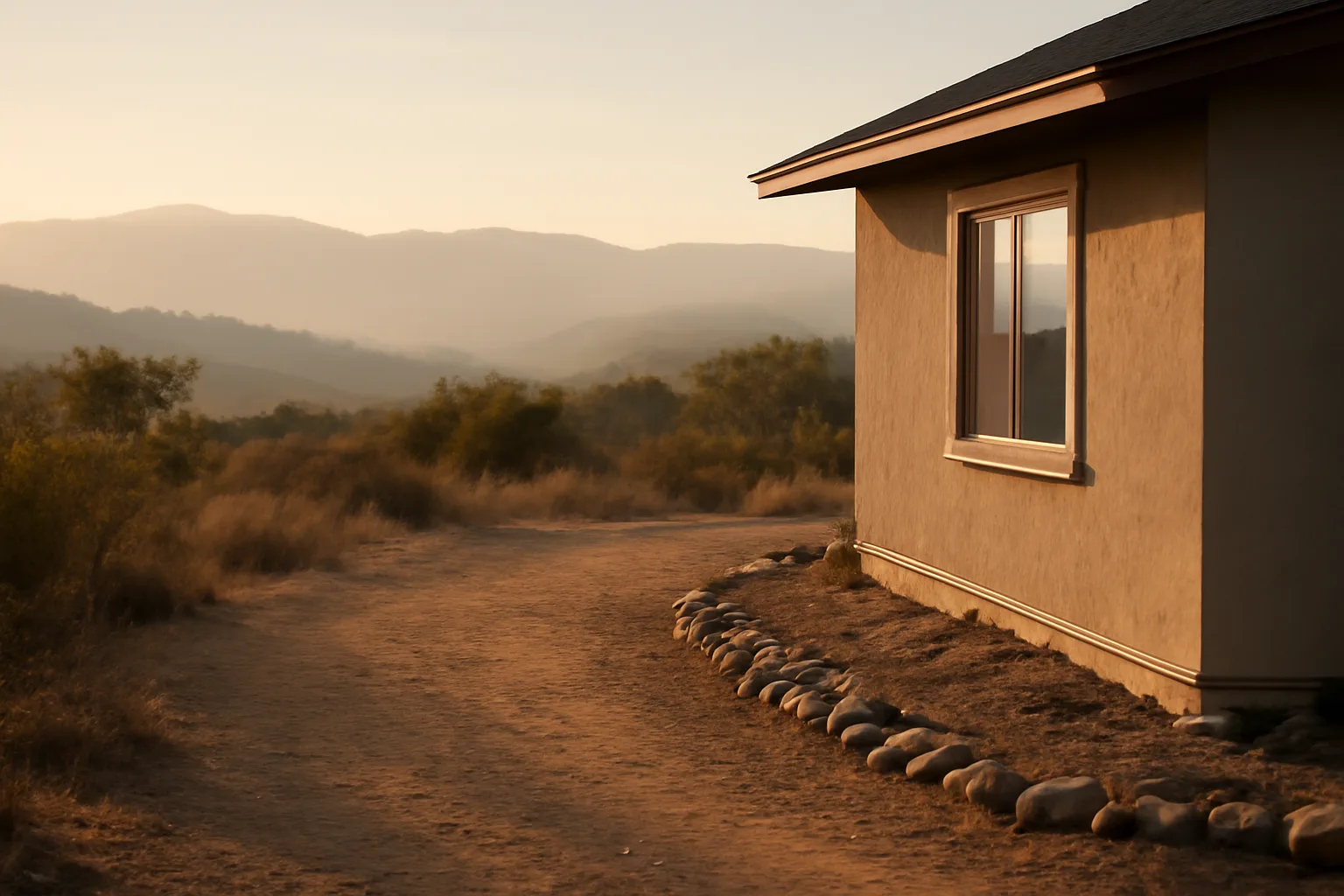
| Zone 0 (ember-resistant zone) | 0-5 ft | No combustible mulch, no flammable plants touching the structure, non-combustible landscaping (rock, pavers, bare soil); pending statewide regulation, not yet final [2] | |
|---|---|---|---|
| Zone 1 | 5-30 ft | Remove dead plants, dead grass, and dead leaves; keep tree limbs 10 ft from other trees; remove vegetation under trees that could carry fire upward [1] | |
| Zone 2 | 30-100 ft | Cut annual grass to 4 inches or less; create horizontal and vertical spacing between shrubs and trees based on slope; remove fallen leaves and pine needles down to 3 inches [1] | The spacing requirements in Zone 2 scale with slope steepness, because fire moves faster uphill. CAL FIRE's defensible space guidance gives specific spacing tables by slope percentage, and your local fire district may add stricter numbers on top of the state minimums, so treat these as a floor, not a ceiling. If you want the zone-by-zone planting logic (what to put back in after you clear), see fire safe landscaping California next to house. |
Defensible space in California is organized into distinct zones measured out from the structure, and each has different clearing standards. | Zone | Distance from structure | What's required |
when does the California defensible space law go into effect (Zone 0)?
The 100-foot defensible space requirement under PRC 4291 has been law for years and is already enforced today; that part isn't new. What's still pending is Zone 0, the ember-resistant zone within 5 feet of structures, which California's legislature directed the Board of Forestry and Fire Protection to develop regulations for under SB 63 (2021) and earlier authorizing legislation [2] [3]. As of mid-2026, the Zone 0 regulation has not been finalized into an enforceable statewide standard. The Board of Forestry has run stakeholder workshops and draft rulemaking, but the formal regulation, with a defined compliance date, was still moving through the state rulemaking process at last check [2]. This is genuinely confusing for homeowners. News coverage and even some insurer letters have referenced 2023, 2025, and 2026 target dates at different points, because the timeline kept slipping through the state's formal rulemaking process. The honest answer: check the Board of Forestry and Fire Protection's current rulemaking status page before you assume a specific enforcement date applies to your property [2]. In the meantime, treat Zone 0 as best practice, not a hard deadline. Insurers underwriting wildfire risk are already asking about it on inspection forms in many high-risk areas, even ahead of formal state enforcement, so building it out early is rarely wasted work.
why won't people follow the defensible space law in California?
It's a fair question, and the honest answer is a mix of cost, confusion, and enforcement gaps, more than stubbornness. Clearing 100 feet of vegetation on a sloped, brush-covered lot can run into real money, sometimes several thousand dollars for a single property depending on density and access. Many owners simply don't have that lying around every year. This is maintenance, not a one-time job; grass and brush regrow annually, so the bill comes back too. Enforcement is also uneven. PRC 4291 gives local fire agencies inspection authority, but staffing varies a lot by county, and rural properties on large parcels are harder to inspect regularly than dense subdivisions. Some homeowners genuinely don't know the law applies to them, especially if they moved in after the last inspection cycle or bought in an area recently redrawn into a Very High Fire Hazard Severity Zone. There's also a real disagreement, sometimes with neighbors, sometimes with local ordinances, about aesthetics and mature trees. Removing a 40-year-old oak's lower limbs or thinning a hedge someone planted for privacy is an emotional decision, more than a fire-safety checkbox. None of that makes non-compliance a good idea. Fire moves through under-cleared lots fastest, and inspection letters (and insurance non-renewals) increasingly cite exactly this gap.
how to prepare for a wildfire (beyond clearing vegetation)
Clearing defensible space is necessary but it's only one piece. Ready.gov's wildfire preparedness guidance recommends building an emergency supply kit, making a family evacuation plan with two ways out of your neighborhood, and signing up for local emergency alerts before fire season starts, not during an active evacuation order. Practical steps that matter alongside clearing: know your evacuation zone and routes in advance, keep your car at least a quarter tank full during fire season, and have a go-bag ready with medications, documents, and a change of clothes for each household member. Ready.gov also recommends photographing or video-recording your home's exterior and interior, and your defensible space work, before fire season, specifically so you have a record if you need to file an insurance claim later. Keep that documentation somewhere off-site (cloud storage, a relative's house), because a house fire can destroy paper records along with everything else. If your property has already had a close call or an inspection letter, read through what a house fire actually does to structures and records; it changes what people prioritize on their go-bag list.
how to prevent wildfires and forest fires (what actually reduces ignition risk)
Most wildfires are human-caused, and the fixes are mundane, not dramatic. CAL FIRE and the U.S. Forest Service both point to unattended campfires, dragging trailer chains that spark on pavement, mowing dry grass with metal blades, and downed power lines as leading ignition sources during peak season. Preventing forest fires at the individual level means: fully extinguish campfires (drown, stir, drown again until cold to the touch), avoid outdoor equipment use during red flag warnings, and never park a hot vehicle over dry grass. At the property level, prevention overlaps heavily with defensible space clearing: removing dead vegetation removes fuel, which is the one variable a homeowner actually controls. You can't control wind or drought, but you can control whether a wind-blown ember lands on bare gravel or a bed of dry mulch against your siding. Smokey Bear's long-running "Only You Can Prevent Wildfires" campaign exists because the data backs it up: human activity, not lightning, causes the large majority of wildfires nationally in most years, per Forest Service reporting tied to the campaign's history [4]. If you want the origin and the actual behavior changes behind that message, see only you can prevent wildfires.
how to prepare for forest fires when you live near wildland
If your property backs up to wildland or open brush, preparation starts with the same 100-foot defensible space zones covered above, but the stakes are higher because you have less warning time. Ready.gov recommends treating any red flag warning day as a trigger to pre-stage your go-bag near the door, move vehicles to face outward in the driveway, and close all windows and vents to reduce ember intrusion. Inside the defensible space zones, Zone 1 and Zone 2 maintenance (removing dead grass, spacing shrubs, limbing up trees) needs to happen before fire season starts each year, not during a red flag warning; by the time conditions are dangerous, cutting dry grass with power equipment is itself a fire risk. Home hardening matters as much as clearing. Ember-resistant vents, a Class A fire-rated roof, and enclosed eaves stop the ember intrusion that clearing alone can't. A cleared yard with an unscreened attic vent is still vulnerable; embers travel miles ahead of a fire front and find any opening.
is Santa Barbara (or my area) safe from fire risk?
No California community with wildland interface is "safe" from fire risk in an absolute sense, and Santa Barbara County is a documented high-risk area, not a low-risk one. The county has burned repeatedly in major fires, including the 2017 Thomas Fire (at the time one of the largest in modern California history) and the debris flow that followed in Montecito. CAL FIRE's Fire Hazard Severity Zone maps classify large portions of Santa Barbara County's hillside and wildland-adjacent communities as Very High Fire Hazard Severity Zones, which is the same designation that triggers PRC 4291 defensible space requirements [1] [5]. The honest way to check your own risk, whether you're in Santa Barbara, Boulder, Ashland, or Prescott, is to look up your address on your state's official fire hazard severity zone viewer rather than relying on general reputation. CAL FIRE publishes these maps by county [5]; Colorado, Oregon, and Arizona have parallel state-level wildfire risk tools through their state forestry or fire marshal offices. Insurers use these same maps (or their own proprietary models built on similar data) when they decide non-renewal, so checking your zone tells you roughly what your insurer already knows about your address.
what fire-safe home rules take effect in 2026?
This is one of the most-searched, least-settled questions in wildfire prep right now, and the honest answer is: it depends which rule you mean, and some dates have already slipped once. California's Zone 0 ember-resistant zone regulation (covered above) has been targeted for various effective dates across several legislative and regulatory cycles; check the Board of Forestry and Fire Protection's current rulemaking page directly rather than trusting any fixed date circulating online, because the timeline has moved before [2]. Separately, California's Chapter 7A building code (wildland-urban interface fire hazard construction standards) already requires ember- and flame-resistant materials, vents, and assemblies for new construction and additions in Fire Hazard Severity Zones, and local jurisdictions periodically adopt updated versions of the California Building Code and Building Standards Code on their own cycles [6]. Colorado, Oregon, and Arizona each have their own separate timelines. Oregon's wildfire risk map and defensible space code requirements went through a well-publicized redo after 2022 pushback, administered through Oregon Department of Forestry rulemaking, not CAL FIRE. If you're in one of those states, check your state fire marshal's office directly rather than assuming California's rule applies to you; mitigation requirements genuinely vary by state and even by local fire district, so treat any single date you read online as a starting point to verify, not a final answer for your address.
how much does defensible space clearing cost, and who does it?
Costs vary widely by lot size, slope, vegetation density, and whether you hire it out or do it yourself. There's no single official national price list, and any number you see quoted online (including here) should be treated as a rough range, not a quote. For DIY work, costs are mostly your time plus tool rental or purchase (chainsaw, brush cutter, chipper rental) and green waste disposal or chipping fees, which many counties subsidize or run free chipper-day programs for during fire season; check your local fire district or county waste management office for current programs. For contracted clearing, costs scale with acreage and density; a small, already-maintained suburban lot might run a few hundred dollars for a seasonal cleanup, while a heavily overgrown rural parcel on a slope can run into the thousands, sometimes requiring heavy equipment or a masticator. Washington State's Department of Natural Resources publishes guidance and, in some cases, cost-share programs for landowners doing this work under formal contracts, which is a useful model for understanding what professional-grade clearing actually costs and involves; see wildfire defensible space clearing contracts Washington State DNR for the specifics. If you're weighing DIY against hiring out, get at least two local quotes before committing; pricing in wildfire-prone markets can swing a lot based on contractor demand right after a nearby fire.
how to document defensible space clearing for your insurer
If you've received a non-renewal notice or an inspection letter, documentation is the single highest-leverage thing you can do after the physical clearing work itself. Insurers and their inspectors can't see work you did last spring unless you show them. Practical documentation steps: photograph each zone (0-5, 5-30, 30-100 ft) separately, dated, ideally with a visible reference point (a fence post, a house corner) so distance is obvious in the frame. Keep receipts for any contracted clearing, chipping, or hauling. If your local fire district did a defensible space inspection, request a copy of the inspection report or compliance letter in writing; many districts issue one on request, and it becomes your best single piece of evidence. A reader doing this work themselves needs a simple, organized way to assemble it: dated photos by zone, contractor receipts, and any compliance letters in one packet you can hand to an inspector or attach to correspondence with your insurer. That's exactly the gap our $99 one-time Wildfire Insurance Survival Kit is built to close: a structured way to organize your defensible space documentation and home-hardening records before you need them, at /survival-kit-builder. To be clear: neither the kit nor this article negotiates with your insurer, files a claim, or promises reinstated coverage; you're preparing your own documentation, not hiring a public adjuster.
what to do next if you got a non-renewal or inspection letter
First, read the letter closely for the specific deficiency cited. Insurers and fire districts increasingly cite specific zone failures (dead vegetation within 5 feet, overhanging limbs, insufficient spacing) rather than a vague "defensible space" complaint, and fixing the named issue first, then documenting it, is more effective than re-clearing the whole property randomly. Second, check your Fire Hazard Severity Zone status directly on CAL FIRE's maps (or your state's equivalent) so you know exactly which PRC 4291 zone requirements legally apply to your address [1] [5]. Third, do the clearing work zone by zone, photograph it as you go, and request a written compliance inspection from your local fire district if they offer one; that written letter carries more weight with an insurer than your own photos alone. For the broader hardening picture beyond vegetation, roofing, vents, and siding materials all factor into how an insurer scores your risk; see defensible for the fuller hardening checklist, and fire at a house for what inspectors and adjusters actually look for after the fact.
Frequently asked questions
When does the California defensible space law go into effect?
The core 100-foot defensible space requirement under Public Resources Code 4291 is already in effect and has been enforced for years. The newer Zone 0 (0-5 ft ember-resistant) rule is still working through Board of Forestry rulemaking as of mid-2026 and has no final statewide enforcement date yet; check the Board's current rulemaking status directly.
Why won't people follow the defensible space law in California?
Mostly cost, confusion, and inconsistent enforcement, not simple defiance. Clearing dense brush on sloped rural parcels can cost thousands of dollars annually, staffing for local fire district inspections varies widely by county, and some owners don't realize their property sits in a Very High Fire Hazard Severity Zone until they get a letter.
How do you prevent wildfires as an individual homeowner?
Fully extinguish campfires (drown, stir, drown again), avoid outdoor power equipment on red flag warning days, don't park hot vehicles over dry grass, and keep your property's defensible space zones cleared. Most wildfires are human-caused, so controlling ignition sources on your own property is the most direct lever you have.
How do I prepare for a wildfire if I live in a high-risk zone?
Build a go-bag with medications and documents, know two evacuation routes out of your neighborhood, sign up for local emergency alerts, and photograph your home and defensible space before fire season starts. Ready.gov recommends doing all of this before a red flag warning, not during one.
What's the difference between preventing wildfires and preventing forest fires?
Functionally nothing; both terms describe the same uncontrolled vegetation fires, just with different emphasis (residential wildland interface versus deeper forest). Prevention steps are identical: control ignition sources, clear fuel near structures, and follow local burn and red flag restrictions.
Is Santa Barbara safe from wildfire?
No. Santa Barbara County has burned repeatedly, including the 2017 Thomas Fire, and CAL FIRE maps classify much of its hillside and wildland-adjacent areas as Very High Fire Hazard Severity Zones, the same designation that triggers state defensible space requirements. Check your specific address on CAL FIRE's zone viewer rather than relying on general reputation.
What fire-safe home rules take effect in 2026?
It depends which rule. California's Zone 0 ember-resistant regulation has had shifting target dates across rulemaking cycles and isn't finalized as of mid-2026; check the Board of Forestry and Fire Protection directly. Existing Chapter 7A wildland-urban interface building code requirements for new construction are already in force in Fire Hazard Severity Zones.
How wide does defensible space need to be around a house in California?
Up to 100 feet from the structure or to the property line, whichever is less, under Public Resources Code 4291. That distance splits into Zone 1 (5-30 ft) and Zone 2 (30-100 ft), each with different vegetation spacing and maintenance standards, plus the newer Zone 0 (0-5 ft) ember-resistant standard.
Can I do defensible space clearing myself or do I need a contractor?
Most homeowners can do basic Zone 1 and Zone 2 maintenance themselves: cutting dry grass, removing dead leaves, pruning low limbs. Steep slopes, heavy brush, or large trees often justify hiring a contractor with proper equipment; check for local chipper-day programs that reduce disposal costs either way.
Does clearing defensible space guarantee my insurance won't be cancelled?
No. Defensible space clearing reduces fire risk and gives you documentation to show an insurer, but no vegetation work guarantees coverage or reinstatement; insurers weigh regional risk models, roofing material, and prior claims alongside your clearing work. Documented compliance is evidence you can present, not a guarantee.
What documentation do insurers want for defensible space compliance?
Dated photos of each zone (0-5, 5-30, 30-100 ft) with a visible reference point, contractor receipts for clearing work, and any written compliance letter from your local fire district's inspection. Organized, dated evidence carries more weight than a verbal description of work done.
How often do I need to redo defensible space clearing?
At least annually before fire season, since grass, leaf litter, and brush regrow every year. Fast-growing vegetation or a wet winter followed by a dry summer can require a mid-season touch-up, especially in Zone 1 within 30 feet of the structure.
What is Zone 0 and why is it different from Zone 1 and Zone 2?
Zone 0 is the 0-5 foot ember-resistant zone directly against the structure, aimed at stopping ember ignition rather than fire spread. It calls for non-combustible materials like rock or pavers instead of mulch or plants touching the walls. It's still in rulemaking in California as of mid-2026, not yet a finalized enforceable statewide standard.
Sources
- California Public Resources Code Section 4291: 100-foot defensible space requirement and its two-zone structure
- California Board of Forestry and Fire Protection, Rulemaking: Zone 0 ember-resistant zone regulation status and rulemaking process
- California SB 63 (2021): Legislative directive establishing the Zone 0 ember-resistant zone requirement
- USDA Forest Service, Smokey Bear Wildfire Prevention: Human activity as the leading cause of wildfires nationally
- CAL FIRE, Fire Hazard Severity Zones Maps: Fire Hazard Severity Zone designations for Santa Barbara County and statewide mapping
- California Office of the State Fire Marshal, Building Materials Listing / Chapter 7A: Chapter 7A wildland-urban interface building code requirements for new construction