Last updated 2026-07-25
TL;DR
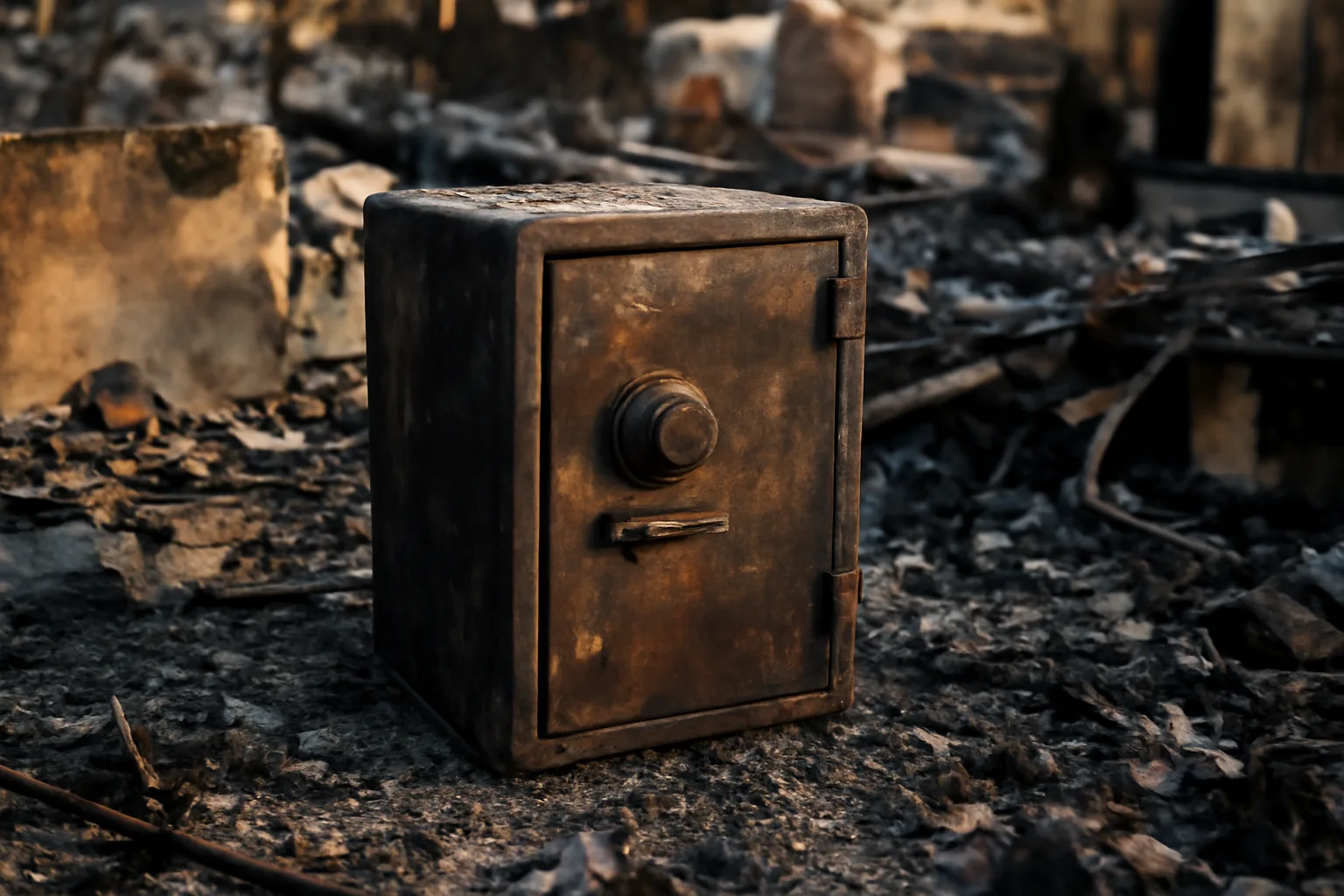
A fire-resistant home safe (like the models Brinks sells) is rated to keep contents below roughly 350°F for about 30 to 60 minutes, enough to survive a typical house fire's early phase but not a slow-burning wildfire ember attack lasting hours. Pair a rated safe with off-site digital backups, defensible space clearing, and CAL FIRE's Ready-Set-Go documentation habits.
What does a "fire-resistant" safe actually protect against?
A fire-resistant safe is built to slow heat transfer long enough for firefighters to knock down a fire before the inside temperature destroys paper, photos, or electronics. Most consumer safes, including Brinks Home Security branded models sold through big-box retailers, carry an Underwriters Laboratories (UL) rating like UL 72 for a specific time and temperature: commonly 30 minutes to 1 hour at an external temperature near 1550°F, holding the internal temperature below 350°F, the scorch point for paper. That's a real, tested standard, but it has limits people miss. UL 72 testing simulates a structure fire, not a wildland-urban interface fire where a home can smolder from radiant heat and embers for hours, or where the safe sits in rubble at high temperature for a full day before rescue crews reach it. A 30-minute-rated safe in a slow, smoldering wildfire aftermath can still cook its contents if nobody pulls it from the debris quickly. Digital media (thumb drives, external hard drives) fails at much lower temperatures than paper, often above 125°F to 150°F. So a safe rated only for paper documents can still ruin a backup drive stored next to your birth certificate. If you keep digital backups in a safe, look for a separate UL rating for data/media protection, which requires holding internal temps and humidity far lower than the paper standard.
How to prepare for a wildfire: the document and valuables checklist
Preparing for a wildfire means assuming you may have 15 minutes or less to leave. Ready.gov's wildfire guidance tells households to build a go-bag with copies of insurance policies, identification, medical records, and a home inventory, stored somewhere you can grab it fast, not locked in a floor safe you'd need tools to move [1]. Here's the order of operations that actually works when you're rushed: 1. Photograph or scan every room, closet, and the garage before fire season starts. Store copies in cloud storage and on a portable drive. 2. Keep original important documents (deeds, passports, policy declarations pages) in a portable fire-rated document box you can grab in seconds, not a heavy built-in safe. 3. Use a heavier fire-resistant safe for backups and valuables you're willing to risk leaving behind if evacuation is forced. 4. Photograph your defensible space work (cleared brush, trimmed trees, ember-resistant vents) each year. Insurers increasingly ask for this exact documentation when reviewing non-renewal disputes. A rated safe is one layer, not a substitute for evacuation prep. If you're rebuilding your go-kit around insurance survival specifically, a prebuilt reference like the Wildfire Insurance Survival Kit ($99, one-time) organizes the photo/document checklist so you're not improvising it during a red flag warning. We don't file claims or negotiate with insurers; the kit just helps you assemble what you'll need to document your own claim and defensible space compliance.
When does the California defensible space law go into effect?
California's core defensible space law, Public Resources Code 4291, already requires 100 feet of defensible space clearance around homes in State Responsibility Areas and has been in effect in some form since 2005, when the distance was expanded from 30 feet to 100 feet [2]. That part isn't new and isn't changing dates. What is changing is the "ember-resistant zone" (Zone 0) rule, the 0-to-5-foot area immediately touching the home. The California Board of Forestry and Fire Protection has been developing Zone 0 regulations under SB 63 (2023) and earlier authorization from AB 3074 (2020), which require removing combustible materials, mulch, and vegetation within 5 feet of structures in the highest fire hazard severity zones. As of this writing, CAL FIRE and the Board of Forestry have pushed the Zone 0 regulatory timeline back multiple times. Check CAL FIRE's defensible space page directly, since the effective date is set by regulation, not statute, and has moved before [3]. Don't rely on a fixed year you saw once online; confirm the current status on fire.ca.gov before doing Zone 0 work for insurance documentation purposes. [Local fire district note: some California counties and fire protection districts adopt stricter local defensible space ordinances than the state minimum. Check with your county fire marshal or local fire district for your specific required clearance distances and inspection schedule before doing any clearing work.]
What fire-safe rules for homes take effect in 2026?
There's no single nationwide "2026 fire-safe home law." What's actually happening is a patchwork of state-level building code and defensible-space updates moving through adoption on different timelines. Homeowners searching for a 2026 date are usually finding early reporting on California's Zone 0 ember-resistant zone rule, which the Board of Forestry has targeted for various effective dates as the rulemaking process continues [3]. Separately, the 2025 California Building Standards Code cycle (Title 24) updates wildfire-related building provisions like Chapter 7A (materials and construction for wildland-urban interface) on its regular three-year update cycle. These apply mainly to new construction and major remodels in Fire Hazard Severity Zones, not existing homes retroactively. The honest answer: if you're in a CA/CO/OR/AZ wildfire zone, don't wait for a headline date. Call your county fire marshal's office or check your state fire marshal's website for the specific rule that applies to your parcel right now. Rules genuinely vary by fire district, and a regulation finalized in one county's jurisdiction may not be in force yet in the next county over.
Why won't people follow the defensible space law in California?
Cost and labor are the two most cited reasons. Clearing 100 feet of defensible space on a sloped, brush-covered lot can run into thousands of dollars if you hire a contractor, and CAL FIRE inspection data has repeatedly shown compliance rates well under 100% in high hazard zones, with many parcels failing initial inspections for incomplete brush clearance, dead vegetation left in place, or wood piles too close to structures. Some of it is genuine confusion: people don't know their parcel is in a State Responsibility Area, don't know the 100-foot rule exists, or assume a small yard exempts them. Some of it is dispute over aesthetics; homeowners with mature trees or landscaping don't want to cut vegetation they've grown for decades. And some of it is simple bandwidth: elderly or disabled homeowners, or those without cash for a contractor, physically can't do the clearing themselves. CAL FIRE's own defensible space guidance acknowledges this tension directly, describing defensible space as work that "allows a firefighter to safely defend the home" while also reducing the odds the home ignites at all, and provides a self-inspection checklist so homeowners can act without hiring anyone [4]. If cost is the barrier, some CAL FIRE units and local fire safe councils run chipper days or cost-share programs. Ask your local unit directly, since availability varies by county and year. For the mechanics of what compliant clearing actually looks like near structures, see fire safe landscaping next to your house and defensible space zone breakdowns.
How to prevent wildfires (and forest fires): what actually moves the needle
Roughly 84% of wildfires in the U.S. are human-caused, according to the National Interagency Fire Center's long-running analysis of ignition sources, meaning most wildfire prevention is really about controlling human ignition sources, more than weather luck [5]. That number gets cited constantly because it's the single clearest argument for why individual behavior matters. The practical prevention list, for both "wildfire" and "forest fire" (same phenomenon, different setting) is short and repetitive across every fire agency's guidance: - Never leave a campfire unattended; drown, stir, and drown again until it's cold to the touch.
- Don't park or drive vehicles on dry grass; catalytic converters can ignite vegetation within minutes.
- Follow local burn permit rules and red flag warning burn bans exactly; don't burn debris on windy days.
- Keep chains from trailer hitches from dragging on pavement; sparks from dragging chains are a documented ignition source CAL FIRE tracks.
- Maintain equipment (mowers, chainsaws, grinders) away from dry grass, and avoid using them during red flag warnings. Smokey Bear's message, still run by the USDA Forest Service and the Ad Council, is built on this same human-ignition data. "Only you can prevent wildfires" isn't a slogan invented for cuteness. It's a direct response to the fact that most fires start with people [6]. For more on what that campaign actually asks of you day to day, see only you can prevent wildfires.
How to prepare for a wildfire before it starts
Preparation splits into three timelines: year-round hardening, red flag warning day actions, and the go-bag you grab in the final minutes. Confusing these three is the most common mistake homeowners make. Year-round, this means defensible space clearing (the 100-foot zones discussed above), ember-resistant vent screens (1/8-inch metal mesh, per CAL FIRE's home hardening guidance), keeping gutters clear of dry leaves, and moving firewood piles at least 30 feet from the structure [4]. Ready.gov's wildfire page also recommends a documented home inventory and reviewing your insurance policy's coverage limits annually, before a non-renewal letter forces the issue [1]. On a red flag warning day, that's when you pack the car: go-bag, medications, pets, important documents, and move any combustible patio furniture or doormats away from the house. CAL FIRE's Ready-Set-Go program frames this exact staging behavior as the "Set" phase, distinct from ordinary daily readiness [4]. If evacuation orders come, that's "Go," immediately, without finishing packing. For a broader walk-through of hardening priorities specific to older or existing homes (not new construction), see house fire and fire at a house for post-incident and prevention comparisons.
Is Santa Barbara safe from fire?
No coastal California city is "safe from fire" in an absolute sense. Santa Barbara County has a documented history of major destructive fires, including the 1990 Painted Cave Fire that destroyed over 400 structures and the 2017 Thomas Fire, which at the time was the largest wildfire in modern California history at over 280,000 acres before being surpassed by later fires [7]. The Thomas Fire also triggered the January 2018 Montecito debris flow, which killed 23 people, showing how wildfire risk in this specific region compounds with post-fire mudslide risk on steep coastal terrain . What's actually true is that risk varies enormously by specific parcel within the county. Homes in the foothill communities (Montecito, Mission Canyon, upper State Street corridor) sit adjacent to chaparral-covered slopes in a State Responsibility Area or Local Responsibility Area with a high Fire Hazard Severity Zone designation, while homes closer to the ocean flatlands carry meaningfully lower wildfire ignition risk, though wind-driven ember risk can still reach further than people expect . If you own property in Santa Barbara County, the only honest answer to "am I safe" comes from checking your specific parcel against CAL FIRE's Fire Hazard Severity Zone maps, available through the state's official viewer, not a general reputation about the city .
Fire-resistant safe ratings compared: what the numbers actually mean
| UL 72 paper/document | Paper documents | 30 min to 2 hr | 350°F | |
|---|---|---|---|---|
| UL data/media (separate cert) | USB drives, hard drives, film | 30 min to 1 hr | 125°F, low humidity | |
| Fireproof document bag (non-UL) | Loose papers, passports | Manufacturer claim only, often untested to UL standard | Varies, no independent verification | |
| Water-resistant add-on | Sprinkler/hose water during fire suppression | N/A (separate submersion rating) | N/A | The practical takeaway: a safe advertised as "fireproof" without a specific UL 72 duration and temperature rating printed on the spec sheet is making a marketing claim, not a tested one. Always check for the actual UL certificate number, more than the word "fireproof" on the box. For wildfire-zone homeowners specifically, buy based on what you're storing. Paper-only documents: a basic UL 72 30-minute safe is adequate as a backup to off-site digital copies. Irreplaceable photos, backup drives, or heirloom jewelry: pay for the higher-duration rating and a separate media protection certification, and still keep a duplicate copy somewhere off-property. |
Homeowners shopping for a safe (Brinks, SentrySafe, and similar brands) see rating labels that sound similar but mean different things. Here's a plain comparison of what's typically tested and marketed: | Rating type | What it protects | Typical duration | Typical internal temp held below |
Building your own defensible space and documentation plan
CAL FIRE's defensible space guidance breaks the yard into zones: Zone 0 (0-5 feet, ember-resistant), Zone 1 (5-30 feet, lean fuel reduction), and Zone 2 (30-100 feet, reduced fuel continuity) [4]. Work through them in that order; Zone 0 protects the structure itself from direct ember ignition, which CAL FIRE data consistently shows is the dominant way homes ignite in wind-driven wildfires, more often than direct flame contact. Document every stage with dated photos. Insurers reviewing a non-renewal or requesting proof of mitigation almost always want to see: cleared vegetation within 5 feet of the foundation, trimmed tree limbs 10 feet from the chimney, and a legible photo of any ember-resistant vent screens installed. Keep these photos with your policy documents, not buried in a phone camera roll you'd lose along with the phone in an evacuation. For a walkthrough of what each defensible space zone requires in more technical detail, see defensible space zones. If you're outside California and dealing with contractor-based clearing requirements instead, Washington State DNR's defensible space clearing contract guidance covers a comparable but state-specific process.
Frequently asked questions
When does the California defensible space law go into effect?
The core 100-foot defensible space requirement under Public Resources Code 4291 has been law since it was expanded in 2005; it's already in effect statewide in State Responsibility Areas. The newer Zone 0 (0-5 foot) ember-resistant zone rule is still moving through Board of Forestry rulemaking; check CAL FIRE's defensible space page for the current effective date before assuming a specific year.
Why won't people follow the defensible space law in California?
Mainly cost, labor, and awareness gaps. Clearing 100 feet on a sloped, brush-heavy lot can cost thousands if contracted out, and many homeowners don't know their parcel sits in a State Responsibility Area at all. CAL FIRE inspection data shows compliance rates well under 100% in high hazard zones for these reasons.
How to prevent wildfires?
Since roughly 84% of wildfires are human-caused (NIFC data), prevention mostly means controlling ignition sources: fully extinguish campfires, avoid parking on dry grass, follow local burn bans during red flag warnings, and keep dragging chains and mower blades off dry vegetation. Defensible space clearing prevents your home from being the fuel that spreads a fire further.
How to prepare for a wildfire?
Build a go-bag with documents, medications, and a home inventory you can grab in under 15 minutes. Clear defensible space year-round, stage your car and pets on red flag warning days, and evacuate immediately once ordered, not after finishing packing. Ready.gov's wildfire page has a printable checklist for each stage.
How to prevent forest fires?
Forest fires and wildfires share the same prevention basics: extinguish campfires completely, obey burn permits and bans, keep vehicles off dry grass, and maintain spark-producing equipment away from vegetation during dry, windy conditions. Most forest fire starts are traced to human activity, not lightning, according to National Interagency Fire Center data.
How to avoid forest fires?
Avoiding forest fires as an individual means eliminating ignition risk: no unattended fires, no fireworks or equipment sparks near dry brush, and strict compliance with local burn restrictions during high fire danger. If you live near forested land, defensible space clearing around structures reduces the odds a nearby fire reaches your home even if it starts elsewhere.
How to prepare for forest fires?
Preparation mirrors wildfire prep: clear defensible space around structures, keep a documented home inventory and go-bag ready, and know your evacuation routes before smoke is visible. Rural properties near forest land should also confirm road access width and water source locations with the local fire district in advance.
What fire-safe rules for homes take effect in 2026?
There's no single national 2026 rule. What people are usually referencing is California's Zone 0 ember-resistant zone regulation, still in Board of Forestry rulemaking with a shifting effective date, plus routine 2025 Title 24 / Chapter 7A building code updates for new construction in wildfire hazard zones. Check CAL FIRE and your state fire marshal directly for the current status.
Is Santa Barbara safe from fire?
No California location near wildland vegetation is fully safe from fire. Santa Barbara County has had major fires including the 1990 Painted Cave Fire and 2017 Thomas Fire. Risk varies sharply by parcel; foothill neighborhoods near chaparral carry meaningfully higher risk than flatland areas closer to the ocean. Check CAL FIRE's Fire Hazard Severity Zone map for your specific address.
How can we prevent forest fires?
Community-level prevention combines individual ignition control (no unattended fires, equipment maintenance) with agency-level work like prescribed burns, defensible space enforcement, and public education campaigns like Smokey Bear, run by the USDA Forest Service. Since most forest fires start with people, prevention is mostly a behavior problem, not a weather problem.
How long does a fire-resistant safe actually protect documents in a real fire?
Most UL 72 rated home safes hold internal temperatures below 350°F for 30 minutes to 2 hours during external temperatures around 1550°F, matching a typical structure fire's early burn phase. In a slow-smoldering wildfire aftermath where debris stays hot for many hours, a 30-minute-rated safe may not be enough; retrieve it and cool it as soon as it's safe to do so.
Do fireproof safes protect USB drives and hard drives the same way they protect paper?
No. Digital media fails at much lower temperatures (around 125-150°F) and needs low humidity too, so a safe rated only for paper (UL 72, 350°F) can still destroy a hard drive stored inside it. Look for a separate media/data protection certification if you're storing digital backups, more than a general "fireproof" label.
What's the difference between Zone 0, Zone 1, and Zone 2 defensible space in California?
Zone 0 is the 0-5 foot ember-resistant zone immediately touching the structure, requiring removal of combustible materials and mulch. Zone 1 covers 5-30 feet with lean, clean, low fuel landscaping. Zone 2 spans 30-100 feet and focuses on reducing fuel continuity between trees and shrubs, per CAL FIRE's defensible space guidance.
Sources
- California Public Resources Code Section 4291: California's 100-foot defensible space clearance requirement around structures in State Responsibility Areas
- California State Senate, SB 63 (2023): Legislative authorization directing the Board of Forestry to adopt ember-resistant Zone 0 regulations
- California Department of Housing and Community Development, 2025 California Building Standards Code Title 24 updates: California building code updates on a regular cycle, including wildland-urban interface Chapter 7A provisions for new construction
- National Interagency Fire Center, Statistics: Approximately 84 to 90 percent of wildfires in the U.S. are caused by human activity, based on long-run federal fire cause data
- USDA Forest Service, Smokey Bear Wildfire Prevention Campaign: USDA Forest Service runs the Smokey Bear wildfire prevention public education campaign centered on human-caused ignition
- National Interagency Fire Center / InciWeb historical fire records, Thomas Fire: The 2017 Thomas Fire burned over 280,000 acres in Ventura and Santa Barbara counties, among the largest California wildfires on record at the time
- CAL FIRE, Fire Hazard Severity Zone Maps: Fire Hazard Severity Zone designation varies by specific parcel and is mapped officially by CAL FIRE/Office of the State Fire Marshal