Last updated 2026-07-25
TL;DR
A fire resistant home in Los Angeles combines Zone 0 (0-5 ft ember-resistant landscaping), a Class A roof, ember-proof vents, and defensible space out to 100 feet. California's Zone 0 regulation, required under AB 3074, still needs final Board of Forestry rulemaking as of 2025; check fire.ca.gov for the current effective date before you spend money chasing a deadline that keeps moving.
What actually makes a house 'fire resistant' in Los Angeles?
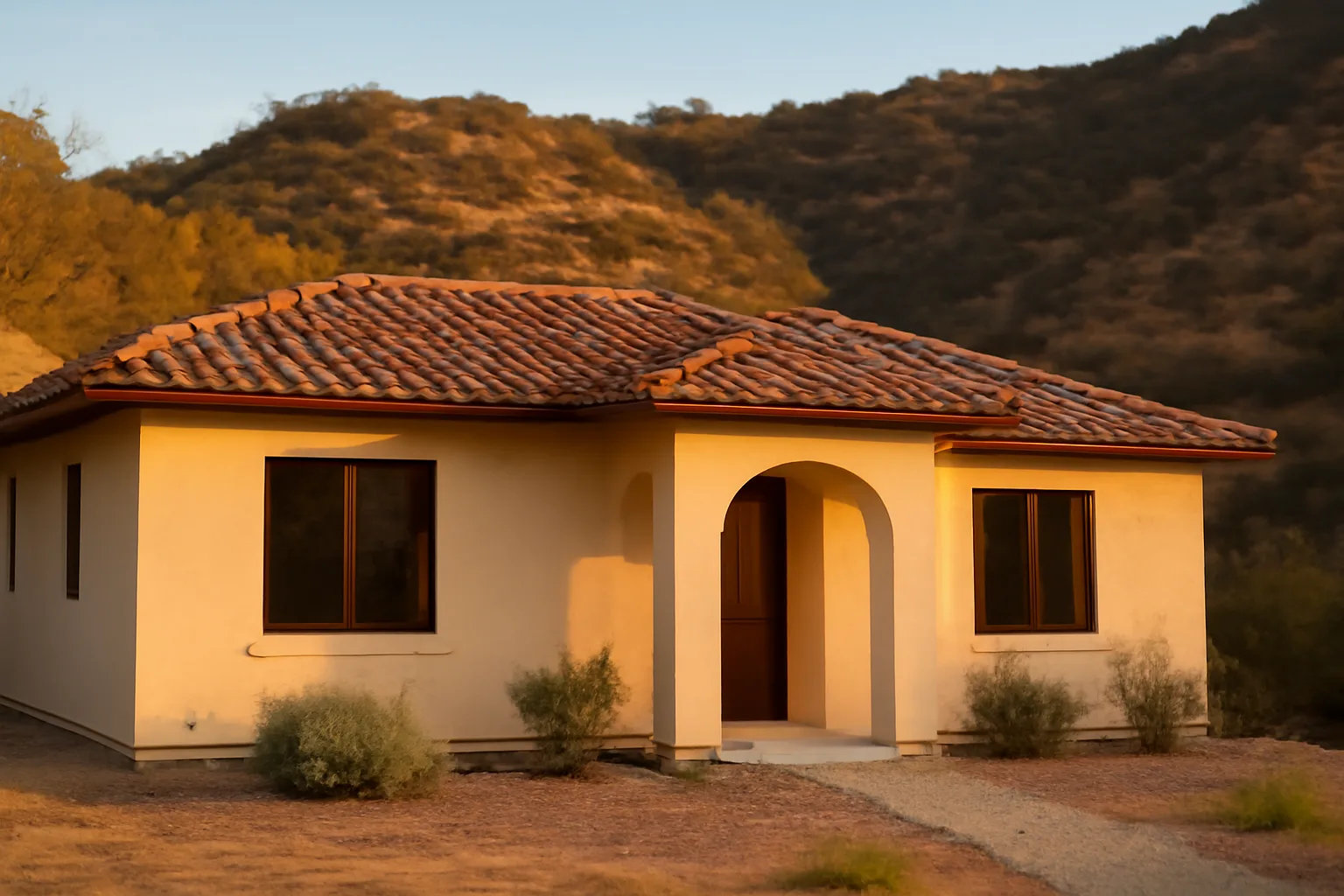
A fire resistant home is one built and maintained to survive an ember storm without direct flame contact, because embers, not walls of fire, destroy most homes in wildland-urban interface fires. CAL FIRE and the Insurance Institute for Business & Home Safety both point to the same three failure points: roofs, vents, and the first five feet of landscaping around the foundation [1]. In LA County that means a Class A fire-rated roof (composition shingle, tile, or metal, not wood shake), ember- and flame-resistant vents (typically 1/8-inch mesh or listed ember-resistant vents), dual-pane tempered windows, and non-combustible siding or at minimum 6 inches of clearance between combustible siding and any mulch or plants. None of this is exotic. It's mostly stuff a roofer and a contractor already know how to do; the problem is most LA homes built before the 2008 wildland-urban interface code (California Building Code Chapter 7A) don't have it. If you're in a Very High Fire Hazard Severity Zone, which covers large parts of the Santa Monica Mountains, the San Gabriel foothills, Malibu, Topanga, and the Angeles National Forest border communities, Chapter 7A retrofit standards apply whenever you do qualifying renovation work, and some jurisdictions require compliance on resale [2]. Check your specific parcel on CAL FIRE's FHSZ viewer, because the zone maps were updated in 2025 and boundaries shifted in several LA-adjacent counties. For a step by step walkthrough of what an inspector actually checks on the structure itself, see defensible, and for the landscaping side specifically, fire safe landscaping California next to house.
When does the California defensible space law go into effect?
California's existing defensible space law, Public Resources Code 4291, has been in effect for years and already requires 100 feet of defensible space (or to the property line) around structures in State Responsibility Areas and some Local Responsibility Areas [3]. What's new and still pending is the Zone 0 ember-resistant zone rule. AB 3074 (2020) directed the Board of Forestry and Fire Protection to adopt regulations requiring an ember-resistant zone within 5 feet of structures, called Zone 0, for homes in Very High Fire Hazard Severity Zones [4]. As of 2025, the Board had released draft Zone 0 regulations and opened public comment periods, but the rule had not been finalized into an enforceable statewide mandate with a hard compliance date. Multiple proposed effective dates have circulated in press coverage and stakeholder meetings, some pointing to 2025, others to 2026 or later, and none of that is settled law yet. Don't take a blog post's word for the exact date, including this one. Check the Board of Forestry's official rulemaking page directly before you plan a renovation budget around a specific deadline, because the timeline has slipped multiple times already. The honest answer right now: it is coming, it will almost certainly require bare ground, gravel, pavers, or non-combustible hardscape (not mulch, not bark, not most shrubs) within 5 feet of your house, but the enforceable start date is not locked as of this writing. What you can act on today regardless of Zone 0's final date: PRC 4291's 100-foot defensible space requirement is already enforceable, and CAL FIRE conducts inspections and can issue notices of violation with fines in some jurisdictions for noncompliance [3].
What fire-safe home rules take effect in 2026?
Nobody outside the Board of Forestry has a confirmed, final list of what triggers in 2026 specifically, and anyone claiming certainty is guessing. Here's what's realistically in motion: the Zone 0 ember-resistant zone regulation under AB 3074 has been targeted for a 2025-2026 rollout window in Board of Forestry discussions, but as of the most recent public rulemaking updates, final adoption and a firm statewide effective date had not been locked in [4]. Separately, California's insurance regulations changed in 2025 under the Department of Insurance's Sustainable Insurance Strategy, which lets insurers use catastrophe modeling in rate filings in exchange for writing more policies in wildfire-prone areas, including a requirement tied to FAIR Plan stabilization [5]. That's an insurance-market change, not a building code change, but it directly affects whether your carrier stays in LA County and what documentation they'll want from you. My honest read: treat 2026 as the year Zone 0 becomes real in some form, but verify the exact trigger date and scope (which counties, which structures, retrofit vs. new construction only) on the Board of Forestry's rulemaking docket before you spend money chasing a specific compliance deadline. Local jurisdictions like the City of Los Angeles and LA County Fire may also adopt their own overlay rules faster than the state does, so check with your local fire district too. [Fill in: your fire district's current defensible space ordinance number and inspection cycle here.]
Is Santa Barbara safe from fire?
No. No coastal or foothill community in California, including Santa Barbara, is 'safe' from wildfire in any durable sense, and Santa Barbara County has a documented history that argues the opposite. The Thomas Fire (2017) burned over 281,000 acres and was, at the time, the largest wildfire in modern California history, followed within weeks by the Montecito debris flow that killed 23 people [6]. The 1990 Painted Cave Fire and 2008 Tea Fire also burned into Santa Barbara's urban edge. Much of Santa Barbara sits directly against the Santa Ynez foothills, which is classified Very High Fire Hazard Severity Zone in CAL FIRE's mapping for large stretches of the hillside neighborhoods (Mission Canyon, San Roque, the Riviera) [2]. Insurers have responded accordingly: Santa Barbara County has seen elevated non-renewal rates alongside the rest of coastal and foothill Southern California, part of a broader pattern where California's FAIR Plan policy count more than doubled between 2020 and 2024 statewide. So the honest answer is: Santa Barbara is not meaningfully safer from fire than comparable LA foothill communities, and in some ways its topography (steep canyons funneling wind, dense chaparral fuel loads that haven't burned in decades in spots) makes it a textbook high-risk zone. If you own there, defensible space and Chapter 7A hardening matter exactly as much as they do in Malibu or Altadena.
How do I prepare for a wildfire, practically, this month?
Start with the documentation, not the landscaping, because that's what actually protects your insurance position and your claim if the worst happens. Photograph every room, your roof, attic vents, and the full perimeter of your property, dated and time-stamped, before fire season peaks (typically May through November in Southern California per CAL FIRE's seasonal outlook). Next, build your go-bag and evacuation plan using Ready.gov's wildfire checklist: water, medications, copies of insurance policy and ID documents, a battery radio, and a list of what to grab in the last five minutes (pets, chargers, external drives) . Ready.gov specifically recommends practicing your evacuation route twice a year and signing up for your county's emergency alert system, which in LA County is Genasys/Alert LA County. Then work the property in this order, because it's the order that actually reduces ember ignition risk according to CAL FIRE's defensible space guidance: clear Zone 1 (0-30 feet, remove dead vegetation, prune tree limbs to 6 feet off the ground), then Zone 2 (30-100 feet, reduce fuel density, mow grass to 4 inches), then the structure itself (clean gutters of debris, screen vents, remove anything stored under decks). This is also where a lot of homeowners realize they need a single, organized packet, photos, receipts, defensible space records, and policy documents, ready to hand an adjuster or show a fire inspector on demand. That's the exact gap our $99 one-time Wildfire Insurance Survival Kit is built to close (/survival-kit-builder); it doesn't file claims for you, it just organizes what you'd otherwise scramble to find at 2 a.m. during an evacuation.
Why won't people follow the defensible space law in California?
Cost, confusion, and enforcement gaps, in that order, based on what CAL FIRE and county fire departments report from inspection cycles. A full defensible space retrofit, brush clearing plus vegetation management across 100 feet, commonly runs from a few hundred dollars for a small suburban lot to several thousand for a hillside property with heavy chaparral, and repeat annual maintenance is a recurring cost most homeowners don't budget for. CAL FIRE's own compliance data shows persistent gaps: statewide defensible space inspections regularly find a meaningful share of properties out of compliance on first inspection, particularly around the harder-to-fix items like vegetation clearance under trees and combustible material against structures. Some of this is simple procrastination. Some of it is genuine hardship: elderly homeowners who physically can't clear brush, renters who don't control the landscaping, or owners in dense urban-adjacent neighborhoods who don't believe 'wildfire' applies to them because they're not literally in the forest. There's also a real confusion problem. Rules differ by Local Responsibility Area versus State Responsibility Area, city ordinances stack on top of state minimums, and enforcement varies wildly by jurisdiction, some counties issue notices and follow up with fines, others rely mostly on voluntary compliance and public education. If you don't know which agency has jurisdiction over your parcel, you often don't know which rule actually applies to you, and that ambiguity is a real driver of non-compliance, more than laziness. [Fill in: your local fire district's citation/fine schedule for defensible space non-compliance here, since this varies by county and even by year.]
How do you prevent wildfires (and forest fires) from starting in the first place?
Roughly 95 percent of wildfires in California are human-caused, according to CAL FIRE, which means prevention is mostly about controlling ignition sources, not luck. The big four: unattended campfires, vehicles and equipment sparking on dry grass (mowing, dragging chains, catalytic converters parked over brush), power tools used during red flag warnings, and improperly discarded smoking materials. At the individual level, prevention looks boring and specific: never mow or use string trimmers on dry grass during red flag warning days (check the National Weather Service red flag warning page for your zone), fully extinguish campfires with water not dirt (dirt insulates embers, it doesn't kill them), keep vehicles off dry grass, and maintain equipment so it isn't throwing sparks. Smokey Bear's long-running public message, 'Only you can prevent wildfires,' exists because human ignition is the dominant, controllable variable; see only you can prevent wildfires for the fuller history and current campaign guidance. At the property level, prevention blends into defensible space work: a fire that starts in your neighbor's yard shouldn't have a fuel bridge (dry brush, wood piles, overhanging branches) straight to your house. That's the whole logic behind Zone 0 and the 100-foot defensible space rule under PRC 4291 [3]. Preventing forest fires broadly (as opposed to preventing your house from burning in one) also means supporting prescribed burn programs and following local burn permit rules, since decades of fire suppression left many California forests with unnaturally heavy fuel loads that make fires, once started, far harder to control.
What does 'hardening' actually cost, roughly, in LA?
| Ember-resistant vents (per vent) | $50-$150 installed | Whole-house vent replacement often 8-15 vents | |
|---|---|---|---|
| Class A roof (full replacement) | $8,000-$25,000+ | Varies hugely by material (asphalt vs. tile vs. metal) and roof size | |
| Zone 0 hardscape conversion (0-5 ft) | $500-$3,000 | Gravel/pavers around foundation perimeter | |
| Defensible space brush clearance (100 ft, annual) | $300-$3,000+ | Depends on lot size, slope, existing fuel load | |
| Dual-pane tempered window upgrade (per window) | $400-$1,200 | Full-house replacement adds up fast | These ranges are directional, not quotes, and every fire district and contractor market prices differently. [Fill in: get 2-3 local contractor bids for your specific home before budgeting.] The point of gathering these numbers isn't just the retrofit itself, it's building a paper trail: dated invoices and before/after photos are exactly what insurers increasingly ask for when deciding whether to renew a policy in a Very High Fire Hazard Severity Zone, and it's the kind of record a lot of homeowners only start compiling after they've already gotten a non-renewal letter. |
Costs vary enormously by home size, current construction, and how much of the work you DIY versus hire out, and nobody has a single clean number that applies to every LA property. Here's the honest range based on typical retrofit scopes: | Retrofit item | Typical cost range | Notes |
How do I prepare for a forest fire if I live near wildland, more than suburban LA?
The prep is the same core checklist, just with tighter margins and less time. If you're on a canyon edge, a ridge line, or directly against Angeles National Forest or the Santa Monica Mountains, your evacuation window can be minutes, not hours, so pre-staging matters more than it does for a flatland suburban lot. Ready.gov recommends identifying two evacuation routes out of your neighborhood in case one is blocked, and keeping your gas tank at least half full during fire season . For rural and semi-rural parcels, CAL FIRE also recommends a driveway and access road wide enough and clear enough for fire engines to actually reach your structure, address numbers visible from the road (reflective, at least 4 inches tall), and a water source (pool, tank, or hydrant) that firefighters can identify and access. If you have livestock, large animals, or limited mobility household members, build that into your plan explicitly and practice it, because generic evacuation checklists tend to assume able-bodied residents with only small pets. The extra planning time (loading a trailer, coordinating a caregiver) needs to be built into your trigger point for when you leave, not figured out in the moment.
What should I actually send my insurer after doing this work?
Send exactly what CAL FIRE and your inspector documented, nothing embellished, nothing you can't back up with a date and a photo. Insurers reviewing wildfire risk in California increasingly want to see specific mitigation evidence, more than a claim that you did the work, and the state's new rate-filing framework under the Sustainable Insurance Strategy explicitly ties insurer participation in high-risk markets to accounting for mitigation [5]. A reasonable documentation packet includes: dated before/after photos of your roof, vents, and 0-5 foot zone; contractor invoices for any hardening work; your most recent defensible space inspection result if your fire district provides one; and a simple property map noting your defensible space zones. Keep copies off-property too (cloud storage, email to yourself), because a house fire destroying your only paper copy defeats the purpose. To be direct about what this is not: we do not file claims on your behalf, contact your carrier, or promise any discount, coverage, or reinstatement outcome. Sending good documentation improves your position; it does not guarantee a specific insurer decision, and nothing here is legal, insurance, or claims advice. If you want a structured starting point for organizing this packet before a non-renewal letter forces you to do it under pressure, that's the specific problem our $99 Wildfire Insurance Survival Kit is built to solve (/survival-kit-builder), alongside general guidance at house fire and fire at a house for post-incident documentation.
What's different about defensible space rules across fire districts?
Every fire district and jurisdiction layers its own specifics on top of the state minimums in PRC 4291, so the number of feet, the inspection cycle, and the fine schedule genuinely differ depending on where your parcel sits. LA County Fire, the City of Los Angeles, Ventura County Fire, and Santa Barbara County Fire each publish their own defensible space brochures and, in some cases, stricter local ordinances for hillside or Very High Fire Hazard Severity Zone parcels. [Fill in: your specific fire district name, its defensible space ordinance number, current inspection cycle (annual/biennial), and fine schedule for non-compliance here.] Because of this variation, the single most useful thing you can do this week, before buying a single bag of gravel, is call your local fire department's brush clearance or vegetation management unit and ask two questions: which zone classification applies to my parcel, and what's my next scheduled inspection date. That call is free and it tells you exactly which version of the rules you're actually working under.
Frequently asked questions
When does the California defensible space law go into effect?
The core 100-foot defensible space requirement under Public Resources Code 4291 is already in effect and enforced through CAL FIRE and local fire agency inspections. The newer Zone 0 ember-resistant zone rule under AB 3074 is still in Board of Forestry rulemaking as of 2025; check the Board's official rulemaking page for the finalized effective date before assuming a specific year applies to you.
Why won't people follow the defensible space law in California?
Cost, confusion over which jurisdiction's rules apply (state vs. local, SRA vs. LRA), and inconsistent enforcement across counties. CAL FIRE inspections regularly find compliance gaps, especially on harder items like vegetation clearance under trees, and physical or financial hardship keeps some homeowners, especially elderly or renting residents, from doing the work even when they know the rule exists.
How do you prevent wildfires?
Control ignition sources: never mow dry grass or use spark-producing equipment during red flag warnings, fully extinguish campfires with water, keep vehicles off dry brush, and maintain defensible space so embers can't reach fuel near structures. CAL FIRE attributes roughly 95 percent of California wildfires to human causes, making prevention mostly about behavior, not luck.
How do I prepare for a wildfire?
Document your home and property with dated photos, build a go-bag per Ready.gov's checklist (water, meds, documents, radio), plan two evacuation routes, sign up for your county's emergency alerts, and complete defensible space work in zones (0-30 ft, 30-100 ft) as outlined in CAL FIRE's guidance. Practice your evacuation plan at least twice a year.
How do you prevent forest fires?
Follow local burn permit rules, avoid equipment use on dry vegetation during high-wind or red flag days, fully extinguish any fire before leaving it, and support prescribed burn and fuel reduction programs in your area. Decades of fire suppression left many California forests with heavy fuel loads, so broader prevention also depends on forest management, more than individual behavior.
How do I avoid forest fires as a homeowner near wildland?
Maintain 100 feet of defensible space per CAL FIRE guidance, harden your home with a Class A roof and ember-resistant vents, clear dead vegetation annually, and avoid activities that spark ignition (mowing dry grass, dragging chains, unattended fires) especially during red flag warnings. Check your parcel's Fire Hazard Severity Zone designation to know your baseline risk.
How do I prepare for a forest fire if I live in a rural or wildland-adjacent area?
Prioritize a clear, wide driveway for fire engine access, visible reflective address numbers, an identifiable water source, and two evacuation routes since rural fires can cut off single roads fast. Keep your gas tank at least half full during fire season and build extra time into your evacuation trigger if you have livestock or mobility-limited household members.
What fire safe home rules take effect in 2026?
The most likely candidate is California's Zone 0 ember-resistant zone regulation under AB 3074, targeted for a 2025-2026 rollout in Board of Forestry discussions, but as of now no final statewide effective date is locked in. Separately, California's 2025 insurance rate-filing reforms (Sustainable Insurance Strategy) already affect how insurers price wildfire risk. Confirm specifics on the Board of Forestry's rulemaking page.
Is Santa Barbara safe from fire?
No. Santa Barbara County has burned repeatedly, including the 2017 Thomas Fire (over 281,000 acres) and the 1990 Painted Cave and 2008 Tea Fires, and much of its foothill area is mapped Very High Fire Hazard Severity Zone by CAL FIRE. Insurance non-renewals have risen there alongside the rest of coastal and foothill Southern California.
How can we prevent forest fires at the community level?
Community chipper days, shared fuel-break maintenance along shared property lines, coordinated defensible space compliance, and support for prescribed burns all reduce fire spread risk beyond what any single homeowner can do alone. Check whether your fire district or a local Firewise USA program organizes these efforts, since coordinated fuel reduction is more effective than isolated individual clearing.
What is Zone 0 and do I have it in Los Angeles?
Zone 0 is the proposed 0-5 foot ember-resistant zone immediately around a structure, required under AB 3074 for homes in Very High Fire Hazard Severity Zones once the Board of Forestry finalizes its regulation. It generally means removing combustible mulch, dense shrubs, and stored items in favor of gravel, pavers, or bare ground. Check current status on the Board of Forestry's site since the rule isn't finalized statewide yet.
Does a Class A roof alone make my home fire resistant?
No. A Class A roof reduces one major ignition point, but embers also enter through unscreened vents, ignite mulch and plants within 5 feet of the house, and catch on combustible siding or decking. CAL FIRE and IBHS both emphasize the roof, vents, and 0-5 foot zone together as the core survivability package, not any single upgrade alone.
Sources
- Insurance Institute for Business & Home Safety, Wildfire Prepared Home: Embers, roofs, vents, and near-home landscaping are the primary home ignition failure points
- CAL FIRE, Fire Hazard Severity Zone Maps: Very High Fire Hazard Severity Zone designations for LA and Santa Barbara foothill areas
- California Public Resources Code Section 4291: 100-foot defensible space requirement around structures in State Responsibility Areas
- California Assembly Bill 3074 (2020), Board of Forestry Zone 0 rulemaking: Requirement for Board of Forestry to adopt an ember-resistant Zone 0 regulation
- California Department of Insurance, Sustainable Insurance Strategy: 2025 regulatory changes allowing catastrophe modeling in rate filings tied to writing more wildfire-area policies
- CAL FIRE, Thomas Fire incident information: Thomas Fire (2017) burned over 281,000 acres in Ventura and Santa Barbara counties