Last updated 2026-07-25
TL;DR
Home Depot sells mineral wool and coated foam boards marketed as "fire-resistant," but none are fireproof. For wildfire hardening, look for products tested to ASTM E84 Class A or ignition-resistant assemblies under California's Chapter 7A, more than a fire-resistant label on the box.
What does "fire-resistant insulation board" actually mean at Home Depot?
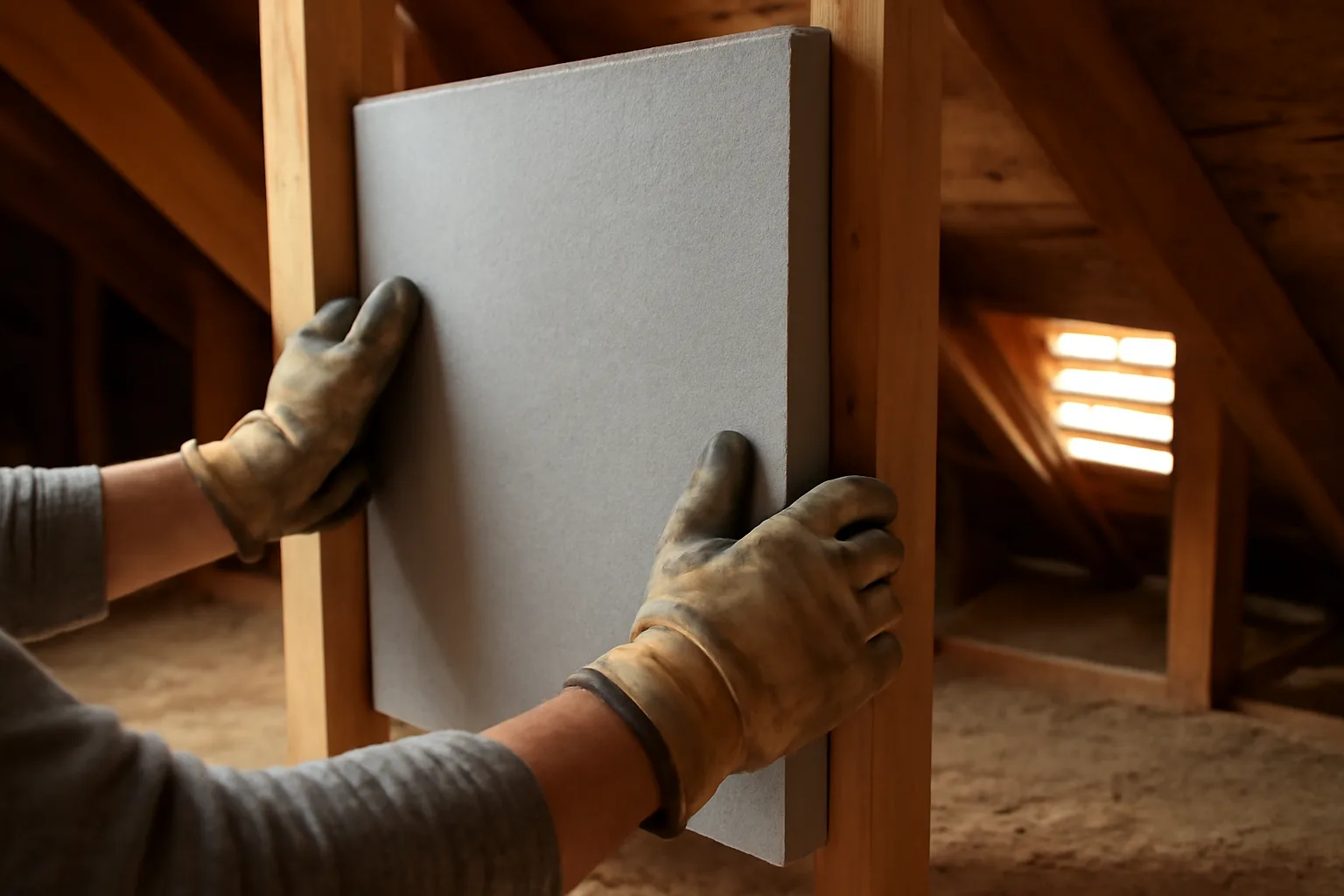
Walk the insulation aisle at Home Depot and you'll see rigid foam boards, mineral wool batts, and fiberglass panels all carrying some version of a "fire-resistant" or "fire-rated" label. That label almost always refers to a flame-spread rating under ASTM E84, the standard test that measures how fast fire moves across a material's surface and how much smoke it produces. It does not mean the product stops a wildfire ember or survives direct flame contact for any set duration. Mineral wool (rock wool) boards, like Rockwool Comfortboard, are naturally non-combustible because they're spun from basalt rock and slag. These carry a Class A flame spread rating and won't sustain combustion on their own. Rigid foam boards (XPS, polyiso, EPS) are combustible at their core; the "fire-resistant" claim on those usually refers to a facer or coating that slows ignition, not the foam itself. Read the product label for the actual ASTM E84 class before assuming a foam board is safe near a wildfire-exposed wall assembly. For a homeowner in a wildfire zone, the real question isn't "is this fire-resistant" in a vague marketing sense. It's whether the wall or attic assembly you're building meets your state's wildland-urban interface (WUI) building code, which is a completely different standard from a single product's fire rating.
Which insulation products at Home Depot are actually rated Class A?
| Mineral wool rigid board | Class A | No | Yes, often used in ember-resistant vents and soffits | |
|---|---|---|---|---|
| Unfaced fiberglass batt | Class A (varies by product) | No (glass fibers), binder may affect rating | Interior use mainly | |
| XPS/polyiso foam board (bare) | Class B or C, varies | Yes | Not for exposed exterior use without a thermal barrier | |
| Foil-faced polyiso | Can reach Class A with facer | Yes (core) | Only as part of a tested assembly | If you're unsure what a specific SKU is rated, ask a Home Depot pro desk associate to pull the manufacturer's data sheet, or look up the product on the manufacturer's site directly. The in-store shelf tag often just says "fire-resistant" without the class number. |
Class A is the top flame-spread rating under ASTM E84, meaning a flame spread index of 25 or less and a smoke-developed index of 450 or less [1]. Mineral wool board insulation (Rockwool Comfortboard 80 and 110) is Class A and non-combustible, and Home Depot stocks it in most regions, though selection varies by store. Fiberglass batt insulation with a paper facer is often NOT Class A because the kraft paper facing burns; unfaced fiberglass or foil-faced options generally test better. Rigid foam boards marketed with fire-resistant coatings (some XPS and polyiso lines) can achieve Class A surface burning characteristics when tested as part of a specific wall assembly with a code-required thermal barrier (typically 1/2-inch gypsum board) over them. The foam itself is not Class A on its own in most cases; the assembly is what gets tested and rated. This distinction matters if you're pulling permits, because inspectors check the assembly, more than what's printed on the insulation packaging. Here's a rough comparison of what you'll find on the shelf: | Product type | Typical ASTM E84 class | Combustible core? | Good fit for WUI exterior use? |
Does fire-resistant insulation actually stop a wildfire ember from igniting my house?
No single insulation product stops embers. Embers ignite homes through gaps, vents, gutters filled with debris, and combustible materials touching the house, not usually through wall insulation itself. CAL FIRE's guidance is explicit that ember intrusion into attics and crawlspaces through unscreened vents is one of the most common ways homes ignite during wildfires. Insulation choice matters most where it's exposed or thinly protected, like in vented attics, under eaves, or in exterior wall cavities near combustible siding. A mineral wool board in an ember-resistant vent assembly adds real protection because it won't feed a fire if an ember gets past the mesh screen. But swapping your attic insulation for a "fire-resistant" product while leaving open eaves, wood siding touching the ground, and a debris-filled gutter does very little for your actual risk. The bigger levers are: Class A roof covering, ember-resistant vents (look for products tested under the SFM 12-7A-1 or -2 standards used in California), non-combustible siding within the first 5 feet of the foundation, and defensible space clearing. Insulation upgrades sit lower on the priority list than those four items for most homes.
When does the California defensible space law go into effect?
California's core defensible space law (Public Resources Code 4291) has been in effect since it was substantially updated, requiring 100 feet of defensible space clearance around structures in State Responsibility Areas and designated Very High Fire Hazard Severity Zones [2]. This isn't a future rule; it's already enforceable and has been the standard for over a decade, with CAL FIRE and local fire agencies conducting inspections. What's newer and still rolling out is the "Zone 0" ember-resistant zone rule, the 0-to-5-foot zone immediately around a structure. The California Board of Forestry and Fire Protection has been developing regulations for this zone under SB 63 (2023) and related legislative direction, with the state's own materials indicating an intended effective date around 2026, though the exact regulatory text and enforcement timeline has shifted as the rulemaking process continues [3]. If you got a non-renewal letter referencing "ember-resistant zone" or "Zone 0," check directly with the Board of Forestry's current rulemaking page, because this is a moving target and your local fire district's enforcement date may differ from the statewide target. Don't wait for the regulation to finalize before doing the work. Insurers are already scoring homes on how close combustible mulch, wood fencing, and vegetation sit to the house, regardless of whether Zone 0 is formally enforced in your county yet.
What fire-safe home rules take effect in 2026?
The most talked-about 2026 target is California's Zone 0 ember-resistant zone requirement, which as of the state's current guidance is aimed at requiring homes in Very High Fire Hazard Severity Zones to keep the 5 feet closest to the structure clear of combustible mulch, wood fencing attached to the house, and most vegetation [3]. This rule has been under Board of Forestry review for several years and specific implementation dates have moved before, so treat any "2026" figure as a target, not a locked date, until you see it published in final regulatory text. Separately, insurance-side changes are landing around the same window. California's Sustainable Insurance Strategy, finalized through Department of Insurance rulemaking, is phasing in requirements that let insurers use catastrophe modeling in rate-setting in exchange for writing more policies in wildfire-exposed areas, with implementation continuing through 2025 and into 2026 [4]. This is a separate track from the building code side, but it's the reason many homeowners are seeing new inspection criteria show up on non-renewal or renewal letters right now. If your fire district has already published local hardening deadlines ahead of the state timeline, follow the earlier, stricter one. [Your local fire district's specific mitigation deadline and Zone 0 enforcement date: fill in from your county or city fire marshal's website.]
Why won't people follow the defensible space law in California?
Cost and labor are the two most cited reasons homeowners give for not completing defensible space work, according to surveys and reporting on wildfire mitigation compliance in California communities. Clearing 100 feet of vegetation on a sloped, wooded lot can run into the thousands of dollars if you hire it out, and many rural and lower-income homeowners simply don't have that cash sitting around or the physical ability to do it themselves. There's also a documented gap between awareness and action. Research on wildfire risk perception (including work summarized by university extension programs) consistently finds that many homeowners understand the general risk but underestimate their own property's specific exposure, or assume a neighbor's cleared lot protects them too. Others simply don't know the rule applies to their zone, since PRC 4291 enforcement varies by county and depends on local fire agency staffing and inspection capacity. A smaller but real group actively disagrees with the aesthetic or ecological tradeoffs, preferring dense native vegetation for privacy, shade, or wildlife habitat over a cleared perimeter. CAL FIRE's own defensible space guidance tries to address this by promoting "lean, clean, and green" landscaping rather than bare dirt, which allows some plants close to the home as long as they're spaced, maintained, and low-fuel. For plant-specific guidance on what actually works within defensible space rules, see fire safe landscaping California next to house.
How do I prepare for a wildfire, step by step?
Start with the structure, then the zone around it, then your evacuation plan. Ready.gov's wildfire preparedness guidance breaks this into building an emergency kit, making a family communication plan, and knowing your evacuation routes before a fire starts, not during one [4]. A practical order of operations: 1. Clear the first 5 feet around your foundation of mulch, dead leaves, and anything combustible touching the house. 2. Extend clearing outward to CAL FIRE's zone standards: Zone 1 (5-30 feet) with widely spaced, low, well-irrigated plants; Zone 2 (30-100 feet) with reduced fuel and spacing. 3. Screen or upgrade attic and foundation vents to ember-resistant models. 4. Clear gutters and roof valleys of debris and keep them clear seasonally. 5. Store a go-bag with medications, documents, and basics per Ready.gov's checklist [4]. 6. Photograph your home's exterior, roof, vents, and defensible space work now, before any inspection or claim, so you have dated proof of conditions. That last step is one people skip constantly and regret. If you get an insurance non-renewal or a mitigation inspection notice, you want dated photos and receipts showing what you'd already done, not a scramble to remember it after the fact. This is the kind of documentation the $99 Wildfire Insurance Survival Kit is built around: a structured way to photograph, log, and organize your hardening and defensible space work so you have something concrete to hand an inspector or attach to your own renewal appeal. We don't file claims or contact your insurer for you; you send your own documentation, and this just helps you organize it before you need it.
How can we prevent wildfires and forest fires overall?
Most wildfires in the U.S. are human-caused, not lightning-caused. The National Interagency Fire Center and related federal reporting have repeatedly found that roughly 85-90% of wildland fires are started by human activity: unattended campfires, debris burning, equipment sparks, and arson. Preventing forest fires at the population level mostly means reducing these ignition sources: proper campfire extinguishing (drown, stir, feel for heat), avoiding debris burning on windy or dry days, keeping vehicles and equipment away from dry grass, and following local burn ban notices. At the community level, prescribed burns and fuel reduction thinning done by agencies like the U.S. Forest Service and CAL FIRE reduce the dense fuel loads that turn a small ignition into a fast-moving fire. This is a policy and land-management question as much as an individual one, and it's a big reason why fire seasons have gotten more severe in fuel-dense forests that went decades without natural or managed fire. For individual homeowners, prevention overlaps heavily with hardening: a house surrounded by defensible space and hardened against embers is far less likely to become a secondary ignition point that then threatens neighboring structures during a wildfire event. CAL FIRE's "Ready, Set, Go" program frames this as a shared responsibility between individual property owners and firefighting agencies. Smokey Bear's long-running "only you can prevent wildfires" message exists precisely because human ignition sources are the dominant cause, and individual behavior genuinely moves the needle; see only you can prevent wildfires for more on the campaign's origin and current relevance.
Is Santa Barbara safe from fire risk right now?
No area in California's wildland-urban interface is "safe" in an absolute sense, and Santa Barbara County has significant Very High Fire Hazard Severity Zone acreage in its foothill and mountain-adjacent communities, per CAL FIRE's Fire Hazard Severity Zone maps for the county [5]. The 2017 Thomas Fire and subsequent Montecito debris flow, and the 1990 Painted Cave Fire before that, are part of the county's documented fire history, and CAL FIRE's hazard maps continue to show elevated severity ratings for foothill neighborhoods in Montecito, Santa Barbara's upper east side, and the San Marcos foothills. Coastal-adjacent, flatter parts of the city carry lower wildfire hazard zone designations than the mountain-facing neighborhoods, so risk varies block by block within the same city, more than county to county. Check your specific parcel against CAL FIRE's official Fire Hazard Severity Zone viewer rather than relying on general reputation, since insurers increasingly use these exact zone designations (and their own catastrophe models) to make non-renewal decisions. If you're in a High or Very High zone anywhere in Santa Barbara County, the same defensible space and hardening priorities apply as anywhere else in California: 100 feet of managed clearance where feasible, ember-resistant vents, and a Class A roof.
What should I prioritize before I buy any insulation product?
Before spending money on insulation upgrades, get your roof, vents, and the first 5 feet around your foundation handled first. These are the three things CAL FIRE's home hardening research (developed with the Insurance Institute for Business & Home Safety) identifies as the highest-leverage ignition points during wildfire ember storms [6]. A Class A roof assembly and ember-resistant vents do more to protect a structure than any interior insulation swap. If you're doing an attic retrofit or building an addition and want insulation that won't add fuel if embers do get in, mineral wool board is the more defensible (pun intended) choice over bare foam board, simply because it's non-combustible at the core rather than relying on a facer or coating. It typically costs more per square foot than fiberglass or basic foam board (expect roughly $1 to $4 per square foot at big box retailers depending on thickness and density, though prices shift with supply), but for a wildfire-exposed attic or a rebuild after fire damage, it's a reasonable upgrade. For readers rebuilding after a fire loss or dealing with an active claim, our related coverage on house fire and fire at a house documentation walks through what to photograph and log for your own insurer submission, separate from any contractor's rebuild scope.
Should I hire a contractor or DIY defensible space clearing?
It depends on lot size, slope, and whether you have standing dead trees or heavy brush that requires chainsaw work and hauling. Flat, small residential lots with grass and a few shrubs are very doable as a weekend DIY project with hand tools and a truck run to the dump. Sloped, wooded, or larger rural parcels often need a licensed contractor, both for safety and because the volume of material removed is more than most people can haul themselves. In some states, including Washington, defensible space clearing contracts go through state DNR-connected cost-share or assistance programs rather than being purely private transactions; if you're outside California, check your state forestry agency's specific program before hiring, since terms and available assistance vary. We cover the contract side of this in wildfire defensible space clearing contracts Washington State DNR for readers in the Pacific Northwest. Whichever route you take, keep receipts and before/after photos. Not because you're required to submit them anywhere automatically, but because if your insurer sends a non-renewal or requests proof of mitigation, you want a folder ready to go rather than a memory of "I think we cleared that in the spring."
What's the honest bottom line on fire-resistant insulation board from Home Depot?
Buy mineral wool board (Class A, non-combustible) if you're doing attic, soffit, or ember-resistant vent work in a wildfire zone; skip bare foam board marketed loosely as "fire-resistant" unless it's part of a code-tested assembly with a proper thermal barrier. Neither product substitutes for the roof, vent, and clearance work that actually determines whether embers ignite your house. For a full picture of where you stand, start with the basics laid out under defensible space guidance, confirm your parcel's Fire Hazard Severity Zone designation with CAL FIRE, and check your specific fire district's local mitigation deadlines, since they can be stricter and earlier than any statewide target date. If you've already received a non-renewal letter, document what you've done before you do anything else. The $99 Wildfire Insurance Survival Kit is built for exactly that step: organizing your hardening photos, receipts, and defensible space records into something you can hand to an inspector or attach to your own appeal letter. We're not adjusters and we don't contact your insurer on your behalf; you stay in control of your own documentation and claims.
Frequently asked questions
When does the California defensible space law go into effect?
California's core defensible space law, Public Resources Code 4291, requiring 100 feet of clearance around structures, has been in effect for years already [3]. What's newer is the Zone 0 ember-resistant 5-foot rule, with a state target around 2026, though the exact regulatory text and county-level enforcement dates are still being finalized by the Board of Forestry and Fire Protection [4].
Why won't people follow the defensible space law in California?
Cost, labor, and low local enforcement capacity are the main reasons. Clearing 100 feet on a sloped or wooded lot can cost thousands if hired out, and PRC 4291 enforcement varies by county depending on fire agency staffing. Some homeowners also underestimate their own property's risk or prefer denser landscaping for privacy and shade.
How to prevent wildfires as an individual homeowner?
Extinguish campfires fully (drown, stir, feel for heat), avoid debris burning on dry or windy days, keep vehicles off dry grass, and harden your own home with a Class A roof, ember-resistant vents, and defensible space clearing. Roughly 85-90% of wildland fires are human-caused, so individual ignition prevention genuinely matters [7].
How to prepare for a wildfire before it starts?
Build a go-bag with medications and documents, make a family communication plan, know two evacuation routes, and complete defensible space clearing per CAL FIRE's zone guidance [2][6]. Photograph your home's exterior, roof, and vents now so you have dated proof of conditions before any inspection or insurance claim.
How to prevent forest fires at a landscape level?
Prescribed burns and fuel reduction thinning by agencies like the U.S. Forest Service and CAL FIRE reduce dense fuel loads that turn small ignitions into major fires. Individually, follow local burn bans, extinguish campfires completely, and avoid equipment use that sparks near dry vegetation during red flag warning days.
How to avoid forest fires when camping or recreating?
Only build fires in designated rings, never leave them unattended, and drown, stir, and feel for heat before leaving. Check local fire restrictions before any campfire, chainsaw, or off-road vehicle use, since equipment sparks and unattended campfires are among the most common human-caused ignition sources tracked by federal fire agencies [7].
How to prepare for forest fires if I live near wildland?
Follow the same steps as home wildfire prep: defensible space clearing to CAL FIRE zone standards, ember-resistant vents, a Class A roof, and an evacuation plan with two routes out. Ready.gov's wildfire guidance recommends having a go-bag and family communication plan set up before fire season starts, not during an active event [6].
What fire-safe home rules take effect in 2026?
California's Zone 0 ember-resistant zone rule, requiring the 5 feet closest to a structure to be kept clear of combustible mulch and vegetation, is targeted around 2026 by the Board of Forestry, though the final regulatory text and enforcement date have shifted before [4]. Insurance rate rules under the state's Sustainable Insurance Strategy are also phasing in through 2025-2026 [5].
Is Santa Barbara safe from wildfire risk?
No, not uniformly. Santa Barbara County has significant Very High Fire Hazard Severity Zone acreage in foothill communities like Montecito and the upper east side, per CAL FIRE's zone maps [8]. Coastal, flatter parts of the city carry lower hazard ratings. Check your specific parcel on CAL FIRE's official viewer rather than assuming general safety.
How can we prevent forest fires as a community?
Support agency-led fuel reduction and prescribed burn programs, comply with local burn bans, and hold neighbors accountable for defensible space compliance, since one uncleared property can threaten an entire block. CAL FIRE's Ready, Set, Go program frames wildfire prevention as a shared responsibility between individual property owners and fire agencies [2].
Is Home Depot fire-resistant insulation board actually fireproof?
No. "Fire-resistant" on a retail label usually refers to an ASTM E84 flame spread class, not fireproofing. Mineral wool board is genuinely non-combustible at its core and rated Class A. Rigid foam boards are combustible at the core even when a facer or coating slows ignition, so check the specific product's tested class, more than the marketing label [1].
What insulation should I use for a wildfire-hardened attic?
Mineral wool rigid board (like Rockwool Comfortboard) is the better choice for wildfire-exposed attics because it's non-combustible and Class A rated. Combine it with ember-resistant attic vents, since insulation choice matters far less than stopping embers from entering the attic space through unscreened or wood-frame vents in the first place [2].
Does defensible space clearing guarantee my insurance won't cancel?
No, there's no guarantee. Insurers weigh catastrophe models, roof material, regional loss history, and other underwriting inputs, more than your individual clearance work alone. Completing and documenting defensible space and hardening work strengthens any appeal or renewal request you submit yourself, but neither CAL FIRE nor any contractor can promise a specific coverage outcome.
Sources
- ASTM International, E84 Standard Test Method Overview (referenced via UL/ASTM classification of Class A materials): Class A flame spread rating requires a flame spread index of 25 or less under ASTM E84
- California Legislative Information, Public Resources Code Section 4291: 100 feet of defensible space clearance requirement around structures in State Responsibility Areas
- California Board of Forestry and Fire Protection, Ember-Resistant Zone (Zone 0) Rulemaking: Zone 0 ember-resistant zone rulemaking status and target implementation timeline
- California Department of Insurance, Sustainable Insurance Strategy: Phased catastrophe modeling and rate rule changes tied to wildfire-exposed area coverage requirements
- National Interagency Fire Center, Statistics: Majority of U.S. wildland fires are human-caused rather than lightning-caused
- CAL FIRE, Fire Hazard Severity Zone Maps: Santa Barbara County foothill communities designated Very High Fire Hazard Severity Zone