Last updated 2026-07-25
TL;DR
A fire-resistant safe rated UL 350 (or ETL equivalent) can protect paper documents and some electronics for 30 minutes to 4 hours at temperatures up to roughly 1,700°F. No home safe is fireproof; interior temps still climb, and most residential house fires burn far hotter and longer than a standard safe's rating window. Pair a safe with offsite digital backups and a documented home inventory.
What does 'fire resistant' actually mean on a home safe?
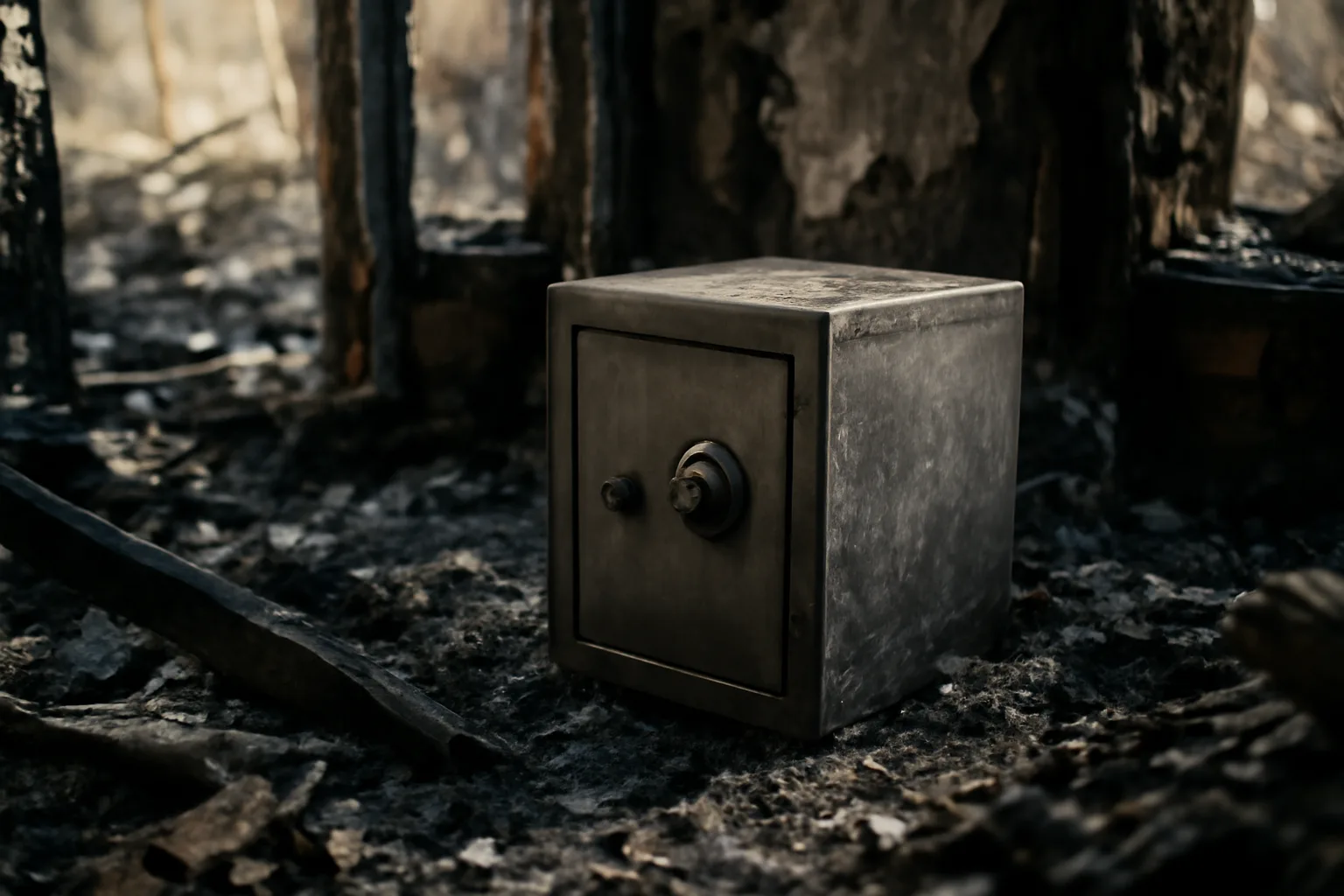
Fire resistant means the safe is tested to keep its interior below a specific temperature for a specific amount of time while the outside burns much hotter. It does not mean fireproof. Nothing sold for home use is fireproof, and any safe advertised that way is using marketing language, not a lab result. The standard most manufacturers reference is UL 350, from Underwriters Laboratories. A safe rated UL 350 for one hour means that during a one-hour test at around 1,700°F external temperature, the interior stayed at or below 350°F, which is the point where paper starts to char and become unreadable. Some safes carry ETL or Intertek certifications instead of UL, using similar test protocols. Ratings typically come in 30-minute, 1-hour, 2-hour, and sometimes 4-hour classes. Higher-end safes add a UL 125 rating for media, meaning the interior stays below 125°F, since digital media (external hard drives, USB drives, some photo negatives) degrades at much lower temperatures than paper does. If you're storing backup drives or memory cards, a paper-rated safe alone won't protect them. You need the 125-degree class specifically. A safe with no independent certification, just a manufacturer's claim of 'fire resistant,' is not something I'd trust with anything irreplaceable. Look for the actual UL or ETL label and test class printed on the safe or in the spec sheet.
How hot does a house fire actually get, and can a safe survive it?
Residential structure fires commonly reach 1,100°F to 1,500°F within a room of origin, and flashover conditions (when a room fully ignites) can push temperatures past 1,700°F to 2,000°F. Wildland-urban interface fires that involve a full home burn can sustain high heat for much longer than a typical accidental house fire, sometimes hours, as structural materials, insulation, and fuel loads keep feeding the fire. This matters because most consumer fire safes are only tested and rated for a single continuous exposure of 30 minutes to 2 hours. If your local fire department response time is 10 to 15 minutes but the structure keeps burning after they arrive, or if a wildfire moves through and the home burns unattended for an extended period, a safe rated for one hour of protection may be well past its tested limit before anyone can retrieve it. There's also a second failure mode people don't think about: the safe survives the fire but gets buried under collapsed framing, soaked by firefighting water, or sits in a structure that partially collapses onto it. A safe that keeps its rated interior temperature but then gets crushed or flooded can still destroy its contents. This is part of why paper backups plus digital, offsite copies matter more than the safe itself for anything you truly cannot replace, like a wet-signed will or a deed with no recorded copy elsewhere. For guidance on hardening the rest of the structure around your safe, see defensible space and home hardening basics.
What should actually go in a fire-resistant home safe?
Prioritize documents that are hard or slow to replace, and small physical items with real sentimental or legal value. Skip anything you can pull from a bank vault, a lawyer's office, or a cloud backup in five minutes. Good candidates: original birth and marriage certificates, passports, Social Security cards, property deeds (though county recorder offices usually keep official copies), vehicle titles, insurance policy declarations pages, a list of account numbers and contacts, external backup drives (in a media-rated safe only), small amounts of cash, jewelry, and a USB drive with scanned copies of everything else. Bad candidates for a small home safe: large amounts of cash (get a bank safe deposit box instead), firearms unless the safe is specifically rated for both fire and security as a gun safe, anything you need daily access to, and anything replaceable through a phone call to an institution (most banks, the IRS, and the DMV can reissue lost documents, sometimes for a small fee and a wait of a few weeks). A practical middle step a lot of homeowners skip: photograph and log the whole house, room by room, closet by closet, before anything happens. If you ever need to file an insurance claim, a fire, or the Wildfire Insurance Survival Kit template we built at DefensibleHome, gives you a structured way to build that room-by-room inventory once, store it off the property, and have it ready before an adjuster ever asks. We don't file claims or negotiate with insurers for you; you send your own documentation.
Where should you put a fire safe in the house?
Lower floors, interior rooms, away from exterior walls and windows, and off the direct path a wildfire ember shower would take through the structure. Heat rises, so a safe on a ground floor or in a basement generally experiences less peak heat than one on an upper floor, where fire and heat concentrate as a structure burns. Avoid closets on exterior walls, especially south- and west-facing walls in most U.S. wildfire regions, since those catch the most radiant heat and ember exposure during a wind-driven fire. A closet in a windowless interior hallway or a below-grade utility room is a better bet. Bolt the safe down if it's not extremely heavy (under roughly 750 lbs), both for burglary resistance and so it doesn't shift or fall through a floor if structural framing weakens. If you live in a wildfire-prone area covered by state defensible space rules, see our fire-safe landscaping guide for California homes for how to reduce the odds the structure ignites in the first place, since no safe substitutes for the home itself not burning.
How to prepare for a wildfire before it happens
Preparation splits into two buckets: hardening the property so it's less likely to ignite, and getting your documents and evacuation plan ready so a fast evacuation doesn't cost you critical records. Ready.gov's wildfire preparedness guidance recommends creating a family emergency communication plan, knowing at least two evacuation routes out of your neighborhood, and assembling a go-bag with copies of key documents, medications, and basic supplies for several days. CAL FIRE's Ready for Wildfire program breaks preparation into three phases: harden your home (Class A roofing, ember-resistant vents, non-combustible siding within 5 feet of the structure), maintain defensible space in zones 0 through 2 (0 to 100 feet, depending on jurisdiction), and have a wildfire action plan with go-bags packed before fire season starts. A fire safe is one small piece of that plan, not the whole plan. Pack a physical folder or use a safe for original documents, but also photograph every page and store a digital copy with a family member out of state, or in cloud storage you can access from your phone. The folder-plus-safe-plus-cloud approach means you're not relying on any single point of failure. For the structural side of preparation, defensible space clearance and ember-resistant construction do more to save the home than any safe does. See defensible space basics and, if you're in Washington State, the DNR's defensible space clearing contract guidance for how professional clearing work is typically scoped and priced.
When does the California defensible space law go into effect?
California's core defensible space requirement, a 100-foot clearance zone around structures in State Responsibility Areas and designated Very High Fire Hazard Severity Zones, has been law since 2005 under Public Resources Code Section 4291 [1]. What's newer and still being finalized is the expanded 'Zone 0' ember-resistant zone within 5 feet of structures. California's Zone 0 regulation was authorized by Assembly Bill 3074 (2020), which directed the Board of Forestry and Fire Protection to develop ember-resistant zone standards for the 0-to-5-foot area immediately around a home [2]. As of this writing, the Board of Forestry has been working through the formal rulemaking process, and the regulation has not taken permanent effect statewide; timelines have shifted more than once. Homeowners should check the current status directly with CAL FIRE or the Board of Forestry, since the effective date is not settled and has been delayed from earlier projected dates. Because implementation dates and specific requirements vary by local fire district even after a statewide rule takes effect, confirm your defensible space zone widths and Zone 0 requirements with [your local fire district or county fire marshal's office] before doing major landscaping or hardscape work near the house.
What fire-safe rules for homes take effect in 2026?
This is genuinely a moving target, and I'd rather tell you that plainly than guess at a firm date. Several states are in active rulemaking around ember-resistant zones, defensible space enforcement, and wildfire disclosure requirements, and effective dates keep sliding as agencies finalize technical standards and respond to public comment. What's confirmed: California's Zone 0 ember-resistant zone standard, once finalized by the Board of Forestry and Fire Protection under AB 3074, will apply to homes in Very High Fire Hazard Severity Zones and State Responsibility Areas. The Board's rulemaking page is the authoritative source for the current proposed effective date, and it has changed more than once, so don't rely on a date from a news article or blog, including this one, without checking the Board of Forestry's site directly [2]. Colorado, Oregon, and Arizona each have their own state fire marshal offices issuing wildland-urban interface building codes and defensible space guidance, and none of them are on the same calendar as California. If you got a non-renewal or inspection letter referencing a specific new rule, ask the inspector or your insurer to name the exact regulation and effective date in writing. Verify it against [your state fire marshal's official rulemaking page] before spending money to comply with something that isn't final yet.
Why won't people follow the defensible space law in California?
Cost, labor availability, and enforcement gaps are the three big reasons, based on how CAL FIRE and state auditors have described the compliance problem. A 2019 California State Auditor report found that CAL FIRE's defensible space inspection program had significant gaps, including inconsistent inspection follow-up and limited enforcement capacity across the state's roughly 31 million acres of wildland [3]. Clearing 100 feet of defensible space around a home, especially a home on a slope with mature trees, can run from a few hundred dollars for a small, flat lot with a homeowner doing the work themselves, to several thousand dollars for professional clearing on a larger or steeply sloped property. For homeowners on fixed incomes, especially retirees in fire-prone foothill and mountain communities, that cost is a real barrier, not a matter of not caring. There's also a compliance-fatigue problem: many homeowners get a notice, do a partial clearing, and then don't maintain it because vegetation regrows every season and nobody re-inspects consistently enough to catch it. CAL FIRE's own defensible space guidance acknowledges that ongoing maintenance, not a one-time clearing, is what the law actually requires: 'Defensible space is not a one-time task. Vegetation grows back and needs regular maintenance to remain effective'. That maintenance burden, repeated every year, is a big part of why compliance rates lag in lower-income and elderly-homeowner communities.
How to prevent wildfires and forest fires
Nationally, the U.S. Forest Service and National Interagency Fire Center attribute roughly 85 to 89 percent of wildland fires in the U.S. to human causes, including unattended campfires, debris burning, equipment use and malfunctions, discarded cigarettes, and arson [4]. That means most wildfires are preventable through basic caution, not something we're powerless against. The practical prevention steps Smokey Bear's official program (managed jointly by the Forest Service, the National Association of State Foresters, and the Ad Council) has promoted for decades still hold up: fully extinguish campfires by drowning, stirring, and feeling for heat before leaving; never leave a fire unattended; avoid burning debris on windy or dry days; keep vehicles off dry grass, since hot exhaust systems can ignite it; and maintain equipment like chainsaws and mowers, since sparks from metal-on-rock contact are a common ignition source [5]. At the home level, prevention shifts toward reducing what a fire has to burn once it starts nearby: maintaining defensible space, using ember-resistant vents and Class A roofing, and clearing gutters and roof valleys of dry debris. CAL FIRE's Ready for Wildfire program has free, home-specific checklists for this. If you want a single next read, what to do around structural fire risk generally covers overlapping prevention basics that apply whether the ignition source is wildland fire or an accidental structure fire.
Is Santa Barbara safe from fire?
No coastal California community is 'safe' from wildfire risk in an absolute sense, and Santa Barbara County has a documented history of major, damaging fires. The 2017 Thomas Fire burned over 281,000 acres across Ventura and Santa Barbara counties and was, at the time, the largest wildfire in modern California history, later surpassed by larger fires in subsequent years [6]. The Thomas Fire's aftermath also triggered the deadly Montecito debris flow in January 2018, which killed 23 people, a reminder that wildfire risk in this region compounds with steep terrain and post-fire flood risk [7]. Parts of Santa Barbara County, especially foothill communities like Montecito, Mission Canyon, and the areas along the wildland-urban interface in the Santa Ynez foothills, sit within CAL FIRE-designated Very High Fire Hazard Severity Zones, which carry the state's strictest defensible space and building code requirements [1]. Lower-elevation, more urbanized parts of the city of Santa Barbara itself carry lower direct wildfire exposure but are not zero-risk, particularly during Santa Ana wind events that can carry embers well beyond a fire's main perimeter. If you own property in or near Santa Barbara County, check your parcel's specific hazard severity zone designation on CAL FIRE's FHSZ viewer rather than relying on the city's general reputation, since risk varies block by block depending on elevation, slope, and vegetation, more than zip code.
How to prepare for a wildfire evacuation with your safe and documents
A fire-resistant safe is for documents you're leaving behind. A go-bag is for documents you're taking with you. Don't confuse the two, because if evacuation orders come with 15 minutes' notice, which is common in fast-moving wind-driven fires, you will not have time to dig originals out of a bolted-down safe. Ready.gov recommends keeping a portable, grab-and-go kit with copies (not necessarily originals) of ID, insurance policies, medical information, and a small amount of cash, packed and ready before fire season starts, not assembled during an evacuation order. Keep this kit near an exit, in a car, or in a bag you can grab in under a minute. Your actual safe stays put and does its job passively: protecting the harder-to-replace originals if the home burns while you're already safely evacuated. That's the real division of labor. The go-bag handles the scenario where you evacuate and the home doesn't burn. The safe handles the scenario where it does. A home inventory, photographed room by room and stored in the cloud, covers the third scenario: proving to an insurer what you owned, in what condition, before the fire. This is the piece most homeowners skip until it's too late, which is exactly the gap our $99 Wildfire Insurance Survival Kit is built to close: a structured, one-time way to document the home and store that documentation off-property before you need it, not after.
How can we prevent forest fires as a community, more than a homeowner?
Individual home hardening matters, but forest and wildland fire prevention at scale is mostly a fuel-management and ignition-prevention problem that plays out at the neighborhood and landscape level. The National Interagency Fire Center and state forestry agencies point to prescribed burning, mechanical fuel thinning, and coordinated defensible space compliance across whole neighborhoods (more than individual lots) as the interventions with the biggest measurable effect on fire behavior and spread [4]. One home with perfect defensible space surrounded by neighbors with none doesn't change much, since embers and radiant heat travel between properties regardless of any single parcel's compliance. This is part of why some California fire-adapted communities have moved toward neighborhood-level 'Firewise' certification (a National Fire Protection Association program) that requires collective participation, more than individual homeowner action, to qualify . At the individual level, the highest-leverage actions remain: never burning debris on red flag warning days, maintaining equipment that could throw sparks, reporting unattended campfires or suspicious smoke immediately to 911 or a local ranger station, and supporting local fuel-reduction and prescribed burn programs even when they cause short-term smoke, since prescribed fire under controlled conditions reduces the fuel available for uncontrolled fire later.
Frequently asked questions
When does the California defensible space law go into effect?
The core 100-foot defensible space requirement under Public Resources Code Section 4291 has been law since 2005. The newer Zone 0 ember-resistant zone rule (0-5 feet from structures), authorized by AB 3074, is still in the Board of Forestry's rulemaking process and hasn't taken permanent statewide effect as of this writing; check the Board's site for the current status.
Why won't people follow the defensible space law in California?
Cost, ongoing maintenance burden, and inconsistent enforcement are the main reasons, per a 2019 California State Auditor report on CAL FIRE's inspection gaps. Clearing 100 feet of vegetation can cost hundreds to thousands of dollars, and it regrows every season, so compliance requires yearly upkeep, not a one-time job.
What fire-safe rules for homes take effect in 2026?
No single confirmed nationwide date exists. California's Zone 0 ember-resistant zone standard is in active rulemaking with a shifting timeline. Check the Board of Forestry and Fire Protection's rulemaking page directly, and confirm any 2026 date your insurer or inspector cites in writing before assuming it's final.
Is Santa Barbara safe from fire?
No, especially in foothill communities like Montecito and Mission Canyon, which sit in CAL FIRE Very High Fire Hazard Severity Zones. The 2017 Thomas Fire burned over 281,000 acres in the region and triggered a deadly 2018 debris flow. Risk varies block by block; check your parcel's specific hazard zone rather than relying on general reputation.
What does UL 350 mean on a fire safe?
UL 350 means Underwriters Laboratories tested the safe to keep its interior below 350°F (the point paper chars) for a rated duration, often 30 minutes to 2 hours, while exposed to roughly 1,700°F externally. It's a paper rating; electronics and media need a separate UL 125 media rating.
Can a fire-resistant safe protect a hard drive or USB drive?
Only if it carries a media or data rating (often UL 125, meaning interior temps stay below 125°F), more than a standard paper rating of 350°F. Digital media degrades at much lower temperatures than paper does, so a paper-rated safe alone won't protect electronics.
How hot does a house fire get compared to a safe's rating?
Residential fires commonly reach 1,100-1,500°F, with flashover conditions exceeding 1,700-2,000°F. Most consumer safes are tested for 30 minutes to 2 hours of exposure. A prolonged burn, common in wildfire-involved structure loss, can exceed a safe's tested duration.
Where is the best place to put a fire safe in a house?
An interior room on a lower floor, away from exterior walls, windows, and south/west-facing sides most exposed to radiant heat and embers. Avoid closets on exterior walls. Bolt lighter safes down so they don't shift if flooring weakens.
How to prepare for a wildfire evacuation?
Pack a go-bag with copies of ID, insurance policies, medications, and cash before fire season starts, per Ready.gov guidance. Know two evacuation routes, have a family communication plan, and keep original documents in a fire safe you're not relying on grabbing during a fast evacuation.
How to prevent wildfires and forest fires?
About 85-89% of U.S. wildfires are human-caused, per the National Interagency Fire Center. Fully extinguish campfires, avoid debris burning on dry or windy days, maintain equipment to prevent sparks, and keep vehicles off dry grass. At home, maintain defensible space and ember-resistant vents.
How can we prevent forest fires at the community level?
Prescribed burning, coordinated fuel thinning, and neighborhood-wide defensible space compliance (more than individual lots) have the biggest measurable effect, since embers travel between properties regardless of one home's preparation. Programs like NFPA's Firewise require collective neighborhood participation to qualify.
Does a fire-resistant safe replace a home inventory for insurance claims?
No. A safe protects physical originals if they survive; a home inventory (photos, video, room-by-room documentation stored off-property) proves to an insurer what you owned and its condition before a fire. You need both, and the inventory should exist in the cloud, more than the safe.
What documents should go in a fire-resistant home safe?
Birth/marriage certificates, passports, Social Security cards, vehicle titles, insurance declarations pages, and a media-rated backup drive if the safe supports it. Skip large cash amounts (use a bank box) and anything you need daily access to.
Sources
- California Public Resources Code Section 4291: 100-foot defensible space clearance requirement in State Responsibility Areas, law since 2005
- California Board of Forestry and Fire Protection, Ember-Resistant Zone (Zone 0) Rulemaking: AB 3074 authorized Zone 0 ember-resistant zone standard, currently in rulemaking with shifting effective date
- California State Auditor, Report 2019-103: CAL FIRE Defensible Space Inspections: Gaps in CAL FIRE's defensible space inspection and enforcement program
- National Interagency Fire Center, Statistics: Roughly 85-89% of U.S. wildfires are human-caused
- Smokey Bear (USDA Forest Service / Ad Council), Prevention Tips: Campfire extinguishing steps and equipment spark prevention guidance
- CAL FIRE, Thomas Fire Incident Archive: 2017 Thomas Fire burned over 281,000 acres across Ventura and Santa Barbara counties
- NFPA, Firewise USA Recognition Program: Neighborhood-level Firewise certification requires collective community participation