Last updated 2026-07-25
TL;DR
The Cannon TS3220 is UL 30-minute fire rated at 1550°F, weighs about 91 lbs, and holds roughly 1.24 cubic feet. It protects paper documents and small electronics from a passing house fire, but it is not built for defensible-space compliance or wildfire survival on its own. Pair it with off-site digital backups of your insurance and mitigation records.
What is the Cannon TS3220 fire safe and what does the 30-minute rating mean?
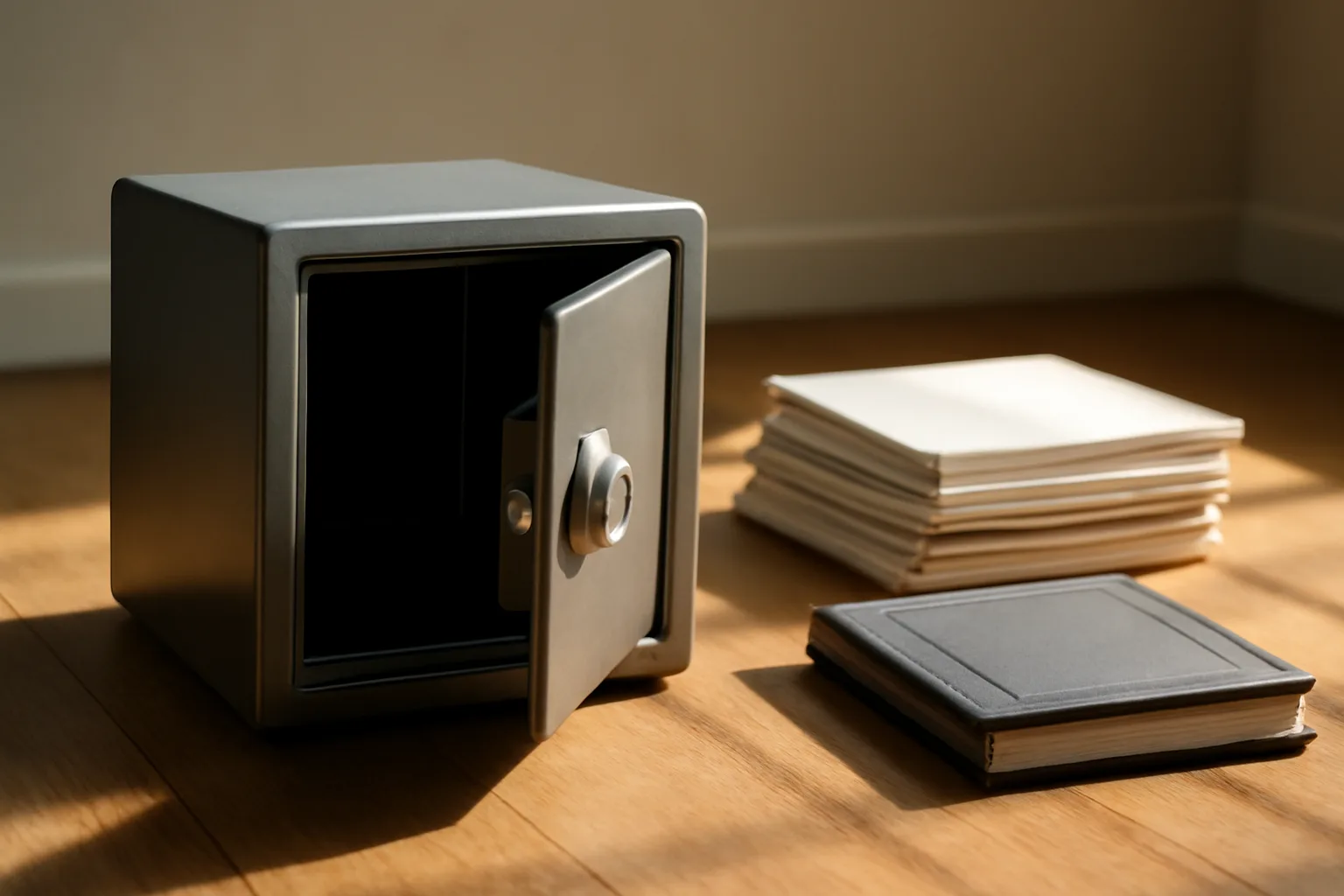
The Cannon TS3220 is a residential fire safe with a UL 30-minute fire rating at 1550°F, meaning independent testing at Underwriters Laboratories found the interior stayed below the scorch point of paper (about 350°F) for at least 30 minutes while the exterior was exposed to that temperature. It holds about 1.24 cubic feet of interior space and weighs around 91 pounds empty, with a body gauge steel construction and a digital electronic lock plus a backup key. A 30-minute rating is the entry tier for home fire safes. It is meant to cover a typical residential structure fire scenario where fire crews arrive and knock down flames within that window, not a prolonged burn. UL also certifies safes at 60-minute, 90-minute, 1-hour, and 2-hour ratings, usually with thicker insulation and higher price points. For most homeowners, the TS3220 is meant for paper documents (passports, birth certificates, property deeds), small drives, and modest jewelry, not gun collections or bulk cash. If you're assembling a wildfire go-bag or a fire-safe kit for insurance documentation, this is the category of product you're shopping in, but the rating tells you about house-fire duration, not wildfire intensity, which behaves very differently. It's worth being honest here: no UL home safe rating is calibrated against wildfire conditions, where structures can burn for hours and ember exposure happens from multiple directions at once. The rating is a lab test using a gas furnace, not a simulation of a home surrounded by burning vegetation.
Does a 30-minute fire safe actually survive a house fire or wildfire?
In a typical residential structure fire, yes, a 30-minute safe usually protects paper contents, because most fire departments report average response times of 5 to 7 minutes for the first-arriving engine in urban and suburban areas, per data compiled by the National Fire Protection Association. Combined with time to knock down the fire, documents inside a properly rated safe often survive. Wildfire is a different animal. When a home ignites during a wildfire event, especially one driven by wind and embers, structures can burn far longer before any suppression happens, sometimes because roads are blocked, water pressure fails, or crews are stretched across hundreds of structures at once. CAL FIRE's own guidance on structure vulnerability during wildfire notes that ember exposure can precede and outlast the main flame front by hours. So a 30-minute or even 60-minute safe is a reasonable bet for a stovetop fire or an electrical fire in a wall. It is a weaker bet if your home is fully involved during a wind-driven wildfire and firefighters cannot reach your street for an hour or more. That does not make the safe useless. It just means you should not treat it as your only line of defense for irreplaceable documents. The more resilient approach: keep digital copies of your insurance policy, defensible-space photos, and mitigation invoices in cloud storage or on a drive you take with you when you evacuate. A safe protects what's left behind. It cannot protect what you need in the 10 minutes you have to leave.
What should I actually store in a fire safe for wildfire prep?
For wildfire-prone households, the practical list is short: your insurance declarations page, a home inventory with photos, defensible-space clearance receipts or contractor invoices, property deed, passports, and a external drive with backed-up photos of your property's vegetation management over time. These are the documents an insurer or adjuster may ask you to reproduce after a loss, and they are exactly the kind of paper and digital media a 30-minute safe is built for. If you've done brush clearance, defensible space work, or roof and vent hardening, keep dated photos and paid invoices. Insurers increasingly want proof of mitigation work before renewal, and having it organized in one place (both physically and digitally) saves you scrambling during a stressful renewal cycle. See our guide on fire safe landscaping next to your house for what that documentation should look like on the ground. Don't store your only copy of anything you can't recreate. A safe is a second layer, not a vault. If the safe survives but your car with your go-bag doesn't, or vice versa, you want redundancy across both. This is part of why we built a $99 one-time Wildfire Insurance Survival Kit: it's a structured way to organize the photos, invoices, and mitigation records insurers ask for, so you're not digging through a fire safe under time pressure trying to remember what you have. We don't negotiate with insurers or file claims for you; you assemble and send your own documentation, and the kit just helps you get it organized before you need it.
How to prepare for a wildfire beyond a fire safe
A fire safe is a small piece of wildfire prep. The bigger levers are defensible space, home hardening, and an evacuation plan you've actually rehearsed. Ready.gov recommends creating a family emergency plan, building a go-bag with at least three days of supplies, and signing up for local wildfire alerts before fire season starts [1]. CAL FIRE's defensible space standard requires two zones around a structure in California: Zone 0 (0 to 5 feet, ember-resistant and free of combustible material) and an extended zone out to 100 feet with reduced fuel load, though specific requirements vary by local fire district and slope. If you're in a different state, check your state fire marshal's page or local fire district for the specific distances and vegetation rules that apply to your parcel; requirements in Colorado, Oregon, and Arizona differ from California's Public Resources Code 4291 framework. Home hardening matters as much as landscaping. Ember entry through vents, gaps under eaves, and combustible siding causes a large share of home ignitions during wildfire, according to research from the Insurance Institute for Business & Home Safety [2]. Ember-resistant vents, a Class A roof, and enclosed eaves are the highest-value retrofits most homeowners can do. Finally, have an evacuation plan with two routes, a place to meet, and a plan for pets and livestock. Practice it once a year like a fire drill, more than once when you move in.
How to prevent wildfires around your home
You can't prevent a wildfire from starting somewhere in the wildland, but you can dramatically reduce the odds that it becomes a home-destroying event on your property. The two biggest levers are defensible space and ignition-resistant construction, both of which are within a homeowner's control regardless of what happens in the surrounding forest. CAL FIRE's guidance is explicit that "defensible space is the buffer you create between a building on your property and the grass, trees, shrubs, or any wildland area that surround it". That buffer slows a fire's approach and gives firefighters a place to work. Removing dead vegetation, keeping gutters clear of leaves and pine needles, and stacking firewood away from structures are cheap, high-value tasks most people can do in a weekend. On the ignition side, most home losses in wildfire events come from embers landing on or in the home, not direct flame contact, per IBHS research on ember and flame exposure zones [2]. That means sealing vents, clearing debris from roof valleys, and removing anything combustible within 5 feet of the foundation (the Zone 0 standard) does more for your specific home than almost anything else. At a broader level, most wildfires are human-caused. The National Interagency Fire Center and Ready.gov both point to unattended campfires, debris burning, and equipment sparks as leading causes, which is why fire-season burn bans and campfire restrictions exist in the first place [1].
How to prevent forest fires and avoid forest fires as an individual
Forest fire prevention at the individual level mostly comes down to fire-source discipline: don't leave a campfire unattended, don't burn debris on a red-flag day, maintain equipment that can throw sparks (chains dragging, mower blades hitting rock), and follow local burn permit rules. Ready.gov's wildfire page frames personal prevention as largely about controlling ignition sources you're responsible for, since most wildfires nationally are human-started rather than lightning-started [1]. If you live near wildland, avoiding forest fires also means paying attention to Red Flag Warnings issued by the National Weather Service, which signal a combination of low humidity, high wind, and dry fuels that make any spark likely to spread fast. On those days, skip the mower, the grinder, the campfire, and the fireworks. Reporting smoke or unattended fires quickly matters too. A fire caught in its first few minutes is a very different problem than one that has run for an hour through dry grass. If you see smoke and you're not sure it's controlled, call it in. None of this eliminates wildfire risk near your home entirely, since fires started miles away by lightning or equipment can still reach your property. That's why prevention (reducing ignition sources) has to pair with preparation (defensible space, hardening, evacuation plans), not replace it.
When does the California defensible space law go into effect?
California's core defensible space law, Public Resources Code Section 4291, has been in effect for decades and currently requires 100 feet of defensible space clearance around structures in State Responsibility Areas and some local fire district-designated areas. What's changing is the added Zone 0 ember-resistant zone requirement. California's Zone 0 regulation (the 0 to 5 foot ember-resistant zone) was authorized by Assembly Bill 3074 (2020) and directs the Board of Forestry and Fire Protection to adopt regulations defining that zone [3]. As of this writing, the Board has been working through the rulemaking process, and the enforceable Zone 0 regulation has been delayed multiple times past its originally discussed effective dates. Homeowners should check the current status directly on the Board of Forestry and Fire Protection's site rather than assume a specific date, because this is exactly the kind of regulatory timeline that has shifted before [4]. The practical takeaway: don't wait for the regulation to become mandatory before doing Zone 0 work. Insurers are already asking about ember-resistant zones in underwriting and renewal conversations in high-risk areas, regardless of the exact date the state rule becomes enforceable. Getting ahead of it protects your coverage options more than waiting does.
What fire-safe standards for homes take effect in 2026?
There isn't one single nationwide "2026 fire safe standard" for homes; what's actually happening is a patchwork of state-level building code and defensible space updates, several of which have 2025-2026 target dates that have moved before and may move again. California's Zone 0 ember-resistant zone regulation is the most-discussed example, originally expected around 2023 and pushed back multiple times as the Board of Forestry works through the regulatory process [4]. Rather than quote a specific date that may be outdated by the time you read this, the honest answer is: check your state fire marshal's office and your local fire district directly. Requirements and effective dates differ by state and even by county fire district within a state, and this is a guided fill-in you need to verify locally: [insert current effective date and requirement from your state fire marshal or local fire district here]. What you can act on now regardless of the exact effective date: ember-resistant vents, a 5-foot noncombustible zone around the foundation, and Class A roofing are consistently the direction every state's fire-safety guidance is heading, per CAL FIRE and IBHS wildfire research [2]. Building to that standard now means you're not scrambling to retrofit later when the rule does land.
Why won't people follow the defensible space law in California?
Compliance with California's defensible space law is inconsistent, and the reasons aren't mysterious: cost, labor availability, confusion about what's actually required, and in some cases simple procrastination or disagreement with the rule. CAL FIRE and local fire agencies conduct defensible space inspections, and non-compliance can result in citations, but enforcement capacity varies a lot by county and fire district. Cost is real. Clearing 100 feet of defensible space on a sloped, brush-covered lot can run into the thousands of dollars if you're hiring a contractor rather than doing it yourself, and some homeowners, especially retirees on fixed incomes, genuinely can't afford it in one go. Others don't realize the requirement applies to them until they get an inspection notice or a non-renewal letter, at which point it feels sudden even though the underlying law (PRC 4291) isn't new. There's also a documentation gap. Even homeowners who do the work often don't keep dated photos or paid invoices, so when an insurer asks for proof of mitigation, they have nothing to show. That's a fixable problem with almost no cost: take photos before and after, and keep receipts. If you want a structured way to organize that, our wildfire defensible space clearing contracts guide walks through what a proper contractor invoice should include, even if you're not in Washington State specifically. Finally, some people just disagree with the rule or think it won't apply to their specific fire risk. That's a bet many have lost. Homes with proper defensible space have measurably better survival odds in wildfire events, according to post-fire assessments cited by CAL FIRE.
Is Santa Barbara safe from fire?
No coastal California community, including Santa Barbara, is "safe" from wildfire in any absolute sense; the region has a documented history of major fires, including the 1990 Painted Cave Fire and the 2017 Thomas Fire, which was at the time one of the largest fires in California history and burned into Santa Barbara County [5]. The hills above Santa Barbara sit directly against chaparral and coastal sage scrub, which are fire-adapted ecosystems that burn periodically by nature. What's changed is risk awareness and mitigation infrastructure. Santa Barbara County has active defensible space inspection programs, and CAL FIRE maintains fire hazard severity zone maps that show much of the wildland-urban interface around Santa Barbara rated as Very High Fire Hazard Severity Zone [6]. If you own property in or near those zones, the defensible space and hardening requirements discussed above apply to you directly, not hypothetically. The honest answer for any specific address is to check the CAL FIRE Fire Hazard Severity Zone viewer for your parcel and talk to your local fire district about your specific risk rating, since risk varies block by block depending on slope, vegetation, and prevailing wind exposure, and this is genuinely a [insert local fire district guidance for your specific Santa Barbara neighborhood here] situation rather than a single yes-or-no answer.
How can we prevent forest fires at a community level?
Community-level forest fire prevention layers on top of individual action: coordinated fuel breaks, community chipping days, HOA-enforced defensible space compliance, and public education campaigns. The long-running "Only You Can Prevent Wildfires" campaign (Smokey Bear, managed by the USDA Forest Service and the Ad Council since 1944) exists specifically because most wildfires are human-caused and preventable through behavior change [7]. Our breakdown of that campaign's core message covers what it actually asks individuals to do. Neighborhood-scale defensible space matters more than any single home's efforts, because embers and radiant heat travel between properties. A home with excellent Zone 0 compliance next to a neighbor with dead brush piled against a fence is still at elevated risk. Some California counties have started requiring HOA-level defensible space enforcement for exactly this reason. Fire districts and CAL FIRE also run community chipping programs, subsidized brush clearance for low-income and elderly residents, and Firewise USA recognition (a National Fire Protection Association program) for neighborhoods that organize collective mitigation work . If your community doesn't have one of these programs, starting the conversation with your local fire district is often the highest-leverage thing a group of neighbors can do together, more effective than any one household's individual purchases.
Fire safe rating comparison: what to look for beyond the TS3220
| Entry (e.g. TS3220 class) | 30 min @ 1550°F | Short structure fire, quick suppression | Paper documents, small drives | |
|---|---|---|---|---|
| Mid-tier | 60 min @ 1550°F | Longer structure fire or delayed response | Documents plus modest electronics | |
| High-tier | 90-120 min @ 1550°F or higher | Extended burn, rural/delayed response areas | High-value documents, family heirlooms | UL's fire testing protocol is the same methodology across tiers (a furnace exposure test with interior temperature and humidity monitoring). The rating differences come from insulation thickness and door seal design, which is also why higher-rated safes are heavier and pricier. For most suburban homeowners in fire-prone but not truly rural areas, a 30 to 60 minute rated safe paired with digital backups is a reasonable, budget-conscious choice. If you're in a rural area with long fire department response times, stepping up to a 90-minute or better rating is worth the extra cost, since it buys you margin against the slower response times common in unincorporated wildland areas. |
If you're comparing home fire safes for wildfire and document protection, the rating, size, and lock type matter most. Here's how the common tiers stack up. | Safe tier | UL fire rating | Typical duration at rated temp | Best for |
What documentation should insurers see after a wildfire mitigation effort?
After doing defensible space or hardening work, insurers generally want dated photos (before and after), contractor invoices with the scope of work described, and if available, a written inspection report from your local fire district. None of this guarantees a renewal or a discount; underwriting decisions belong entirely to the insurer, and we don't negotiate with insurers, file claims, or promise coverage outcomes on anyone's behalf. What you can control is having your own documentation ready and organized before you're asked for it. Photograph your Zone 0 area, your roof and vents, and your broader defensible space clearance at least once a year, and keep every invoice from tree and brush removal work. If a non-renewal letter or inspection notice arrives, you want to be pulling from an organized folder, not searching your phone's camera roll from three years ago. This is the specific gap our $99 one-time Wildfire Insurance Survival Kit is built to close: a structured way to organize your mitigation photos, invoices, and property records into something you can hand to an insurer or adjuster yourself. It's a documentation tool, not a claims service. You send your own paperwork; we just help you get it organized ahead of time.
Frequently asked questions
How long does the Cannon TS3220 actually protect documents in a fire?
The Cannon TS3220 is UL-listed for 30 minutes at 1550°F, meaning the interior stays below paper's scorch point for at least that long during a lab furnace test [1]. In a typical house fire with a 5-7 minute average fire department response time, that's usually enough. It is not designed or tested for prolonged wildfire structure burns.
Is a 30-minute fire safe good enough for wildfire prep?
It's a reasonable second layer, not your primary defense. Wildfire structure fires can burn far longer than a lab-tested 30 minutes if firefighters can't reach your property quickly, which happens during major wind-driven events. Pair a fire safe with off-site digital backups of insurance and mitigation documents, since those you truly cannot afford to lose.
When does the California defensible space law go into effect?
The core law, Public Resources Code 4291, requiring 100 feet of defensible space, has been in effect for years [5]. The newer Zone 0 (0-5 foot ember-resistant zone) regulation was authorized by AB 3074 in 2020 but its enforceable effective date has been delayed multiple times; check the Board of Forestry and Fire Protection's current rulemaking status directly [7][8].
Why won't people follow the defensible space law in California?
Mostly cost, confusion, and enforcement gaps. Clearing 100 feet of brush can cost thousands with a contractor, some homeowners don't realize it applies until an inspection notice arrives, and enforcement capacity varies by county fire district [5]. Many who do the work also fail to document it, which hurts them later with insurers.
How do I prepare for a wildfire if I get a non-renewal letter?
Start with defensible space (CAL FIRE's Zone 0 and extended zone standards), harden ember entry points like vents and eaves, and document everything with dated photos and invoices [5][6]. Ready.gov also recommends a family evacuation plan and a go-bag with three days of supplies before fire season starts [4].
How can individuals help prevent wildfires?
Most wildfires are human-caused, so individual prevention means controlling ignition sources: never leave campfires unattended, avoid debris burning on Red Flag Warning days, and maintain equipment that can spark. Ready.gov and the Smokey Bear campaign (USDA Forest Service, since 1944) both center prevention on these behavioral choices [4][11].
What fire-safe home standards take effect in 2026?
There's no single national 2026 standard; it's a state-by-state patchwork. California's Zone 0 ember-resistant zone rule is the most-discussed pending regulation but its effective date has shifted before [8]. Check your specific state fire marshal and local fire district for the exact requirement and date that applies to your address.
Is Santa Barbara safe from wildfire?
No, not in any absolute sense. Santa Barbara County has a documented history of major fires, including the 2017 Thomas Fire [9], and much of the wildland-urban interface around the city is mapped as Very High Fire Hazard Severity Zone by CAL FIRE [10]. Risk varies by specific parcel and slope.
What's the difference between defensible space Zone 0 and the 100-foot zone?
Zone 0 is the 0-5 foot area immediately around a structure, meant to be ember-resistant and free of combustible material. The broader defensible space requirement under PRC 4291 extends to 100 feet (where terrain allows) with reduced fuel loads, not full clearance [5]. Both work together; Zone 0 stops ember ignition, the outer zone slows flame approach.
What should I store in a fire safe for wildfire insurance purposes?
Insurance declarations pages, a photographed home inventory, defensible space and mitigation invoices, your property deed, and passports. Keep digital copies of all of it off-site too, since a safe protects what's left behind in a fire, not documents you need to grab during a fast evacuation.
How do fire district defensible space rules vary by location?
Significantly. Distance requirements, vegetation species restrictions, and enforcement mechanisms differ by state and even by county fire district within California. Always confirm the specific rule for your address with your local fire district or state fire marshal rather than assuming a statewide standard applies uniformly [5].
Does a fire-rated safe protect against wildfire ember intrusion into the home?
No. A fire safe only protects its own contents from heat exposure once fire is present. It does nothing to stop embers from entering your home through vents or gaps, which is the leading cause of home ignition during wildfire according to IBHS research [6]. That's a home-hardening problem, not a safe-buying problem.
Sources
- California Public Resources Code Section 4291: 100 feet of defensible space requirement around structures in State Responsibility Areas
- California Assembly Bill 3074 (2020): Authorization for Zone 0 ember-resistant zone regulation
- California Board of Forestry and Fire Protection, Zone 0 Rulemaking: Zone 0 regulation rulemaking status and delayed effective dates
- CAL FIRE, Thomas Fire Incident Information: 2017 Thomas Fire burned into Santa Barbara County and was among the largest fires in California history at the time
- CAL FIRE, Fire Hazard Severity Zone Maps: Very High Fire Hazard Severity Zone designation for wildland-urban interface areas near Santa Barbara
- USDA Forest Service, Smokey Bear Campaign History: Smokey Bear/Only You Can Prevent Wildfires campaign running since 1944, focused on human-caused wildfire prevention
- National Fire Protection Association, Firewise USA Program: Firewise USA community recognition program for collective wildfire mitigation work