Last updated 2026-07-25
TL;DR
Concrete, fiber-cement siding, and stucco resist ignition far better than wood because they don't burn and don't off-gas flammable vapors under radiant heat. California's Chapter 7A building code (SFM/CBSC) requires ignition-resistant materials in Wildland-Urban Interface zones; concrete and fiber-cement products routinely pass the required ASTM E84 and SFM 12-7A tests that plywood siding cannot.
What makes concrete and fiber-cement fire resistant compared to wood siding?
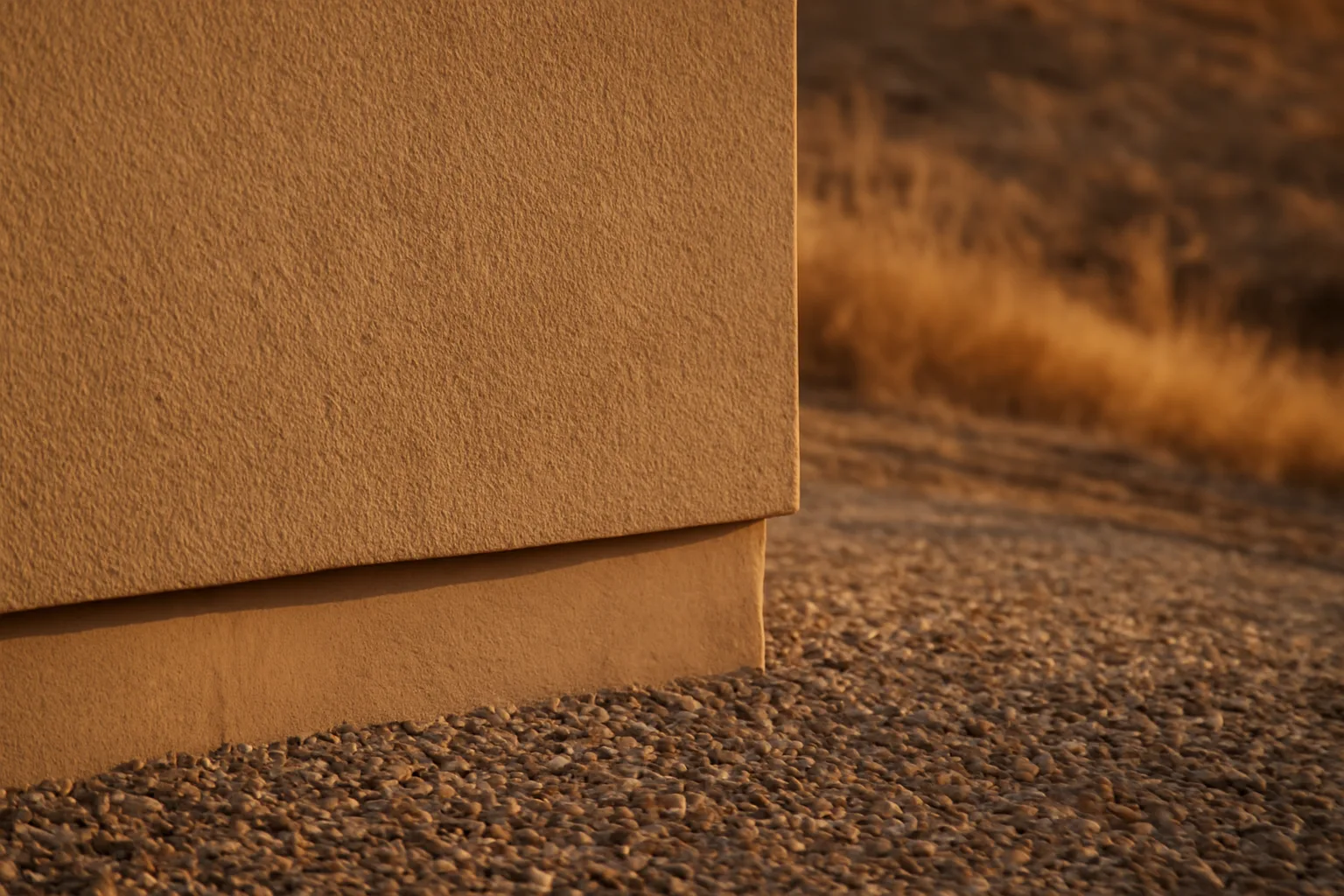
Concrete doesn't burn. That's the whole story in one sentence, but it's worth unpacking because "fire resistant" gets used loosely in home improvement marketing. Wood siding ignites because heat drives off flammable gases (mostly wood tar vapors) that catch fire around 300°C, well below the radiant heat a wildfire throws off from 30 feet away. Concrete, fiber-cement board, and stucco are mostly inorganic. There's no volatile fuel to off-gas. They can crack, spall, or discolor under extreme heat, but they don't add fuel to a fire the way cedar shingles or vinyl siding does. Fiber-cement siding (the category that includes James Hardie's HardiePlank and similar products) is Portland cement, sand, and cellulose fiber pressed into boards. It's been tested and rated noncombustible under ASTM E136 in most formulations, and it routinely passes the ignition-resistance tests California requires for Wildland-Urban Interface (WUI) construction [1]. Stucco (cement plaster) performs similarly and has been a Southern California and Arizona standard for decades, partly for this reason. The catch: assembly matters more than material. A concrete or fiber-cement exterior over untreated wood sheathing, with gaps at eaves or vents, still lets embers in. CAL FIRE's own guidance stresses that ignition resistance is a whole-assembly property, more than a surface material choice [2]. See also: fire safe landscaping California next to house for how material choice and defensible space work together.
What building code actually requires fire-resistant materials, and where does it apply?
California's Chapter 7A of the California Building Code (Title 24, Part 2) sets material and construction standards for buildings in Wildland-Urban Interface Fire Areas. It applies to new construction and, in some jurisdictions, to remodels and additions that trigger permit review. Chapter 7A requires ignition-resistant construction for exterior walls, decking, eaves, vents, windows, and roofing in designated WUI zones, referencing standards like SFM 12-7A-1 (exterior wall siding and sheathing) and SFM 12-7A-3 (decking) [3]. Materials that pass these tests include noncombustible options (concrete, fiber-cement, stucco, brick) and certain treated or engineered wood products that meet the ignition-resistance threshold without being literally noncombustible. The standard doesn't ban wood outright. It bans wood assemblies that fail the test. That distinction matters if a contractor tells you code "requires concrete." It doesn't; it requires passing performance, and concrete is one of several ways to get there. CAL FIRE maintains the official list of Wildland-Urban Interface designated areas and links to the current Building Materials Listing Program, which is the actual searchable database of products certified to meet these standards [4]. If a product isn't on that list, don't take a salesperson's word that it's "code compliant." Mitigation and building requirements vary by local fire district and county; check with [your local fire authority / building department] for the specific Chapter 7A trigger thresholds and any local amendments before assuming a product choice satisfies your permit.
When does the California defensible space law go into effect?
California's core defensible space statute, Public Resources Code 4291, has been in effect since it was substantially amended in 2005, requiring 100 feet of defensible space clearance around structures in State Responsibility Areas and some local responsibility areas [5]. That part isn't new. What's newer and often confused with it is Assembly Bill 3074 (2020), which directs the Board of Forestry to adopt a specific "ember-resistant zone" regulation for the 0-to-5-foot area immediately around a home, sometimes called "Zone 0." As of this writing, the Board of Forestry and Fire Protection has been through multiple rulemaking cycles on the Zone 0 regulation, with proposed effective dates that have slipped more than once; check the Board of Forestry's current rulemaking status page for the finalized effective date before assuming a specific year [6]. So if someone asks "when does the California defensible space law take effect," the honest answer has two parts: the 100-foot defensible space requirement under PRC 4291 has applied for close to two decades, while the newer Zone 0 ember-resistant zone rule is still working through adoption, and homeowners should check CAL FIRE's defensible space page for the current status rather than relying on a year that may already be outdated. For a broader walk-through of the zone-by-zone requirements, see defensible.
What fire-safe home rules take effect in 2026?
There isn't one single national "2026 rule." What's actually happening is a patchwork: California's Zone 0 ember-resistant zone regulation has been targeted for various effective dates in Board of Forestry rulemaking documents, and some insurers and FAIR Plan-adjacent programs have signaled 2025-2026 as the window they expect stricter documentation requirements to phase in. Rather than repeat a specific date that risks being wrong by the time you read this, the reliable move is to check two sources directly: CAL FIRE's defensible space and Zone 0 page for the state regulatory timeline, and your county building department for any local ordinance that pulls forward a state deadline (several WUI-heavy counties in California have adopted their own accelerated compliance dates ahead of the state's). Oregon's Senate Bill 762 (2021) created a statewide wildfire risk map and directed the state fire marshal to develop defensible space and building code standards for high-risk zones, with implementation phased over several years and repeatedly revised after public pushback over the risk map itself [7]. If you're in Oregon, check the Oregon Department of Forestry's SB 762 implementation page rather than assuming California's timeline applies. Colorado and Arizona don't have a single statewide Chapter 7A-equivalent code; both rely more heavily on county-level wildland-urban interface codes and local fire district adoption of the International Wildland-Urban Interface Code (IWUIC). Check with [your county building department] for the specific code edition and effective date in force locally.
Why won't people follow the defensible space law in California?
A few honest reasons keep coming up, and none of them are stupidity. Cost is the biggest one. Clearing 100 feet of defensible space, replacing wood decking, or re-siding a home in fiber-cement can run from a few hundred dollars in labor for a small lot to tens of thousands of dollars for a full retrofit, and CAL FIRE doesn't fund the work; it mostly funds education and, in limited cases, chipper programs. For a retiree on fixed income, "clear your defensible space" and "replace your roof" are not the same ask. Ambiguity is the second reason. PRC 4291 sets the 100-foot standard, but local fire districts interpret and enforce it differently, and homeowners genuinely get conflicting guidance from a county inspector, a real estate disclosure form, and an insurance inspector, all citing different rules. Third, enforcement has historically been inconsistent. Studies and reporting on defensible space compliance in California have found compliance rates well below 100% in many WUI communities, and CAL FIRE inspections have not historically resulted in heavy penalties for first-time non-compliance in most jurisdictions, which reduces the felt urgency. None of that means skip it. It means the barriers are mostly money, clarity, and follow-through, not a mystery about whether wildfire is a real risk.
How do you prevent wildfires from starting or spreading to your home?
Preventing ignition and preventing spread are two different jobs, and most "how to prevent wildfires" advice conflates them. Preventing ignition (the wildfire never starts near you) means following basic outdoor fire safety: no debris burning on red flag days, spark arrestors on chainsaws and mowers, proper disposal of cigarettes, and keeping vehicles off dry grass (catalytic converters and hot undercarriages start a meaningful share of roadside wildfires). Ready.gov's wildfire prevention guidance lists these as the practical, individual-level actions that reduce human-caused ignition, which accounts for the large majority of wildfires nationally. Preventing spread to your specific structure is the defensible space and hardening job: 100 feet of vegetation management (per PRC 4291), ember-resistant vents, noncombustible siding within 5 feet of the structure, and a Class A fire-rated roof. CAL FIRE's "Ready, Set, Go!" program frames this as reducing the odds embers (not direct flame contact) ignite your home, since ember cast, not the fire front itself, destroys most homes in WUI fires [8]. Both jobs matter, but if you're a homeowner asking how to prevent forest fires or how to avoid forest fires broadly, the honest answer is that individual homeowners have very limited ability to prevent large wildland fires from starting (lightning and, increasingly, power line failures cause a large share) but a lot of control over whether your specific home survives one.
How do you prepare for a wildfire before it happens?
Preparation splits into documentation, physical hardening, and an evacuation plan, and skipping any one of the three leaves a gap. Documentation means photos and video of your home's exterior, roof, vents, and defensible space zones, dated and stored somewhere other than your house (cloud storage, email to yourself, or a physical copy at a relative's place). This matters twice: once for your own insurance claim if the worst happens, and once because some insurers and FAIR Plans are now asking for proof of mitigation work before they'll renew a policy. Physical hardening follows CAL FIRE's zone system: Zone 0 (0-5 feet, ember-resistant, noncombustible), Zone 1 (5-30 feet, lean and green), Zone 2 (30-100 feet, reduced fuel). Ready.gov also recommends an emergency supply kit, a family communication plan, and multiple evacuation routes practiced in advance, since wildfire evacuation orders can arrive with very little lead time. This is also where a lot of homeowners get stuck: they know what to do in theory but never build the actual folder of photos, receipts, and inspection notes an insurer wants to see. A Wildfire Insurance Survival Kit is a $99 one-time way to organize that documentation (photos, mitigation records, a defensible space log) into the format insurers and FAIR Plans actually request, so you're not scrambling to find receipts after a non-renewal letter shows up. To be clear: this doesn't file claims or contact your insurer on your behalf; it just gets your own paperwork in order.
How can concrete and fiber-cement fit into a defensible space and hardening plan?
| Vinyl siding | Combustible, melts/drips | $3-$8 | Generally fails without listed backer assembly | |
|---|---|---|---|---|
| Wood/cedar siding, untreated | Combustible | $5-$10 | Fails standalone | |
| Fiber-cement siding | Noncombustible per ASTM E136 (most formulations) | $6-$13 | Passes when installed per manufacturer WUI listing | |
| Stucco (cement plaster) | Noncombustible | $7-$12 | Passes | |
| Brick veneer | Noncombustible | $10-$20 | Passes | |
| Poured/precast concrete wall system | Noncombustible | $15-$30+ | Passes | Cost ranges are rough national estimates and vary heavily by region, labor market, and whether it's new construction versus retrofit; get local contractor quotes rather than budgeting off a national average. For decking specifically, see the SFM 12-7A-3 standard for ignition-resistant decking materials, which some composite and all-concrete/paver decking systems can meet, while most untreated wood decking cannot [3]. |
Material choice does the most good in Zone 0, the 0-to-5-foot ring right against your walls, because that's where radiant heat and direct ember contact are most concentrated and where CAL FIRE's proposed ember-resistant zone rule focuses [6]. Practical, in-order priorities if you're budgeting a hardening project: Class A roof covering first (roofs and gutters are where most ember ignitions start), then vents (ember-resistant, 1/8-inch mesh, WUI-listed), then the first 5 feet of siding and any attached fencing or decking, then windows (dual-pane, tempered glass reduces radiant heat cracking). Here's a rough comparison of common exterior wall materials against ignition resistance and typical installed cost, useful for the actual decision most homeowners face when re-siding: | Material | Combustibility | Typical installed cost (per sq ft, 2024 estimates) | Chapter 7A pass status |
Is Santa Barbara safe from fire, and how do coastal California areas fit the risk picture?
No California community with wildland vegetation nearby is "safe" from fire risk in an absolute sense, and Santa Barbara County has a documented history that argues against complacency: the 2017 Thomas Fire (at the time one of the largest in modern California history) burned into Santa Barbara County and was followed by the deadly Montecito debris flow in January 2018, and the 1990 Painted Cave Fire and 2008 Tea Fire both burned into Santa Barbara's foothill neighborhoods [9]. What's true is that risk varies enormously by exact location within the county. A home tucked against the Santa Ynez foothills in a WUI-designated zone carries meaningfully different risk than a home in flat, urbanized Goleta or downtown Santa Barbara away from wildland fuel. CAL FIRE's Fire Hazard Severity Zone maps let you check the specific designation for an address, and that's a far more useful answer than a yes/no on the whole city or county [10]. If you own in or near a Very High Fire Hazard Severity Zone anywhere in California, including parts of Santa Barbara's foothill communities, Chapter 7A construction standards and PRC 4291 defensible space requirements both apply, regardless of how the broader region "feels" in terms of safety.
What's the honest cost-benefit on fire-resistant materials versus other hardening priorities?
If you have limited money, roof and vents beat siding material almost every time, because embers entering through roof vents and gaps account for a large share of home ignitions in WUI fires, more than direct wall ignition from radiant heat alone, according to post-fire investigation work CAL FIRE and researchers have documented in fire-damage assessments [2]. A rough spending order for a $10,000-$15,000 hardening budget: ember-resistant vents and gutter guards (relatively cheap, often under $2,000 total), Zone 0 clearing and hardscaping (variable, often $1,000-$5,000 depending on lot), then siding upgrades in the highest-exposure wall sections rather than the whole house if budget is tight. Full-house fiber-cement or stucco re-siding often costs more than a partial, ember-zone-focused approach, and unless you're already re-siding for other reasons (age, damage, aesthetics), a full swap may not be the best first dollar spent purely for fire risk reduction. That's a real opinion, not a hedge: spend on vents and the first 5 feet before you spend on the whole exterior. See house fire and fire at a house for what post-ignition damage patterns typically look like and why the ember zone gets the attention it does.
How do you prepare for forest fires if you live near wildland, more than in a subdivision?
Rural and semi-rural properties near actual forest, more than WUI-adjacent subdivisions, carry additional considerations beyond the standard Zone 0-1-2 hardening plan. Access matters more: fire district response times can be significantly longer, and some rural fire districts require specific driveway width, turnaround space, and address signage for engine access, which is a defensible-space-adjacent requirement that gets missed in generic advice. Check with [your local fire district] for specific access requirements. Water supply for firefighting (a dedicated cistern, pond, or verified hydrant access) is a bigger factor for rural properties than urban ones, and some rural fire districts offer reduced insurance-adjacent risk ratings for properties with a verified water source. Vegetation management contracts are also more common and more necessary at this scale; if you're managing several acres rather than a quarter-acre lot, see wildfire defensible space clearing contracts Washington State DNR for how larger-scale clearing agreements typically work, since the same principles (documented scope, timeline, and proof of completion) apply across states even where the specific program differs.
How can homeowners actually prevent forest fires as individuals?
Individual homeowners can't stop lightning-caused fires or most large-scale wildland fires, but the human-caused share is real and preventable at the household level: campfire negligence, equipment sparks, and debris burning together account for a large share of wildfire starts nationally, and Smokey Bear's long-running "only you can prevent wildfires" campaign exists because that individual-behavior share is genuinely significant . Practical individual actions: fully extinguish campfires (drown, stir, drown again), avoid parking or driving on dry grass, don't use fireworks or exploding targets on high fire-danger days, maintain equipment spark arrestors, and follow local burn permit rules exactly rather than assuming "it's fine, everyone does it." For more on the individual-prevention angle and why it's framed the way it is, see only you can prevent wildfires. Beyond individual ignition prevention, the single most useful thing most homeowners can do is make their own structure less likely to catch, because a neighborhood of hardened homes measurably slows structure-to-structure fire spread during a WUI event, which is a documented pattern in post-fire investigations of which homes survived and which didn't within the same fire perimeter [2].
What should you document before an insurer or inspector shows up?
Insurers and FAIR Plans in California, Colorado, Oregon, and Arizona increasingly want photographic and written proof of defensible space compliance and structural hardening, more than a self-attestation checkbox, especially after a non-renewal notice. Date-stamped photos of all four sides of the exterior, the roof (from ground level is fine if you can't safely get on it), all vents, the first 5 feet around the foundation, and the 30-foot and 100-foot vegetation zones give you the strongest documentation set. Keep receipts for any hardening work (new vents, siding, roof, deck) since "I did the work" without a receipt or invoice carries much less weight than a paper trail. A defensible space clearing log (dates, what was cleared, by whom) is worth keeping even if no one asks for it immediately, because insurance mitigation credit programs and FAIR Plan compliance reviews have both leaned harder into requiring this kind of record over the past few renewal cycles. This is the exact gap the Wildfire Insurance Survival Kit is built to close: a $99 one-time organizing tool for the photos, receipts, and defensible space log format insurers actually ask for, so you're sending your own complete documentation rather than reconstructing it under deadline pressure after a non-renewal letter. It doesn't file claims, contact your insurer on your behalf, or promise reinstatement; it just gets your paperwork ready for you to send.
Frequently asked questions
When does the California defensible space law go into effect?
The core 100-foot defensible space requirement under Public Resources Code 4291 has been in effect since a 2005 amendment; it's not new. A newer "Zone 0" ember-resistant zone regulation (from AB 3074) has gone through multiple Board of Forestry rulemaking delays, so check CAL FIRE's defensible space page for the current finalized effective date rather than assuming a specific year.
Why won't people follow the defensible space law in California?
Mostly cost, ambiguity, and inconsistent enforcement. Full compliance can run from a few hundred dollars to tens of thousands for a full hardening retrofit, local fire districts interpret the rules differently, and historically CAL FIRE inspections haven't carried heavy first-offense penalties in most jurisdictions, which reduces urgency even where risk is high.
How do you prevent wildfires from starting near your property?
Follow basic outdoor fire safety: no debris burning on red flag days, spark arrestors on equipment, proper cigarette disposal, and keeping vehicles off dry grass. Ready.gov's wildfire guidance lists these as the practical individual-level steps that reduce human-caused ignition, which accounts for the majority of wildfire starts nationally.
How do you prepare for a wildfire if you get an evacuation warning?
Have a packed go-bag, multiple practiced evacuation routes, and a family communication plan set up before fire season, per Ready.gov guidance. Also keep dated photos of your home's exterior and defensible space, and store hardening receipts somewhere accessible off-site, since both matter for insurance documentation after the fact.
How do you prevent forest fires as an individual homeowner?
You can't stop lightning-caused fires, but human-caused ignitions (campfires, equipment sparks, debris burns) are a real and preventable share nationally. Fully extinguish campfires, avoid parking on dry grass, skip fireworks on high fire-danger days, and follow local burn permits exactly rather than assuming exceptions.
How do you avoid forest fires spreading to your home specifically?
Defensible space (100 feet under California's PRC 4291) plus structural hardening: a Class A roof, ember-resistant vents, and noncombustible material in the first 5 feet. Post-fire investigations show ember cast, not direct flame contact, destroys most homes in wildland-urban interface fires, so vents and roofs matter more than most homeowners assume.
How do you prepare for forest fires if you live in a rural, wildland-adjacent area?
Beyond standard defensible space zones, check driveway width and turnaround access requirements with your local fire district, since rural response times are often longer. A dedicated water source (cistern or pond) and larger-scale vegetation management contracts become more relevant at multi-acre properties than at typical subdivision lots.
What fire-safe home rules take effect in 2026?
There's no single confirmed 2026 rule; California's Zone 0 ember-resistant zone regulation has been targeted for various dates across multiple Board of Forestry rulemaking cycles and has slipped before. Check CAL FIRE's defensible space page directly and your county building department for any local ordinance with its own accelerated deadline.
Is Santa Barbara safe from fire?
No California community near wildland vegetation is fully safe from fire risk. Santa Barbara County has a documented history including the 2017 Thomas Fire and 1990 Painted Cave Fire. Risk varies hugely by exact address; check CAL FIRE's Fire Hazard Severity Zone maps for your specific location rather than judging the whole city or county.
How can we prevent forest fires at a community level?
Community-level prevention combines individual ignition-prevention behavior (extinguishing campfires, following burn permits) with coordinated defensible space and hardening across a neighborhood, since post-fire investigations show hardened, well-spaced homes slow structure-to-structure spread during wildland-urban interface fires within the same fire perimeter.
Is fiber-cement siding actually fireproof?
No material is fully fireproof, but fiber-cement is noncombustible under ASTM E136 in most formulations and routinely passes California's SFM 12-7A ignition-resistance tests for Wildland-Urban Interface construction, unlike wood or vinyl siding, which either ignites or melts under radiant heat exposure.
Does concrete siding cost more than wood siding?
Yes, generally. Fiber-cement typically runs $6-$13 per installed square foot versus $5-$10 for untreated wood siding, and full poured or precast concrete wall systems can run $15-$30+ per square foot, though these are rough national estimates that vary heavily by region and labor market; get local quotes.
Do I need Chapter 7A materials if my home isn't new construction?
Chapter 7A primarily applies to new construction in designated Wildland-Urban Interface Fire Areas, but many California jurisdictions also trigger compliance for significant remodels or additions requiring permits. Check with your local building department, since the trigger threshold varies by county and city amendment.
Sources
- California State Fire Marshal, Building Materials Listing Program: Fiber-cement and other WUI construction materials are tested and certified against SFM ignition-resistance standards
- CAL FIRE, Wildfire Home Retrofit Guide: Ignition resistance is a whole-assembly property and embers cause most home ignitions in WUI fires
- California State Fire Marshal, SFM Standard 12-7A-3: Ignition-resistant decking materials standard under Chapter 7A
- CAL FIRE, Wildland-Urban Interface Building Standards: Chapter 7A applies to designated Wildland-Urban Interface Fire Areas and references the Building Materials Listing Program
- California Public Resources Code Section 4291: 100 feet of defensible space clearance is required around structures in State Responsibility Areas
- California Board of Forestry and Fire Protection, Zone 0 Rulemaking: Zone 0 ember-resistant zone regulation status and rulemaking timeline
- Oregon Legislature, Senate Bill 762 (2021): Oregon's wildfire risk map and defensible space/building code standard mandate
- CAL FIRE, Ready Set Go Program: Ember cast rather than direct flame contact destroys most homes in WUI fires
- CAL FIRE, Fire Hazard Severity Zone Maps: Address-level fire hazard severity zone designations vary across California including within Santa Barbara County
- USDA Forest Service, Smokey Bear Wildfire Prevention Campaign: Human-caused ignition is a significant share of wildfires and the basis of individual-behavior prevention campaigns