Last updated 2026-07-25
TL;DR
Most Redding homes sit in a CAL FIRE State Responsibility Area, so California's 100-foot defensible space law (Public Resources Code 4291) already applies, not some future 2026 date. Zone 0 (0-5 feet, ember-resistant materials) is in rulemaking with a state deadline that keeps slipping, but Zones 1 and 2 clearance is enforceable today, and Shasta County/CAL FIRE inspectors do write citations.
Does defensible space law apply to homes in Redding, CA?
Yes, for most properties. Redding sits inside Shasta County, and a large share of the city's outer neighborhoods (the areas up against Shasta Bally, along the Sacramento River corridor, and the hillside subdivisions east and west of I-5) fall inside a CAL FIRE State Responsibility Area (SRA), where the state, more than the local fire department, has direct authority over vegetation management. If your parcel is in an SRA, or in a Very High Fire Hazard Severity Zone that a local jurisdiction has adopted, Public Resources Code Section 4291 requires you to maintain defensible space out to 100 feet from any structure, or to your property line, whichever is closer [1]. This isn't a suggestion. CAL FIRE and, in some areas, Shasta County Fire or CAL FIRE's Shasta-Trinity Unit can inspect and issue a notice of violation if the vegetation around your house doesn't meet the standard. Check your specific parcel status with the [Shasta County GIS/SRA lookup or CAL FIRE's local unit], since responsibility area lines don't follow city limits and some in-city parcels in Redding are Local Responsibility Area (LRA) instead, which shifts enforcement to the city fire marshal under a similar but locally-adopted ordinance.
When does the California defensible space law go into effect?
The 100-foot, two-zone requirement (Zones 1 and 2) is not new. It has been law since 2005 legislation expanded the old 30-foot standard to 100 feet under PRC 4291, and CAL FIRE has enforced it in SRAs continuously since [1]. If you got a letter this year telling you to clear brush, that's this existing law, not something new phasing in. What is new, and still not final as of this writing, is Zone 0: the 'ember-resistant zone' within 0 to 5 feet of a structure. Assembly Bill 3074 (2020) directed the Board of Forestry and Fire Protection to develop Zone 0 regulations, and the Board has been through multiple draft rulemaking cycles [2]. CAL FIRE's own program page has referenced a 2023 target and later a 2025-2026 window for the regulation to take effect, but as of mid-2025 the formal regulatory text still had not been adopted into the California Code of Regulations [2]. So if you're searching for 'what fire safe rules for homes take effect in 2026,' the honest answer is: probably Zone 0, likely with a compliance grace period after adoption, but the exact date has moved before and could move again. Don't wait for a hard deadline. Treat the 0-5 foot zone around your Redding home as something to start clearing now, using noncombustible mulch, moving woodpiles and propane tanks off the wall line, and pulling attached fencing away from siding, because insurers are already asking about it during underwriting even before it's codified.
What does defensible space actually require, zone by zone?
| Zone 0 (pending) | 0-5 ft | Noncombustible materials, no stored fuel against walls | |
|---|---|---|---|
| Zone 1 | 5-30 ft | Remove dead vegetation, space tree canopies, mow grass under 4 in | |
| Zone 2 | 30-100 ft | Reduce ladder fuels, thin vegetation, maintain spacing | For the landscaping choices that fit inside these zones without stripping your yard bare, see fire safe landscaping in California next to house. |
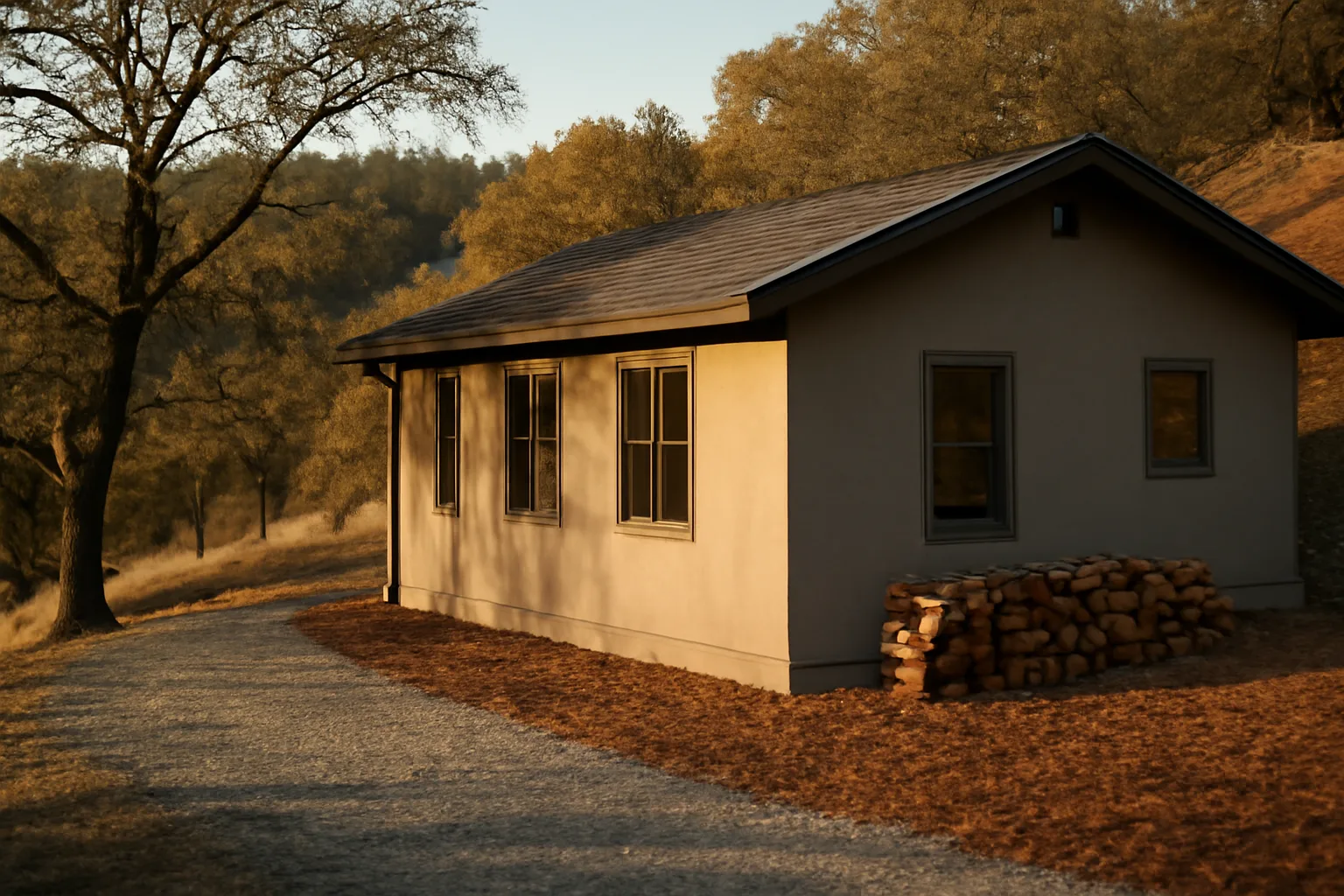
PRC 4291 breaks the 100 feet into two zones with different jobs. Zone 1 runs from the structure out to 30 feet (or to the property line) and requires removing dead plants, dead branches, and needle/leaf litter, spacing tree canopies, and keeping grass mowed to under 4 inches [1]. Zone 2 runs from 30 to 100 feet and allows more natural vegetation but still requires 'greater spacing between plants and trees' and removal of ladder fuels that let a ground fire climb into tree canopies [1]. Zone 0, once formally adopted, is expected to require noncombustible material within 5 feet of the structure: no bark mulch, no stored firewood, no combustible fencing attached to the house, per the Board of Forestry's draft framework referenced in CAL FIRE's defensible space guidance [2]. Here's a rough reference table for Redding-area properties. Always confirm specifics with your local fire district, since Shasta County and CAL FIRE's Shasta-Trinity Unit can add local conditions. | Zone | Distance from structure | Core requirement |
Why won't people follow the defensible space law in California?
Cost and confusion are the two biggest reasons, and both are legitimate, more than excuses. Clearing 100 feet of vegetation on a sloped, oak-and-manzanita hillside lot outside Redding can run into thousands of dollars if you hire it out, and CAL FIRE's own compliance surveys have repeatedly found that a meaningful share of inspected parcels fail on first inspection, often for things like uncleared leaf litter in gutters or firewood stacked against a fence rather than dramatic full-yard neglect. There's also a real gap between what the law says and what a homeowner can picture. 'Remove ladder fuels' and 'maintain proper spacing' are qualitative. Two neighbors can look at the same manzanita thicket and disagree about whether it's compliant. That ambiguity is part of why CAL FIRE publishes defensible space checklists and why some counties run free inspection programs before the punitive ones. And some people just don't believe it matters, especially in neighborhoods that haven't burned in living memory. That's a bad bet. The Camp Fire investigation and multiple post-fire studies out of institutions like the Insurance Institute for Business & Home Safety have found that home ignition in wind-driven wildfires is overwhelmingly about embers landing on flammable material within a few feet of the structure, not a wall of flame marching up to the house, which is exactly why Zone 0 exists. Skipping defensible space doesn't just risk a citation. It measurably raises the odds your specific house ignites.
How do I get my Redding property inspected before I get a non-renewal letter?
Ask first, don't wait to be told. Shasta County and CAL FIRE's local unit run inspection programs, and some are free or low-cost for residents in SRA zones. Contact your local CAL FIRE unit office or Shasta County Fire to ask about a defensible space inspection before wildfire season, and get it in writing if they clear you. That written record matters more than people expect. If your insurer sends a non-renewal or inspection notice, a dated, signed inspection report from a fire agency is stronger evidence than photos you took yourself, because it comes from a third party with authority. Keep copies of any inspection report, any citation and its resolution, and dated before/after photos of cleared zones. If you want a structured way to organize that paperwork before you're in a scramble, a Wildfire Insurance Survival Kit walks through exactly what documentation insurers and adjusters ask for, in the order they ask for it, so you're not hunting for a five-year-old inspection letter the week your renewal is due. We don't file claims or represent you with your insurer; the kit just helps you build the file you hand them yourself.
How to prevent wildfires around your home and neighborhood
Most wildfires that reach homes start small and human-caused, so prevention starts with the everyday stuff: don't park hot vehicles on dry grass (catalytic converters routinely start roadside fires), finish debris burns completely and check them the next day, and keep mowing to early morning when it's cooler and less windy. At the home level, prevention and defensible space are the same conversation. CAL FIRE's guidance is direct: 'Defensible space is the buffer you create between a building on your property and the grass, trees, shrubs, or any wildland area that surrounds it'. That buffer is what gives firefighters a place to work and reduces the chance embers find fuel right at your wall. At the neighborhood level, coordinated clearing matters more than any single yard. A perfectly cleared lot next to three overgrown ones doesn't buy much protection, because wildfire moves through a landscape, not through individual parcels. Firewise USA, the National Fire Protection Association's community program, exists specifically because block-by-block coordination outperforms isolated compliance [3]. If Redding neighborhoods want real risk reduction (and better standing with insurers), organizing a shared chipper day or group contractor bid for Zone 2 clearing does more than any one household going it alone.
How to prepare for a wildfire (evacuation and home checklist)
Preparation splits into two tracks: getting people out safely and giving the structure its best shot while you're gone. Ready.gov's wildfire guidance recommends building a go-bag with medications, documents, and basic supplies, and having two exit routes planned in case one is blocked by fire or traffic. For the home itself, close all windows and doors (but leave them unlocked for firefighter access), remove flammable curtains, shift furniture away from windows, turn off gas at the meter if instructed, and turn on exterior lights so the house is visible in smoke, per Ready.gov's evacuation checklist. Sign up for Shasta County's emergency alert system before fire season starts, not during an evacuation order; check with your local Office of Emergency Services for the current platform, since alert systems have changed names and vendors across California counties in recent years. Know your zone before smoke is in the air, not after.
How to prevent forest fires and avoid forest fires near your property
'Forest fire' and 'wildfire' get used interchangeably, but the prevention steps are the same whether you're worried about the timberland behind your Redding property or a grass fire along a rural road. Nearly nine in ten wildfires nationally are human-caused, according to the National Interagency Fire Center's long-standing estimate, which means the biggest lever most homeowners have isn't clearing brush, it's controlling ignition sources: campfires fully out and cold to the touch, no fireworks or exploding targets on dry land, chains not dragging from trailer hitches, and equipment with spark arrestors on dry vegetation [4]. If you're on wooded acreage near Whiskeytown or the Shasta-Trinity National Forest boundary, check for local burn permit and burn day restrictions before any outdoor debris burning; Cal Fire and county fire agencies suspend permitted burning during red flag conditions and can issue citations for burning outside permitted windows. Avoiding forest fires around your own land also means managing what you don't think of as fuel: dead needle drop under conifers, dry grass along fence lines and driveways, and stacked lumber or pallets near a property edge. These aren't dramatic fire risks individually, but they're exactly the kind of continuous fuel path that lets a small ignition become a running fire.
Is Redding (or Santa Barbara, or any California city) 'safe' from fire?
No California community surrounded by wildland vegetation is safe from fire risk, and that includes both Redding and Santa Barbara, even though people search both names hoping for a reassuring answer. Redding sits at the edge of the Shasta-Trinity National Forest and has burned before: the 2018 Carr Fire, one of California's most destructive wildfires on record, burned into Redding itself, destroyed over 1,000 structures, and killed multiple people, according to CAL FIRE's incident archive [5]. Santa Barbara isn't safer by comparison. The Thomas Fire in December 2017 burned over 280,000 acres across Ventura and Santa Barbara counties and was, at the time, the largest wildfire in modern California history, followed weeks later by the Montecito debris flow that killed 23 people when rain hit the burn scar [6]. Being in a scenic, forested, or hillside setting is precisely what raises fire exposure; it isn't a protective feature. The honest framing insurers use, and that homeowners should use too, is exposure level, not binary safe/unsafe. Every SRA parcel in California carries some wildfire exposure. Defensible space, home hardening, and evacuation planning lower that exposure. Nothing eliminates it.
What fire-safe home rules take effect in 2026?
The most-cited 2026-adjacent rule is CAL FIRE's Zone 0 ember-resistant zone regulation, which the Board of Forestry has been drafting under authority from Assembly Bill 3074 (2020) [2]. As of this writing, the Board had not finalized adoption into the California Code of Regulations, and CAL FIRE's public materials describe an ongoing rulemaking process rather than a locked statewide date, so treat any specific 2026 date you see online as provisional until the Office of Administrative Law confirms a final adopted regulation [2]. Separately, California's building code side has its own timeline: Chapter 7A of the California Building Code already sets ignition-resistant construction standards (roofing, vents, siding, eave materials) for new construction and substantial remodels in Wildland-Urban Interface Fire Areas, and local jurisdictions periodically adopt updated versions of the state building code on the standard three-year cycle the California Building Standards Commission runs [7]. If you're building or majorly remodeling in Redding's WUI zones, check with the city or county building department about which code cycle currently applies to your permit, since that answer changes with each triennial update. The practical move for homeowners: don't wait for Zone 0's exact effective date. Start treating the 5 feet around your house as noncombustible now. For a broader picture of what 'defensible' means across all the zones together, see defensible.
What happens if you don't comply, and how do you fix a citation?
If a CAL FIRE or local fire inspector finds your property out of compliance with PRC 4291, you'll typically get a notice specifying what to fix and a reinspection window, often 30 to 90 days depending on the local agency's practice. If you still haven't corrected it, some jurisdictions can issue citations with fines, and in persistent cases a local agency can perform the abatement work itself and bill the property owner [1]. The fix is almost always straightforward: clear the specific items listed (dead brush, ladder fuels, overhanging limbs, debris under decks), photograph the completed work with date stamps, and request a reinspection. Keep every piece of that paperwork. It becomes useful again later if your insurer questions your risk profile, since a documented, agency-verified defensible space correction is concrete evidence you took action, more than a claim you make in an email. If a citation or an insurance letter is what brought you here, it helps to see what a full defensible space workup looks like across all zones at once, which is covered in defensible space clearing contracts and what they typically cover (the underlying scope and pricing logic applies broadly, even though that piece is framed around Washington DNR contracts).
How does defensible space connect to home hardening and insurance?
Defensible space and home hardening are two halves of the same problem: keeping fire and embers away from the house (defensible space) and making the house itself resistant when embers do arrive (hardening). Vents with 1/8-inch metal mesh, Class A roofing, ember-resistant eaves, and dual-pane tempered windows all matter because embers, not flame fronts, cause most home ignitions in wind-driven wildfires, a pattern documented repeatedly in post-fire structure surveys. Insurers increasingly ask about both together. Some California insurers now offer discounts or use defensible space and hardening documentation as part of underwriting decisions, following state efforts (including California Department of Insurance regulatory action) to tie wildfire mitigation to availability of coverage. We don't promise any discount, reinstatement, or coverage outcome; check your specific policy and ask your agent what documentation they accept. What you can control is the paper trail: inspection reports, contractor invoices for clearing, photos of your Zone 0-5 area, and any hardening upgrades. For a walkthrough of what a fire actually does to an unprepared structure versus a hardened one, see house fire and fire at a house. And if you haven't started your own defensible space yet, the seasonal reminder campaign is right there in the name: only you can prevent wildfires.
Frequently asked questions
When does the California defensible space law go into effect?
PRC 4291's 100-foot, two-zone defensible space requirement has been law since 2005 and applies now in State Responsibility Areas, including much of the Redding area. It isn't a future date. The new piece still in rulemaking is Zone 0 (0-5 feet), which CAL FIRE and the Board of Forestry haven't finalized as of mid-2025.
Why won't people follow the defensible space law in California?
Cost, ambiguity, and complacency are the main reasons. Clearing 100 feet of hillside vegetation can cost thousands of dollars, terms like 'ladder fuels' and 'proper spacing' are subjective, and homeowners in areas that haven't burned recently often underestimate how quickly conditions change during red flag events.
How do I prevent wildfires around my property?
Control ignition sources: keep vehicles off dry grass, fully extinguish debris burns and check them the next day, use spark arrestors on equipment, and maintain your defensible space zones. CAL FIRE notes defensible space is the buffer between your home and surrounding wildland vegetation, and it's the single biggest factor in ember-driven ignition.
How do I prepare for a wildfire?
Build a go-bag with medications and documents, plan two evacuation routes, and sign up for your county's emergency alert system before fire season. When an evacuation order comes, close windows and doors (unlocked), remove flammable curtains, and turn off gas at the meter if instructed, per Ready.gov's wildfire evacuation checklist.
How can we prevent forest fires?
About 9 in 10 wildfires nationally are human-caused, per National Interagency Fire Center estimates, so prevention mostly means controlling ignition: fully extinguished campfires, no burning on red flag days, working spark arrestors, and no dragging trailer chains on dry roads near forested land.
What fire-safe rules for homes take effect in 2026?
The most likely 2026-related rule is CAL FIRE's Zone 0 ember-resistant zone regulation under AB 3074, requiring noncombustible material within 5 feet of structures. As of this writing it hasn't been formally adopted into the California Code of Regulations, so treat any specific date as provisional until the Board of Forestry confirms it.
Is Santa Barbara safe from fire?
No. Santa Barbara County sits in a high wildfire hazard region and experienced the 2017 Thomas Fire, which burned over 280,000 acres and was followed by a deadly debris flow in Montecito. Being scenic or coastal-adjacent doesn't reduce wildfire exposure; hillside and wildland-adjacent areas carry real risk regardless of city reputation.
Does defensible space law apply inside Redding city limits?
It depends on the parcel. Many outer Redding neighborhoods sit in a CAL FIRE State Responsibility Area where PRC 4291 applies directly. Other in-city parcels are Local Responsibility Area, where a similar ordinance is enforced by the city fire marshal. Check your parcel's designation with Shasta County or your local CAL FIRE unit.
How far from my house does defensible space have to extend?
Up to 100 feet, or to your property line if that's closer. Zone 1 covers 5 to 30 feet with stricter clearance rules, Zone 2 covers 30 to 100 feet with more flexibility, and Zone 0 (pending final regulation) covers the first 5 feet closest to the structure.
What happens if I don't clear defensible space and get inspected?
You'll typically get a written notice describing required fixes and a reinspection deadline. If uncorrected, some agencies issue citations with fines, and in persistent cases the agency can perform the clearing itself and bill you. Keep every inspection document, since it also matters for insurance conversations later.
Does clearing defensible space guarantee my insurance won't be cancelled?
No. Defensible space and hardening documentation can support your case with an insurer, but nobody, including us, can promise coverage, reinstatement, or a discount. Insurers set their own underwriting criteria. Documentation helps you make your case; it doesn't obligate any specific outcome.
What's the difference between defensible space and home hardening?
Defensible space is vegetation and fuel management around the house (out to 100 feet). Home hardening is upgrading the structure itself, things like ember-resistant vents, Class A roofing, and dual-pane windows, so embers that do arrive can't ignite it. Insurers and fire agencies increasingly expect both.
Where can I get my Redding property inspected for free?
Contact Shasta County Fire or your local CAL FIRE unit office directly and ask about defensible space inspection programs; many California counties run free or low-cost inspections seasonally, especially before peak fire season starts in late spring.
Sources
- California Public Resources Code Section 4291: 100-foot defensible space requirement, Zone 1 and Zone 2 rules
- California Board of Forestry and Fire Protection, Zone 0 rulemaking: Zone 0 ember-resistant zone regulation development under AB 3074, not yet finalized
- National Fire Protection Association, Firewise USA: Community-level coordinated mitigation program for wildfire risk reduction
- National Interagency Fire Center, statistics: Roughly 9 in 10 wildfires nationally are human-caused
- CAL FIRE, Carr Fire incident information: 2018 Carr Fire burned into Redding, destroyed over 1,000 structures
- CAL FIRE, Thomas Fire incident information: 2017 Thomas Fire burned over 280,000 acres across Ventura and Santa Barbara counties
- California Building Standards Commission, Triennial Code Adoption Cycle: California building code, including Chapter 7A WUI standards, updates on a triennial cycle