Last updated 2026-07-25
TL;DR
Home Depot sells several genuinely ember-resistant products (fiber-cement siding, Class A rated shingles, 1/8-inch metal mesh vent screens), but no single product makes a home "fireproof." You need the right materials in the right assemblies, matched to your local defensible-space and building code rules, which vary by fire district.
Does Home Depot actually sell fire-resistant building materials?
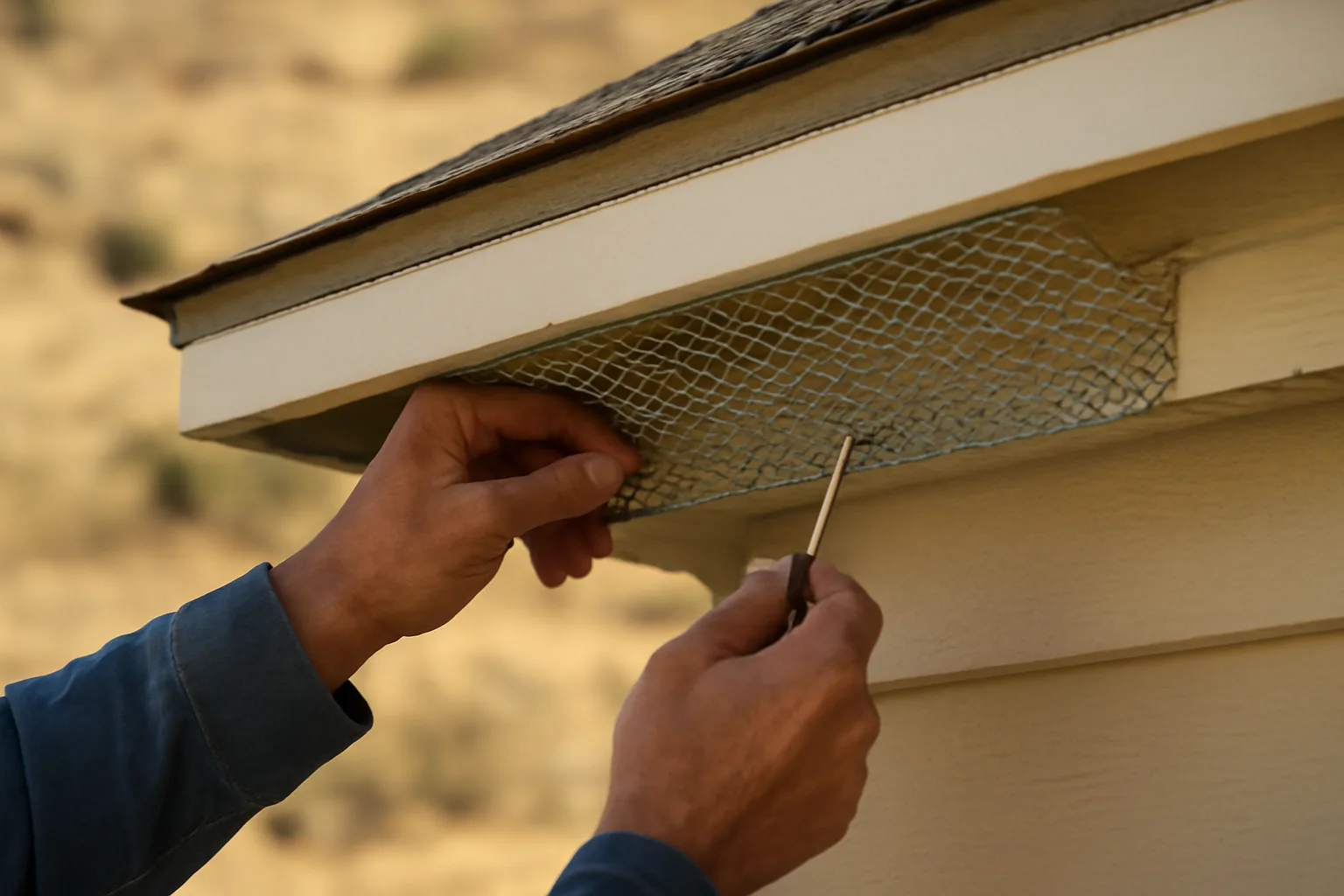
Yes, but the store aisle doesn't sort things by "fire resistant" the way you'd want. You have to know what to look for. The products that matter most for wildfire hardening: fiber-cement siding and trim (brands like HardiePlank, sold through Home Depot and its pro desk), Class A fire-rated asphalt and composite shingles, 1/8-inch or smaller corrosion-resistant metal mesh for vent screens, tempered dual-pane windows, and non-combustible gutter guards. None of these are marketed with a "wildfire" label on the shelf tag. You're reading UL ratings, ASTM test numbers, and manufacturer spec sheets, not big red stickers. CAL FIRE's own guidance is blunt about this: home hardening isn't one product, it's an assembly problem. Embers exploit gaps, more than flammable materials. That's why the agency's checklist covers vents, eaves, decking, siding, and windows as a system, not a shopping list of one magic material. If you're starting from zero, treat a Home Depot run as step two. Step one is walking your own roofline and yard with the defensible space checklist so you know which assemblies actually need replacing before you buy anything.
Which Home Depot products meet California's wildfire building codes?
| Roofing | Class A fire rating | GAF Timberline HDZ, Owens Corning Duration, and most architectural shingles now carry Class A; confirm on the wrapper | |
|---|---|---|---|
| Vents | Ember- and flame-resistant, tested to SFM 12-7A-1 | Vulcan Vents and similar ember-resistant vent products, sometimes special order | |
| Siding | Ignition-resistant material, tested per SFM 12-7A-1 | Fiber-cement (HardiePlank), not vinyl or untreated wood | |
| Decking | Ignition-resistant, tested per SFM 12-7A-4 | Composite decking rated for wildfire zones (check the spec sheet, not all composite qualifies) | |
| Windows | Multi-pane with at least one tempered pane | Standard dual-pane vinyl or fiberglass windows with tempered glass, confirm with a sales associate | The standard is enforced through the State Fire Marshal's Building Materials Listing program, which tests and certifies specific products (not brands generally) to the 12-7A series test standards [2]. A shingle isn't "Chapter 7A compliant" just because it's Class A; the whole assembly has to be tested and listed. This is the single most common mistake homeowners make buying materials off the shelf. |
California's Chapter 7A of the building code (Title 24, Part 2) governs "Materials and Construction Methods for Exterior Wildfire Exposure" in designated Fire Hazard Severity Zones. It requires ember- and flame-resistant assemblies for roofs, vents, eaves, decking, windows, and siding in new construction and major remodels in those zones [1]. Home Depot doesn't sell to Chapter 7A spec by default. You have to check labels yourself: | Component | What Chapter 7A generally requires | What to look for at Home Depot |
When does the California defensible space law go into effect?
California's defensible space requirement itself isn't new. Public Resources Code 4291 has required 100 feet of defensible space clearance around structures in State Responsibility Areas since it was expanded in 2005 [3]. What's changing is the enforcement layer: the "ember-resistant zone" (Zone 0, the 0-to-5-foot area immediately around the structure). The State Board of Forestry and Fire Protection has been developing Zone 0 regulations under SB 63 (2023) and earlier authorizing legislation. As of this writing, CAL FIRE's public guidance describes Zone 0 regulations as still in the rulemaking process, with the Board of Forestry working through the formal adoption steps required for any new state regulation. Target effective dates have shifted more than once; CAL FIRE's own defensible space page is the place to check current status because the timeline keeps moving as the rulemaking proceeds. Don't wait for the ink to dry on Zone 0 to act. Insurers pulling policies now are already scoring homes against something close to a Zone 0 standard (bare ground or non-combustible material within 5 feet of the structure, no bark mulch, no shrubs touching siding). Waiting for the regulation to become final before you clear that zone is backwards; do it now and you're ahead of both the law and your insurer's underwriter.
What fire-safe rules for homes take effect in 2026?
This is a moving target and the honest answer is: it depends heavily on which state and which fire district you're in, so treat any specific date as provisional until you check your local building department. What's fairly stable: In California, Zone 0 ember-resistant zone regulations have been through Board of Forestry rulemaking cycles with implementation dates proposed for new construction first, then existing homes on a longer compliance runway. Check the Board of Forestry's current rulemaking status page directly rather than relying on any article's stated date, because proposed effective dates have already slipped multiple times. Colorado passed HB24-1006, which as of 2024 directs the Colorado Division of Insurance and other state agencies to study wildfire mitigation and resilience programs; specific statewide building material mandates for existing homes are less centralized than California's, and mitigation requirements are set more at the county and fire-district level [4]. Oregon's wildfire risk map and defensible space / home hardening requirements under SB 762 (2021) have gone through repeated revisions after public pushback; the Oregon Department of Forestry paused and reworked the statewide risk map after widespread errors were found in the first version. [Guided fill-in: check your specific fire district or county building department for the exact 2026 compliance date and scope that applies to your parcel, since this varies by jurisdiction and changes on its own schedule.]
Why won't people follow the defensible space law in California?
CAL FIRE and outside researchers have looked at this, and the reasons aren't just stubbornness. Cost is the biggest one. Clearing 100 feet of defensible space on a sloped, brush-covered lot can run into the thousands of dollars, especially if it requires tree removal, chipping, or hauling. Retrofitting vents, siding, or a roof to Chapter 7A standard costs more still. A 2021 Headwaters Economics analysis of wildfire mitigation found that home hardening measures (vents, roofing, siding) commonly range from a few thousand dollars for vent retrofits to tens of thousands for full siding and roof replacement, putting compliance out of reach for many fixed-income and rural homeowners [5]. Enforcement is uneven. Defensible space inspections are typically done by local fire agencies or CAL FIRE units with limited staff covering large areas; violations often result in a notice and a re-inspection window rather than immediate fines, and many properties simply never get inspected in a given year. There's also a genuine information gap. Homeowners often don't know their parcel is in a State Responsibility Area, don't know the 100-foot rule applies to them, or don't know which of their landscaping choices (bark mulch against the foundation, junipers under eaves) actually violate it. And some homeowners, especially longtime rural residents, are skeptical that clearing native vegetation reduces risk as much as agencies claim, a friction CAL FIRE addresses directly in its defensible space education materials. None of this is a reason to skip it. It's a reason the law keeps needing better outreach, and a reason you should document your own compliance rather than assume an inspector will ever show up to confirm it for you.
How to prevent wildfires around your own home
You can't prevent a wildfire from starting in the hills above you. You can control almost everything about whether it becomes your house's problem. The things that matter most, in rough order of impact: clear anything flammable within 5 feet of your structure (Zone 0), keep gutters and roof valleys free of pine needles and leaves, screen every vent opening with 1/8-inch metal mesh, and remove or trim vegetation that overhangs the roof or touches siding. CAL FIRE's defensible space program breaks this into Zone 0 (0-5 ft), Zone 1 (5-30 ft), and Zone 2 (30-100 ft), each with different clearance standards. Ready.gov's wildfire preparedness guidance adds the human side: keep gas and propane tanks clear of vegetation, store firewood at least 30 feet from structures, and keep a hose long enough to reach every side of the house [6]. None of that requires a Home Depot run to fix, just an afternoon of yard work. For the ignition-source side, the National Fire Protection Association's Firewise USA program and CAL FIRE both flag embers, not direct flame contact, as the way most homes ignite during wildfires; embers can travel over a mile ahead of a fire front and find their way into vents, gutters, and under decks. That's why vent screens and roof debris matter as much as clearing brush 50 feet out. If you want the yard-side version of this in more depth, fire safe landscaping in California covers plant selection and spacing specifically.
How to prepare for a wildfire (the 72-hour version)
Preparation splits into two buckets: what you do to the house, and what you do for the people in it. Both matter, and most guides only cover one. For the house: complete defensible space clearance, close up gaps where embers can enter (vents, eaves, under decks), and keep a fire-resistant hose connected and accessible. Ready.gov recommends assembling a go-bag with medications, copies of insurance documents, chargers, and a change of clothes per person, stored somewhere you can grab it in under two minutes [6]. For documentation, which almost nobody does until it's too late: photograph or video every room, your roof, your yard clearance, and your major appliances before fire season starts. If you're ever filing a claim after a loss, dated proof of your home's condition and your mitigation work is worth more than anything else you can hand an adjuster. This is exactly the gap our $99 Wildfire Insurance Survival Kit is built to close: a structured way to document your home, your defensible space work, and your belongings before anything happens, so you're not reconstructing your life from memory during a stressful year. It's a one-time purchase, not a subscription, and you build it yourself at /survival-kit-builder. We don't file claims or negotiate with insurers; the kit just gets your own paperwork and photos organized so you're ready if you ever need them. For evacuation: know two routes out of your neighborhood, not one, because wildfire road closures are common and unpredictable. Practice loading pets and irreplaceable documents. Sign up for your county's emergency alert system before fire season, not during it.
How to prevent forest fires and how to avoid forest fires (what's actually in your control)
Most forest fires that threaten homes are started by people, not lightning. National Interagency Fire Center data consistently shows that roughly 85-90% of wildfires in the U.S. are human-caused, through causes like unattended campfires, equipment sparks, downed power lines, and debris burning . The practical prevention list is short and boring: never leave a campfire unattended, drown and stir campfire ashes until they're cold to the touch, don't park or drive on dry grass (a hot undercarriage or catalytic converter can ignite it), avoid outdoor equipment use (chainsaws, mowers, grinders) during red flag warnings, and check local burn permit requirements before any debris burning. Smokey Bear's messaging ("Only you can prevent wildfires") has been around since 1944 for a reason: it targets the one variable individuals actually control, which is ignition behavior, not fire behavior once a fire starts. If you want the fuller version of that campaign's history and current guidance, see Only You Can Prevent Wildfires. None of this prevents a fire that starts miles away and runs toward your neighborhood. That's what defensible space and home hardening are for, and it's a different problem than ignition prevention. Both matter; they're just not the same task.
Is Santa Barbara safe from fire?
No coastal California community is "safe" from wildfire risk in an absolute sense, and Santa Barbara County has a well-documented history that argues against complacency. The Thomas Fire (2017) burned over 280,000 acres and was, at the time, the largest wildfire in modern California history; it was followed weeks later by the Montecito debris flow, which killed 23 people when rain hit the fire-scarred hillsides above town . Large parts of the Santa Barbara foothills and the communities of Montecito, Mission Canyon, and the Santa Ynez foothills sit within CAL FIRE-mapped Very High Fire Hazard Severity Zones, which trigger Chapter 7A construction requirements and the 100-foot defensible space rule under Public Resources Code 4291 [1] [3]. You can check any specific address against CAL FIRE's Fire Hazard Severity Zone viewer rather than relying on general reputation about a neighborhood's safety. The honest framing: Santa Barbara isn't uniquely dangerous compared to other Southern California wildland-urban interface communities, but it's also not exempt because of ocean views or affluent zip codes. Insurers have been non-renewing policies in exactly these foothill areas at rates that track the fire hazard maps, not the median home price.
What fire-resistant materials should you prioritize first if budget is limited?
If you can only afford one project this year, do the vents. Ember intrusion through unscreened or coarse-mesh vents is one of the most common ways homes ignite, and 1/8-inch metal mesh retrofits typically cost far less than a full roof or siding replacement [5]. Rough priority order based on cost-to-risk-reduction ratio, drawing on CAL FIRE's home hardening guidance and Headwaters Economics' cost analysis [5]: 1. Vent screens (1/8-inch non-combustible mesh) - lowest cost, high impact 2. Roof gap sealing and gutter guards - low cost, high impact 3. Clearing Zone 0 (0-5 ft) vegetation and combustibles - low cost (mostly labor), high impact 4. Deck and fence attachment points where they meet the house - moderate cost 5. Window upgrades to dual-pane with tempered glass - moderate to high cost 6. Siding replacement (fiber-cement) - high cost 7. Full roof replacement to Class A rated material - highest cost Home Depot's pro desk can special-order Chapter 7A-listed vent products and fiber-cement siding even when the retail floor stock doesn't carry them; it's worth asking specifically for products on the State Fire Marshal's Building Materials Listing rather than settling for whatever's in stock [2].
How does a fire-resistant material actually stop a house fire from spreading?
Two different things are happening, and it helps to know which one you're solving. Ignition resistance stops embers and radiant heat from starting a fire on your structure in the first place. Fire resistance (as in a rated wall assembly) slows a fire that's already burning from spreading room to room or structure to structure. For wildfire specifically, ignition resistance is what matters most, and it's mostly about eliminating gaps and combustible surfaces embers can catch on: mesh over vents, non-combustible ground cover within 5 feet, gutters kept clear, and roofing that doesn't ignite from a landed ember (Class A rated). If you're also thinking about the house fire risk from an interior ignition source (an electrical fault, a stove fire), that's a separate set of materials and codes (fire-rated drywall, self-closing doors) that overlaps only partly with wildfire hardening. If your home already caught fire once, whether from wildfire exposure or an interior cause, the rebuild is a good moment to upgrade to Chapter 7A materials even if your jurisdiction doesn't strictly require it for repairs below a certain damage threshold. Ask your contractor directly whether your rebuild triggers mandatory compliance; thresholds vary by county and by percentage of structure damage.
Frequently asked questions
When does the California defensible space law go into effect?
The base 100-foot defensible space requirement (Public Resources Code 4291) has been in effect since 2005. The newer Zone 0 (0-5 ft ember-resistant zone) rule is still moving through Board of Forestry rulemaking, with proposed effective dates that have shifted more than once. Check CAL FIRE's defensible space page for the current status before assuming any specific date.
Why won't people follow the defensible space law in California?
Mainly cost (clearing brush and retrofitting vents or siding can run thousands of dollars), uneven enforcement (many properties never get inspected in a given year), and an information gap about who the law applies to. It's not simple defiance; it's a mix of affordability and awareness problems CAL FIRE has acknowledged in its own outreach.
How can we prevent forest fires?
About 85-90% of U.S. wildfires are human-caused, per National Interagency Fire Center data. Prevention means drowning and stirring campfire ashes cold, avoiding vehicle or equipment use on dry grass, following local burn permits, and skipping outdoor power tool use during red flag warnings. It won't stop lightning-caused fires, but it removes most ignition sources people actually control.
How to prepare for a wildfire if you get a non-renewal notice?
Complete defensible space clearance first, then document your home's condition and mitigation work with photos and video before anything happens. Keep insurance documents, medications, and a go-bag ready. Insurers often reconsider or reduce scrutiny when you can show completed vent, roofing, and clearance work, though we don't file claims or guarantee reinstatement.
Is Santa Barbara safe from fire?
No California wildland-urban interface community is fully safe from fire risk. Santa Barbara County had the 2017 Thomas Fire (over 280,000 acres) followed by the deadly Montecito debris flow. Foothill neighborhoods like Montecito and Mission Canyon sit in CAL FIRE's Very High Fire Hazard Severity Zones, which trigger stricter building and defensible space rules.
What fire-resistant materials does Home Depot actually carry?
Fiber-cement siding (HardiePlank), Class A rated asphalt and composite shingles, tempered dual-pane windows, and some ember-resistant vent products, sometimes special order through the pro desk. None are labeled "wildfire rated" on the shelf; check the manufacturer spec sheet or ask for products on the State Fire Marshal's Building Materials Listing.
What are Chapter 7A building materials in California?
Chapter 7A of California's Title 24 building code sets ignition- and ember-resistant standards for roofs, vents, siding, decking, and windows in Fire Hazard Severity Zones. Products must be tested under State Fire Marshal standards (the 12-7A series) and listed, more than generally similar to a compliant material.
What fire-safe rules for homes take effect in 2026?
This varies significantly by state and fire district. California's Zone 0 ember-resistant zone rules are in an active rulemaking process with dates that have shifted. Colorado and Oregon have separate, evolving wildfire mitigation frameworks tied to state legislation. Check your specific county or fire district building department for the exact compliance date that applies to your parcel.
How do I know if a shingle or siding product meets wildfire codes?
Look for the specific product name on the State Fire Marshal's Building Materials Listing, more than a general Class A fire rating on the label. A Class A shingle isn't automatically Chapter 7A compliant as part of a full roof assembly; the assembly itself needs testing under standard SFM 12-7A-2, and vents need SFM 12-7A-1 testing.
Does clearing defensible space really reduce fire risk to my house?
CAL FIRE's research-based guidance holds that defensible space combined with home hardening is the most reliable way to increase a structure's chance of surviving wildfire exposure, largely by reducing ember ignition points and radiant heat exposure near the structure, not by stopping the fire itself.
What's the cheapest fire-hardening upgrade with the biggest impact?
Vent screens with 1/8-inch non-combustible metal mesh, according to CAL FIRE home hardening guidance and Headwaters Economics' mitigation cost research. It's a low-cost retrofit that closes one of the most common ember entry points, usually far cheaper than roof or siding replacement.
Do I need a permit to replace siding or roofing with fire-resistant materials?
Usually yes for roofing and often for siding, depending on your city or county. Requirements and inspection triggers vary by jurisdiction and fire district, so check with your local building department before starting work, especially if your parcel is in a designated Fire Hazard Severity Zone.
Sources
- California Building Standards Commission, Title 24 Part 2 Chapter 7A: Chapter 7A wildfire exposure construction requirements for Fire Hazard Severity Zones
- California State Fire Marshal, Building Materials Listing Program: Product testing and listing requirements under SFM 12-7A series standards
- California Public Resources Code Section 4291: 100-foot defensible space clearance requirement in State Responsibility Areas
- Colorado General Assembly, HB24-1006: Colorado wildfire mitigation and resilience study directive
- National Interagency Fire Center, Statistics: Roughly 85-90% of U.S. wildfires are human-caused
- CAL FIRE, Thomas Fire Incident Archive: Thomas Fire (2017) burned over 280,000 acres in Santa Barbara and Ventura counties