Last updated 2026-07-25
TL;DR
You can't make a home fireproof, but you can make it ignition-resistant. Start with the roof, vents, and the 0-5 foot zone around the foundation, since embers (not flame walls) ignite most homes. CAL FIRE's Zone 0 ember-resistant rule is expected in 2026 for many California parcels. Budget hardening in this order: roof and gutters, vents, siding gaps, then defensible space.
can you actually fireproof a home, or just harden it?
No material or contractor can make a home fireproof. What you can do is make it ignition-resistant, meaning embers and radiant heat are far less likely to start a fire on your property in the first place. That distinction matters because it changes where you spend money. CAL FIRE's own research program has tracked this for two decades: most homes lost in wildfires don't burn because a wall of flame rolls through. They ignite because wind-blown embers, sometimes traveling a mile or more ahead of the fire front, land in gutters full of dry leaves, get sucked into attic vents, or ignite mulch and shrubs pressed against siding. The Insurance Institute for Business & Home Safety (IBHS) has run full-scale ember and firebrand tests confirming that vent openings and unscreened gaps are among the most common failure points. So "fireproofing" in the real world means closing those specific entry points: the roof-to-wall junction, vents, gutters, decking, and the first five feet of ground around your foundation. Get those right and you've done more than most of your neighbors ever will. Skip them and a $40,000 landscaping job upslope won't save the house.
what are the highest-priority home-hardening upgrades?
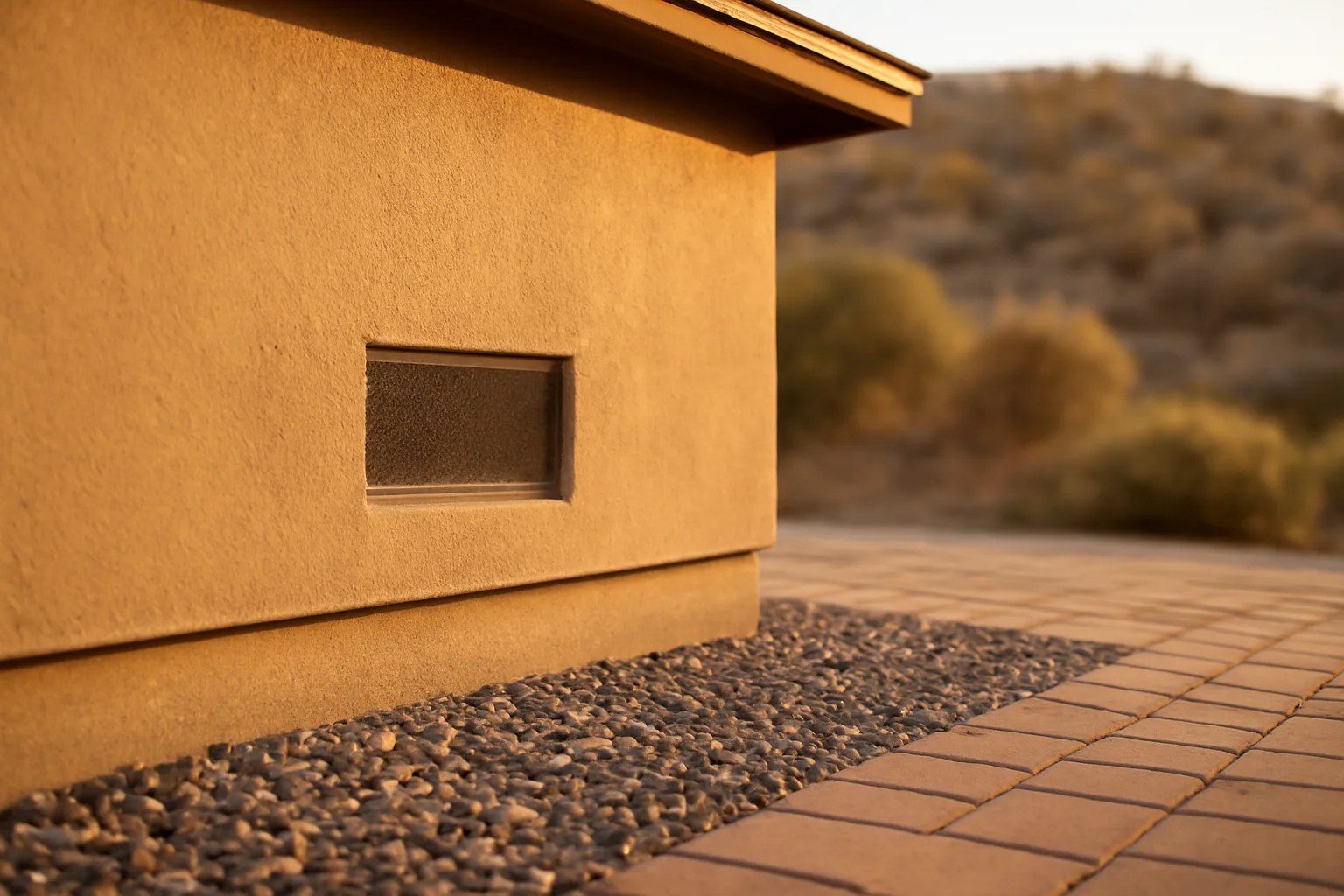
If you only have budget for one season, work in this order: roof, vents, gutters, the 0-5 foot zone, then windows and siding. This isn't arbitrary. It matches where CAL FIRE's Wildfire Mitigation Program and IBHS testing show embers actually get in. Roof and gutters. Class A fire-rated roofing (asphalt shingle, metal, tile) is the baseline most fire-safe building codes now require in wildfire hazard zones. Clean gutters twice a year in fire season; a gutter full of dry pine needles is a ready-made ember catcher sitting right below your roofline. Vents. Open attic, crawlspace, and eave vents are one of the top three home ignition points documented in post-fire damage assessments. Retrofit with 1/8-inch corrosion-resistant metal mesh, or better, use ember- and flame-resistant vents built to the emerging test standard. The 0-5 foot zone (Zone 0). Nothing combustible touching the house: no mulch, no wood fencing attached to the structure, no shrubs against siding. Gravel, pavers, or bare mineral soil only. California is moving to make this a legal requirement, covered below. Windows and siding. Dual-pane windows with tempered glass on at least one pane resist cracking under radiant heat far better than single-pane. Seal gaps where siding meets the foundation or trim; even a quarter-inch gap can catch an ember. For a full room-by-room and material-by-material checklist, see fire safe landscaping California next to house and defensible for the broader zone system.
when does the California defensible space law go into effect?
California's core defensible space law, Public Resources Code 4291, has been in effect since 2005 and currently requires 100 feet of defensible space (or to the property line) around homes in State Responsibility Areas and designated Very High Fire Hazard Severity Zones [1]. That part isn't new and isn't changing dates. What is new is the "Zone 0" ember-resistant zone, the 0-5 foot ring immediately around structures. The California Board of Forestry and Fire Protection was directed under SB 63 (2020) and later legislation to develop specific Zone 0 regulations, and CAL FIRE has stated the intent is for these rules to take effect for affected structures starting around 2026, phased in for high-risk areas first [2]. As of this writing, the regulation package has moved through public comment and board hearings but the final adopted text and enforcement date can still shift, so check your local fire district and CAL FIRE's regulation page before you assume a hard deadline. Bottom line: the 100-foot defensible space requirement is already law and enforced today. The stricter 5-foot ember-resistant zone is the piece landing in 2026, and it will likely apply first to homes in the highest-hazard mapped zones.
what fire-safe home rules take effect in 2026?
The headline 2026 change in California is the Zone 0 ember-resistant zone regulation described above, moving from guidance to enforceable rule for many parcels in Very High Fire Hazard Severity Zones [2]. Expect it to require noncombustible ground cover, removal of attached wood fencing within 5 feet, and clearance of overhanging vegetation directly against the structure. Outside California, rules vary by state and even by fire district, so treat any specific date as a local question, not a national one. Oregon's statewide wildfire risk map and defensible space code framework (under SB 762, 2021) has gone through its own revision cycles after early map versions drew public pushback; Colorado and Arizona largely handle this through county and local fire-district codes rather than one statewide mandate. Guided fill-in: check your county or fire protection district's current defensible space ordinance and building code amendments before budgeting for 2026 compliance, since requirements and enforcement timelines differ by jurisdiction. Your local CAL FIRE unit, county fire marshal, or state fire marshal's office is the fastest way to get the current, binding answer for your address.
why won't people follow the defensible space law in California?
Cost, confusion, and inconsistent enforcement are the three biggest reasons, and none of them are really about people not caring whether their house burns down. Cost is real. Removing mature trees, regrading slopes, replacing wood fencing with metal, and hauling brush isn't cheap, and CAL FIRE inspections don't come with a contractor referral or a subsidy attached in most areas. For a homeowner on a fixed income, a $5,000-$15,000 defensible space job competes with a mortgage payment. Confusion is also real. PRC 4291 sets a statewide baseline, but local fire districts can add stricter requirements, and homeowners often don't know which rules apply to their specific parcel, or that the 100-foot rule doesn't require clear-cutting, just thinning and spacing [1]. Some homeowners assume compliance means bulldozing every tree, so they avoid the whole project out of fear it'll be worse (and uglier) than it actually needs to be. Enforcement is uneven. CAL FIRE and local fire agencies do inspections and can issue violation notices, but staffing and inspection frequency vary a lot by county, and there's rarely a foreclosure-style consequence for ignoring a notice quickly. That said, insurers increasingly are the real enforcement mechanism now: a failed inspection letter often triggers a non-renewal notice long before any government fine does.
how to prevent wildfires
You can't prevent every wildfire, since lightning and geology guarantee some fires will always start, but human-caused ignitions are the majority in most western states, and those are preventable with basic discipline. Roughly 85% of wildfires nationally are human-caused, according to National Interagency Fire Center data cited by the U.S. Forest Service and Ready.gov [3]. The practical prevention list: don't burn debris on windy or red-flag days, keep trailer chains from dragging on pavement (a classic spark source), maintain vehicle mufflers and catalytic converters, don't park hot vehicles on dry grass, extinguish campfires completely (drown, stir, drown again), and check local burn-ban status before any outdoor fire. Power line contact with dry vegetation and utility equipment failure have also caused some of the largest and most destructive fires in California history, which is part of why utility-driven Public Safety Power Shutoffs now happen during extreme fire weather. At the neighborhood level, coordinated defensible space matters more than any single home's effort, because embers don't respect property lines. See only you can prevent wildfires for the full behavioral and community-level picture.
how to prevent forest fires and how to avoid forest fires
Forest fire prevention is mostly about ignition control and fuel management, and the two questions ("prevent" and "avoid") really point to the same set of actions from different angles: stopping fires from starting, and keeping yourself and your property out of harm's way when one does. On ignition control: follow local fire restrictions strictly (they change by season and by year), never leave a campfire unattended, use spark arrestors on chainsaws and off-road vehicles, and report unattended fires or suspicious smoke immediately by calling 911 rather than assuming someone else will. On fuel management, which is the longer-game answer: the U.S. Forest Service and CAL FIRE both run prescribed burn and fuel reduction programs designed to remove the dense undergrowth that turns a manageable fire into a catastrophic one. Homeowners near forested land can support this by thinning their own parcel, maintaining defensible space, and not blocking prescribed burn or fuel-break projects proposed by local fire agencies, which are a genuinely effective (if politically touchy) prevention tool. If you live at the edge of forested land, the honest advice is: your individual prevention effort matters less than the collective fuel load in the surrounding wildland, so support local fuel management projects even when they're inconvenient (smoke, road closures, cost).
how to prepare for a wildfire and how to prepare for forest fires
Wildfire preparation has two tracks: preparing your home (hardening and defensible space, covered above) and preparing your household (evacuation plan, go-bag, documentation). Both matter, and most people only do one. Ready.gov's wildfire preparedness guidance recommends assembling an emergency kit with at least a 3-day supply of food and water per person, a battery or hand-crank radio, copies of important documents, and a family communication plan agreed on before an evacuation order, not during one. Specific to wildfire, also do this: know two evacuation routes out of your neighborhood (more than one), sign up for your county's emergency alert system, keep your gas tank at least half full during fire season, and take video walkthroughs of your home's interior and exterior every 6-12 months for insurance documentation. That last one is boring and easy to skip, and it's exactly the thing that saves people weeks of pain if they ever do have to rebuild a claim from memory. This is also where a pre-built kit earns its cost instead of sitting in a drawer. Our $99 one-time Wildfire Insurance Survival Kit bundles a documentation checklist, defensible space photo log template, and inspection-letter response guide, so you're not building all of this from scratch the week after a non-renewal notice shows up. It won't file a claim or talk to your insurer for you (we don't do that, and you shouldn't trust anyone who promises they can guarantee reinstatement), but it gets your paperwork in the shape insurers actually want to see.
is Santa Barbara safe from fire?
No coastal California community, including Santa Barbara, is "safe" from fire risk, and Santa Barbara County has a documented history of major wildfires, including the 2017 Thomas Fire (at the time the largest wildfire in modern California history by acreage) and the 1990 Painted Cave Fire, which destroyed over 400 structures in a matter of hours [4]. CAL FIRE's Fire Hazard Severity Zone maps classify large portions of the hillside and foothill areas around Santa Barbara, Montecito, and Goleta as Very High Fire Hazard Severity Zones, which is CAL FIRE's highest risk tier and triggers the strictest defensible space and building code requirements [5]. Coastal fog and marine layer do reduce fire risk somewhat in immediate beachfront areas, but that protection drops off fast as you move inland or up in elevation, and Santa Barbara's terrain (steep canyons, dense chaparral, seasonal Santa Ana/sundowner winds) is close to a textbook setup for fast-moving fire. If you own property anywhere in the Santa Barbara foothills or similar terrain (steep slope, chaparral fuel, wind exposure), check your parcel's specific Fire Hazard Severity Zone designation on CAL FIRE's map rather than relying on general reputation or how the coastline looks from the beach.
how can we prevent forest fires at the community level?
Community-level prevention works better than individual effort alone, because a single hardened home surrounded by unmanaged fuel is still at serious risk from radiant heat and ember cast off neighboring properties. The National Fire Protection Association's Firewise USA program, recognized by CAL FIRE and most state fire marshals, organizes neighborhoods to do coordinated defensible space work, shared chipper days, and joint risk assessments, and NFPA reports thousands of recognized Firewise sites across the country as of recent program data [6]. Coordinated action also matters for insurance: some carriers and state programs (including California's FAIR Plan discount framework tied to the Safer from Wildfires regulation) give credit for community-level mitigation certifications, more than individual home upgrades [7]. Practical community steps: organize a joint chipper day so brush removal isn't a solo cost, push your HOA or neighborhood association to adopt a shared defensible space standard, support your local fire district's fuel break and prescribed burn projects even when they cause short-term smoke or road closures, and share your Fire Hazard Severity Zone status with neighbors so nobody is guessing at their risk tier.
what should you document before or after an insurance non-renewal letter?
If you've received a non-renewal or inspection letter, document your mitigation work before you respond, because insurers and state programs generally want dated, photographic proof, more than a claim that you did the work. Photograph the 0-5 foot zone from all four sides of the house, the roof and gutters, vent screens, and any cleared vegetation, with a timestamp or dated metadata. Keep receipts for any contractor work (tree removal, gutter guards, vent retrofits) since some state FAIR Plan and admitted-market mitigation credit programs require proof of professional installation, more than a homeowner's word [7]. Request a copy of the specific inspection checklist your fire district or insurer used, since compliance standards vary by jurisdiction and by carrier, and knowing exactly what they scored you against is the only way to fix the actual deficiency rather than guessing. To be clear: this kind of documentation work is not insurance or legal advice, and we don't file claims, talk to insurers on your behalf, or promise any discount or reinstatement outcome. What you're doing is building the paper trail that you, or an attorney or public adjuster you separately hire, would need to make your own case. For the broader defensible space zone breakdown that most inspection checklists are based on, see defensible.
Frequently asked questions
When does the California defensible space law go into effect?
The core 100-foot defensible space law (Public Resources Code 4291) has been in effect since 2005. The new Zone 0 ember-resistant 5-foot rule is expected to take effect around 2026 for homes in Very High Fire Hazard Severity Zones, though the final adopted regulation and exact enforcement date can still shift, so verify with CAL FIRE or your local fire district.
Why won't people follow the defensible space law in California?
Mainly cost, confusion over which local rules apply, and inconsistent enforcement. Clearing brush and hardening a home can run $5,000-$15,000 or more, many homeowners don't realize compliance doesn't mean clear-cutting every tree, and government penalties for noncompliance are rarer than people assume, though insurance non-renewal has become the real enforcement mechanism.
How to prevent wildfires from starting in the first place?
Avoid outdoor burning on windy or red-flag days, fully extinguish campfires, keep trailer chains off pavement, maintain vehicle mufflers, and never park a hot vehicle on dry grass. Roughly 85% of U.S. wildfires are human-caused according to National Interagency Fire Center data cited by the U.S. Forest Service, so basic ignition discipline prevents most fires.
What's the single most effective thing a homeowner can do to prepare for a wildfire?
Build defensible space and harden ignition points (vents, gutters, the 0-5 foot zone) before fire season, then separately prepare an evacuation plan and go-bag under Ready.gov guidance. Most home losses trace back to embers entering through vents or igniting debris near the foundation, not direct flame contact.
How do I prepare for a forest fire if I live near wildland?
Maintain defensible space to at least 100 feet where required, know two evacuation routes, keep your gas tank half full during fire season, sign up for county emergency alerts, and support local fuel-reduction and prescribed burn projects, since individual home prep matters less when surrounding fuel loads are unmanaged.
Is Santa Barbara safe from wildfire risk?
No. Santa Barbara County has seen major fires including the 2017 Thomas Fire and the 1990 Painted Cave Fire, and CAL FIRE maps classify much of the surrounding foothill terrain as Very High Fire Hazard Severity Zone. Coastal fog reduces risk near the beach but not inland or upslope.
What fire-safe home rules take effect in 2026 in California?
The main change is CAL FIRE's Zone 0 ember-resistant zone rule, requiring noncombustible material in the 0-5 foot ring around structures in Very High Fire Hazard Severity Zones. The exact final text and rollout date were still moving through regulatory review as of this writing, so check CAL FIRE's site for the current status.
Can a home actually be made fireproof?
No. Nothing is truly fireproof against sustained wildfire exposure. What's achievable is ignition resistance: sealing ember entry points (vents, gutters, roof gaps) and clearing combustibles from the 0-5 foot zone, which is where CAL FIRE and IBHS research shows most home ignitions actually start.
What is the difference between defensible space and home hardening?
Defensible space is vegetation management around the property, typically required out to 100 feet in California's SRA and VHFHSZ areas. Home hardening is upgrading the structure itself (roof, vents, siding, windows) to resist embers and radiant heat. You need both; one without the other leaves a real gap.
Does clearing defensible space guarantee my insurance won't be cancelled?
No. Defensible space and hardening reduce risk and can support your case in an appeal or reinspection, but no contractor, checklist, or kit can guarantee coverage, a discount, or reinstatement. Insurers weigh their own underwriting criteria, and outcomes vary by carrier and by state program.
How much does it cost to harden a home against wildfire?
Costs vary widely by home size and existing condition. Vent retrofits and gutter guards often run a few hundred to a few thousand dollars; full defensible space clearing and Class A roofing can run into the tens of thousands. There's no single fixed number, so get a local written estimate rather than relying on a national average.
How often should I document my home's defensible space for insurance purposes?
Every 6-12 months, and again immediately after any major mitigation work. Photograph all four sides of the structure, the roof, gutters, vents, and the 0-5 foot zone with dated images, and keep contractor receipts, since some mitigation credit programs require proof of professional installation.
Sources
- California Public Resources Code Section 4291: California requires 100 feet of defensible space (or to the property line) around structures in State Responsibility Areas and Very High Fire Hazard Severity Zones
- California Board of Forestry and Fire Protection, Zone 0 Ember-Resistant Zone Rulemaking: California is developing a Zone 0 ember-resistant zone regulation for the 0-5 foot area around structures, with an anticipated 2026 timeline for affected zones
- USDA Forest Service, Wildfire Causes and Evaluations: The majority of U.S. wildfires are human-caused rather than started by lightning or other natural sources
- CAL FIRE, Thomas Fire Incident Information: The 2017 Thomas Fire in Santa Barbara and Ventura counties was, at the time, the largest wildfire in modern California history by acreage
- CAL FIRE, Fire Hazard Severity Zone Maps: CAL FIRE and the Office of the State Fire Marshal classify hillside and foothill terrain in and around Santa Barbara as Very High Fire Hazard Severity Zone
- National Fire Protection Association, Firewise USA Program: Firewise USA organizes neighborhood-level defensible space and risk reduction efforts recognized by state fire agencies
- California Department of Insurance, Safer from Wildfires Regulation: California's Safer from Wildfires regulation ties insurance discount credit to documented individual and community wildfire mitigation actions