Last updated 2026-07-25
TL;DR
Wind-blown embers, not the flame front itself, ignite most homes lost in wildfires. They can travel over a mile ahead of a fire and find gaps in vents, roofs, gutters, and mulch beds. Closing those entry points (ember-resistant vents, metal mesh, noncombustible zone 0) does more to save your house than clearing brush alone.
how do embers actually start home fires?
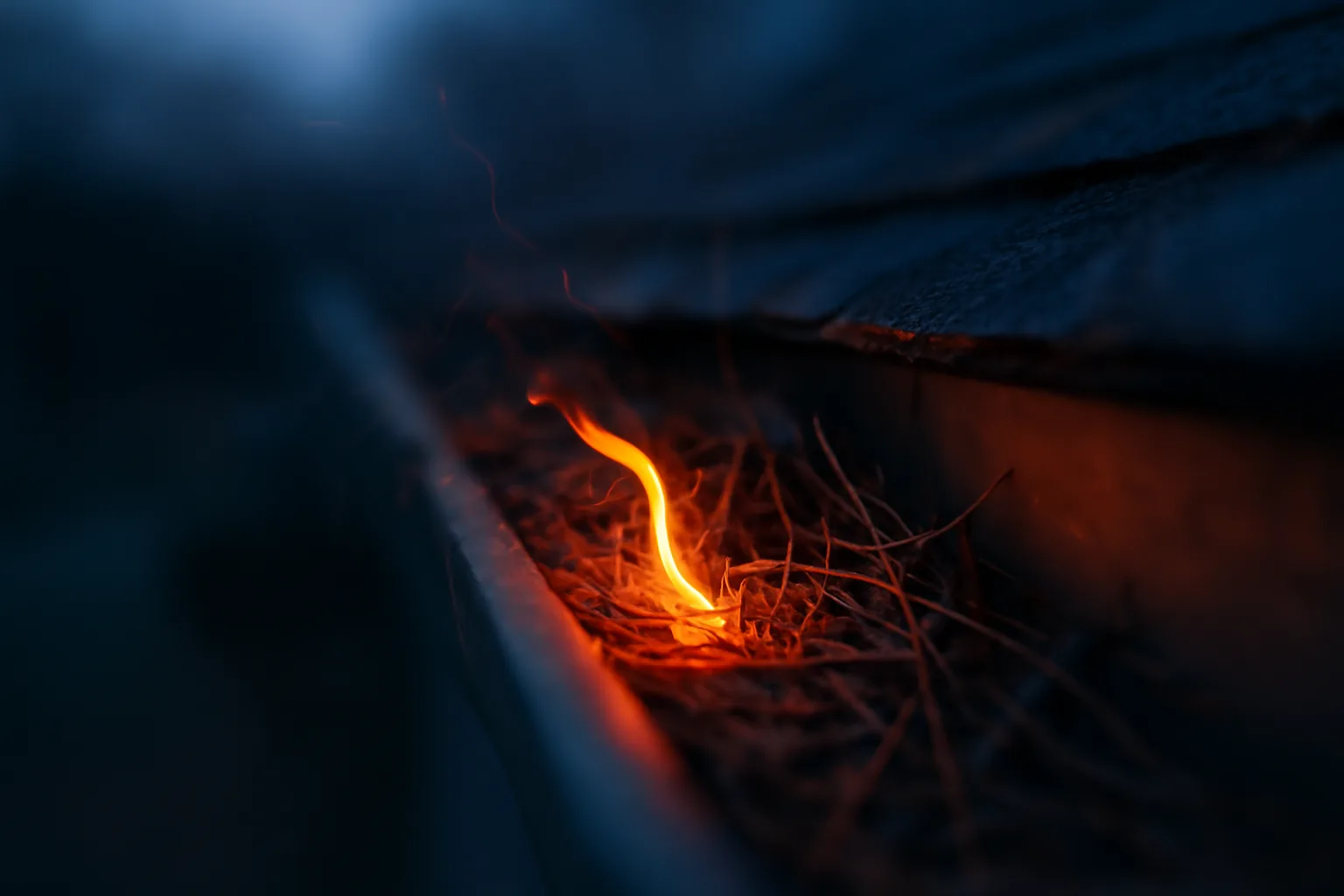
Embers are the burning bits of bark, leaves, and wood that break off a wildfire and get carried by wind, sometimes a mile or more ahead of the actual flame front. They land on or near a house, find something that will catch (dry pine needles in a gutter, a wood pile against the siding, mulch touching the foundation), and start a small fire that grows. This is the mechanism insurance adjusters and fire scientists actually worry about, more than the wall of flame you see in news footage. The Insurance Institute for Business & Home Safety (IBHS) has documented that embers and small flames are the primary way homes ignite during wildfires, not radiant heat from a distant fire front. That distinction matters because it changes what you should spend money on. You don't need a moat. You need to deny embers a place to land and something to eat once they do. CAL FIRE's own guidance is blunt about it: "Embers from a wildfire can travel more than a mile and ignite a home". That's the sentence that should reframe how you think about defensible space. It's more than about the trees near your house. It's about every gap, vent, and pile of dead leaves that could catch a spark blown in from somewhere you can't even see.
how to prevent wildfires from starting near your home
You can't stop lightning strikes or arson, but a large share of wildfires are human-caused, and simple habits cut risk. Debris burning, equipment sparks, unattended campfires, and dragging trailer chains are common ignition sources that CAL FIRE and the U.S. Forest Service both flag as preventable [1]. A few things that actually move the needle: never burn yard debris on windy or red-flag days, keep mower and trimmer use to early morning when it's cooler and less windy, make sure trailer chains don't drag on pavement, and douse campfires cold (stir, soak, stir again) before you leave them. Ready.gov's wildfire prep page recommends checking local burn restrictions before doing any outdoor burning and keeping a hose or extinguisher on hand whenever you're doing yard work that could spark. None of this is complicated. It's just habits that people skip when they're in a hurry, and those are the moments fires start.
how to prepare for a wildfire before it's on the horizon
Preparing for a wildfire really has three layers: the structure itself, the zone immediately around it, and your evacuation plan. Most homeowners jump straight to worrying about the flame front and skip the part that actually determines survival, ember-proofing the first five feet. CAL FIRE's defensible space model breaks your property into zones: Zone 0 (0-5 feet from structures), Zone 1 (5-30 feet), and Zone 2 (30-100 feet). Zone 0 is the newest and strictest requirement, because it's the zone where embers land and start house fires directly. Nothing combustible belongs there: no bark mulch, no wood fencing attached to the house, no stored firewood. Beyond the property, Ready.gov recommends a written evacuation plan with two routes out of your neighborhood, a family communication plan, and a go-bag ready before fire season even starts. If you've gotten a non-renewal or inspection letter, this is also the moment to start your own documentation trail: dated photos of your roof, vents, gutters, and defensible space zones, because you may need to show an insurer (or a new one) what you've actually done, more than what you plan to do. For a structured way to build that record, see the wildfire insurance survival kit, a $99 one-time tool for organizing before/after photos and mitigation proof for adjusters and new carriers. It doesn't file claims or handle your coverage discussions for you; it just gets your paperwork in order.
how to prevent forest fires when you're recreating or working outdoors
Most forest fires start from things people do outdoors, not lightning. The U.S. Forest Service and CAL FIRE both point to unattended or improperly extinguished campfires, sparks from equipment (chainsaws, mowers, grinders), and vehicles parked on dry grass as leading causes [1]. Simple rules cut this risk a lot: check local fire restrictions before any campfire or debris burn, never leave a fire unattended even for a few minutes, and keep vehicles off dry grass where a hot exhaust or catalytic converter can ignite it. If you're doing chainsaw or grinding work, keep water or an extinguisher within reach and avoid it entirely on red-flag warning days. None of this is exotic advice. It's the boring stuff that actually prevents most human-caused ignitions, according to fire agencies that track cause data every year [1].
how to avoid forest fires around your property and community
Avoiding forest fires at the community level comes down to reducing fuel and reducing ignition sources at the same time. That means coordinated brush clearing along shared property lines, keeping roadside vegetation cut back so sparks from vehicles or brakes don't catch dry grass, and following local burn permit rules instead of assuming your neighborhood is exempt. If you're in a wildland-urban interface community, check whether your fire district runs a chipper day or a defensible space cost-share program; many California counties do, though availability and rules vary by district. This is one of those areas where a quick call to your local fire department or county fire safe council saves you money and tells you exactly what's required in your specific zone, because requirements differ by jurisdiction even within the same state. For structures near shared fences or wildland edges, see fire safe landscaping next to your house for plant spacing and species guidance that reduces the chance a neighbor's yard fire becomes yours.
when does the California defensible space law go into effect?
California's Zone 0 (ember-resistant zone, 0-5 feet from structures) requirement was created by Assembly Bill 3074 (2020), which directed the Board of Forestry and Fire Protection to develop regulations for an ember-resistant zone around homes [2]. As of early 2025, the Board had not yet finalized and adopted the Zone 0 regulations; the requirement exists in statute, but the specific enforceable rules were still moving through the regulatory process [2] [3]. This is genuinely confusing for homeowners, and understandably so. The underlying defensible space requirement (100 feet of clearance in State Responsibility Areas, per Public Resources Code 4291) has been law for years and is enforced now [4]. Zone 0 is the newer, stricter layer specifically targeting ember ignition in the space immediately touching your house, and its formal regulatory timeline has shifted more than once. Because dates and enforcement mechanisms can change and vary by county and fire district, don't rely on a single article (including this one) for your compliance deadline. Check directly with CAL FIRE's defensible space program page and your local fire authority for the current status in your area [3]. If you've received an inspection letter citing specific code sections, that letter is your most authoritative source, more current than any general guidance.
what fire-safe home rules take effect in 2026?
There's no single nationwide "2026 fire-safe home" law, and coverage of this topic varies by state, so treat any specific date claim with caution unless it's tied to your county or fire district. What's true broadly: California's Zone 0 ember-resistant zone regulations, authorized under AB 3074, have been in an extended rulemaking process, and various proposed effective dates have circulated without a final locked-in statewide date as of the most recent Board of Forestry updates [2] [3]. Rather than anchor to a date that may shift again, do this instead: [_____ guided fill-in: check your county fire marshal's website or call your local fire district directly and ask, "Has Zone 0 been adopted here, and what's my compliance deadline?" _____]. Requirements and enforcement timelines differ across California counties, and other wildfire states (Colorado, Oregon, Arizona) have their own separate codes and adoption schedules that don't automatically mirror California's. If your insurer's non-renewal or inspection letter cites a specific rule or deadline, treat that letter as the operative document for your property, not a general article.
why won't people follow the defensible space law in California?
This is worth being honest about, because it's not usually about ignorance. Cost, labor, and clarity are the three real barriers. Clearing 100 feet of defensible space on a sloped, wooded acre can run into thousands of dollars in contractor fees, and many rural or fixed-income homeowners simply don't have that available, especially if it needs to happen again next year as vegetation regrows. There's also a real confusion problem: Zone 0 rules have shifted in the regulatory process [2] [3], county enforcement varies, and some homeowners genuinely don't know what's required until they get a letter. Others don't believe enforcement is real, because historically, defensible space violations weren't cited or fined consistently in every county, though that's changed in high-risk areas as insurers have pushed harder on documentation. And some people just prioritize aesthetics or shade over compliance, not maliciously, just because a fire that might happen someday feels less real than the oak tree they love right now. None of these are unreasonable human responses. They're just the reasons the law, on paper, and defensible space, in practice, don't always match up. If cost is the blocker, ask your fire district about chipper programs or cost-share grants before assuming full-price contractor clearing is your only option.
is Santa Barbara safe from fire?
No area in California's wildland-urban interface is "safe" from fire risk, and Santa Barbara County has direct experience with this: the 2017 Thomas Fire burned over 281,000 acres and was, at the time, the largest wildfire in modern California history, followed by the deadly Montecito debris flow in January 2018 [5]. The county sits against steep, chaparral-covered mountains with a history of Santa Ana wind events, which is exactly the terrain and weather combination that drives fast-moving, ember-heavy fires. That said, "high risk" doesn't mean every property is equally exposed. Risk depends heavily on your specific parcel: distance from wildland vegetation, slope, prevailing wind exposure, roof and vent materials, and how well your Zone 0 and defensible space are maintained. Two houses a quarter mile apart in the Santa Barbara foothills can have very different real risk profiles based on those factors alone. If you're evaluating a property in Santa Barbara or similar terrain (Malibu, the East Bay hills, Boulder foothills), check CAL FIRE's Fire Hazard Severity Zone viewer for your specific parcel rather than relying on the county's overall reputation [6]. A "Very High" zone designation on your specific lot matters more for insurance underwriting than the county's general history.
how can we prevent forest fires as a community, more than a household?
Individual defensible space work matters less if your neighbor's overgrown lot sits 20 feet from your fence line. Embers and fire don't respect property boundaries, which is why fire-adapted communities work at the neighborhood level, more than the parcel level. Things that actually help at scale: shared chipper days (many California fire safe councils run these seasonally), coordinated brush clearance along shared boundaries and roads, community chipping or biomass programs that make Zone 1/Zone 2 clearance cheaper because costs get split, and neighborhood-level evacuation planning so everyone isn't improvising a route on the worst day of the year. Firewise USA, a National Fire Protection Association program, recognizes communities that organize this kind of coordinated mitigation, and being part of a recognized Firewise community can sometimes factor into insurance underwriting discussions, though it's not a guarantee of coverage or pricing [7]. Check with your HOA or county fire safe council about whether a Firewise designation exists or is feasible in your neighborhood. For a broader look at what "defensible" actually means at the property and neighborhood level, see defensible space fundamentals.
which parts of a house are most vulnerable to ember ignition?
| Open attic/foundation vents | Embers blow directly into enclosed combustible space | 1/8-inch metal mesh or ember-resistant vents | $150-$600 per vent, varies by size/count | |
|---|---|---|---|---|
| Gutters full of debris | Dry leaves/needles ignite easily, sit against roofline | Gutter guards + seasonal cleaning | $10-$25/linear ft installed | |
| Wood decking, especially underneath | Embers collect in gaps, ignite deck framing | Noncombustible decking or fine mesh skirting | Varies widely by deck size | |
| Zone 0 (0-5 ft) mulch/plants | Direct fuel touching siding/foundation | Replace with gravel, pavers, or bare mineral soil | Often DIY-feasible; low cost | |
| Wood fencing attached to house | Fence acts as a fuse straight to the structure | Noncombustible fence section nearest house | Varies by fencing type | Cost ranges above are general estimates and vary by region, contractor, and material choice; get local quotes rather than budgeting off this table alone. For roofing and vent specifics by state, see defensible space clearing contracts for how other states structure this work, and what happens during a house fire for how these ignition points play out in real incidents. |
Not all parts of a house are equally exposed. IBHS research and CAL FIRE both point to the same weak points repeatedly: vents (attic, foundation, crawlspace), roof valleys and gutters where debris collects, decks and the gap underneath them, and anywhere combustible material touches the structure directly (wood fencing, mulch beds, stored firewood). Here's a rough comparison of vulnerability and typical fix cost, useful for prioritizing when budget is tight: | Vulnerable area | Why embers ignite it | Typical mitigation | Rough cost range |
what should you do first if you got a non-renewal or inspection letter?
Read the letter closely for the specific code section or requirement cited; it's usually more precise than general defensible space guidance and tells you exactly what the inspector or insurer flagged. Then walk your property with that checklist in hand, not a generic one. Document everything with dated photos, before you touch anything and after you fix it. This matters more than people expect: insurers and adjusters want to see proof of completed mitigation, more than a promise that you'll get to it. A dated photo of a cleared Zone 0, a receipt for ember-resistant vent screens, a contractor invoice for defensible space clearing, these are the things that make your case concrete when you're trying to keep or regain coverage. This is exactly the gap the Wildfire Insurance Survival Kit is built for: a $99 one-time tool that helps you organize before/after mitigation photos, receipts, and documentation into something an adjuster or new carrier can actually review quickly. It doesn't file claims on your behalf or promise reinstatement or a discount; you still send your own documentation and make your own case. It just makes sure that case is organized instead of scattered across your phone's camera roll. See also what to do after a house fire and why prevention still starts with you for the broader mindset behind this kind of prep.
Frequently asked questions
When does the California defensible space law go into effect?
The base 100-foot defensible space requirement (Public Resources Code 4291) has been enforced for years. The newer Zone 0 ember-resistant zone rule, created by AB 3074, was still in the regulatory adoption process as of the most recent Board of Forestry updates, without one final locked-in statewide effective date. Check CAL FIRE's defensible space page and your county fire authority for current status.
Why won't people follow the defensible space law in California?
Mostly cost, labor, and confusion, not ignorance. Clearing 100 feet on a wooded parcel can cost thousands and needs redoing yearly. Zone 0 rules have shifted during rulemaking, enforcement varies by county, and some homeowners simply don't know the current requirement until an inspection letter arrives.
How to prevent wildfires from starting near my property?
Avoid outdoor burning on windy or red-flag days, keep mowing and trimming to cool mornings, don't let trailer chains drag on pavement, and fully douse campfires (stir, soak, stir again) before leaving. Most wildfires are human-caused, and these habits address the most common ignition sources CAL FIRE and the U.S. Forest Service track.
How do I prepare for a wildfire if I live in a high-risk zone?
Build defensible space in Zones 0, 1, and 2 around your home, keep an evacuation plan with two routes out, pack a go-bag before fire season starts, and photograph your mitigation work for insurance documentation. Ready.gov's wildfire page has a full household checklist.
How can we prevent forest fires as a community?
Coordinate brush clearing across shared property lines, run neighborhood chipper days, and consider Firewise USA recognition through the National Fire Protection Association, which formalizes community-level mitigation. Individual defensible space work is limited in value if neighboring parcels stay overgrown, since embers and fire cross property lines freely.
How do embers travel and why are they more dangerous than flames?
Wind carries embers over a mile ahead of a wildfire's flame front, according to CAL FIRE. They land on roofs, in gutters, and near foundations, igniting homes directly without the main fire ever arriving. IBHS research identifies embers and small flames, not radiant heat, as the primary way homes ignite in wildfires.
Is Santa Barbara safe from wildfire?
No, Santa Barbara County has significant wildfire exposure, evidenced by the 2017 Thomas Fire (over 281,000 acres) and the subsequent Montecito debris flow. Risk varies a lot by specific parcel though; check CAL FIRE's Fire Hazard Severity Zone viewer for your exact address rather than judging by the county's general reputation.
What fire-safe home rules take effect in 2026?
There's no single confirmed nationwide 2026 rule. California's Zone 0 ember-resistant regulations under AB 3074 have moved through an extended rulemaking process without one final locked-in date as of recent updates. Check your county fire marshal or fire district directly, since adoption and enforcement timelines vary by jurisdiction.
What part of my house is most likely to catch fire from embers?
Open attic and foundation vents, debris-filled gutters, the underside of wood decks, and anything combustible touching the house directly (mulch, firewood, wood fencing) are the most common ignition points, per IBHS and CAL FIRE research. Ember-resistant vent mesh and a cleared, noncombustible Zone 0 address most of this risk.
How much does defensible space clearing typically cost?
Costs vary widely by parcel size, slope, and vegetation density; a wooded acre needing full 100-foot clearance can run into the thousands with a contractor. Smaller Zone 0 fixes (removing mulch, adding gravel) are often low-cost or DIY. Check with your fire safe council about chipper days or cost-share programs before assuming full contractor pricing is your only option.
Does clearing brush actually stop embers from igniting my house?
Brush clearing (Zones 1 and 2) reduces fuel that helps fire spread toward your home, but it doesn't stop embers landing directly on your roof or in your vents. That's why Zone 0 (0-5 feet, ember-resistant) and vent/roof hardening matter separately from broader defensible space clearing.
Can I still get insurance if I haven't finished defensible space work?
Possibly, depending on your insurer and state programs (like California's FAIR Plan), but documented mitigation generally strengthens your case. Photograph and date your progress as you go rather than waiting until everything is finished, since insurers often want evidence of completed work, not plans.
Sources
- USDA Forest Service, Wildfire Prevention: Human-caused ignition sources including debris burning, equipment sparks, and unattended campfires
- California Legislature, Assembly Bill No. 3074 (2019-2020): AB 3074 directed the Board of Forestry and Fire Protection to develop ember-resistant Zone 0 regulations
- California Board of Forestry and Fire Protection, Zone 0 Rulemaking: Zone 0 ember-resistant zone regulations status and rulemaking timeline
- California Public Resources Code Section 4291: 100 feet of defensible space clearance required around structures in State Responsibility Areas
- CAL FIRE, Thomas Fire Incident Archive: The 2017 Thomas Fire burned over 281,000 acres in Ventura and Santa Barbara counties
- CAL FIRE, Fire Hazard Severity Zones Viewer: Fire Hazard Severity Zone designations vary by specific parcel, used for insurance and building code purposes
- National Fire Protection Association, Firewise USA: Firewise USA recognizes communities for coordinated wildfire mitigation efforts