Last updated 2026-07-25
TL;DR
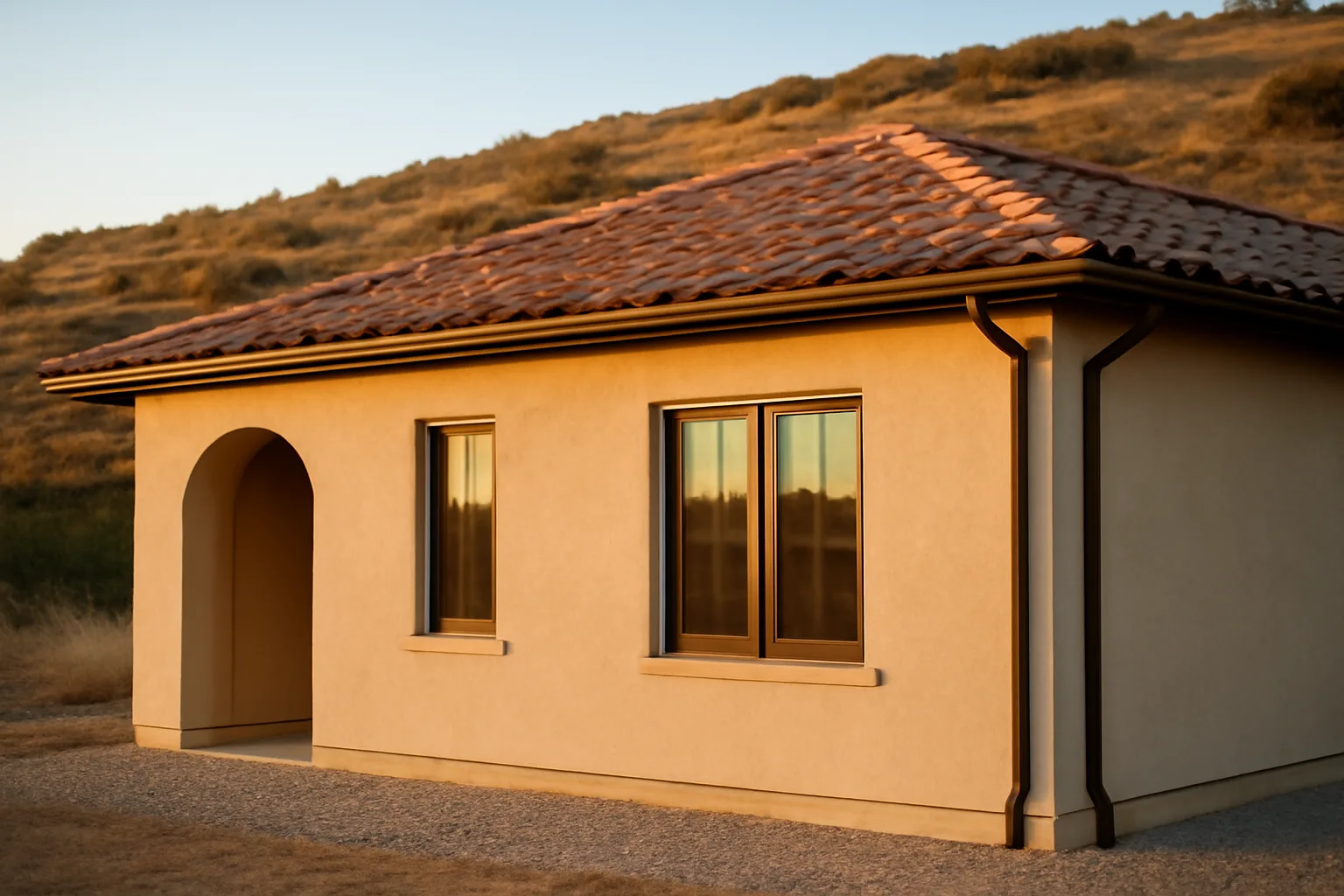
Fire resistant materials are roofing, siding, decking, and window products rated to resist ignition from embers and radiant heat, things like Class A asphalt shingles, fiber-cement siding, tempered dual-pane glass, and metal or ignition-resistant deck boards. None of these make a house fireproof. They buy time and cut the odds embers catch on your structure, which is how most homes actually burn in wildfires [1].
What does "fire resistant" actually mean for building materials
Fire resistant doesn't mean fireproof. It means a material has been tested and rated for how long it resists ignition or how well it keeps flame from spreading, usually under a standard test like ASTM E84 (flame spread) or the Class A/B/C roofing assembly tests under ASTM E108 or UL 790 [1]. A Class A roof assembly is the highest rating and is required or strongly recommended in most California high fire hazard severity zones. The distinction matters because most homes lost in wildfires don't burn from a wall of flame rolling through. Research from the Insurance Institute for Business & Home Safety (IBHS) and CAL FIRE both point to embers, tiny burning pieces of debris that can travel over a mile ahead of a fire front, landing in gutters, on roofs, in vents, and against siding, as the dominant ignition source for homes in the wildland-urban interface [2]. So "fire resistant" in practice means: does this material ignite when a smoldering ember sits on it for several minutes? Does it melt and create gaps? Does it conduct enough heat to ignite what's behind it? Vinyl siding, for instance, can deform and pull away from a house at surprisingly low temperatures, well below what's needed to ignite wood framing, which then exposes the sheathing to direct flame [2]. For a home-by-home breakdown of where these materials matter most on an actual structure, see defensible.
What are the main fire resistant materials used in home hardening
| Roofing | Class A asphalt shingle, concrete or clay tile, metal roofing | Wood shake, untreated wood shingle | |
|---|---|---|---|
| Siding | Fiber-cement board, stucco, brick, metal panel | Vinyl, untreated wood siding | |
| Windows | Tempered dual-pane glass | Single-pane, non-tempered glass | |
| Decking | Ignition-resistant composite, metal, or fire-retardant-treated wood | Untreated wood decking | |
| Vents | Ember- and flame-resistant vents (1/8 inch mesh, baffled) | Standard open-mesh vents | |
| Gutters | Metal gutters with leaf guards, kept clear | Debris-clogged gutters of any material | CAL FIRE's Wildland-Urban Interface Building Standards, adopted under California Building Code Chapter 7A, spell out ignition-resistant construction requirements for new construction and additions in State Responsibility Areas and designated Very High Fire Hazard Severity Zones [3]. Chapter 7A covers roofing, vents, exterior walls, windows, and decking assemblies specifically because those are the components ember storms exploit. Roofing is usually the highest-leverage fix. A Class A roof, paired with a metal drip edge and gutter guards, closes off one of the biggest ember traps on a house. Vents are the cheapest fix that gets ignored most often: swapping standard attic and foundation vents for ember-resistant versions with 1/8-inch mesh costs relatively little compared to a full re-roof, but it closes a path embers use to get directly into the attic. |
The materials that matter most are the ones on the exterior of the house: roof, vents, siding, windows, decking, and gutters. Here's how the common choices stack up. | Component | Fire resistant option | Common vulnerable alternative |
When does the California defensible space law go into effect
California's expanded defensible space requirements, sometimes called the "ember-resistant zone" or Zone 0 rule, come from Assembly Bill 3074 (2020), which added an area within 5 feet of structures where flammable vegetation and combustible materials must be restricted. The law directed the Board of Forestry and Fire Protection to develop specific regulations for this zone. As of this writing, CAL FIRE and the Board of Forestry have been working through the formal rulemaking process for Zone 0 regulations, and the enforceable start date has shifted more than once. Homeowners should check the current status directly on CAL FIRE's defensible space page rather than relying on any single article, because rulemaking timelines move [4]. The broader defensible space law (100 feet of clearance in two zones, under Public Resources Code 4291) has been in effect and enforced for years already, well before Zone 0 was added [5]. If you got a defensible space inspection notice, don't wait on Zone 0 to take effect before acting. The 30-foot and 100-foot zone requirements are already enforceable in most State Responsibility Areas, and many local fire districts layer their own stricter rules on top. Check with your local fire district for the exact zone boundaries and current enforcement date in your area, since this varies by county and by whether you're in a State Responsibility Area or a Local Responsibility Area with its own ordinance.
What fire safe home rules take effect in 2026
There's a lot of confusion online about a specific "2026 fire safe home" rule. What's actually happening is a patchwork of state and insurer-driven changes converging around that timeframe, not one single federal mandate. Three threads to track: First, California's Zone 0 (ember-resistant zone) regulations are moving through Board of Forestry rulemaking, and various public statements have floated 2025-2026 as target enforcement windows for existing homes in Very High Fire Hazard Severity Zones [4]. Confirm the current status on the Board of Forestry's website or with your local fire marshal before assuming a hard deadline. Second, insurers operating in California are adjusting underwriting under the state's Sustainable Insurance Strategy, which includes new rules (effective 2025 rulemaking, phased in through 2026) intended to let insurers use catastrophe modeling in rate-setting in exchange for writing more policies in high-risk areas, administered by the California Department of Insurance. This is separate from building code, but it's driving a lot of the non-renewal letters homeowners are getting. Third, some jurisdictions in Colorado, Oregon, and Arizona are adopting their own wildfire-hazard building codes on their own timelines, often modeled loosely on California's Chapter 7A but not identical. There is no single national "2026 fire safe home" standard. Check your state fire marshal's office for what actually applies where you live: this varies enough by state and even by county that a general article can't give you a firm date.
Why won't people follow the defensible space law in California
Cost, labor, and trust are the three real reasons, and none of them are irrational. Clearing 100 feet of defensible space around a home on sloped, brushy terrain isn't a weekend project; for larger or heavily wooded lots it can mean hiring a crew, renting chippers, and disposing of tons of vegetation, which can run from a few hundred dollars for a small lot to several thousand for an acre of dense brush. There's also a genuine disagreement in some communities about whether clearing actually helps, especially among residents who've seen homes with good defensible space burn anyway during extreme wind-driven fires. CAL FIRE's own position is nuanced here: defensible space and hardened construction change the odds, they don't guarantee survival in every fire, and CAL FIRE explicitly states defensible space work is about giving firefighters a safer place to defend a home and slowing fire spread, not creating a guarantee. Enforcement is also uneven. Inspections happen on a schedule set by local fire districts and CAL FIRE units, and in many rural State Responsibility Areas there simply aren't enough inspectors to check every parcel every year. Homeowners who've never been inspected sometimes conclude, incorrectly, that the law doesn't really apply to them. Finally, there's a real fairness complaint from renters and lower-income owners: defensible space rules assume you own the land, have the money for a chipper rental or contractor, and have the physical ability to do the labor yourself. None of those are guaranteed. If you're weighing a DIY clearing approach against hiring it out, wildfire defensible space clearing contracts washington state dnr walks through how contracted clearing programs work in one state, which is a useful comparison point even outside Washington.
How to prepare for a wildfire (and what actually helps)
Preparing for a wildfire has two tracks that both matter: hardening the structure and clearing the vegetation around it, and having an evacuation and documentation plan ready before you need it. Ready.gov's wildfire preparedness guidance recommends building an emergency kit, planning two evacuation routes, and signing up for local emergency alerts before fire season starts. On the structure side, prioritize in this order if you're working with limited time or budget: clear gutters and the 5-foot zone right against the house, install ember-resistant vents, address the roof if it isn't already Class A, then work outward through the 30-foot and 100-foot defensible space zones. For zone-by-zone specifics, fire safe landscaping california next to house covers plant selection and spacing near the structure. On the documentation side, before a fire threatens your area: photograph or video every room and your exterior, save receipts for major purchases and renovations, and store copies of your insurance policy declarations page somewhere other than your house (cloud storage or with a relative). If you've already gotten a non-renewal notice, this documentation matters even more, because you'll likely need to shop for FAIR Plan or surplus lines coverage and provide proof of mitigation work completed. This is also where a prebuilt kit saves time under stress: DefensibleHome's $99 Wildfire Insurance Survival Kit organizes the photo documentation, mitigation records, and insurer-facing paperwork into one place so you're not building it from scratch during an evacuation warning. You still send your own documentation to your insurer; nobody on our end negotiates your claim or promises coverage.
How to prevent wildfires (and forest fires) around your property
Preventing ignition on your own property comes down to eliminating the small stuff: dry grass against a fence, a pile of pine needles in a gutter, an unattended grill on a wood deck during red flag warnings. CAL FIRE's data consistently shows human activity, including debris burning, equipment use, and vehicle-caused sparks, accounts for the large majority of wildfire ignitions in California [6]. Practical prevention steps that apply whether you're worried about a wildfire reaching your neighborhood or a forest fire starting from activity on your own land: - Never burn debris on windy days or during a red flag warning; check local burn day status with your county air district or fire department first.
- Keep mowing and any equipment with a spinning blade off dry grass after 10 a.m. in fire season; a lawnmower blade striking a rock is a documented ignition source.
- Maintain a clear area around any grill, fire pit, or outdoor heater, at least 10 feet from structures and vegetation.
- Store firewood and lumber piles at least 30 feet from the house, not stacked against it.
- Report unattended campfires or suspicious smoke immediately rather than assuming someone else will. None of this replaces defensible space clearing or structure hardening. It's the ignition-prevention layer that sits alongside them. For how these pieces fit into an overall home-hardening plan, see only you can prevent wildfires.
How to prepare for forest fires as opposed to a home wildfire threat
If you're preparing for a forest fire near recreational property, a cabin, or forested land you manage (rather than a suburban wildland-urban interface home), the fundamentals are similar but the scale is different. Forest fire prevention on managed land generally means fuel reduction (thinning dense stands, removing ladder fuels that let ground fire climb into tree canopies), maintaining fire breaks, and coordinating with state forestry agencies on prescribed burn windows. The U.S. Forest Service and state forestry divisions (in California, CAL FIRE; in Colorado, the Colorado State Forest Service; in Oregon, the Oregon Department of Forestry) all publish fuel reduction cost-share programs for private landowners, and terms vary significantly by state and by year's budget, so check directly with your state forestry agency for current cost-share availability rather than assuming a fixed rate. For an isolated cabin, apply the same structure-hardening principles as a suburban home: Class A roof, ember-resistant vents, defensible space clearing, but plan for the fact that fire response times to remote forested parcels are often far longer than in town. That makes structure hardening proportionally more important, since you can't count on a fire crew reaching an isolated structure before an ember storm passes through.
How can we prevent forest fires at a community or regional level
Individual property prevention only goes so far; most large wildfires start from a mix of human ignition sources (power line failures, vehicle sparks, unattended fires, arson) and lightning, and community-level prevention requires coordination beyond any one homeowner [6]. Utility companies in high fire-risk areas now run Public Safety Power Shutoff programs, de-energizing lines during extreme wind and dryness to cut ignition risk from equipment failure, a practice that expanded significantly in California after utility equipment was found responsible for several major fires in the 2010s. At the community level, the things that move the needle are: coordinated fuel breaks between neighborhoods and wildland areas, community chipper days that make vegetation disposal free or cheap so more residents actually clear their defensible space, and mutual aid agreements between local fire districts so more engines can respond to a fast-moving fire. Firewise USA, a National Fire Protection Association program, recognizes communities that organize collective mitigation work, and being in a recognized Firewise community sometimes factors into insurer underwriting decisions, though this varies by insurer and isn't guaranteed to affect your premium [7]. Realistically, no homeowner can single-handedly prevent a regional wildfire. What you can control is whether your specific structure becomes an ignition point that helps a fire jump from house to house within a neighborhood, which is exactly what defensible space and ignition-resistant materials are designed to interrupt.
Is Santa Barbara safe from fire
No coastal California community, including Santa Barbara, is "safe" from wildfire risk in any absolute sense, and the area has direct history to prove it. The Thomas Fire in December 2017 burned over 281,000 acres across Ventura and Santa Barbara counties and was, at the time, the largest wildfire in modern California history by acreage . The subsequent debris flow in Montecito in January 2018, worsened by the fire-denuded hillsides, killed 23 people . Much of Santa Barbara County, particularly the foothill communities along the base of the Santa Ynez Mountains (Montecito, Mission Canyon, upper State Street areas), sits directly in the wildland-urban interface and is mapped by CAL FIRE within Very High Fire Hazard Severity Zones [3]. Homes in these zones face the same defensible space and Chapter 7A construction requirements as any other VHFHSZ property in California, and insurance non-renewals have hit this area hard for exactly this reason. If you own property in or near Santa Barbara's foothill communities, check your specific parcel against CAL FIRE's Fire Hazard Severity Zone viewer rather than assuming coastal proximity offers any protection; several of the hardest-hit areas in the Thomas Fire were close to the coast and to town.
How much do fire resistant materials cost compared to standard materials
Costs vary widely by region, contractor, and product line, so treat these as rough ranges rather than quotes. A Class A asphalt shingle roof typically costs somewhat more per square than a standard non-rated shingle, while metal or tile roofing (also Class A rated) runs meaningfully higher than asphalt of either type; get at least two local quotes since regional material and labor costs swing these numbers significantly. Fiber-cement siding generally costs more than vinyl siding per square foot installed, but it doesn't deform under heat the way vinyl does, which is the entire point for a fire-prone property. Ember-resistant vent retrofits are one of the cheaper high-impact fixes, often costing far less than a re-roof for a whole house's worth of vents. The honest answer on payback: these upgrades aren't primarily an energy-bill or resale-value play, they're a risk-transfer play. Insurers increasingly ask about Class A roofing, ember-resistant vents, and defensible space compliance on renewal applications and wildfire mitigation surveys, and providing documented proof of this work is often what keeps a policy from lapsing into FAIR Plan territory. See house fire and fire at a house for what inspectors and adjusters actually look for after the fact, which tells you a lot about what they're checking for beforehand too.
Frequently asked questions
When does the California defensible space law go into effect
The core 100-foot defensible space law (Public Resources Code 4291) is already in effect and has been enforced for years. The newer Zone 0 (5-foot ember-resistant zone) rule from AB 3074 is still moving through Board of Forestry rulemaking; check CAL FIRE's defensible space page for the current enforcement date since it has shifted more than once.
Why won't people follow the defensible space law in California
Cost of clearing, physical labor demands, uneven enforcement in rural areas, and skepticism after seeing homes with good defensible space still burn in extreme wind-driven fires. CAL FIRE itself notes defensible space improves odds and firefighter safety, it doesn't guarantee a home survives every fire.
How to prevent wildfires from starting on my property
Avoid burning debris on windy or red flag warning days, keep mowers and equipment off dry grass after mid-morning, keep grills and fire pits at least 10 feet from structures and vegetation, and store firewood 30 feet from the house. Most wildfires are human-caused, according to CAL FIRE data, so ignition prevention is largely behavioral.
How to prepare for a wildfire if I live in a high-risk zone
Harden your structure (Class A roof, ember-resistant vents, tempered windows), clear defensible space in the required zones, and build an evacuation plan with two routes and an emergency kit per Ready.gov guidance. Document your home with photos and store insurance paperwork off-site before fire season starts.
How to prevent forest fires on managed or recreational land
Thin dense stands and remove ladder fuels that let ground fire reach tree canopies, maintain fire breaks, and follow state forestry agency guidance on burn windows. Check with your state forestry division (CAL FIRE, Colorado State Forest Service, Oregon Department of Forestry) for current fuel-reduction cost-share programs.
How to avoid forest fires when using equipment or vehicles outdoors
Avoid operating chainsaws, mowers, or off-road vehicles on dry vegetation during red flag warnings, since sparks from metal-on-rock contact are a documented ignition source. Carry a fire extinguisher and shovel, and never park a hot vehicle over dry grass.
What fire safe home rules take effect in 2026
There's no single national 2026 rule. California's Zone 0 regulations are in active rulemaking with proposed timelines in this window, and California's insurance rate reforms are phasing in through 2025-2026. Check your state fire marshal and the Board of Forestry directly, since dates have shifted before.
Is Santa Barbara safe from fire
No. Santa Barbara County includes Very High Fire Hazard Severity Zones per CAL FIRE mapping, and the 2017 Thomas Fire burned over 281,000 acres in the region, followed by a deadly debris flow in Montecito in January 2018. Foothill communities face the same mitigation requirements as any other high-risk California area.
How can we prevent forest fires at a community level
Coordinated fuel breaks, community chipper days that lower the cost barrier to defensible space clearing, mutual aid agreements between fire districts, and utility Public Safety Power Shutoff programs during extreme wind events all reduce regional ignition and spread risk beyond what one homeowner can control alone.
What is the single most cost-effective fire resistant upgrade
Ember-resistant vent retrofits (1/8-inch mesh, baffled design) are usually the cheapest high-impact fix, since vents are a direct path for embers into the attic. A close second is clearing gutters and the 5-foot zone against the house, which costs little beyond labor time.
Does a Class A roof rating mean the roof can't catch fire
No. Class A is the highest fire rating under ASTM E108/UL 790 testing, meaning the assembly resists ignition and flame spread better than Class B or C, but no roofing material is literally fireproof under prolonged direct flame contact or a heavy ember accumulation combined with wind.
Do fire resistant materials guarantee my house won't burn down
No, and no legitimate source claims this. CAL FIRE frames defensible space and ignition-resistant construction as measures that improve survival odds and give firefighters a safer place to work, not a guarantee. Extreme, wind-driven fires have destroyed well-hardened homes.
Sources
- CAL FIRE, Building Materials List (Chapter 7A): Ignition-resistant building materials for WUI construction are formally listed and tested
- CAL FIRE, Fire Hazard Severity Zone Maps: CAL FIRE maps Very High Fire Hazard Severity Zones including parts of Santa Barbara County
- California Legislature, Assembly Bill 3074 (2020): AB 3074 created the ember-resistant Zone 0 defensible space requirement within 5 feet of structures
- California Public Resources Code Section 4291: State law requires 100 feet of defensible space clearance around structures in State Responsibility Areas
- California Department of Insurance, Sustainable Insurance Strategy: California's insurance rate reforms allow catastrophe modeling in exchange for expanded coverage in high-risk areas
- NFPA, Firewise USA Program: Firewise USA recognizes communities for organized collective wildfire mitigation work
- CAL FIRE, Thomas Fire Incident Archive: The 2017 Thomas Fire burned over 281,000 acres across Ventura and Santa Barbara counties