Last updated 2026-07-25
TL;DR
The highest-impact wildfire projects are cheap: clearing the 0-5 foot zone around your foundation, adding metal mesh over vents, and cleaning gutters cost under $500 combined and address how most homes actually ignite. California's new zone 0 ember-resistant standard is expected to take effect in 2026, though CAL FIRE has pushed the rulemaking timeline before.
What are the best wildfire projects to start with?
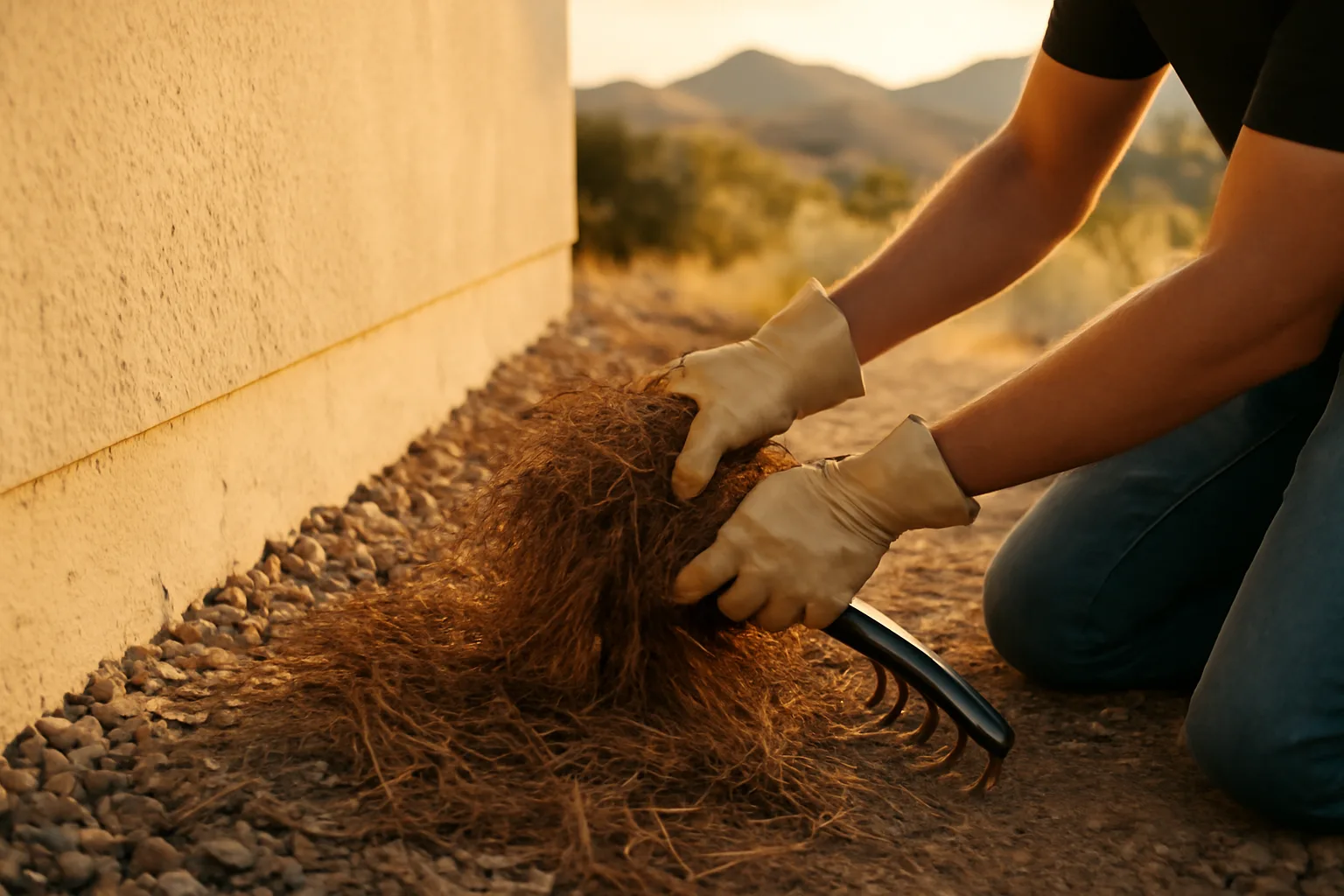
Start with the zone within 5 feet of your house, not the far edges of your yard. Research from the Insurance Institute for Business & Home Safety (IBHS) and CAL FIRE's own home ignition zone guidance both point the same direction: embers landing in mulch, dead leaves, or stored firewood touching your siding cause more home losses than the flame front itself. A wall of trees 100 feet away rarely burns your house down. A pile of pine needles against your wood fence usually does. So the highest-return projects, in order, are: clear combustibles from the 0-5 foot zone (free to under $200), install 1/8 inch metal mesh over foundation and attic vents (roughly $150-$600 depending on vent count), clean gutters and roof valleys of debris twice a year (free if you DIY), and replace bark mulch next to the foundation with gravel or pavers ($100-$400 for a small perimeter). None of these require a contractor. All of them address the ways embers actually get into a structure. After that, move to medium-cost projects: trimming tree limbs so nothing overhangs the roof or comes within 10 feet of a chimney, moving propane tanks and woodpiles at least 30 feet from the house, and enclosing open eaves. Big-ticket items like a Class A fire-rated roof or ember-resistant siding matter, but they're five-figure projects. Do the free and cheap fixes first. They're the ones insurers and inspectors actually check. For a structured breakdown of what goes in each zone around the house, see defensible space zones and the landscaping-specific guidance at fire safe landscaping California next to house.
When does the California defensible space law go into effect?
California's existing defensible space law, Public Resources Code 4291, is already in effect and requires 100 feet of defensible space (or to the property line, whichever is less) around structures in State Responsibility Areas and some Local Responsibility Areas classified as Very High Fire Hazard Severity Zones [1]. That's the law that's been enforced for years through the 0-5, 5-30, and 30-100 foot zone system. What's new, and often confused with a single 'defensible space law,' is the zone 0 ember-resistant zone regulation. Senate Bill 63 (2024) directed the Board of Forestry and Fire Protection to adopt regulations for an ember-resistant zone within 5 feet of structures in Very High Fire Hazard Severity Zones, and earlier law (AB 3074, 2020) had already added this zone 0 concept to Public Resources Code 4291 [2]. The Board's rulemaking process has been ongoing, with the regulation expected to take effect in 2026 for existing homes, though CAL FIRE and the Board of Forestry have shifted proposed effective dates before, so treat any specific date as provisional until the Board publishes a final rule [3]. In practice: if you're in a California Very High Fire Hazard Severity Zone, don't wait for the regulation to become mandatory. Insurers are already scoring homes on zone 0 conditions (bare ground or noncombustible material within 5 feet, no mulch, no stored fuel, nothing wood touching the siding) because that's what the underwriting models flag. Getting ahead of it now is cheaper than a scramble later, and it's the single biggest lever you have if you've received a non-renewal notice.
What fire-safe rules for homes take effect in 2026?
The main one homeowners ask about is California's zone 0 ember-resistant zone standard, expected to become enforceable for existing homes sometime in 2026 under the Board of Forestry and Fire Protection's SB 63 rulemaking [2] [3]. The proposed standard generally requires the 5 feet immediately around a structure to be clear of combustible vegetation, mulch, and stored items, with hardscape (gravel, pavers, concrete) as the preferred surface. Beyond California, Colorado, Oregon, and Arizona don't have a single statewide 'zone 0' law on the same timeline. Oregon's defensible space requirements are tied to its wildfire risk map and Senate Bill 762 framework, administered through the Oregon Department of Forestry, and specific standards vary by designated wildfire risk area [4]. Colorado and Arizona largely leave defensible space requirements to county and local fire district codes, so what's 'required' can differ block to block. If you're outside California, check with your local fire district or state forestry agency directly, because there's no single answer that applies statewide. The practical takeaway: regardless of exact effective dates, insurers in all four states are already using zone 0 style criteria (bare ground near the house, mesh on vents, no attached fencing in wood) in their wildfire risk scoring models. Waiting for the regulation to become mandatory means waiting to become insurable.
Why won't people follow the defensible space law in California?
Cost, confusion, and enforcement gaps are the three real reasons, not laziness. CAL FIRE's own defensible space inspection data shows compliance rates well under 100% in many jurisdictions, and post-fire studies (including analysis after the 2018 Camp Fire and 2021 Dixie Fire) found many destroyed homes had partial or no defensible space compliance despite the law existing [1]. Cost is real for lower-income and rural homeowners: removing large trees, regrading slopes, or replacing a wood fence that touches the house can run into the thousands. A retired homeowner on a fixed income in the Sierra foothills doesn't have $8,000 for tree removal, even when they know the risk. Confusion is also real. The zone system (0, 5-30, 30-100) has changed and been clarified multiple times since 2020, and 'defensible space' rules differ between State Responsibility Areas, Local Responsibility Areas, and specific fire district overlays. Homeowners genuinely don't always know which rules apply to their specific parcel. Enforcement is uneven. Many California counties rely on self-certification or infrequent inspections rather than annual mandatory checks, and fire agencies with limited staff can't inspect every parcel every year. CAL FIRE's Defensible Space Program page describes inspections as prioritized by risk rather than universal [1]. The law is real and violations can carry fines, but the practical odds of getting caught in any given year vary a lot by county, which undercuts the incentive to comply even for homeowners who know the rules. For state-specific procedural questions on cutting contracts and clearing work, see wildfire defensible space clearing contracts Washington State DNR as an example of how a state agency structures compliance work.
How can I prevent wildfires (and forest fires) starting near my property?
Almost all wildfires that threaten homes start from a human source, not lightning: CAL FIRE and multiple federal analyses attribute the large majority of wildfires in California to human causes including equipment use, vehicles, unattended campfires, and arson, with lightning responsible for a minority. So the honest answer to 'how to prevent forest fires' is mostly about controlling ignition sources on your own property and in your immediate area, not something you can control at a landscape scale. The concrete steps: never mow dry grass in the afternoon heat (mower blades hitting rocks throw sparks; California actually restricts mowing hours during red flag conditions in some counties), don't park or idle vehicles over dry grass (catalytic converters run over 500°F and are a documented ignition source), fully extinguish campfires with water until they're cool to the touch (more than doused, actually cold), and maintain equipment like chainsaws and generators so they're not throwing sparks near dry fuel. On the 'how to avoid forest fires' angle for outdoor recreation: follow local burn bans and Red Flag Warnings issued by the National Weather Service, which signal conditions (low humidity, high wind, dry fuel) where any spark spreads fast. Report unattended fires immediately. None of this is complicated, but it's the difference between the roughly 85% of wildfires nationally attributed to human causes and the ones that would have happened anyway.
How do I prepare for a wildfire (and forest fires) before one starts?
Preparing for a wildfire has two tracks: hardening the structure so it survives without you there, and having a go-bag and evacuation plan so your family gets out safely. Ready.gov's wildfire preparedness guidance recommends assembling an emergency kit with water, medications, copies of important documents, and a battery radio, plus signing up for local emergency alerts before fire season starts [5]. On the property side: know your two evacuation routes (not one, because one may be blocked by fire or traffic), keep your car fueled above half a tank during fire season, and photograph your home's interior and exterior room by room for insurance purposes before anything happens. This documentation matters enormously if you ever need to support a claim: adjusters move faster and disputes go smoother when you can show pre-fire condition and value with dated photos, not memory. This is the exact gap the $99 Wildfire Insurance Survival Kit at DefensibleHome's survival kit builder is built for: a structured way to document your home, your hardening work, and your defensible space compliance before you need it, so you're not reconstructing your property's condition from memory during a claim. To be clear: we don't file claims, negotiate with insurers, or promise coverage or discounts. You prepare the documentation; you send it. That's the whole model. For the household plan itself, Ready.gov recommends practicing your evacuation route at least twice a year and designating an out-of-area contact, since local phone networks can be overloaded during an actual evacuation [5].
Is Santa Barbara safe from fire? Are coastal CA cities lower risk?
No coastal California city is 'safe' from wildfire in an absolute sense, and Santa Barbara County has direct experience proving it: the Thomas Fire (2017) burned over 281,000 acres and was followed by the Montecito debris flow that killed 23 people, and the Jesusita Fire (2009) and Tea Fire (2008) both burned into Santa Barbara's urban edge [6]. The city sits against the Santa Ynez Mountains with dense chaparral, strong sundowner wind events, and a long history of wind-driven fires reaching residential neighborhoods. That said, risk isn't uniform within the county. CAL FIRE's Fire Hazard Severity Zone maps show large areas of Santa Barbara's foothill and mountain-adjacent neighborhoods rated Very High, while flatter areas closer to the coast carry lower zone designations [7]. If you're evaluating a specific address, the honest move is to look up its exact Fire Hazard Severity Zone on CAL FIRE's map rather than relying on the city's general reputation, because 'Santa Barbara' as a label covers both high-risk canyon-adjacent lots and comparatively lower-risk flat coastal blocks. The same logic applies to any 'is [city] safe from fire' question. Fire risk in the wildland urban interface is parcel-specific, driven by slope, aspect, fuel type, and distance from wildland vegetation, not by city name. A property two blocks from another can carry meaningfully different risk.
What's the difference between defensible space and full home hardening?
| Metal mesh over vents (1/8 inch) | $150-$600 | Ember entry through attic/foundation vents | |
|---|---|---|---|
| Gutter guards + regular cleaning | $0-$800 | Ember ignition in debris-filled gutters | |
| Replace mulch with gravel (0-5 ft) | $100-$400 | Ember ignition at foundation | |
| Enclose open eaves | $500-$2,500 | Ember accumulation under eaves | |
| Dual-pane or tempered windows | $1,000-$8,000+ | Radiant heat window failure | |
| Class A fire-rated roof replacement | $8,000-$25,000+ | Direct flame/ember ignition on roof | |
| Ember-resistant vent replacement (full house) | $1,000-$5,000 | Whole-house ember intrusion | Costs vary a lot by region, roof size, and contractor availability; treat these as planning ranges, not quotes. Prioritize the top three rows first. They're the cheapest and address the most common failure point (ember intrusion), which IBHS's home ignition research identifies as the dominant way homes in the wildland urban interface actually catch fire, more than direct flame contact. |
Defensible space is what's around your house (vegetation clearance, spacing, fuel management in the 0-100 foot zones). Home hardening is what your house is made of and how it's built (roofing material, vent screens, siding, window glazing). CAL FIRE treats them as two separate, complementary requirements, and research from IBHS's wildfire testing program found that both together dramatically outperform either alone, because a hardened home surrounded by unmanaged fuel can still be exposed to enough radiant heat and ember density to fail, and a well-cleared yard around a home with open vents and a wood shake roof still gives embers an entry point. Home hardening projects, roughly ordered by cost: | Project | Approx. cost | Addresses |
How do I document my hardening work for my insurer?
Insurers and state programs increasingly want proof, more than a claim that you did the work. California's Safer from Wildfires regulation (adopted by the California Department of Insurance) requires insurers to give discounts or recognition for specific mitigation actions, including defensible space compliance and home hardening measures, but the homeowner has to be able to show what was done . The practical documentation habit: photograph before-and-after for every project, keep receipts for materials and contractor invoices, and note dates. If you had a defensible space inspection, keep the inspection report or checklist. If your fire district or FAIR Plan uses a specific mitigation verification form, get it filled out and signed rather than relying on a verbal confirmation from an inspector. This is where organizing matters more than most homeowners expect. A folder of scattered receipts from three years of work isn't useful in a renewal dispute; a dated, organized packet showing zone 0 clearance, vent mesh installation, and roof material is. That's the specific gap a structured survival kit or binder closes: not doing the work for you, but making sure the work you already did is documented in a form an underwriter or adjuster can actually use. We don't negotiate with insurers or promise reinstatement; we help you organize what you send them.
What should go in a wildfire go-bag or family plan?
Ready.gov recommends a basic emergency kit covering at least three days: water (one gallon per person per day), non-perishable food, a battery or hand-crank radio, flashlight, first aid kit, medications, a whistle, dust masks (N95 for smoke), and copies of personal documents in a waterproof container [5]. For wildfire specifically, add a list of your home's defensible space and hardening work, insurance policy numbers, and recent photos of your property, since these matter if you need to support a claim after the fact. For the family plan itself: agree on two evacuation routes out of your neighborhood, not one. Designate an out-of-state contact everyone calls or texts, since local circuits get overloaded fast during a real evacuation. Practice loading the car with your go-bag at least once a year, timed, so it's not a scramble at 2 a.m. with smoke visible from the window. Related reading if you want the structural side of prevention rather than the emergency-kit side: house fire and fire at a house cover ignition and response basics that overlap with wildfire prep, and only you can prevent wildfires covers the human-caused ignition angle in more depth.
Frequently asked questions
When does the California defensible space law go into effect?
The core defensible space law (Public Resources Code 4291, requiring 100 feet of clearance) is already in effect. The newer zone 0 ember-resistant zone standard, mandated by SB 63, is expected to become enforceable for existing homes in 2026, though the Board of Forestry and Fire Protection has adjusted this rulemaking timeline before, so confirm the final date on the Board's official rulemaking page.
Why won't people follow the defensible space law in California?
Mainly cost, confusion over which zone rules apply to their parcel, and uneven enforcement. Removing large trees or regrading a slope can cost thousands, which many homeowners can't absorb. Inspection rates also vary widely by county, so the practical odds of being checked in any given year are low in many areas, which weakens the incentive to comply.
How do I prevent wildfires from starting near my property?
Control ignition sources: don't mow dry grass in afternoon heat, never park running vehicles over dry grass, fully extinguish campfires with water until cold, and maintain chainsaws and equipment so they don't throw sparks. CAL FIRE and federal data attribute the large majority of wildfires to human causes, not lightning, so most prevention is behavioral, not structural.
How do I prepare for a wildfire if I live in a high-risk zone?
Assemble a three-day emergency kit per Ready.gov guidance, know two evacuation routes, keep your car fueled during fire season, and photograph your home's interior and exterior before fire season starts. Pair that with defensible space clearance and vent mesh installation, since preparation covers both getting your family out safely and giving your house a better chance of surviving unattended.
How can we prevent forest fires as a community, more than individually?
Support local fuel reduction programs, follow county burn bans and Red Flag Warning restrictions, report unattended campfires or suspicious smoke immediately, and push for consistent defensible space enforcement in your fire district. Individual home hardening matters, but fire moves through neighborhoods, so a block where most homes comply is safer overall.
What fire-safe rules for homes take effect in 2026?
California's zone 0 ember-resistant zone standard, requiring the 5 feet around a structure to be largely free of combustible material, is expected to take effect for existing homes in 2026 under SB 63 rulemaking. Other states (Oregon, Colorado, Arizona) don't have one unified statewide 2026 rule; check your state forestry agency or local fire district for specifics.
Is Santa Barbara safe from fire?
No. Santa Barbara has burned repeatedly, including the Thomas Fire (2017, over 281,000 acres) and the Jesusita and Tea Fires reaching into residential neighborhoods. Risk varies block to block: foothill and canyon-adjacent areas carry Very High Fire Hazard Severity Zone ratings on CAL FIRE's map, while some flatter coastal areas are lower risk. Check your specific address's zone rather than relying on the city's general reputation.
What's the single cheapest wildfire project with the biggest impact?
Clearing combustible material (mulch, dead leaves, stored wood) from the 5 feet immediately around your foundation. It costs nothing if you DIY and directly addresses how embers most commonly ignite structures, according to IBHS and CAL FIRE home ignition zone research. Pair it with metal mesh over vents for under $600 combined.
How is defensible space different from home hardening?
Defensible space is vegetation and fuel management around the house, covering zones 0 through 100 feet. Home hardening is the building itself: roof material, vent screens, siding, and windows. CAL FIRE treats them as separate requirements that work together; a cleared yard around a home with open vents still lets embers in, and a hardened home surrounded by unmanaged fuel can still fail under enough radiant heat.
Do I need a permit to clear defensible space or remove trees?
It depends on your county and whether trees are protected (oaks and other species are protected in many California jurisdictions). Contact your local fire district or planning department before removing large trees. Basic brush clearing and mulch removal in the 0-5 foot zone typically doesn't require a permit, but tree removal often does.
Can home hardening or defensible space actually lower my insurance premium?
California's Safer from Wildfires regulation requires insurers to give some recognition (discount or underwriting credit) for documented mitigation, including defensible space compliance and specific hardening measures. Whether and how much varies by insurer. Keep dated photos and receipts, since insurers generally require documentation, more than a claim that work was done.
What should I do first if I got a non-renewal letter?
Read the letter for the specific reason cited (often defensible space, roof material, or brush density), fix what you can before any reinspection deadline, and document everything with dated photos and receipts. Then start shopping other carriers or your state's FAIR Plan while gathering documentation, since a documented mitigation history helps with any insurer, more than the one that non-renewed you.
Sources
- California Public Resources Code Section 4291: 100 feet of defensible space required around structures in SRA and applicable LRA VHFHSZ
- California SB 63 (2024): SB 63 directs the Board of Forestry to adopt zone 0 ember-resistant zone regulations
- California Board of Forestry and Fire Protection, Zone 0 Rulemaking: Zone 0 ember-resistant zone regulation rulemaking timeline and expected 2026 effective date
- CAL FIRE, Wildfire Statistics and Prevention: The large majority of California wildfires are human-caused rather than lightning-caused
- CAL FIRE, Thomas Fire Incident Information: Thomas Fire burned over 281,000 acres in Santa Barbara and Ventura counties in 2017
- CAL FIRE, Fire Hazard Severity Zone Viewer: Fire Hazard Severity Zone ratings vary by parcel within a single city like Santa Barbara
- California Department of Insurance, Safer from Wildfires Regulation: Insurers are required to recognize documented wildfire mitigation actions including defensible space and home hardening