Last updated 2026-07-25
TL;DR
A wildfire resistant home combines a Class A roof, ember-resistant vents, noncombustible siding, and a cleared zone within 5 feet of the structure. California's new zone 0 ember-resistant zone requirement targets 2026 enforcement for existing homes, though the rule has been delayed before. Start with the roof, vents, and gutters; those three items stop most home ignitions.
What makes a home actually wildfire resistant?
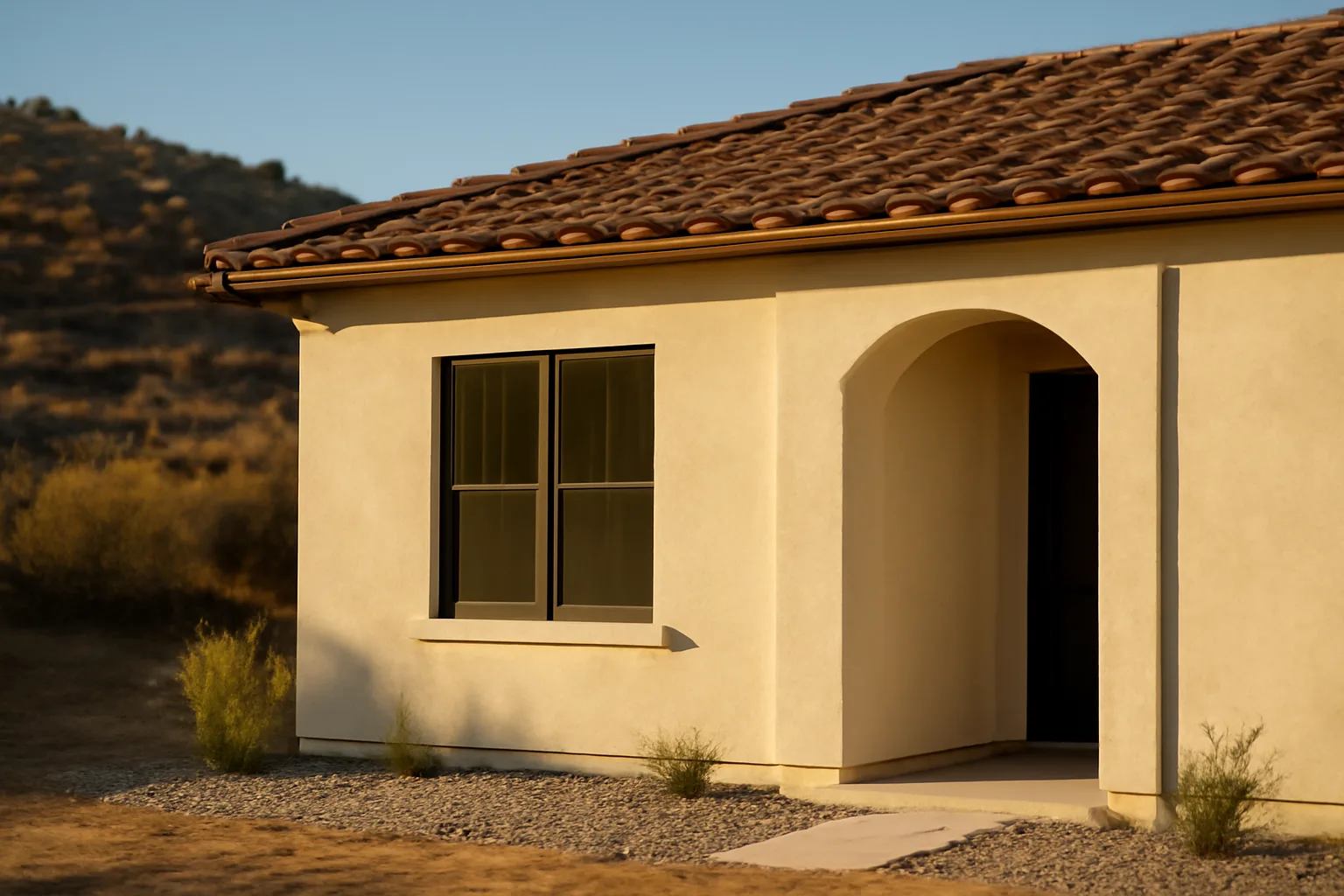
A wildfire resistant home is not fireproof. Nothing is. What separates a home that survives a wildfire from one that doesn't usually comes down to embers, not the wall of flame you see on the news. CAL FIRE's research and the work of retired U.S. Forest Service scientist Jack Cohen (the researcher most cited for this finding) established that most homes lost in wildfires ignite from windblown embers landing on or near the structure, not from direct flame contact with the fire front. Embers can travel a mile or more ahead of a fire. That means a home a half mile from the nearest flame can still burn down, and a home that gets flame right up to its defensible space edge can survive if embers can't find fuel. So a resistant home has three layers working together: a hardened structure (roof, vents, siding, windows, gutters), defensible space around it (the 0 to 100 foot zones CAL FIRE lays out), and a maintenance habit that keeps both from sliding backward. Skip any one and you've got a weak link. I've seen plenty of homes with a brand new Class A roof and dry pine needles packed into the gutters. That's a house waiting for one ember to prove the roof didn't matter. For the specific zone-by-zone clearing rules, see defensible space and fire safe landscaping next to the house.
When does the California defensible space law go into effect?
California's core defensible space law, Public Resources Code 4291, has been in effect for decades and currently requires 100 feet of defensible space clearance around structures in State Responsibility Areas and some Local Responsibility Areas classified as Very High Fire Hazard Severity Zones. That part isn't new and isn't changing. What's newer, and what people mean when they ask this question in 2024 through 2026, is the ember-resistant "zone 0" requirement under Assembly Bill 3074 (2020), which directs the Board of Forestry to adopt regulations for a 0 to 5 foot ember-resistant zone immediately around the home [1]. The statute passed in 2020. Regulations to implement it have gone through multiple draft cycles at the Board of Forestry and Fire Protection, and enforcement dates have slipped more than once. As of this writing, the Board's rulemaking timeline points toward zone 0 regulations taking effect for existing homes around 2026, with new construction facing requirements sooner in some drafts. Because this keeps moving, check the Board of Forestry's current rulemaking page before you plan around a specific date [2]. Don't build your renovation schedule around a date you read in an article, including this one; verify against the source before you sign a contract.
What fire-safe home rules take effect in 2026?
The rule most homeowners are watching for 2026 is California's zone 0 ember-resistant zone, the 5-foot noncombustible buffer immediately touching the house. Under the Board of Forestry's proposed regulations, that zone would generally prohibit combustible mulch, wood fencing attached to the house, stored firewood, and other burnable materials within 5 feet of exterior walls [1] [2]. The practical version of zone 0 usually means: gravel, pavers, or bare soil instead of bark mulch next to the foundation; no wood fencing making direct contact with the house (use a metal gate section for the first few feet); potted plants moved back if flammable; and nothing stored under decks or against siding. Outside California, watch your own state fire marshal's office. Oregon's Department of Forestry and Office of State Fire Marshal have been implementing their own wildfire risk map and defensible space standards under Senate Bill 762 (2021), Colorado leaves most wildfire mitigation code adoption to counties and fire districts, and Arizona similarly defers to local jurisdiction and the State Forestry Division for guidance rather than a single statewide zone 0 mandate. That's the honest answer: check your specific fire district, because 'wildfire rules' in the U.S. are not one law, they're a patchwork of state statutes, county ordinances, and local fire district codes. Fill in for your property: ___ (your fire district or county's specific defensible space and zone 0 requirements, checked against your local fire marshal or fire safe council).
How do I prevent wildfires from starting near my home?
Most wildfires that threaten homes are started by people, not lightning. CAL FIRE and the National Interagency Fire Center attribute a large majority of wildfire ignitions nationally to human causes: unattended campfires, equipment sparks, downed power lines, discarded cigarettes, fireworks, and vehicle exhaust systems parked in dry grass [3]. On your own property, the highest-value prevention habits are boring but they work. Don't mow dry grass midday in summer; a lawnmower blade hitting a rock can throw a spark hot enough to ignite dry vegetation. Keep chainsaws and other gas equipment away from cured grass when running. If you have a burn permit for debris, check it against local red flag warnings first, and never leave it unattended. Around the house, this overlaps heavily with hardening: clean gutters of pine needles and leaves, because a stray ember landing in dry gutter debris is a common ignition point that has nothing to do with the fire front reaching your yard. Same logic applies to woodpiles stacked against a fence or wall; move them at least 30 feet from any structure per CAL FIRE guidance [4]. The Smokey Bear campaign line "Only you can prevent forest fires" (later updated to "wildfires") from the U.S. Forest Service exists because the data backs it up: humans start most of them. For more on personal fire-starting risks and outdoor fire behavior, see only you can prevent wildfires.
How do I prepare for a wildfire before it happens?
Preparing for a wildfire means having your evacuation plan, your documentation, and your home hardening done before a red flag warning, not during one. Ready.gov's wildfire preparedness guidance recommends assembling a go-bag, planning two evacuation routes, and signing up for local emergency alerts well ahead of fire season. Here's a realistic prep checklist, roughly in order of what actually moves the needle: 1. Sign up for reverse-911 or your county's emergency alert system. Most evacuation deaths and near-misses happen because people didn't get the warning in time, not because they refused to leave. 2. Photograph and document your home and possessions now, room by room, dated, before any damage. This is separate from any insurance claim process; it's just good records that you control. 3. Clean gutters, mow dry grass, and clear the 5-foot zone around the house. This is the single highest-leverage afternoon of yard work most homeowners can do. 4. Check your roof vents for 1/8 inch mesh screening (finer than standard bug screen); embers get through standard mesh. 5. Pack a go-bag with medications, copies of ID, insurance policy numbers, and chargers, kept somewhere you can grab it in five minutes. 6. Know your two evacuation routes in case one is blocked by fire or traffic. A lot of this documentation work (the room-by-room photos, the receipts, the proof of what hardening you've done) is exactly the kind of thing that matters later if you're contesting a non-renewal or trying to show an insurer or inspector what you've actually done to the property. We built a $99 Wildfire Insurance Survival Kit specifically for that gap: a structured way to document your home and mitigation work yourself. To be clear, we don't file claims, negotiate with insurers, or promise any discount or reinstatement. You prepare your own documentation and send it yourself; we just help you organize it so it's usable.
How do I prepare for forest fires if I live near wildland?
Preparing for forest fires near your property follows the same defensible space logic as wildfire prep generally, but the wildland-urban interface (WUI) adds a few specific concerns: fuel continuity, slope, and access for fire equipment. CAL FIRE's defensible space guidance breaks the property into three zones: zone 0 (0-5 feet, ember-resistant), zone 1 (5-30 feet, lean and green, well-spaced plants), and zone 2 (30-100 feet, reduced fuel, spaced trees and shrubs). If your property backs onto forest or wildland, that outer zone 2 work matters more than in a typical suburban lot, because you're managing the fuel that connects your yard to the forest itself. Slope matters too: fire moves faster uphill, so a home below a slope needs a wider clearance than the same home on flat ground; CAL FIRE and many local ordinances adjust required clearance distances based on slope percentage. Check your specific fire district's ordinance for the slope-adjusted distance table, since this varies by jurisdiction. Fill in for your property: ___ (your fire district's slope-adjusted defensible space distance, if your property is on a grade).
Why won't people follow the defensible space law in California?
This gets asked because compliance rates are genuinely low in some areas, and the reasons are more practical than defiant. Cost is the biggest one. Clearing 100 feet of defensible space on a wooded acre, especially removing mature trees or grinding stumps, can run into the thousands of dollars, and CAL FIRE inspections in some counties find noncompliance rates well above 50% in the highest-risk zones during spot audits, though exact figures vary widely by county and year. Other honest reasons: aesthetic attachment to trees and landscaping people planted decades ago; confusion about what's actually required (the rules read differently depending on whether you're in a State Responsibility Area, Local Responsibility Area, or a Very High Fire Hazard Severity Zone); disagreement with local fire officials over what counts as adequate clearance; and simple lack of enforcement capacity, since most counties don't have the staff to inspect every parcel every year. There's also a real tension between defensible space rules and erosion control or habitat concerns on steep or ecologically sensitive lots, which sometimes puts homeowners between two sets of local guidance that don't fully agree. None of that changes the underlying incentive problem: PRC 4291 puts the legal responsibility on the property owner, and insurers increasingly use compliance (or the appearance of it during exterior inspections) as a factor in renewal decisions. Whether or not you agree with every line of the ordinance, the more concrete documentation you have of what you've cleared and when, the stronger your position if an inspector or insurer questions your property.
Is Santa Barbara safe from fire?
No location in California's wildland-urban interface, including Santa Barbara, can be called fully safe from wildfire. Santa Barbara County has a documented history of major fires including the 1990 Painted Cave Fire, the 2008 Tea Fire, and the 2017 Thomas Fire, which at the time was the largest wildfire in modern California history by acreage before being surpassed by later fires [5]. The Thomas Fire also triggered the January 2018 Montecito debris flow, which killed 23 people, a reminder that wildfire risk in this region doesn't end when the flames go out; burned hillsides lose the root structure that holds soil during heavy rain. The city and county sit against the Santa Ynez Mountains with dense chaparral fuel, seasonal Sundowner winds that behave similarly to Santa Ana winds and can push fire rapidly downslope toward populated areas, and a long dry season. CAL FIRE maps much of the foothill area as Very High Fire Hazard Severity Zone [6]. That doesn't mean every property in Santa Barbara faces equal risk. A home in the flatter, more urbanized parts of the city with irrigated landscaping and distance from wildland fuel is meaningfully lower risk than a hillside home backing onto chaparral in Montecito or the San Roque foothills. Check your specific parcel against CAL FIRE's Fire Hazard Severity Zone viewer rather than relying on the city's general reputation either way [6].
How can we prevent forest fires as a community, more than individually?
Individual home hardening matters, but wildfire behavior at the neighborhood scale depends heavily on what your neighbors do too, since a single unhardened, overgrown property can become the ignition point that takes out an entire block through radiant heat and ember cascade even if your own home is perfectly prepared. This is where Firewise USA, a program run by the National Fire Protection Association in partnership with the U.S. Forest Service and state forestry agencies, comes in. Firewise-recognized communities coordinate defensible space standards, shared chipping days for cleared brush, and joint grant applications for larger fuel reduction projects that no single homeowner could afford alone [7]. At the policy level, community wildfire prevention includes prescribed burning and fuel breaks managed by the U.S. Forest Service and state forestry agencies, utility vegetation management around power lines (a major ignition source in several major California fires including the 2018 Camp Fire, which state investigators tied to Pacific Gas & Electric equipment), and county-level building codes that require ignition-resistant construction in new WUI development. If you're on an HOA board or active in a neighborhood association, pushing for a Firewise USA designation or a shared chipping program is genuinely one of the higher-leverage things a group of homeowners can do together, more effective per dollar than most individuals hardening alone without any coordination.
What are the highest-priority home hardening upgrades?
| Class A fire-rated roof | Roofs are a top entry point for wind-blown embers landing on debris or in valleys | $8,000-$25,000+ for full replacement, varies hugely by material and roof size | |
|---|---|---|---|
| Ember-resistant vents (1/8 in. mesh) | Standard attic and foundation vents let embers directly into the structure | $150-$600 per vent installed, several vents per home typically | |
| Gutter guards + regular cleaning | Dry leaf and needle debris in gutters is a common ignition point | $10-$40/ft for guards, or free if you just clean them regularly | |
| Noncombustible siding (fiber cement, stucco) | Wood siding ignites at lower ember exposure than fiber cement or stucco | $6-$14/sq ft installed | |
| Dual-pane tempered windows | Radiant heat can crack single-pane glass, letting embers and flame inside | $600-$1,200 per window | |
| Zone 0 clearance (0-5 ft) | Removes the closest fuel to the structure itself | Often low cost if it's just mulch/landscaping changes, higher if fencing or decking needs replacement | None of this needs to happen in one summer. Most homeowners triage: fix the roof and vents this year, tackle siding and windows over the next few, and keep zone 0 and zone 1 clearance as an every-spring maintenance task rather than a one-time project. |
If you can only do three things this year, do the roof, the vents, and the gutters. In that order, roughly, based on how often each shows up as an ignition point in post-fire investigations. | Upgrade | Why it matters | Rough cost range |
How do insurers and inspectors view a hardened home?
Insurers increasingly use exterior inspections, satellite and aerial imagery, and defensible space compliance as inputs into non-renewal and underwriting decisions in wildfire-prone ZIP codes, though the specific criteria vary by carrier and aren't always disclosed in detail. California's Department of Insurance implemented the Safer from Wildfires regulation in 2022, which requires insurers to give discounts or recognize mitigation actions like defensible space compliance and home hardening in their wildfire risk models . In practice, this means documenting what you've done (roof replacement, vent upgrades, cleared zone 0, gutter maintenance) with dated photos and receipts is worth having on hand regardless of whether a specific discount applies to your policy. We're not a public adjuster and don't file claims, negotiate settlements, or promise any specific discount, reinstatement, or coverage outcome. What we built the Survival Kit for is the boring but necessary part: organizing your own room-by-room photos, mitigation receipts, and defensible space records into something you can hand to an inspector or attach to your own renewal appeal. You still send it yourself. For general house fire risk factors that inspectors also look at beyond wildfire specifically, see house fire and fire at a house.
What should I do if I already got a non-renewal or inspection letter?
First, read the letter carefully for the actual stated reason and any deadline to respond or appeal; carriers often cite a specific issue like vegetation clearance, roof condition, or defensible space rather than a general risk score. Second, document your property's current state immediately: photos of your roof, vents, gutters, and the zone around the house, dated and organized, before you make any changes, so you have a clear before picture. Third, make the fixes that are genuinely cheap and fast: clear the zone 0 area, clean gutters, remove woodpiles from against the house, trim vegetation to your local ordinance's spacing requirements. Document each one as you go. Fourth, if your state has a FAIR Plan or similar residual market option (California FAIR Plan, and similar programs exist in Oregon, Colorado, and other wildfire-exposed states), understand it before you need it; these plans typically cost more and cover less than standard policies, so they're a backstop, not a first choice. We don't negotiate with insurers or promise a reinstatement outcome. What matters most in our experience watching this space is having organized, dated proof of your mitigation work ready before you need it, not scrambling to find receipts after a denial.
Frequently asked questions
When does the California defensible space law go into effect?
The core 100-foot defensible space requirement under Public Resources Code 4291 has been in effect for years. The newer zone 0 ember-resistant zone rule, from Assembly Bill 3074, has faced repeated delays and points toward roughly 2026 enforcement for existing homes, though check the Board of Forestry and Fire Protection's current rulemaking page since dates have shifted before.
Why won't people follow the defensible space law in California?
Cost is the main reason; clearing acres of mature vegetation can run into thousands of dollars. Other factors include confusion over which zone rules apply to a given property, attachment to existing landscaping, disagreement with local officials over adequate clearance, and limited county enforcement staff to inspect every parcel.
How do I prevent wildfires from starting?
Avoid mowing dry grass midday, keep gas equipment away from cured vegetation, never leave campfires or debris burns unattended, and check local red flag warnings before any outdoor burning. Most wildfires nationally are human-caused, according to National Interagency Fire Center data, not lightning-caused.
How do I prepare for a wildfire?
Sign up for local emergency alerts, document your home and belongings with dated photos now, clear the 5-foot zone around your house, check that vents have 1/8 inch ember-resistant mesh, pack a go-bag with medications and documents, and know two evacuation routes out of your neighborhood.
What fire-safe home rules take effect in 2026?
California's zone 0 ember-resistant zone regulation, requiring a noncombustible 0-5 foot buffer around structures, is currently targeted for roughly 2026 enforcement on existing homes under the Board of Forestry's rulemaking. The date has moved before, so verify against the Board's current published timeline.
Is Santa Barbara safe from fire?
No part of Santa Barbara County is fully safe from wildfire. The area has a documented history including the 1990 Painted Cave Fire, 2008 Tea Fire, and 2017 Thomas Fire. Hillside and Montecito-area properties near chaparral face materially higher risk than flatter, urbanized neighborhoods.
How can we prevent forest fires as a community?
Join or start a Firewise USA recognized community program (run by the National Fire Protection Association), coordinate shared brush chipping days, push utilities on vegetation management near power lines, and support county-level fuel reduction and prescribed burn projects rather than relying only on individual home hardening.
What's the single highest-priority wildfire home hardening upgrade?
A Class A fire-rated roof combined with ember-resistant 1/8 inch mesh vents, because roofs and vents are consistently the most common entry points for wind-blown embers in post-fire home loss studies. Clean gutters regularly too; debris buildup there is a frequent, low-cost-to-fix ignition point.
Do ember-resistant vents actually make a measurable difference?
Standard bug screen mesh lets embers through; 1/8 inch or smaller ember-resistant mesh, sometimes paired with baffled vent designs, blocks most ember intrusion into attics and crawlspaces. Cost is roughly $150-$600 per vent installed, small compared to full roof or siding replacement.
What's the difference between defensible space zones 0, 1, and 2?
Zone 0 (0-5 feet from the structure) requires the strictest ember-resistant, noncombustible treatment. Zone 1 (5-30 feet) calls for well-spaced, lean and green landscaping. Zone 2 (30-100 feet) allows more vegetation but requires reduced fuel continuity and tree spacing, per CAL FIRE's defensible space guidance.
Does clearing defensible space guarantee my insurer won't cancel my policy?
No. Defensible space compliance and home hardening are factors some insurers weigh, and California's Safer from Wildfires regulation requires insurers to recognize certain mitigation actions in their models, but no single upgrade guarantees renewal. Documentation of your mitigation work strengthens your position but isn't a guarantee.
How much does it cost to make a home wildfire resistant?
Costs vary enormously by starting condition. A full package (Class A roof, ember-resistant vents, fiber cement siding, dual-pane windows, and cleared zone 0) can run $20,000 to $60,000 or more, but many homeowners phase it over several years, starting with the roof and vents since those carry the most risk reduction per dollar.
Where can I check my property's official fire hazard severity zone?
CAL FIRE maintains a public Fire Hazard Severity Zone viewer covering State Responsibility Areas and Local Responsibility Areas statewide. Search your address there to see your official zone classification, which also determines which defensible space and building code requirements legally apply to your property.
Sources
- California Legislative Information, AB-3074 (2020): Statute directing the Board of Forestry to adopt ember-resistant zone 0 regulations
- California Board of Forestry and Fire Protection, Ember-Resistant Zone Rulemaking: Current status and timeline of zone 0 regulation development
- National Interagency Fire Center, Statistics: Most U.S. wildfires are human-caused rather than lightning-caused
- CAL FIRE, Ready for Wildfire: Prepare Your Property: Recommendation to keep woodpiles at least 30 feet from structures
- Santa Barbara County, Thomas Fire and Montecito Debris Flow information: 2017 Thomas Fire history and its link to the January 2018 Montecito debris flow that killed 23 people
- National Fire Protection Association, Firewise USA program: Community-level wildfire mitigation program coordinated by NFPA with fuel reduction and neighborhood standards
- California Department of Insurance, Safer from Wildfires regulation: Regulation requiring insurers to recognize wildfire mitigation and defensible space actions in underwriting