Last updated 2026-07-25
TL;DR
Vegetation management, clearing and thinning plants around a structure, is the single biggest factor homeowners control in a wildfire. CAL FIRE research shows homes with proper defensible space and hardening survive at far higher rates than those without. California's 100-foot defensible space zones are law now (Public Resources Code 4291); a stricter Zone 0 ember-resistant rule is set to phase in after state fire marshal rulemaking.
why does vegetation management matter for wildfire risk
Vegetation is fuel. That's the whole story in one sentence. A house doesn't usually burn because a wall of flame marches up and swallows it. It burns because embers, sometimes traveling a mile or more ahead of the fire front, land in dry leaves, mulch, or a woodpile pushed against the siding, and that small ignition grows until it reaches the structure. CAL FIRE's own research group has found that defensible space combined with home hardening is the strongest predictor of whether a structure survives a wildfire, more than fire intensity or proximity to wildland alone. That's not a marketing line, it's the conclusion of post-fire damage assessments the agency has run for years. Here's the part that surprises people: managing vegetation isn't about turning your yard into gravel. It's about spacing, species, and maintenance. A well-hydrated, well-spaced landscape with the right plant choices can be greener than your neighbor's and still be far safer, because fire needs continuous fuel to travel, and defensible space breaks that continuity. Think of it as three separate jobs: reduce what can burn near the house, break up how fire moves across a property, and keep embers from finding a foothold once they land. Vegetation management does the first two. Fire safe landscaping and home hardening handle the third.
how do defensible space zones actually work
| Zone 0 | 0-5 ft | No combustible vegetation or materials; ember-resistant | |
|---|---|---|---|
| Zone 1 | 5-30 ft | Lean, clean, green; canopy spacing; limb up 6 ft | |
| Zone 2 | 30-100 ft | Cut grass to 4 in; reduce fuel continuity | For the zone-by-zone planting and spacing detail, see defensible space. |
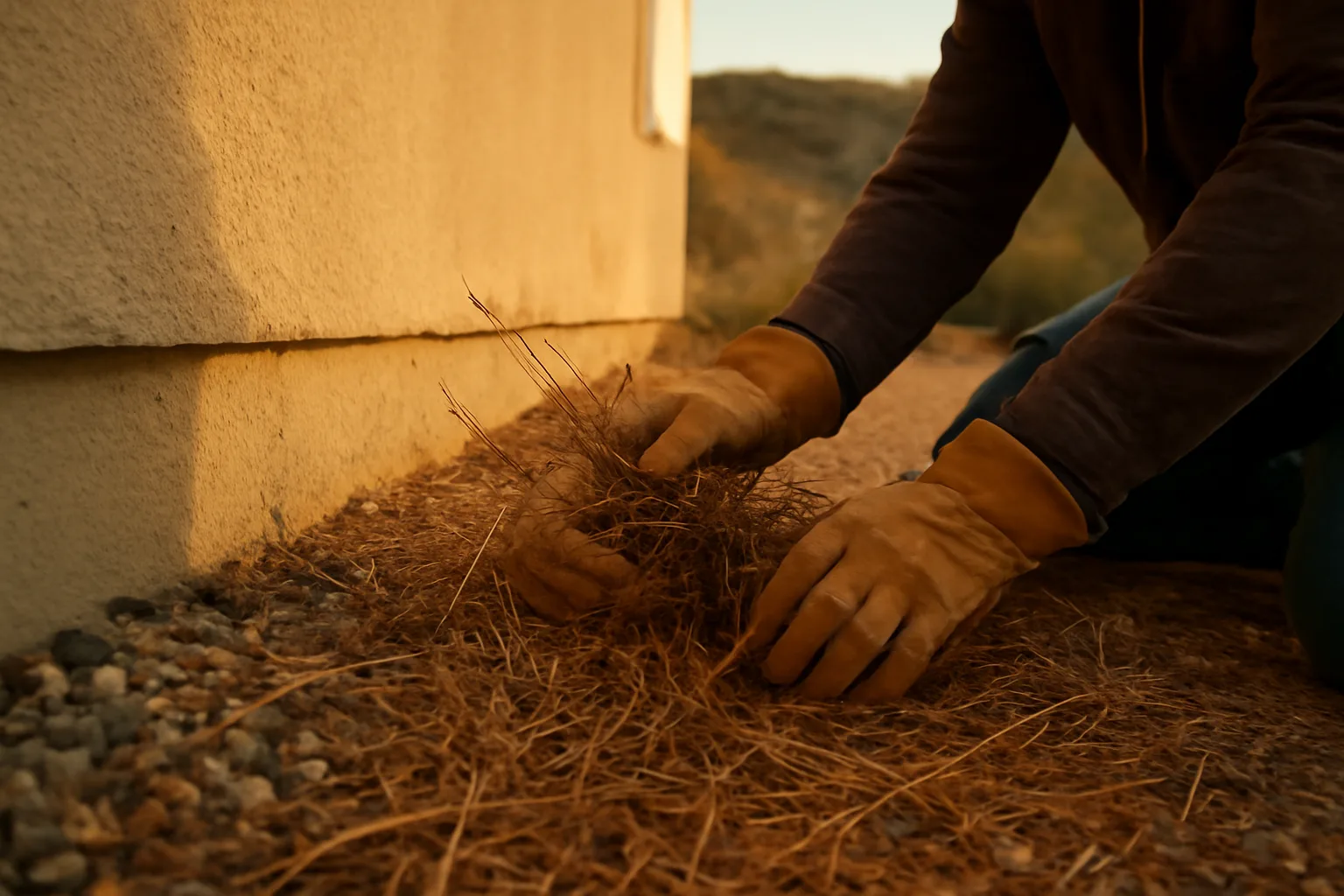
California law splits the required clearance into zones measured from the structure, not the property line, and each zone has different rules. Zone 0 is 0 to 5 feet from the house, Zone 1 runs 5 to 30 feet, and Zone 2 runs 30 to 100 feet, or to the property line if it's closer. Zone 0 is the ember-ignition zone. This is the area where a wind-blown ember is most likely to land and find something to catch: mulch against the foundation, a wood fence attached to the house, dry leaves in gutters. CAL FIRE's guidance calls for zero combustible vegetation or materials directly against the structure in this zone. Zone 1 asks for "lean, clean and green" landscaping: trees spaced so their canopies don't touch, limbs removed up to 6 feet from the ground, and dead plant material cleared regularly. Zone 2 is about fuel breaks: cutting annual grass to 4 inches or less, widely spacing shrubs and trees, and removing fallen leaves and needles. | Zone | Distance from structure | Core requirement |
when does the california defensible space law go into effect
The core 100-foot defensible space requirement is already in effect and has been for years. Public Resources Code Section 4291 has required 100 feet of defensible space clearance around structures in State Responsibility Areas since it was amended in 2005, and it applies today [1]. What's newer is Zone 0. Assembly Bill 3074 (2020) directed the state fire marshal to develop ember-resistant zone regulations for the 0 to 5 foot area around homes in high fire severity zones [2]. As of this writing, the Board of Forestry and Fire Protection has been working through the formal rulemaking process to adopt those Zone 0 regulations, and CAL FIRE's public guidance has said implementation will follow once the rule is finalized and adopted, with compliance timelines still being set through that process. If you've seen headlines asking whether "fire safe home rules take effect in 2026," that's what they're pointing at: the Zone 0 ember-resistant standard, not the general defensible space law, which has been active. Homeowners in high fire severity zones should check with their local fire district or CAL FIRE unit now, because some jurisdictions are already recommending Zone 0 compliance ahead of the formal deadline. Your local fire district's exact enforcement timeline and inspection cadence: ___________ (fill in from your fire district or CAL FIRE unit contact).
why won't people follow the defensible space law in california
Cost, confusion, and disbelief. Those are the three real reasons, and none of them are stupid reasons even if they're wrong. Cost is real. Removing mature trees, regrading a slope for fuel breaks, or replacing a wood fence that touches the house can run into thousands of dollars, and CAL FIRE inspections don't come with a check to cover it. Low-income and elderly homeowners, especially those on fixed incomes in rural SRA parcels, are disproportionately non-compliant not because they don't care but because they can't afford a contractor crew for two acres of brush. Confusion is the second problem. The zone rules sound simple on paper but get complicated fast on a real, oddly shaped lot with a slope, a neighbor's overhanging oak, and a septic field you can't disturb. A lot of homeowners genuinely don't know if their landscaping passes or fails until an inspector shows up. Disbelief is the quiet third reason. Plenty of people have lived on the same lot for 30 years without a fire reaching them, and it's human nature to assume that pattern holds. Then a neighbor's policy gets non-renewed after an inspection, or a nearby fire jumps a ridge nobody expected it to jump, and the calculation changes overnight. None of that changes the law or the risk. Counties can and do issue citations for non-compliance under PRC 4291, and insurers increasingly use aerial and satellite vegetation surveys to flag high-risk parcels regardless of whether a citation was ever issued [1].
how to prevent wildfires around your home
You can't prevent a wildfire from starting somewhere in the wildland. You can dramatically reduce the odds that it becomes a fire that destroys your house. Start with ignition sources you control. Roughly 84 percent of wildfires in the U.S. are human-caused, according to a National Park Service analysis of federal fire data, things like unattended campfires, equipment sparks, and debris burning. That means basic discipline (no burning on windy days, properly extinguished cigarettes and campfires, spark arrestors on equipment) matters as much as landscaping in the aggregate risk picture. Around the structure itself, the highest-leverage moves in order are: clear Zone 0 completely, remove or replace anything flammable touching the house, screen vents with 1/8-inch metal mesh to block embers, clean gutters and roof valleys of debris, and space out Zone 1 and Zone 2 vegetation per the zone table above. None of these require a permit in most jurisdictions, and most can be done over a weekend or two. If you're renting equipment or hiring a crew for larger vegetation removal in Washington state, the wildfire defensible space clearing contracts through Washington state DNR program is worth checking, since some states subsidize or contract out this work directly.
how to prepare for a wildfire before it starts
Preparation splits into three buckets: the property, the go-bag, and the paperwork. Most guides only cover the first two. On the property, defensible space and hardening come first, covered above. Add an emergency water source if you have one (a pool, a tank, a hydrant location you know), and make sure your address is visible from the street in reflective numbers, since responding crews waste critical minutes on unmarked driveways. Ready.gov recommends assembling a go-kit with at least a three-day supply of water (one gallon per person per day), a battery-powered or hand-crank radio, a flashlight, and copies of important documents in a waterproof container [3]. That last part, documents, is the one people skip and regret. Insurance policy numbers, a home inventory with photos, and any prior inspection or defensible space certificates are worth having somewhere you can grab them in five minutes. The paperwork side matters more than most checklists admit. If your insurer has sent a non-renewal or inspection letter, or you're worried one is coming, documenting your defensible space work before a fire (dated photos, receipts for vegetation removal, any fire district inspection reports) gives you something concrete to point to. This is where a structured kit for organizing that documentation, like the $99 Wildfire Insurance Survival Kit at /survival-kit-builder, can save real time versus building a binder from scratch the week before a renewal deadline. Nothing here replaces filing your own claim or negotiating with your insurer; you send your own documentation, and this is prep, not legal or insurance advice.
how to prevent forest fires and avoid forest fires more broadly
At the landscape level, forest fire prevention is mostly about fuel load and ignition source, the same two variables as home defense, just at larger scale. Decades of fire suppression policy across the U.S. West left many forests with far more fuel (dead wood, dense underbrush, overcrowded stands) than historical fire regimes would have allowed to accumulate, according to U.S. Forest Service research on fuel treatment effectiveness [4]. Prescribed burns and mechanical thinning are the primary tools agencies use to reverse that, and study after study on treated stands shows meaningfully lower fire severity when a wildfire later burns through a treated area compared to an untreated one [4]. For an individual, "preventing forest fires" mostly means not being the ignition source: follow local burn bans, don't drive or park on dry grass (catalytic converters run hot enough to ignite it), maintain spark arrestors on chainsaws and ATVs, and fully extinguish campfires by drowning and stirring, more than dousing the top. The famous "Only You Can Prevent Wildfires" Smokey Bear campaign exists because human-caused ignition is the piece individuals can actually move the needle on; see only you can prevent wildfires for the fuller history and current guidance.
is santa barbara safe from fire
No coastal California community is "safe" from wildfire in an absolute sense, and Santa Barbara County has direct experience proving it. The Thomas Fire in December 2017 burned over 281,000 acres and was, at the time, the largest wildfire in modern California history, followed weeks later by the Montecito debris flow that killed 23 people after the fire had stripped hillside vegetation that normally holds soil in place [5]. That sequence, fire followed by mudslide, is exactly why vegetation management matters even after a fire passes: burned hillsides lose the root systems that stabilize soil, and the next heavy rain can turn a burn scar into a debris flow risk for a year or more. Santa Barbara County sits in a mix of high and very high fire hazard severity zones per CAL FIRE's zone maps, particularly in the foothill communities of Montecito, Mission Canyon, and the San Marcos foothills [6]. If your property is in one of those zones, the 100-foot defensible space rule under PRC 4291 applies to you directly, not as a suggestion. The honest answer for any specific address is: check CAL FIRE's Fire Hazard Severity Zone viewer for your parcel, and talk to your local fire district about your zone-specific requirements, since Santa Barbara County's terrain varies enormously from flat valley floor to steep chaparral canyon within a few miles.
how can we prevent forest fires at a community level
Individual defensible space work matters less if your neighbor's overgrown lot is 20 feet from your fence line, so community-scale action is where a lot of the real risk reduction happens. Firewise USA, a National Fire Protection Association program, organizes neighborhoods into recognized communities that coordinate vegetation management, host chipper days, and share the cost of fuel reduction work across a block rather than leaving it to individual homeowners . Over 1,500 communities nationally hold Firewise recognition, and insurers in some states have started referencing that status in underwriting conversations, though it's not a substitute for coverage decisions made on other risk factors. At the county level, look for Community Wildfire Protection Plans (CWPPs), which map fuel breaks, evacuation routes, and priority treatment areas across jurisdictions rather than parcel by parcel. These plans, required for communities seeking certain federal fuel treatment funding under the Healthy Forests Restoration Act, are public documents worth reading if you want to know what's planned near you . The blunt truth: a single well-hardened, well-cleared house surrounded by neglected lots still has elevated risk, because fire behavior in a neighborhood is a chain reaction, house to house, via radiant heat and ember cast, more than wildland to house. This is documented in post-fire studies of urban conflagrations like the 2018 Camp Fire and the 2021 Marshall Fire, where structure-to-structure ignition, not direct wildland contact, destroyed entire blocks.
what fire safe rules for homes take effect in 2026
There's no single nationwide "2026 fire safe home law." The phrase circulating online mostly traces back to California's Zone 0 ember-resistant zone rulemaking, which the state fire marshal and Board of Forestry have been developing under the authority of AB 3074, and which some public agency communications have referenced with 2026 or later target dates for phased implementation in high and very high fire severity zones [2]. Because rulemaking timelines shift, don't rely on a specific date without checking current status. The most reliable path is CAL FIRE's defensible space program page and your county's building department, since some California counties have already begun requiring Zone 0-consistent practices ahead of the state deadline as part of local ordinances. Colorado, Oregon, and Arizona each have their own, separate vegetation management and wildland-urban interface codes, generally administered at the state forestry or fire marshal level rather than a single unified "2026 law." If you're outside California, check your state fire marshal's wildfire mitigation page directly rather than assuming California's timeline applies. Your local fire district's current Zone 0 enforcement status and any local ordinance ahead of the state rule: ___________ (fill in from your county building department or fire marshal contact).
what happens if you get a non-renewal or inspection letter
First, don't panic and don't ignore it either. A non-renewal letter usually gives you a window, often 60 to 75 days depending on your state's notice requirements, before coverage actually lapses, which is real time to act . Second, read exactly what triggered it. Some letters cite specific defensible space deficiencies (vegetation touching the structure, dead trees within a set distance) that you can photograph and remedy directly. Others cite broader wildfire risk scoring tied to your area, which vegetation work alone won't fully offset, but which documented mitigation can still support if you later appeal or shop for new coverage. Third, build your own record. Photograph all three defensible space zones, dated and from multiple angles, keep receipts for any tree removal, brush clearing, or vent screening work, and request a copy of any fire district inspection if one was done. This is documentation you compile and send yourself; nobody here files a claim, negotiates with an insurer, or promises reinstatement, that's not what this is. If your neighbor lost coverage after a similar letter, or you're bracing for one, this is exactly the situation the $99 Wildfire Insurance Survival Kit at /survival-kit-builder is built around: organizing photos, receipts, and inspection records into a clean packet before you need it, not after. For structure-specific hardening that often shows up on these letters, see house fire and fire at a house risk factors, plus fire safe landscaping next to the house for the Zone 0 details insurers look at most closely.
Frequently asked questions
When does the California defensible space law go into effect?
The core 100-foot defensible space requirement under Public Resources Code 4291 has been in effect since 2005. The newer Zone 0 ember-resistant zone rule (0-5 feet from structures) is still going through state fire marshal rulemaking under AB 3074, with implementation timelines still being finalized as of this writing; check CAL FIRE's defensible space page for current status.
Why won't people follow the defensible space law in California?
Mainly cost, confusion, and disbelief. Clearing vegetation on a large or sloped lot can cost thousands of dollars, the zone rules get complicated on irregular parcels, and many longtime residents assume their property is safe because it hasn't burned before. None of that removes the legal requirement or the fire risk.
How do I prevent wildfires from starting on my property?
Follow local burn bans, keep equipment spark arrestors maintained, never park or drive on dry grass, fully drown and stir out campfires, and store gas-powered tools away from dry vegetation. Roughly 84% of U.S. wildfires are human-caused according to National Park Service data, so ignition discipline matters as much as landscaping.
How do I prepare for a wildfire if I live in a high-risk zone?
Complete defensible space clearing in all three zones, harden vents and eaves against embers, assemble a Ready.gov-style go-kit with water, radio, and document copies, and photograph your property's mitigation work before fire season. Keep insurance policy numbers and a home inventory somewhere you can grab in five minutes.
How can we prevent forest fires at a larger scale?
Prescribed burns and mechanical thinning reduce accumulated fuel loads that decades of fire suppression left behind, per U.S. Forest Service research. At the community level, programs like Firewise USA coordinate neighborhood-wide vegetation management, and Community Wildfire Protection Plans map priority fuel breaks across jurisdictions rather than leaving it to individual parcels.
Is Santa Barbara safe from fire?
No California coastal community is fully safe from fire risk. Santa Barbara County includes high and very high Fire Hazard Severity Zones in foothill areas like Montecito and Mission Canyon, and the county experienced the 281,000-acre Thomas Fire in 2017 followed by a deadly debris flow. Check CAL FIRE's zone viewer for your specific parcel.
What fire safe home rules take effect in 2026?
There's no single nationwide 2026 law. The reference mostly points to California's pending Zone 0 ember-resistant zone regulation (0-5 feet from structures), developed under AB 3074, which some agency communications have tied to 2026-era phased implementation. Confirm current status with CAL FIRE and your county building department since timelines have shifted before.
What are the three defensible space zones in California?
Zone 0 (0-5 feet from the structure) requires no combustible vegetation or materials. Zone 1 (5-30 feet) requires lean, clean, green landscaping with spaced canopies. Zone 2 (30-100 feet, or to the property line) requires cut grass and reduced fuel continuity, per CAL FIRE's defensible space guidance.
Does defensible space actually stop a house from burning?
CAL FIRE post-fire damage assessments consistently find that homes with proper defensible space and hardening survive at much higher rates than those without, since most home ignitions come from wind-blown embers landing in nearby vegetation or debris, not direct flame contact from an approaching fire front.
What should I do if I get an insurance non-renewal letter for wildfire risk?
Read exactly what the letter cites, photograph all three defensible space zones with dates, gather receipts for any vegetation or hardening work, and request any fire district inspection report. You send this documentation yourself; it doesn't guarantee reinstatement, but it gives you a real record to work from.
How much does defensible space vegetation clearing typically cost?
Costs vary enormously by lot size, slope, and vegetation density, from a few hundred dollars for a small flat suburban lot to several thousand for a large sloped rural parcel needing tree removal. There's no single reliable national average; get quotes from local licensed contractors for your specific property.
Does Firewise USA certification lower my insurance premium?
Firewise USA recognition (via the National Fire Protection Association) documents community-level wildfire mitigation, and some insurers reference it in underwriting conversations, but it does not guarantee any specific premium reduction or coverage decision. Check directly with your insurer about how they weigh it in your state.
Sources
- California Legislative Information, Public Resources Code Section 4291: 100 feet of defensible space clearance around structures in State Responsibility Areas has been required since the 2005 amendment
- California Legislative Information, Assembly Bill 3074 (2020): AB 3074 directed the state fire marshal to develop ember-resistant Zone 0 regulations for 0-5 feet around structures
- USDA Forest Service, Fuel Treatment Effectiveness research: Fuel treatments like prescribed burns and mechanical thinning reduce fire severity in treated forest stands compared to untreated areas
- CAL FIRE, Fire Hazard Severity Zone Viewer: Santa Barbara County contains areas mapped as high and very high Fire Hazard Severity Zones
- National Fire Protection Association, Firewise USA program: Firewise USA recognizes over 1,500 communities nationally that coordinate neighborhood-level wildfire mitigation
- California Department of Insurance, Notice of Non-Renewal requirements: Non-renewal notices generally provide a defined notice window before coverage lapses