Last updated 2026-07-25
TL;DR
Most house fires start in the kitchen, from unattended cooking, and most wildfire home losses happen from embers landing in gutters, vents, and mulch, not direct flame contact. Prevent both by keeping cooking areas clear, testing smoke alarms monthly, clearing the first 5 feet around your house (CAL FIRE's Zone 0), and screening vents with 1/8-inch mesh.
What actually causes most house fires?
Cooking is the number one cause of house fires and house fire injuries in the United States, not electrical faults or candles like most people assume. The National Fire Protection Association (NFPA) reports that cooking equipment was involved in 49% of reported home fires between 2018 and 2022, and unattended cooking was a factor in roughly a third of those. Heating equipment is second, especially space heaters placed too close to curtains, bedding, or furniture. Electrical distribution and lighting equipment fires rank third, often from old wiring, overloaded outlets, or extension cords used as permanent wiring. Here's the split that matters for wildfire-zone homeowners specifically: a structure fire caused by a stovetop is a different animal than a home ignited during a wildfire. In wildfire events, most homes don't burn because a wall of flame rolls over them. They burn because embers, tiny burning debris that can travel over a mile ahead of a fire front, land in a vulnerable spot and smolder until something catches. A well-known analysis from the Insurance Institute for Business & Home Safety (IBHS) and prior research from fire scientist Jack Cohen at the U.S. Forest Service found that home ignition is driven mostly by embers finding fuel next to the house (dry mulch, pine needles in gutters, a wood fence touching the siding), not by direct flame contact [1]. That means a fire prevention plan for a wildfire-zone home has two separate tracks: normal household fire safety (cooking, heating, electrical) and ember-resistant hardening (vents, roofs, the zone right next to your walls). Most guides only cover one. You need both.
How to prevent a house fire, room by room
Start with the kitchen because that's where you'll get the most risk reduction per hour spent. Never leave cooking unattended on the stovetop, keep a lid nearby to smother a grease fire (never water), and keep anything flammable, oven mitts, paper towels, curtains, at least three feet from the burner. If a grease fire starts, slide the lid on and turn off the heat. Do not carry the pan outside. In the laundry room, clean the lint trap before every load and check the dryer vent duct for lint buildup at least once a year. Dryer fires cause an estimated several thousand home fires annually according to the U.S. Fire Administration, and clogged venting is the leading contributing factor [2]. In bedrooms and living rooms, keep space heaters three feet from anything flammable, plug them directly into a wall outlet (never a power strip or extension cord), and turn them off when you leave the room or go to sleep. Never leave candles burning unattended, and consider battery flameless candles if you like the ambiance without the risk. In the garage and utility areas, store gasoline, propane, and other flammable liquids in approved containers away from any heat source or pilot light. Check your electrical panel for warm spots, buzzing, or a burning smell, all signs of a loose connection that an electrician needs to look at. Outside, in wildfire country, the garage and attached structures deserve separate attention because they're often the weak point insurers flag first. See our fire hardening priorities for attached structures for what inspectors actually check.
How to prevent wildfires from starting in the first place
Roughly 89% of wildfires in the United States are human-caused, according to National Interagency Fire Center data cited by CAL FIRE and the U.S. Forest Service, from things like unattended campfires, downed power lines, dragging trailer chains, and debris burning on windy days. Preventing wildfires at the source is mostly about behavior, not equipment. Never leave a campfire unattended, and always drown it, stir it, and drown it again until it's cold to the touch. Don't park or drive vehicles over dry grass, since a hot catalytic converter can ignite dry vegetation in seconds. Avoid outdoor debris burning on windy or Red Flag Warning days, check with your local fire department for burn permit rules, and keep a shovel and water source nearby if you do burn. Mow and maintain equipment away from dry grass during peak fire season, and if you're pulling a trailer, make sure chains aren't dragging on pavement (a single dragging chain can throw enough sparks to start a roadside fire). Report downed power lines immediately to your utility, don't try to move them yourself. CAL FIRE's own guidance states plainly: "Nearly 95 percent of wildfires in California are caused by humans" in some reporting years, though the national figure hovers closer to 85-90% depending on the year and dataset. Either way, the takeaway is the same: individual behavior on a red flag day matters more than most people think.
How to prevent forest fires and avoid forest fires when you're outdoors
Preventing forest fires comes down to a short list of habits that campers, hikers, and rural landowners can control directly. Check current fire restrictions before you go, many national forests ban campfires entirely during peak season, and that information is posted on the specific forest's InciWeb or Forest Service page, not a general homepage. Build campfires only in designated fire rings, keep them small, and never leave them unattended even for a few minutes. Fully extinguish with water, not dirt, since dirt can insulate embers and let them reignite hours later. The Ready.gov wildfire preparedness page recommends keeping a shovel and bucket of water at any outdoor fire site as standard practice [3]. Don't toss cigarettes out of car windows or onto dry ground. Avoid parking on dry grass. If you're operating equipment like chainsaws or grinders in dry vegetation, keep a fire extinguisher and water source within reach, and avoid midday operation during extreme heat when possible. The honest answer to "how can we prevent forest fires" as individuals is that we can't eliminate lightning-caused fires (roughly 10-15% of wildfires nationally), but the 85-90% that are human-caused are largely preventable through exactly these habits.
How to prepare for a wildfire if you live in a fire-prone area
Preparing for a wildfire means having an evacuation plan built before you need it, a hardened home that resists embers, and a go-bag ready at all times. Ready.gov recommends preparing an emergency supply kit with water, medications, important documents, and a battery radio, and practicing two evacuation routes from your neighborhood in case one is blocked [3]. Sign up for your county's emergency alert system (more than relying on a phone push notification, since cell towers can fail or get overwhelmed). Know your evacuation zone designation if your county uses one, many California counties now assign zone numbers you can look up by address. Harden your home's most vulnerable points before fire season starts: clear gutters of leaves and needles, install 1/8-inch metal mesh over attic and foundation vents to block ember entry, and move anything flammable (woodpiles, propane tanks, patio furniture cushions) at least 30 feet from the house. Document your home's condition and contents before anything happens. Photos and video of your defensible space work, your roof, and your belongings are the single most useful thing you can hand an insurance adjuster or use for your own records later. This is exactly the gap our $99 Wildfire Insurance Survival Kit is built to close: a structured way to document defensible space work and home conditions so you have your own paper trail, independent of what an insurer's field inspector writes down. We don't file claims or act on your behalf with insurers, we just help you build the documentation you'd want in hand either way. Finally, prepare mentally for the possibility of non-renewal. If a neighbor already lost coverage, assume your insurer's inspection algorithm has flagged your zip code too, and start your defensible space and hardening work now rather than after a letter arrives.
When does the California defensible space law go into effect?
California's core defensible space law, requiring 100 feet of clearance around structures in State Responsibility Areas, has been in effect since 2005 under Public Resources Code Section 4291, so it's not new. What's changing is the Zone 0 ember-resistant zone rule. Assembly Bill 3074 (2020) directed CAL FIRE and the Board of Forestry to develop regulations for a new "Zone 0" requiring ember-resistant, non-combustible materials within 5 feet of a structure. As of early 2025, CAL FIRE's Board of Forestry and Fire Protection had not yet finalized the enforceable Zone 0 regulation, meaning the specific 2026 date attached to "Zone 0 takes effect" claims circulating online had not been confirmed in final adopted regulatory text as of this writing. Homeowners in high fire severity zones should check CAL FIRE's Zone 0 program page directly for the current rulemaking status rather than relying on a fixed date, since the timeline has shifted more than once. Separately, existing defensible space law already breaks clearance into two zones: Zone 1 (0-30 feet from structures) requires removing dead vegetation and creating separation between plants, and Zone 2 (30-100 feet) requires reduced fuel volume with more spacing allowed. These zones are enforced today, statewide, in State Responsibility Areas and many Local Responsibility Areas with local ordinances. Check your specific fire district's current requirements, since some cities (Los Angeles, San Diego, and others) layer additional local defensible space or brush clearance ordinances on top of the state minimum, with different measurement points and enforcement deadlines. [[Your local fire district's defensible space ordinance number and effective date: fill in here]]
Why won't people follow the defensible space law in California?
Cost, labor, and the sheer scale of the job are the three biggest reasons homeowners fall behind on defensible space compliance, according to CAL FIRE inspection data and reporting from state fire officials. Clearing 100 feet of vegetation around a home on a sloped, wooded lot can run into thousands of dollars in contractor labor, and elderly or disabled homeowners often can't do the physical clearing themselves. CAL FIRE inspection reports have repeatedly found compliance rates well below 100% in high-severity zones, with many jurisdictions reporting that a significant share of inspected properties fail on first inspection, most commonly for overgrown vegetation within 5 feet of the structure or dead fuel left in place [4]. Some homeowners also genuinely don't know the rule exists until they get a violation notice, since defensible space enforcement is handled locally and communication varies a lot by county. There's also a real tension between fire safety and privacy landscaping, or between fire safety and drought-tolerant native plant choices that happen to be flammable (many California natives, like chamise and manzanita, are both drought-adapted and highly flammable). Homeowners sometimes choose aesthetics or established landscaping over compliance because the tradeoff isn't obvious until a fire official walks the property. For plant-by-plant guidance on what to keep and what to remove, see fire-safe landscaping choices for the zone next to your house. Finally, enforcement itself is uneven. Some counties issue warnings with long compliance windows and rarely follow through with fines, which reduces the practical incentive to act before a fire, not after.
What fire-safe home rules take effect in 2026?
The honest answer is that no single nationwide "2026 fire code" exists, and California's own Zone 0 ember-resistant zone rule remained in the regulatory process rather than finalized as of early 2025, so specific 2026 effective dates you may have seen online should be verified against CAL FIRE's current Board of Forestry rulemaking calendar before you plan around them. What is confirmed and already in effect: California's Wildland-Urban Interface (WUI) building code requirements under Chapter 7A of the California Building Code apply to new construction and some remodels in high fire severity zones, requiring ignition-resistant materials for roofing, vents, siding, and decking [5]. These aren't a future rule, they apply now to covered new construction and substantial remodels. Separately, insurers operating under California's FAIR Plan and the state's evolving wildfire mitigation discount framework (following 2022 regulations from the California Department of Insurance requiring insurers to account for wildfire mitigation in pricing) continue to roll out updated mitigation verification standards, and some of those insurer-specific programs have 2025-2026 rollout timelines of their own, separate from the state building code . Our advice: don't plan your hardening budget around a rumored date. Instead, check CAL FIRE's official Zone 0 program page and your insurer's current wildfire mitigation discount criteria directly, since both have moved multiple times already.
Is Santa Barbara safe from fire?
No part of Santa Barbara County is fully safe from wildfire, and large sections of the county, especially the foothill communities of Montecito, Santa Barbara's east side, and the San Marcos foothills, sit within CAL FIRE's Very High Fire Hazard Severity Zone designation . The county has a long, documented history of major fires, including the 1990 Painted Cave Fire, the 2008 Tea Fire, the 2017 Thomas Fire (at the time one of the largest in state history), and the resulting January 2018 Montecito debris flow that killed 23 people after the burned hillsides couldn't absorb rainfall . That said, "safe" is relative and depends heavily on exact location, defensible space work, and home hardening. A home on a flat lot in downtown Santa Barbara with irrigated landscaping faces meaningfully lower risk than a home tucked into a canyon in the foothills with chaparral on three sides. Check your specific parcel's Fire Hazard Severity Zone designation on CAL FIRE's official FHSZ viewer, since the designation (not the city name) is what actually drives insurance underwriting and defensible space requirements . If you're in a Santa Barbara foothill community and have received a non-renewal letter or inspection notice, the fastest path forward is a documented defensible space clearing and a written record of your hardening work, since that's what insurers and the California FAIR Plan look for when reassessing a property. See our guide on what a defensible space actually requires for the zone-by-zone breakdown.
How to prepare for forest fires as a rural or wildland-adjacent homeowner
If your property borders forest or wildland, preparation means treating the first 100-200 feet around your structures as an active fuel management zone, not a passive landscaping choice. Thin trees so canopies don't touch (CAL FIRE recommends at least 10 feet of horizontal spacing between tree crowns on level ground, more on slopes), remove ladder fuels (low branches and shrubs that let ground fire climb into tree canopies), and keep grass mowed to under 4 inches. Stack firewood at least 30 feet from any structure, and store it off the ground if possible. Keep a defensible perimeter around propane tanks and outbuildings too, more than the main house, since an unprotected shed or fuel tank can become the ignition point that takes down everything else on the property. Maintain an accessible driveway and turnaround wide enough for fire engines, since a narrow, overgrown driveway is one of the most common reasons fire crews can't defend an otherwise defensible home. If you're in Washington, Oregon, or another Pacific Northwest state, defensible space clearing contract standards differ meaningfully from California's; see our breakdown of wildfire defensible space clearing contracts in Washington State if you're hiring out the work. Rural homeowners should also have a water source accessible to fire equipment, whether that's a pond, cistern, or hydrant, and should mark it clearly for responding crews.
What should I actually do this weekend if I'm worried about fire risk?
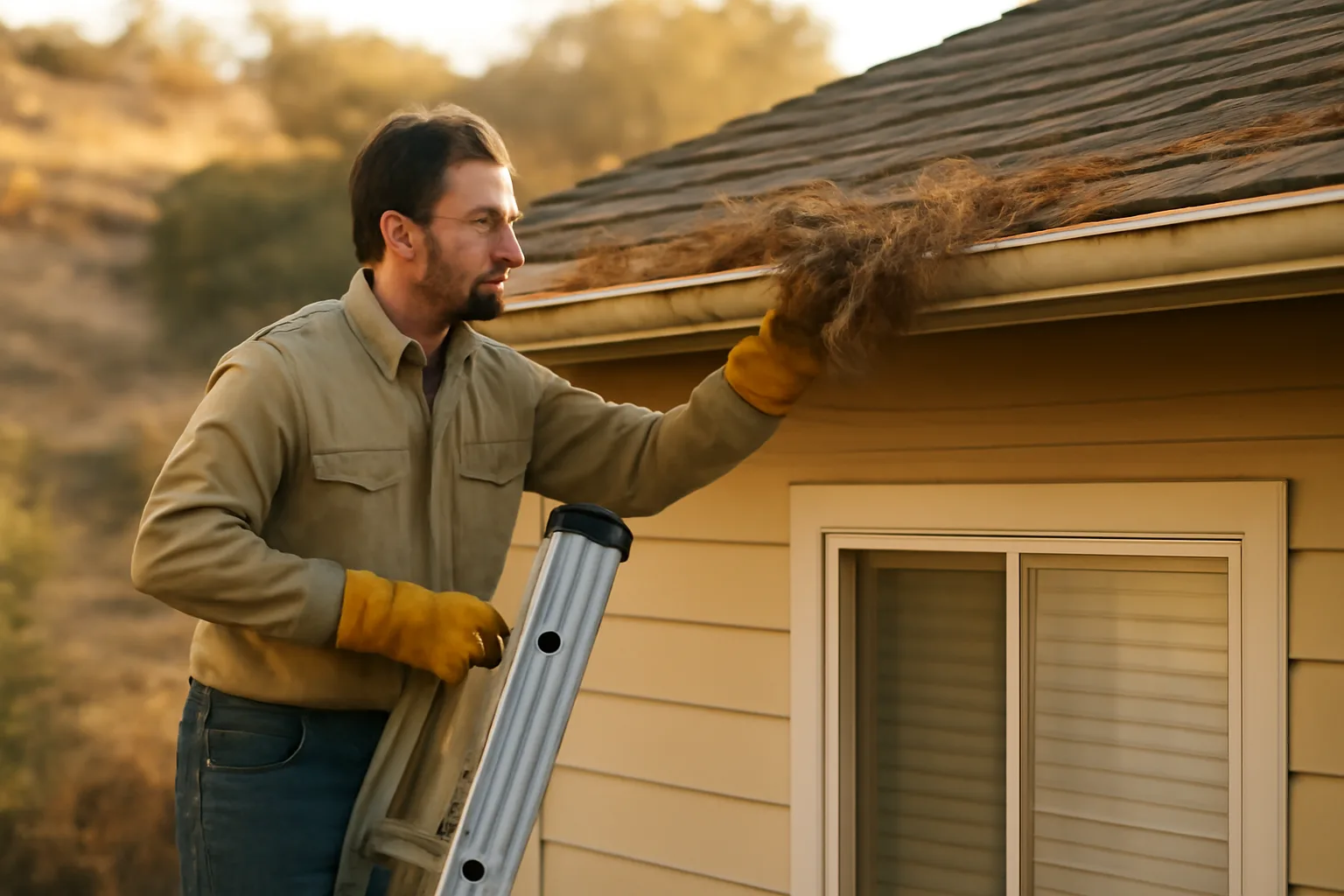
Start with the highest-leverage, lowest-cost items: test every smoke alarm in the house (press the test button, don't just assume the light means it works), and replace batteries if it's been over a year. The U.S. Fire Administration recommends testing monthly and replacing alarms entirely every 10 years [2]. Clear your gutters and roof of leaves, needles, and debris, this alone eliminates one of the most common ember-ignition points identified in IBHS research [1]. Move firewood stacks, propane tanks, and anything flammable at least 5-10 feet from your walls as a first pass, even if full defensible space compliance takes longer. Walk your property with a phone camera and photograph the current state of your roof, vents, siding, and the 5-foot zone around your foundation. This baseline documentation matters whether you're trying to get ahead of an insurance non-renewal or just want a record for yourself. It's the exact kind of record our Wildfire Insurance Survival Kit is designed to help you organize, a one-time $99 structured documentation tool, not a claims service. We don't act on your behalf with your insurer or promise reinstatement; we help you build the paper trail you'd want regardless of what your insurer decides. For a full breakdown of what "defensible space" legally means in your state and how it differs from general fire safety advice, start with our core house fire prevention and hardening guide and our piece on why "only you can prevent wildfires" is more than a slogan.
Frequently asked questions
When does the California defensible space law go into effect?
California's base defensible space law (100 feet of clearance in State Responsibility Areas) has been in effect since 2005 under Public Resources Code 4291. The newer Zone 0 (5-foot ember-resistant zone) rule from AB 3074 remained in CAL FIRE's regulatory process as of early 2025, without a confirmed final effective date; check CAL FIRE's Zone 0 page directly.
Why won't people follow the defensible space law in California?
Cost of contractor labor, physical inability to clear steep or wooded lots, uneven local enforcement, and lack of awareness are the main reasons. CAL FIRE inspection data shows meaningful first-inspection failure rates in high-severity zones, often for vegetation left within 5 feet of structures.
How do I prevent wildfires from starting?
Since roughly 85-90% of wildfires are human-caused, prevention means fully extinguishing campfires, avoiding debris burning on windy or Red Flag days, not parking on dry grass, and keeping trailer chains from dragging on pavement. Report downed power lines instead of approaching them.
How do I prepare for a wildfire?
Build a go-bag, plan two evacuation routes, sign up for county emergency alerts, harden your home's vents and gutters, clear the 5-foot zone around your structure, and document your home's condition with photos before fire season starts.
How do I prevent forest fires when camping or hiking?
Use only designated fire rings, keep fires small, never leave them unattended, and extinguish with water (not dirt) until cold to the touch. Check current fire restrictions for the specific forest before you go, since many ban campfires entirely during peak season.
What fire-safe home rules take effect in 2026?
No confirmed nationwide 2026 rule exists. California's Zone 0 regulation was still in CAL FIRE's rulemaking process as of early 2025. What's already active is Chapter 7A of the California Building Code, requiring ignition-resistant materials in WUI new construction and major remodels.
Is Santa Barbara safe from fire?
No, especially the foothill areas like Montecito and the east side, which sit in CAL FIRE's Very High Fire Hazard Severity Zone. The county has had major fires including the 2017 Thomas Fire and the deadly 2018 Montecito debris flow. Check your specific parcel's FHSZ designation.
What causes most house fires?
Cooking, involved in 49% of reported home fires per NFPA data from 2018-2022, mostly from unattended stovetops. Heating equipment and electrical wiring are the second and third leading causes.
How often should I test smoke alarms?
Test every smoke alarm monthly using the test button, and replace the entire unit every 10 years regardless of battery changes, per U.S. Fire Administration guidance. Replace batteries at least once a year, or immediately if the low-battery chirp sounds.
What is Zone 0 in California defensible space rules?
Zone 0 is the proposed 5-foot ember-resistant zone immediately around a structure, requiring non-combustible materials like gravel or pavers instead of mulch, bark, or plants. It comes from AB 3074 and was still in CAL FIRE's rulemaking process as of early 2025.
How can we prevent forest fires as individuals?
Fully extinguish campfires and cigarettes, avoid outdoor burning on windy days, keep vehicles off dry grass, maintain equipment away from dry vegetation, and report downed power lines rather than moving them. These behaviors address the roughly 85-90% of wildfires that are human-caused.
What's the difference between house fire prevention and wildfire home hardening?
House fire prevention targets ignition sources inside the home: cooking, heating, electrical. Wildfire home hardening targets ember entry points from outside: vents, gutters, roofing, and the vegetation zone right next to your walls. A wildfire-zone home needs both plans, more than one.
Sources
- U.S. Fire Administration, home fires and smoke alarm guidance: Dryer lint buildup is a leading cause of clothes dryer fires; smoke alarms should be tested monthly and replaced every 10 years
- CAL FIRE, wildfire prevention information: The large majority of wildfires are human-caused
- California Public Resources Code Section 4291: Establishes 100-foot defensible space clearance requirement around structures in State Responsibility Areas since 2005
- California Building Code, Chapter 7A: Requires ignition-resistant materials for construction in Wildland-Urban Interface fire areas
- California Department of Insurance, wildfire mitigation regulations (SB 824 / mitigation discount framework): Requires insurers to account for wildfire mitigation efforts in pricing and offer mitigation-based discounts