Last updated 2026-07-25
TL;DR
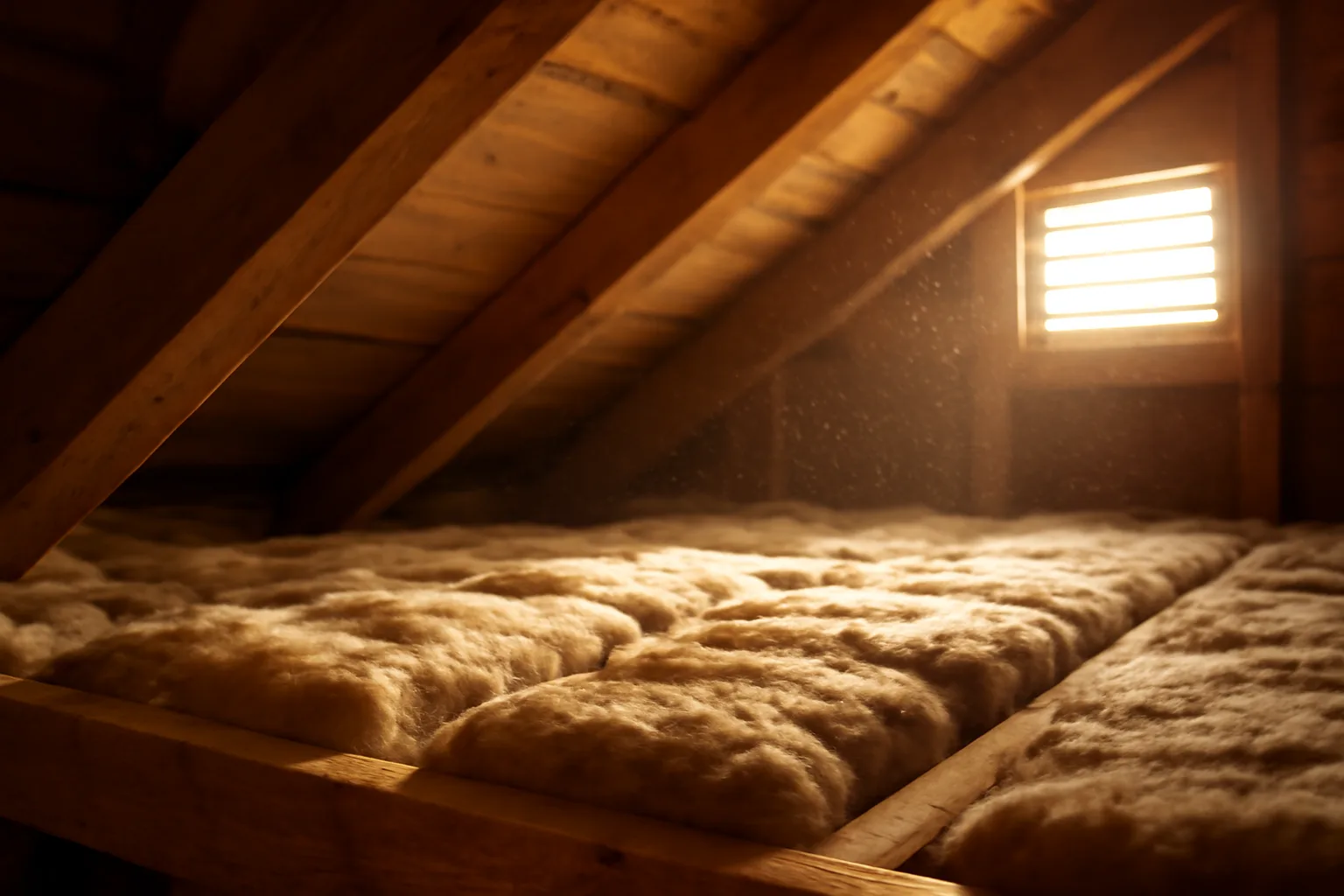
Mineral wool (rock wool) insulation resists direct flame contact up to roughly 1,800°F and doesn't melt or drip, making it the strongest fire performer for walls and attics. Fiberglass won't burn either but can shrink and expose framing. Spray foam and rigid foam board ignite at lower temperatures and produce heavy smoke, so building codes require them to be covered by a fire-rated barrier like 5/8-inch Type X drywall.
Which insulation material has the best fire resistance rating?
| Mineral wool | 1,800-2,150°F | Yes | Walls, attic, rim joists | |
|---|---|---|---|---|
| Fiberglass batt | Doesn't melt, softens under heat | Yes (glass fiber) | Walls, attic | |
| Cellulose (borate-treated) | Chars, doesn't flame-spread easily | No (treated organic) | Attic, dense-pack walls | |
| Spray foam / rigid foam | ~700°F ignition range, varies by product | No | Walls, roof decks (needs thermal barrier) | None of this replaces the exterior hardening work that actually keeps embers from reaching your walls in the first place. CAL FIRE's Zone 0 guidance, phased in under AB 3074, covers the first five feet around your home and matters more for wildfire survival than what's inside your wall cavity. For homeowners rebuilding or retrofitting after a non-renewal letter, the smart order of operations is roof and vents first, then siding and windows, then insulation choice, in that priority order. |
Mineral wool (also sold as rock wool or stone wool) has the highest melting point of any common residential insulation, typically listed between 1,832°F and 2,150°F depending on the manufacturer's blend of basalt and slag [1]. That's well above the temperature of a typical structure fire, which usually runs 1,100°F to 1,500°F in a fully involved room, and can spike higher during flashover. Fiberglass batts also qualify as noncombustible under ASTM E136 testing, since the glass fibers themselves don't burn. But fiberglass can slump or lose its facing paper in sustained heat, which lets flame reach the wood studs behind it faster than mineral wool does. Cellulose insulation is treated with borate fire retardants and passes flame-spread tests, but it's still a wood-fiber product at its core, so it chars rather than staying inert. Spray polyurethane foam and rigid foam board (XPS, EPS, polyiso) are the weakest performers on raw fire resistance. Foam plastics are organic (petroleum-based) and can ignite at much lower temperatures than mineral wool, then release dense black smoke and, in some formulations, hydrogen cyanide gas [2]. That's exactly why the International Building Code and International Residential Code require a 15-minute thermal barrier, almost always 1/2-inch gypsum board, between foam insulation and any occupied interior space [3]. If you already have foam in your attic or walls, the fire performance depends entirely on whether that gypsum barrier is intact. | Material | Melts/ignites near | Noncombustible? | Typical use |
Is mineral wool insulation worth the extra cost?
Mineral wool typically costs 20% to 40% more than comparable fiberglass batts, running roughly $1.20 to $2.00 per square foot installed versus $0.90 to $1.50 for fiberglass, depending on region and R-value [4]. For a full attic retrofit in a 2,000-square-foot home, that's usually a difference of $600 to $1,500 total, not a budget-breaker in the context of a full hardening project. Where it earns its keep is at vulnerable transition points: rim joists, above garages, around chimneys, and in any wall cavity near an ember-catching detail like a deck ledger or bay window. Mineral wool also handles moisture better than fiberglass (it doesn't wick water the same way), which matters in homes that get wildfire smoke and ash followed by monsoon or winter rain, a common pattern in Arizona and Southern California canyon lots. I wouldn't tell someone to rip out functioning fiberglass insulation from a whole house just to swap in mineral wool. That money is better spent on Zone 0 gravel or pavers, ember-resistant vents, and a Class A roof assembly, because insulation fire resistance only matters after flame or extreme radiant heat has already reached your wall cavity. If you're doing new construction, an addition, or a post-fire rebuild anyway, specifying mineral wool at the rim joists and in any wall adjacent to attached fuel (fence, deck, shed) is a reasonable upgrade for a modest cost.
When does the California defensible space law go into effect?
California's 100-foot defensible space requirement under Public Resources Code 4291 has been in effect for years and applies to homes in State Responsibility Areas and some Local Responsibility Areas designated as Very High Fire Hazard Severity Zones. What's newer is Zone 0, the ember-resistant zone within the first 5 feet of a structure. Assembly Bill 3074 (2020) directed CAL FIRE's Board of Forestry to develop Zone 0 regulations, and the Board has been working through rulemaking since then. As of the most recent public timelines, the state has targeted 2026 for Zone 0 regulations to become enforceable for existing homes in high hazard zones, though the exact effective date has shifted during the regulatory process and homeowners should check CAL FIRE's current defensible space page for the finalized date before assuming compliance deadlines [5]. Local jurisdictions can also adopt their own stricter timelines, so a rural fire district may already be citing Zone 0 concepts in inspection letters even before the state rule is final. [Guided fill-in: check with your local fire district or county fire marshal for the exact Zone 0 enforcement date and any local ordinance that predates the state rule.]
What fire safe home rules take effect in 2026?
The most consequential 2026-targeted rule is CAL FIRE's Zone 0 ember-resistant zone requirement, which would mandate noncombustible materials (rock, pavers, concrete, bare mineral soil) within 5 feet of the structure, no combustible mulch, no wood fencing attached directly to the house, and removal of items like firewood stacks or wooden furniture from that zone [5]. This is distinct from insulation choice, but it changes what's allowed to touch your exterior walls, which indirectly protects whatever insulation sits behind your siding. Separately, insurers operating in California are adjusting underwriting models under the state's Sustainable Insurance Strategy, which took effect through 2024-2025 regulatory actions and is meant to let insurers use catastrophe modeling in exchange for writing more policies in high-risk areas [6]. That's an insurance regulatory change, not a building code, but it's the reason many homeowners are getting new inspection letters that reference specific hardening items, sometimes including attic insulation and venting. Colorado, Oregon, and Arizona don't have a direct Zone 0 equivalent yet, but Oregon's SB 762 created a statewide wildfire risk map and defensible space code framework that has been phased in since 2021, with implementation details still evolving at the state fire marshal level. [Guided fill-in: confirm your state's current defensible space and home hardening code cycle with your state fire marshal's office, since requirements differ by state and even by local fire protection district.]
Why won't people follow the defensible space law in California?
Cost, labor, and enforcement gaps are the three real reasons, not ignorance of the rule. Clearing and maintaining 100 feet of defensible space on a sloped, brush-covered lot can run into the thousands of dollars annually for larger parcels, and many rural and elderly homeowners simply can't do the physical labor themselves or afford a contractor every year. Enforcement is also inconsistent. CAL FIRE and local fire departments conduct defensible space inspections, but the volume of parcels in Very High Fire Hazard Severity Zones vastly exceeds annual inspection capacity in many counties, so plenty of homeowners go years without a visit. When a letter does arrive, it's often framed as an inspection notice with a compliance deadline rather than an immediate fine, which lowers the perceived urgency. There's also a real disagreement in some communities about aesthetics and ecology, homeowners who like a wooded, natural-looking yard resist clearing native vegetation, especially when the rule reads as more about brush removal than about the specific ember-entry points that actually burn homes. The data increasingly shows the second issue (embers and small ignitions at the house itself) matters more than distant brush, which is exactly why CAL FIRE shifted attention toward Zone 0. For a broader breakdown of state-by-state clearing rules, see defensible space clearing contracts in Washington state.
How do I prevent wildfires from starting near my property?
Most wildfires near homes start from human sources, not lightning. Debris burning, equipment sparks (mowers, chainsaws, grinders), vehicle exhaust or dragging trailer chains, and unattended campfires account for the large majority of ignitions in wildland-urban interface areas, according to National Interagency Fire Center reporting patterns cited by Ready.gov. Practical prevention on your own property: mow before 10 a.m. in dry season, keep a shovel and water source at hand during any outdoor equipment use, never park a hot vehicle on dry grass, and fully drown and stir campfire ash rather than just covering it. Keep propane tanks and wood piles at least 30 feet from structures. If you have a fire district burn permit system, use it rather than burning debris on a red flag day. A lot of prevention overlaps with hardening: a Class A fire-rated roof, ember-resistant vents, and Zone 0 clearing don't stop a wildfire from starting, but they stop a nearby ignition from becoming your house fire. See our breakdown of house fire causes and prevention for the indoor-source side of this.
How do I prepare for a wildfire before it happens?
Ready.gov's wildfire preparedness guidance centers on three things: build a go-bag, harden the home, and have an evacuation plan with more than one route out [7]. Don't wait for a red flag warning to figure out where your documents, medications, and pet carriers are. A reasonable preparation checklist: photograph every room and major asset for insurance documentation, keep copies of your policy declarations page off-site or in cloud storage, know your exact defensible space zone requirements for your address, and pre-stage a hose long enough to reach your roofline. If you've received a non-renewal or inspection letter, documentation matters as much as physical prep, insurers and FAIR Plans want to see dated photos and receipts showing you've done the hardening work, more than a verbal claim that you did. This is where a lot of homeowners get stuck, not because the hardening work is impossible, but because organizing proof of it for an insurer is tedious and easy to put off. A $99 one-time Wildfire Insurance Survival Kit (available at /survival-kit-builder) is built around exactly that documentation gap: a structured way to log defensible space work, material specs, and dated photos in the format insurers and FAIR Plans actually want to see. We don't contact your insurer or file claims for you; you prepare and send your own documentation, we just help you build it correctly the first time.
How can we prevent forest fires and reduce risk at the community level?
Individual home hardening only goes so far if the whole block or canyon is still vulnerable. Community-level prevention includes coordinated fuel breaks, shared chipper days for cleared vegetation, and neighborhood-level compliance with local defensible space ordinances, since a single unmaintained lot can undermine a whole street's hardening work. The US Forest Service and CAL FIRE both fund Fire Safe Councils and Firewise USA communities, which organize collective brush clearing, evacuation drills, and grant applications for larger fuel reduction projects [8]. If your neighborhood doesn't have one, starting a Firewise USA recognition process is free and gives residents access to National Fire Protection Association resources and, in some states, insurance discount eligibility (though eligibility and discount amounts vary by insurer and state, so confirm locally rather than assuming a specific percentage). At a landscape level, prescribed burning and mechanical thinning on public land reduce the fuel load that turns a small ignition into a fast-moving crown fire, though funding and staffing for that work varies year to year with federal and state budgets.
Is Santa Barbara safe from fire risk?
No coastal or foothill community in California is fully insulated from wildfire risk, and Santa Barbara County has direct experience with this: the 2017 Thomas Fire burned over 281,000 acres and was, at the time, the largest wildfire in modern California history, followed within weeks by the deadly Montecito debris flow that killed 23 people [9]. The 1990 Painted Cave Fire and 2009 Jesusita Fire also burned into Santa Barbara's urban edge, both starting in the same foothill wildland-urban interface that still exists today. Parts of Santa Barbara city itself sit in or near a Very High Fire Hazard Severity Zone as mapped by CAL FIRE, particularly neighborhoods against the foothills like the Riviera, Mission Canyon, and the upper Eastside . Lower, flatter areas closer to the ocean carry meaningfully lower wildfire risk but aren't zero, since ember cast from a wind-driven fire can travel over a mile. If you own property in Santa Barbara County and got an inspection or non-renewal letter, check your specific parcel against the current CAL FIRE Fire Hazard Severity Zone viewer rather than relying on the county's general reputation, because risk varies block by block, more than by city name.
What's the priority order for fire-hardening a home, and where does insulation fit?
Roof, vents, and Zone 0 clearing come first because they address the two ways homes actually ignite: direct ember entry and radiant heat from nearby fuel. Insulation choice sits lower on the priority list because it only becomes relevant after flame has already breached the exterior assembly. A reasonable order for a homeowner working with a limited budget: (1) Class A roof covering and ember-resistant attic and foundation vents, (2) Zone 0 noncombustible zone within 5 feet, (3) ignition-resistant or noncombustible siding, (4) dual-pane tempered windows, (5) gutters cleared of debris and covered, (6) insulation upgrades at rim joists and vulnerable wall sections. See fire safe landscaping next to a house for the Zone 0 planting and hardscape specifics, and defensible space for the broader zone system. If you're already mid-renovation or rebuilding after a fire loss, that's the moment to specify mineral wool at rim joists and any wall adjacent to attached combustibles, since the marginal cost during new construction is much lower than a retrofit later.
Frequently asked questions
When does the California defensible space law go into effect?
The 100-foot defensible space rule under Public Resources Code 4291 is already in effect and has been for years. The newer Zone 0 ember-resistant zone rule, mandated by AB 3074, is targeted for 2026 enforcement in high hazard zones, but the exact date has shifted during CAL FIRE's Board of Forestry rulemaking process, so confirm the current date with your local fire district.
Why won't people follow California's defensible space law?
Cost, labor, and inconsistent enforcement are the main reasons. Clearing 100 feet on a sloped brush lot can cost thousands per year, many homeowners can't do the physical work themselves, and inspection capacity in Very High Fire Hazard Severity Zones doesn't match the number of parcels, so many properties go uninspected for years despite the rule being on the books.
What fire safe home rules take effect in 2026?
CAL FIRE's Zone 0 ember-resistant zone rule, requiring noncombustible material within 5 feet of structures, is the headline 2026-targeted change in California. It bans combustible mulch, wood fencing attached to the house, and stored combustibles in that zone. Confirm your exact local timeline, since some fire districts already enforce similar standards ahead of the state deadline.
Is Santa Barbara safe from wildfire?
No. Santa Barbara County has burned repeatedly, including the 2017 Thomas Fire (281,000+ acres) and the 2009 Jesusita and 1990 Painted Cave fires, both of which reached the city's edge. Foothill neighborhoods sit in mapped Very High Fire Hazard Severity Zones. Risk varies block by block, so check CAL FIRE's hazard zone viewer for your specific address rather than assuming based on the city's coastal reputation.
Which insulation material has the highest fire resistance?
Mineral wool (rock wool) has the highest fire resistance among common residential insulation, with a melting point around 1,800°F to 2,150°F and no dripping or flame spread. Fiberglass is also noncombustible but can slump under heat. Foam plastics ignite at much lower temperatures and require a code-mandated gypsum thermal barrier.
Does fiberglass insulation catch fire?
Fiberglass itself doesn't burn because it's made of glass fibers, but it can soften, shrink, or lose its paper facing under sustained high heat, exposing the wood framing behind it sooner than mineral wool would. It's still considered noncombustible under standard ASTM E136 testing.
Is spray foam insulation a fire hazard?
Spray polyurethane foam can ignite at lower temperatures than mineral wool or fiberglass and produces dense, sometimes toxic smoke when burning. Building codes require a 15-minute-rated thermal barrier, typically 1/2-inch gypsum board, between foam insulation and living space. If that barrier is missing or damaged, the foam's fire risk increases significantly.
How do I prevent wildfires from starting on my own property?
Avoid mowing dry grass after 10 a.m., keep a shovel and water nearby during outdoor power equipment use, never park hot vehicles on dry vegetation, fully drown campfire ash, and keep wood piles and propane tanks at least 30 feet from structures. Most wildland-urban interface fires start from human activity, not lightning.
How do I prepare for a wildfire evacuation?
Build a go-bag with medications, documents, and pet supplies, plan at least two evacuation routes, and photograph your home and belongings for insurance documentation before a fire threatens. Ready.gov recommends treating evacuation planning and home hardening as equally important, not sequential, steps.
How can communities prevent forest fires together?
Organized fuel breaks, shared vegetation-clearing events, and joining a Firewise USA community all help, since one unmaintained lot can undermine a whole neighborhood's hardening work. CAL FIRE and the US Forest Service both support Fire Safe Councils that coordinate larger fuel reduction and grant funding at the community level.
Is mineral wool insulation worth the higher cost compared to fiberglass?
For a full-house retrofit just for fire resistance, usually not, the money is better spent on roof, vents, and Zone 0 clearing. For new construction or a rebuild, specifying mineral wool at rim joists and walls near attached combustibles (decks, fences) is a reasonable, modest-cost upgrade given its much higher melting point.
Do fire-resistant insulation choices affect my home insurance rates?
Insulation choice alone rarely changes a quote, since underwriters focus on roof material, defensible space, and vent screening first. Some insurers and FAIR Plans do ask about overall wall assembly fire ratings during inspections, so documenting your insulation type and any gypsum thermal barrier can support your file if questioned.
What is Zone 0 and how is it different from defensible space?
Zone 0 is the innermost 5 feet around a structure, requiring noncombustible ground cover and no attached combustible items like wood fences or mulch. Broader defensible space under PRC 4291 extends up to 100 feet and focuses on vegetation thinning and spacing rather than strictly noncombustible materials.
Sources
- North American Insulation Manufacturers Association, mineral wool product data: Mineral wool melting point range of roughly 1,832°F to 2,150°F
- Consumer Product Safety Commission, foam plastics combustion hazard review: Foam plastic insulation ignition behavior and smoke/gas hazards
- International Code Council, IRC Section R316 foam plastic thermal barrier requirement: Requirement for a 15-minute thermal barrier over foam plastic insulation in occupied spaces
- California Public Resources Code Section 4291: 100-foot defensible space clearing requirement for structures in State Responsibility Areas
- California Department of Insurance, Sustainable Insurance Strategy: California's regulatory changes allowing catastrophe modeling in exchange for expanded high-risk coverage
- Oregon State Legislature, Senate Bill 762 (2021): Oregon's statewide wildfire risk mapping and defensible space code framework
- National Fire Protection Association, Firewise USA program: Community-level wildfire risk reduction through Firewise USA recognized neighborhoods
- CAL FIRE, Thomas Fire incident information: 2017 Thomas Fire burned over 281,000 acres in Ventura and Santa Barbara counties
- CAL FIRE, Fire Hazard Severity Zone Viewer: Mapped Very High Fire Hazard Severity Zones in Santa Barbara County foothill neighborhoods