Last updated 2026-07-25
TL;DR
Wildfire defense mesh is fine, corrosion-resistant screening (usually 1/8-inch, sometimes called ember-resistant vent mesh) installed over attic, foundation, and eave vents to stop wind-blown embers from entering a home. California's Chapter 7A building code requires it on new construction and additions in Fire Hazard Severity Zones; existing homes are covered under a phased retrofit law that still needs final state regulations to take effect.
What is wildfire defense mesh, exactly?
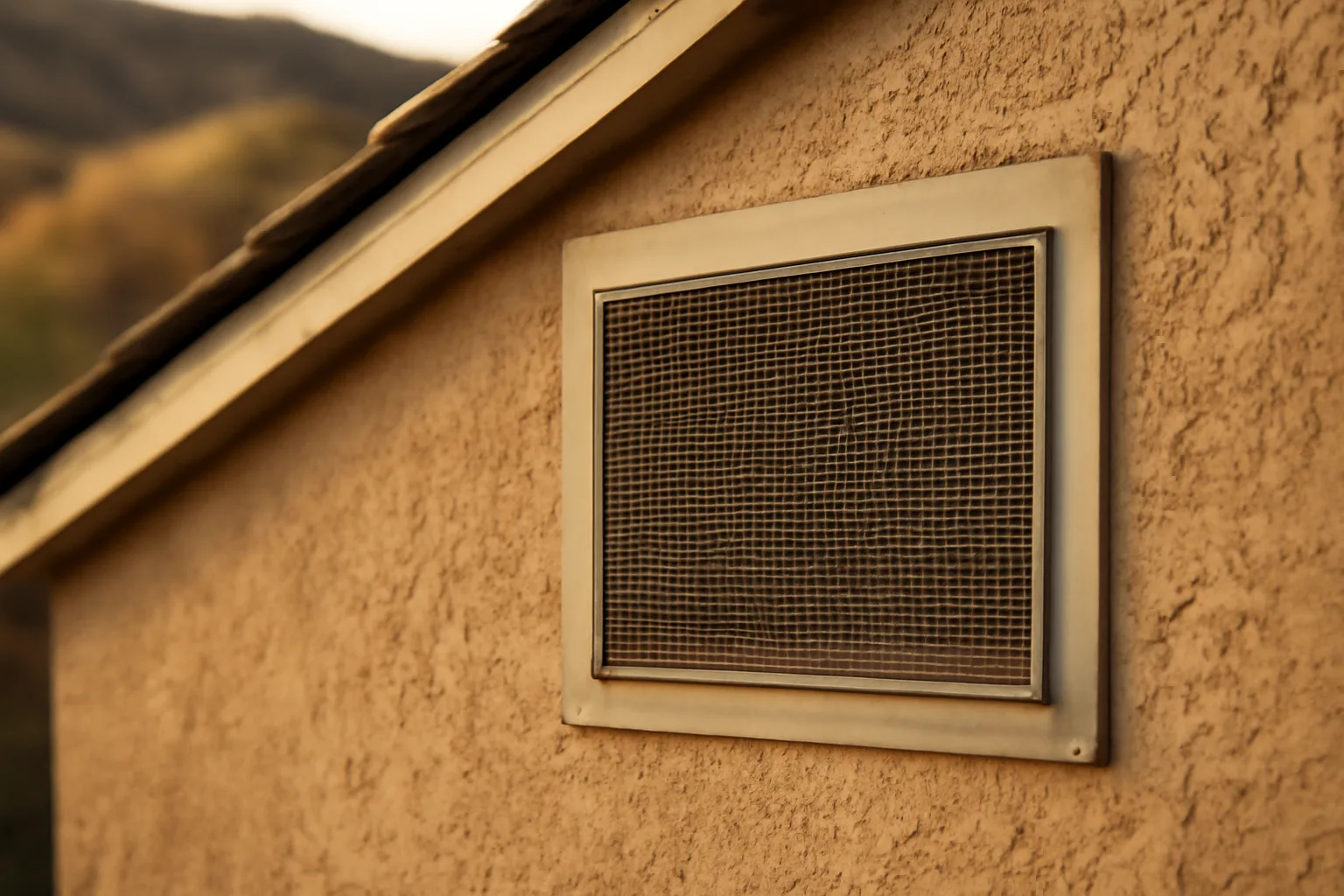
Wildfire defense mesh is metal screening, usually corrosion-resistant steel or bronze, installed over every vent opening in a home so embers can't blow inside and ignite insulation, framing, or debris in the attic. It's not a fabric or coating. It's hardware, and it's one of the cheapest, highest-leverage things you can do to a house in a fire zone. Embers, not the flame front, are what actually destroys most homes in a wildfire. Embers can travel over a mile ahead of a fire and land on or inside a structure through gaps as small as a vent opening. If a vent has standard insect screen (usually 1/4-inch mesh) or no screen at all, embers get sucked in by the building's own draft and start a fire inside the attic where nobody can see it until it's too large to stop. The fix codified in California's building code is straightforward: cover vents with corrosion-resistant, noncombustible mesh with openings no larger than 1/8 inch, and no smaller than 1/16 inch (too fine and it clogs with debris and restricts airflow) [1]. Some products marketed as 'ember-resistant vents' combine the mesh with a baffle or intumescent material that swells shut under heat, but the mesh screen alone, correctly sized and installed, is the baseline requirement. This single component shows up in nearly every serious home-hardening checklist, right alongside the broader work covered in defensible space clearing and the landscaping buffer described in fire safe landscaping next to the house.
Does wildfire defense mesh actually stop embers?
Yes, when it's the right mesh size, the right material, and installed with no gaps. Research from the Insurance Institute for Business & Home Safety (IBHS) and the U.S. Forest Service's ember-storm testing shows that vents are one of the top entry points for embers into structures, and that mesh screening sized at 1/8 inch significantly reduces ember intrusion compared to standard 1/4-inch insect screening [2]. The mesh isn't magic. It stops embers and larger firebrands from physically entering the vent cavity. It does very little against radiant heat or direct flame contact, which is why mesh has to be paired with noncombustible siding, ember-resistant eaves, and a cleared zone right next to the foundation. CAL FIRE's own guidance frames vent screening as one piece of a layered hardening strategy, not a standalone fix [3]. Material matters too. Fiberglass or plastic screen melts. Standard aluminum screen can soften and deform under sustained heat. That's why code specifies corrosion-resistant metal, typically stainless steel or a heavier-gauge galvanized steel, sometimes bronze on coastal homes where salt air corrodes cheaper metals within a few years.
When does the California defensible space law go into effect?
California's core defensible space law (Public Resources Code 4291) has been in effect since it was last substantially amended in 2020, requiring 100 feet of defensible space clearance around homes in State Responsibility Areas and some local Very High Fire Hazard Severity Zones [4]. That part is already active and enforced today. What's still pending is the companion 'Zone 0' ember-resistant zone rule (the first 5 feet around a structure), created by Assembly Bill 3074 in 2020. That law directed the Board of Forestry and Fire Protection to develop specific regulations for the 0-5 foot zone, but as of 2024 those regulations were still in the rulemaking process and had not been formally adopted or given an enforcement date [5]. The Board has released draft regulatory language and continued stakeholder workshops, but homeowners should not assume Zone 0 is legally enforceable yet in their area; check with your local fire district for the current status, since some jurisdictions are adopting stricter local ordinances ahead of the state rule. Building code requirements (Chapter 7A, which covers vent mesh, roofing, siding, and windows) are a separate track and apply now to new construction, additions over 50% of existing floor area, and major remodels in Fire Hazard Severity Zones. Chapter 7A does not automatically require retrofitting mesh onto an existing, unmodified older home, though several local ordinances and insurer mitigation programs do push retrofits.
What fire-safe home rules take effect in 2026?
The honest answer: there is no single nationwide 2026 fire-safe home mandate. What's happening instead is a patchwork of state-level rulemaking, and 2026 shows up as a target or review year in a few different tracks, not one unified deadline. In California, the Zone 0 regulations under AB 3074 have been through extended rulemaking, and the Board of Forestry has discussed phased compliance timelines in draft proposals, but as of this writing no final regulation with a hard 2026 effective date has been chaptered into the Government Code. Homeowners in high-severity zones should treat any '2026' date they see online as provisional until the Board of Forestry's official rulemaking page confirms adoption [5]. Separately, insurers operating under California's Safer from Wildfires regulation (which took effect in 2022) are required to give discounts or credits for specific mitigation actions, including ember-resistant vents, and the California Department of Insurance has continued to update guidance on how those credits get verified [6]. If your renewal or non-renewal letter references specific hardening standards, treat that letter, not a general news date, as your actual compliance deadline. Colorado, Oregon, and Arizona each have their own separate tracks. Oregon's wildfire hazard mapping and defensible space code requirements (under Senate Bill 762, passed 2021) went through a contentious rollout and revision process, including a 2023 legislative pause after public pushback over the hazard map itself [7]. Check your specific county and fire district; state-level rules in all four states are unusually fluid right now.
How do I install wildfire defense mesh correctly?
Mesh installed wrong is close to useless, so the details matter more than the material choice. First, measure every vent opening: attic gable vents, soffit vents, foundation and crawlspace vents, and any dryer or bathroom exhaust vents that exit through an exterior wall or roof. Second, choose 1/8-inch mesh in corrosion-resistant metal (stainless steel is the most common, 304 or 316 grade for coastal exposure). Third, the mesh has to cover the entire vent opening with no gaps at the frame, secured with screws or rivets, more than friction-fit or stapled on. A common mistake is stacking standard insect screen behind new ember-resistant mesh and assuming that's equivalent to a certified ember-resistant vent assembly. It isn't. Products tested and listed under the State Fire Marshal's Building Materials Listing Program for wildfire-resistant vents have been through an actual ignition-resistance test as an assembly, more than a mesh-size spec sheet. If you're in a Fire Hazard Severity Zone doing new construction or a qualifying remodel, code requires a listed assembly, not a DIY screen retrofit. For existing homes doing voluntary retrofits (not triggered by a permit), DIY mesh over vents is still meaningfully better than nothing, and it's one of the lower-cost upgrades on the hardening list, typically running somewhere in the range of $15-$40 per vent in material cost if you're handy, versus several hundred dollars per vent for professional installation of a full listed assembly. Bathroom and dryer vents need special attention: many older homes have these terminating in soffits with plastic housings or flapper vents that will deform under heat well before an ember ever reaches the mesh.
How do I prepare for a wildfire, beyond just mesh?
Vent mesh is one line item in a longer hardening and preparedness checklist. Treat it as part of a system: structure hardening, defensible space, and an evacuation plan, in that order of what actually saves the house versus what saves you. CAL FIRE and Ready.gov both organize home hardening around the same core categories: roof, gutters, vents, windows, decks, siding, and the zones of vegetation clearance around the structure [8]. Ready.gov's wildfire preparedness guidance specifically recommends creating and maintaining defensible space, using fire-resistant building materials, and having a family emergency communication and evacuation plan ready before fire season, not during it [8]. A practical prep sequence: clear gutters and roof valleys of dead leaves and needles (a top ignition point from falling embers), install or verify ember-resistant vent mesh, remove combustible material within 5 feet of the foundation (mulch, wood piles, dry plants), and confirm your address is clearly visible from the road for responding fire crews. Then build the evacuation side: a go-bag, a family meeting point, and copies of insurance documents and home inventory stored somewhere other than the house itself. Documentation matters more than most homeowners realize until they're filing a claim. Photos of installed vent mesh, receipts for hardening work, and a dated inventory of the home's condition before fire season are the difference between a fast claims process and a drawn-out dispute. This is the gap a lot of non-renewed homeowners fall into: they did the mitigation work but never documented it in a form an insurer or adjuster can quickly verify. That's the specific problem the $99 Wildfire Insurance Survival Kit is built to solve: a structured way to document hardening work and home condition before you need it, not a claims-filing service. We don't negotiate with insurers or file claims on your behalf; you send your own documentation.
How to prevent wildfires from starting in the first place
Roughly 85-90% of wildfires in the U.S. are human-caused, according to the National Park Service and multiple federal wildfire agencies, meaning the single highest-leverage prevention action is controlling ignition sources, more than hardening structures after a fire starts . The most common human-caused ignition sources include unattended campfires, debris burning, equipment use (chainsaws, mowers, grinders that throw sparks onto dry grass), vehicle exhaust or dragging chains on pavement, fireworks, and downed or arcing power lines. Preventing wildfires at the source means: fully extinguish campfires (drown, stir, drown again, and check for heat with your hand before leaving), avoid mowing or using power equipment on dry, windy days, never park a hot vehicle on dry grass, and follow local burn-ban restrictions, which most counties post seasonally. At the home and neighborhood level, prevention also means maintaining defensible space so that if a fire does start nearby, it doesn't have a fuel path to your structure. CAL FIRE's guidance is explicit that defensible space is about slowing or stopping fire spread and giving firefighters a safer space to defend a home, not eliminating fire risk entirely. That's the same logic behind the only you can prevent wildfires messaging that's been part of federal fire prevention campaigns since the 1940s: individual behavior is the biggest lever. Utility-related ignitions are a separate category homeowners can't control directly but should know about: several major California wildfires, including some of the state's most destructive, have been linked to utility equipment failures, which is part of why utilities in high-risk areas now conduct Public Safety Power Shutoffs during extreme fire weather.
Why won't people follow the defensible space law in California?
Compliance with Public Resources Code 4291 is inconsistent, and the reasons are more practical than defiant. Cost is the biggest one: clearing 100 feet of defensible space on a sloped, heavily vegetated lot can run into the thousands of dollars, especially for elderly or fixed-income homeowners who can't do the physical labor themselves and have to hire it out. Confusion is the second big driver. The 100-foot rule has different specifics depending on zone (0-5 feet, 5-30 feet, 30-100 feet), slope, and local ordinance additions, and many homeowners genuinely don't know what's required until an inspector shows up. A 2021 legislative analysis and multiple CAL FIRE public communications have noted that enforcement varies significantly by county, with some fire districts doing proactive inspections and others responding complaint-driven, which means two neighbors on the same street can face very different actual enforcement pressure . There's also a real tension between defensible space rules and other values: mature trees people don't want to remove, privacy screening, erosion control on slopes, and in some cases local tree protection ordinances that conflict with clearance requirements. None of these excuse noncompliance from a fire-safety standpoint, but they explain why adoption isn't universal even where the law is clear. Finally, some homeowners simply don't believe it will happen to them, a well-documented psychological bias in disaster preparedness research generally: normalcy bias leads people to underweight low-frequency, high-consequence events until they've had a personal or near-miss experience.
Is Santa Barbara safe from fire?
No California coastal community, including Santa Barbara, is 'safe' from fire in any absolute sense; the honest framing is relative risk and mitigation, not safety as a binary. Santa Barbara County has a well-documented history of significant wildfires, including the 1990 Painted Cave Fire and the 2017 Thomas Fire, which at the time was the largest wildfire in modern California history by acreage and burned into the following winter's Montecito debris flow disaster that killed 23 people . The hills above Santa Barbara and Montecito sit directly against chaparral-covered slopes with steep terrain and Santa Ana/sundowner wind patterns that have historically driven fast-moving, wind-driven fires. CAL FIRE's Fire Hazard Severity Zone maps classify large portions of the Santa Barbara foothills and adjacent unincorporated areas as Very High or High severity zones, which is the same classification tier used to trigger Chapter 7A building code requirements and the 100-foot defensible space rule [1] [4]. If you own or are considering property in the Santa Barbara foothills, checking your parcel against the current CAL FIRE severity zone map is a concrete first step, not a formality; it determines what code applies to any remodel or new construction on the property. The practical takeaway isn't that Santa Barbara is uniquely dangerous compared to other California wildland-urban interface communities; it's that any hillside community with chaparral fuel, steep terrain, and seasonal offshore winds carries real structural fire risk, and mitigation work (defensible space, vent mesh, ember-resistant roofing) measurably changes a home's odds in that specific setting.
How to prevent forest fires and protect property at the same time
'Preventing forest fires' and 'protecting your home from forest fires' are related but distinct goals, and conflating them is a common mistake. Forest fire prevention is mostly about ignition control across a landscape (as covered above); protecting your home is about survivability once a fire is already burning nearby. On public and shared land, prevention efforts homeowners can actually participate in include supporting or attending prescribed burn and fuel-reduction projects run by the U.S. Forest Service and state agencies, reporting unattended fires or suspicious smoke promptly, and following local burn permit rules. The U.S. Forest Service's Smokey Bear campaign statistic that roughly 9 in 10 wildfires are human-caused is the foundational data point behind most public fire-prevention messaging, and it applies to forest fires specifically as much as it does to wildland-urban interface fires generally . On your own property, forest-fire protection converges with the same defensible space and hardening work already covered: the three-zone clearance system (immediate zone 0-5 feet, intermediate zone 5-30 feet, extended zone 30-100 feet), ember-resistant vents, noncombustible roofing, and gutter maintenance. If your property borders national forest or state forest land, check whether your local fire district participates in Firewise USA or a similar community-level program; these programs coordinate fuel reduction across property lines, which matters because defensible space on one lot doesn't help much if the neighboring parcel is untouched, given how far embers travel.
How do vent mesh requirements compare across CA, CO, OR, and AZ?
| California | Chapter 7A, Title 24 Building Code; PRC 4291 (defensible space) | 1/8 inch corrosion-resistant mesh, listed assemblies required in new construction/major remodel in Fire Hazard Severity Zones [1] | Active; Zone 0 (0-5 ft) rules under AB 3074 still in rulemaking [5] | |
|---|---|---|---|---|
| Colorado | No single statewide wildfire building code; county/local adoption of International Wildland-Urban Interface Code (IWUIC) varies | Varies by county; some adopt IWUIC vent-screening provisions, others have no mesh mandate | Patchwork; check county planning department | |
| Oregon | Senate Bill 762 (2021); Oregon Department of Forestry hazard mapping | Defensible space and code standards tied to hazard map designation; map rollout paused and revised after 2022-2023 public pushback [7] | In flux; final mapping and code triggers under revision | |
| Arizona | No statewide wildfire building code; local/county wildland-urban interface ordinances in some high-risk counties (e.g., Coconino, Yavapai) | Varies by county ordinance; some require ember-resistant vents in designated WUI zones | Local-only; no statewide mandate as of 2025 | [Guided fill-in: enter your county/fire district here to note the specific mitigation rule that applies to your property, since this table is a starting reference, not a substitute for your local fire marshal's current requirements.] The pattern across all four states is the same: California has moved furthest toward a statewide mandate, while Colorado, Oregon, and Arizona lean on county-level or local fire district ordinances that can be stricter or looser than any state baseline. If you got a non-renewal or inspection letter, the letter itself, and a call to your specific fire district, are more reliable than any state-level summary, including this one. |
Requirements vary meaningfully by state, and none of them are static right now, so treat this as a starting point for your own district's guided fill-in. | State | Governing code/law | Vent mesh requirement | Status as of 2025 |
What should I document once mesh and hardening work are done?
Once vent mesh, roofing, and defensible space work are done, the single biggest mistake homeowners make is not documenting it in a form insurers and adjusters can use quickly. Photograph every installed vent (before and after), keep receipts and contractor invoices, and note the mesh size and material on record, since '1/8 inch stainless steel, installed [date]' is a very different insurance conversation than 'I think we did the vents.' Many insurers, especially those operating under California's Safer from Wildfires framework, are required to offer premium credit or discount consideration for specific, documented mitigation actions [6]. Without documentation, you can't claim the credit, and after a fire, you can't demonstrate pre-loss condition for a claim either. A simple system: a dated folder (physical or digital) with photos of every hardening upgrade, contractor invoices, before/after shots of defensible space clearance, and a running home inventory. This is exactly the gap the Wildfire Insurance Survival Kit is built for: a $99 one-time structured way to organize that documentation into something an insurer or adjuster can review quickly, not a claims-filing or negotiation service. We don't negotiate with insurers, file claims, or promise coverage outcomes; you assemble and send your own documentation, and this just makes that process faster and harder to get wrong. For anyone recently non-renewed or worried about a coming inspection, pairing that documentation work with the broader hardening context in house fire prevention and fire at a house response basics rounds out the picture: prevention, hardening, and paperwork, together, are what actually change outcomes.
Frequently asked questions
When does the California defensible space law go into effect?
The core 100-foot defensible space law (Public Resources Code 4291) is already in effect and has been enforced for years. What's still pending is the Zone 0 (0-5 foot) ember-resistant zone rule from AB 3074, which was still in state rulemaking as of 2024 with no confirmed enforcement date; check the Board of Forestry's site for current status.
Why won't people follow the defensible space law in California?
Cost, confusion about zone-specific requirements, physical inability to do the clearing labor, and inconsistent county-level enforcement are the main reasons. Clearing a sloped, heavily vegetated lot can cost thousands of dollars, and requirements differ by zone, slope, and local ordinance, which leads to genuine confusion, more than noncompliance out of defiance.
How do I prevent wildfires from starting near my property?
Fully extinguish campfires, avoid using spark-throwing equipment on dry windy days, never park hot vehicles on dry grass, follow local burn restrictions, and maintain defensible space so a nearby ignition doesn't reach your structure. Roughly 85-90% of wildfires are human-caused, so controlling ignition sources is the highest-leverage prevention step.
How do I prepare for a wildfire if I live in a high-risk zone?
Harden the structure (vent mesh, ember-resistant roofing, gutter maintenance), maintain the three defensible space zones out to 100 feet, and build an evacuation plan with a go-bag and family communication point before fire season starts. Ready.gov recommends having this plan in place well ahead of any active fire threat.
How can we prevent forest fires at the community level?
Support prescribed burn and fuel-reduction programs run by the U.S. Forest Service or state agencies, report unattended fires or suspicious smoke immediately, follow local burn permits, and coordinate defensible space clearing with neighbors, since embers ignore property lines. Community-level programs like Firewise USA organize exactly this kind of coordinated fuel reduction.
What fire-safe home rules take effect in 2026?
There's no confirmed single 2026 nationwide rule. California's Zone 0 regulations have been in extended rulemaking with no final adopted date as of this writing; Oregon's hazard-map-triggered code requirements are also under revision. Treat any specific '2026' date as provisional until your state fire marshal or Board of Forestry confirms adoption.
Is Santa Barbara safe from fire?
No community in the wildland-urban interface is fully 'safe,' and Santa Barbara's foothills carry real risk: chaparral fuel, steep terrain, and sundowner winds drove the 1990 Painted Cave Fire and the 2017 Thomas Fire. Much of the Santa Barbara foothills falls in CAL FIRE's Very High or High Fire Hazard Severity Zones, triggering stricter building code.
What size mesh do I need for ember-resistant vents?
California's Chapter 7A building code specifies corrosion-resistant, noncombustible mesh with openings no larger than 1/8 inch and no smaller than 1/16 inch. Stainless steel (304 or 316 grade in coastal or corrosive environments) is the most common material used in listed, code-compliant vent assemblies.
Can I install ember-resistant vent mesh myself?
For voluntary retrofits on existing homes not triggered by a building permit, DIY mesh installation is allowed and meaningfully better than no mesh at all, typically $15-$40 per vent in materials. For new construction or qualifying remodels in Fire Hazard Severity Zones, code requires a tested, listed vent assembly, not a standalone DIY screen.
Does vent mesh alone protect my home from wildfire?
No. Mesh stops ember intrusion through vent openings specifically, but it does nothing against radiant heat or direct flame contact. CAL FIRE frames it as one layer in a broader hardening strategy that also needs noncombustible siding, ember-resistant roofing, and cleared defensible space around the foundation.
How to avoid forest fires when doing yard work or camping?
Avoid mowing, grinding, or using chainsaws on hot, dry, windy days since sparks from equipment are a common ignition source. Fully drown and stir campfires until cold to the touch, never leave them unattended, and check local burn bans before any debris burning; most human-caused fires trace back to exactly these everyday activities.
Do insurers give discounts for installing ember-resistant vent mesh?
Under California's Safer from Wildfires regulation, insurers are required to consider specific mitigation actions, including ember-resistant vents, for premium credits, though the exact discount amount varies by insurer. You need documented proof (photos, receipts, mesh specifications) to claim any credit; undocumented work generally doesn't count.
Sources
- California Building Standards Commission, Title 24 Chapter 7A: Vent mesh openings must be corrosion-resistant, noncombustible, and sized between 1/16 inch and 1/8 inch.
- IBHS, Wildfire Prepared Home Standard: Vents are a top ember entry point and 1/8-inch mesh reduces ember intrusion versus standard insect screen.
- CAL FIRE, Ready for Wildfire home hardening guidance: Vent screening is one component of a layered home hardening strategy, not a standalone fix.
- California Public Resources Code Section 4291: State law requires 100 feet of defensible space clearance around structures in State Responsibility Areas.
- California Board of Forestry and Fire Protection, Zone 0 Ember-Resistant Zone rulemaking: Zone 0 regulations under AB 3074 were still in active rulemaking with no final adopted enforcement date as of the cited period.
- California Department of Insurance, Safer from Wildfires regulation: Insurers must consider specific wildfire mitigation actions, including ember-resistant vents, for premium discounts or credits.
- California Office of the State Fire Marshal, Building Materials Listing Program: Ember-resistant vent products must be tested and listed as an assembly, more than spec'd by mesh size alone.
- California Legislative Analyst's Office, wildfire mitigation enforcement analysis: Enforcement of defensible space requirements varies significantly by county and local fire district.