Last updated 2026-07-25
TL;DR
California fire prevention centers on defensible space law (PRC 4291), already active statewide, requiring 100 feet of cleared, zoned vegetation around homes in State Responsibility Areas. A stricter Zone 0 (ember-resistant zero-to-5-foot) rule is moving through CAL FIRE's Board of Forestry rulemaking, with 2026 cited as a likely enforcement horizon for many high-risk parcels, though the exact statewide compliance date is still being finalized.
When does the California defensible space law go into effect?
The core defensible space law is not new and it is not waiting for 2026. Public Resources Code 4291 has required 100 feet of defensible space around homes in State Responsibility Areas (and many Local Responsibility Areas with similar local ordinances) since amendments took effect in 2005, when the distance was expanded from 30 feet to 100 feet [1]. If you got a non-renewal or inspection letter this year, you are already subject to this law, not waiting on some future deadline. What is genuinely new, and genuinely confusing, is Zone 0. In 2020, the legislature passed AB 3074, which directed the Board of Forestry and Fire Protection to develop regulations for an ember-resistant zone within 5 feet of structures [2]. That zone (Zone 0) is not yet a final, statewide enforced regulation as of this writing. CAL FIRE and the Board have been through multiple rulemaking drafts, and the target for finalizing and beginning enforcement has repeatedly been described in state materials and legislative summaries as 2025 into 2026, with local jurisdictions given lead time before individual property enforcement. So the honest answer has two parts. The 100-foot, three-zone defensible space law is already in effect, already enforceable, already the reason your inspector is on your property. The Zone 0 five-foot ember-resistant standard is in active rulemaking, with 2026 as the most commonly cited target window in state legislative tracking. Check your local CAL FIRE unit or fire district for the exact local timeline before you assume a specific date applies to your address. If an inspector cited you, ask specifically which code section: PRC 4291 (existing, 100 ft) or a local Zone 0 ordinance already adopted ahead of the state timeline. Some cities, including parts of the Bay Area, have already implemented their own version of a 0-5 foot zone rule ahead of the state's finalized regulation.
What fire safe rules take effect in 2026 for California homes?
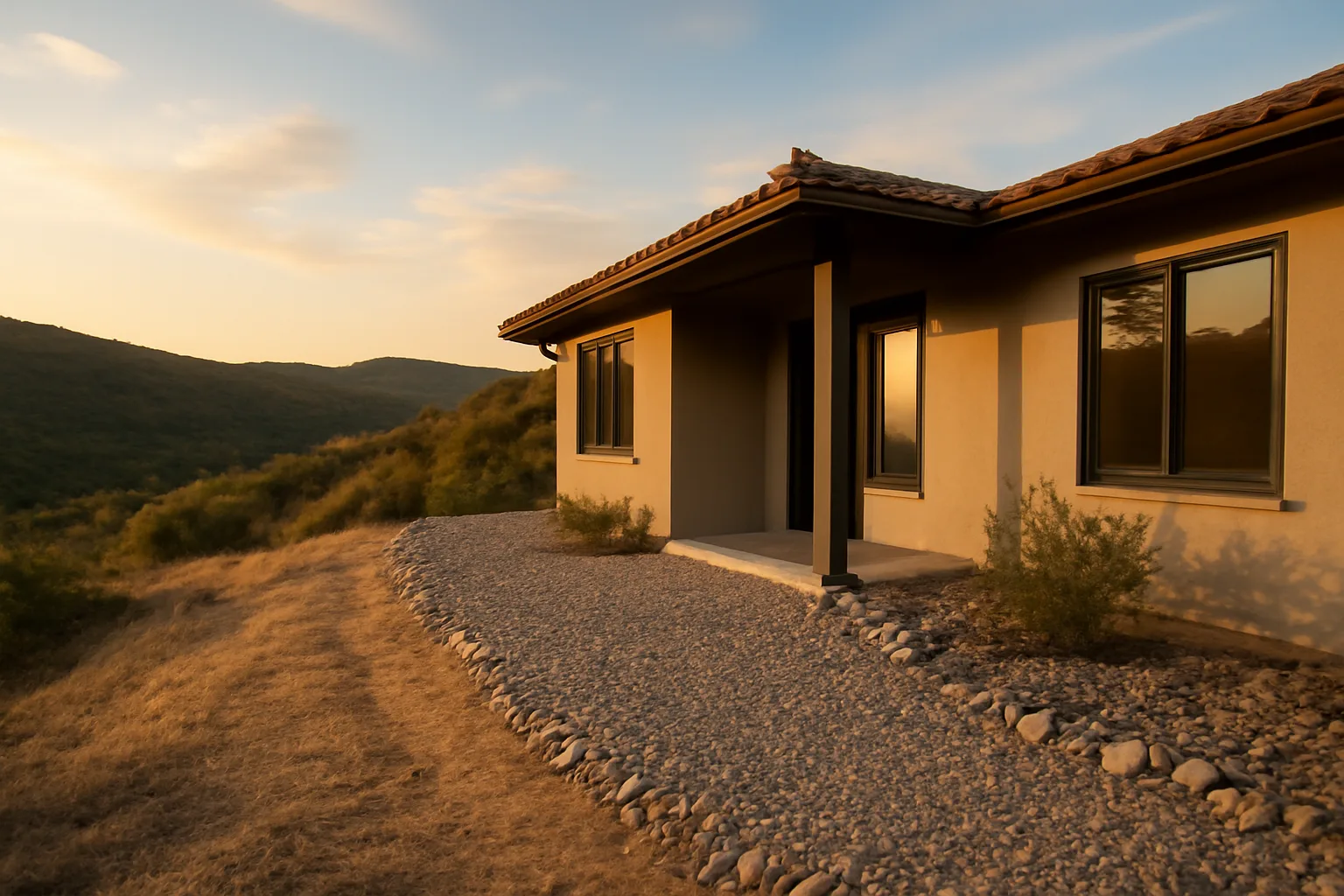
The rule most people mean when they ask this is Zone 0, the ember-resistant zone within 5 feet of a structure. Under the framework created by AB 3074 and refined in subsequent Board of Forestry proceedings, Zone 0 generally prohibits combustible mulch, stored firewood, dry vegetation, and combustible fencing attached to the house within that 5-foot band, and pushes toward hardscape, gravel, or well-irrigated low-growing plants instead [2]. The Board of Forestry's regulatory process has moved slower than the original 2020 legislative intent, and multiple public comment cycles have pushed implementation dates back. As of the most recent state tracking, enforcement is expected to phase in starting with new construction and higher-risk Very High Fire Hazard Severity Zone parcels first, with broader retrofit requirements for existing homes following on a longer runway, potentially extending past 2026 for some categories. Don't wait for a final regulation number to start clearing the 5 feet nearest your house. Removing bark mulch, moving woodpiles away from the foundation, and swapping combustible fencing gates for metal near the structure costs very little and gets ahead of whatever the final rule says, because every draft version points the same direction. For the specifics that apply to your parcel right now, your city or county's building department or local CAL FIRE unit is the accurate source, since some jurisdictions have already adopted local Zone 0-style ordinances ahead of the state.
Why won't people follow the defensible space law in California?
This gets asked a lot, and the honest answer is money, confusion, and enforcement gaps, roughly in that order. Cost is the biggest one. Clearing 100 feet of vegetation on a sloped, brush-covered lot is not a weekend project. Tree removal, chipping, and hauling can run into the thousands of dollars depending on lot size and terrain, and many homeowners simply defer it. A 2021 UC Cooperative Extension analysis of wildfire risk reduction programs found cost was consistently the top-cited barrier to homeowner compliance with defensible space recommendations across multiple California counties [3]. Confusion is the second driver. Homeowners genuinely don't know whether the 100-foot rule applies to their parcel, whether their neighbor's untreated brush counts against them, or which of three overlapping fire agencies (CAL FIRE, a local fire district, and a city) actually enforces the standard on their street. That confusion is not accidental; jurisdiction really does vary by district in California, and "the law" someone read about online may not be the exact ordinance enforced where they live. Enforcement inconsistency is the third piece. CAL FIRE's own defensible space inspection program reports large numbers of properties inspected annually, but historically only a minority face any real penalty for noncompliance beyond a re-inspection notice, and fines when issued have often been modest relative to actual clearing costs. That gap between "the law says 100 feet" and "nobody enforced it on my block until my insurer flagged it" is exactly why so many homeowners are only doing the work now, after a non-renewal letter, rather than years ago.
How to prevent wildfires: what actually works at the home level
Prevention at the home scale comes down to three things: what's on your roof and vents, what's touching your walls, and what's growing in the first 100 feet. CAL FIRE's "Ready for Wildfire" defensible space guidance breaks the 100 feet into two zones with different jobs. Zone 1 (0 to 30 feet from structures) requires removing dead vegetation, keeping tree branches at least 10 feet from other trees and chimneys, and creating vertical and horizontal spacing between plants. Zone 2 (30 to 100 feet) allows more vegetation but requires cutting annual grass to 4 inches or less and maintaining wider spacing between shrubs and trees. Home hardening matters as much as landscaping, arguably more, because embers travel far ahead of a flame front and land on the house itself. Ember-resistant vents, Class A fire-rated roofing, ignition-resistant siding, and enclosed eaves are the categories CAL FIRE's Wildfire Preparedness materials point to repeatedly, because most home ignitions in wildfire events trace back to embers entering vents or landing on debris in gutters, not direct flame contact. For a full walk-through of prioritizing which hardening project to do first when you're on a budget, see our guide on defensible space clearing work and contractor options, and for landscaping choices that satisfy Zone 1 and 2 without turning your yard into gravel, see fire safe landscaping next to the house.
How to prepare for a wildfire (the household plan, more than the yard)
Preparing for a wildfire means having an evacuation plan, a go-bag, and a documented home inventory ready before an evacuation order, not during one. Ready.gov's wildfire preparedness page recommends assembling an emergency supply kit, planning two evacuation routes out of the neighborhood, and signing up for local emergency alerts before fire season starts [4]. A practical prep checklist looks like this: know your evacuation zone and sign up for county alerts, keep a full tank of gas or charged EV during red flag warnings, have an N95 mask and go-bag per person, and photograph or video every room of your house for insurance documentation purposes before anything happens. That last one matters enormously if you're later dealing with a claim; adjusters move faster with dated, organized photo evidence than with a homeowner's memory of what was in the closet. Ready.gov specifically advises households to "know your evacuation zone, route, and shelter locations" and to keep vehicles fueled and pointed for a quick exit during high fire risk periods [4]. That's not dramatic advice, it's just the difference between a calm exit and a bad one. If you've already gotten a non-renewal letter, the prep math changes slightly. You need documentation that proves you did the mitigation work, in a format an underwriter can actually review, more than photos on your phone that never get organized. That's the gap a $99 Wildfire Insurance Survival Kit is built to close (see survival-kit-builder), pulling your defensible space photos, hardening receipts, and inspection notes into one packet you send yourself. We don't file claims for you or promise a rate outcome; you're documenting your own mitigation work so you can make your own case to your insurer.
How to prevent forest fires and avoid forest fires at the source
Most wildfires in California are human-caused, not lightning-caused, and prevention at the source means controlling ignition sources during dry, windy conditions. CAL FIRE and the US Forest Service both point to debris burning, equipment sparks, vehicle exhaust on dry grass, unattended campfires, and fireworks as the recurring, preventable causes. Specific, boring, effective habits: never mow dry grass midday during red flag warnings (a hot mower blade striking a rock is a real, common ignition source), fully drown and stir campfires until cold to the touch, don't park or idle a vehicle over dry grass, and check local burn permit status before any debris burning, since permits are suspended entirely during fire season in most counties. CAL FIRE's public messaging campaign, built around the "Only You Can Prevent Wildfires" partnership with the US Forest Service and the Ad Council, exists specifically because human-caused ignition is preventable in a way lightning is not. If you want the fuller history and current campaign specifics, we cover it in only you can prevent wildfires. At a community level, forest fire prevention also means supporting prescribed burns and fuel reduction projects near your area rather than opposing them, since a lack of managed fuel reduction is a major driver of the unusually severe fire behavior California has seen in the last decade.
How to prepare for forest fires if you live near wildland
Preparing specifically for a forest fire (as opposed to a fire in a suburban WUI neighborhood) means treating fuel breaks, water access, and access roads as part of your defensible space plan, not separate from it. If your property backs onto national forest, BLM land, or unmanaged private timber, your Zone 2 (30-100 ft) work matters more than it would in a denser subdivision, because that's the buffer between wildland fuel and your Zone 1. Check whether your property qualifies for a Firewise USA recognition program (run through the National Fire Protection Association, with state partnership support from CAL FIRE) which can formalize a shared fuel reduction plan with neighbors, something individual homeowner action can't achieve alone on a shared wildland edge. Also confirm your address is legibly posted and visible from the road, and that your driveway can accommodate a fire engine (generally 12 feet wide, 13.5 feet of vertical clearance is the common state standard cited in CAL FIRE building and access guidance for rural properties). None of this replaces defensible space clearing. It supplements it by making sure responders can actually reach your structure.
Is Santa Barbara safe from fire?
No California coastal or foothill community, including Santa Barbara, is "safe" from wildfire risk in an absolute sense, and Santa Barbara County has a documented history that argues the opposite. The 2017 Thomas Fire burned over 281,000 acres across Ventura and Santa Barbara counties and was, at the time, the largest wildfire in modern California history [5]. The subsequent January 2018 Montecito debris flow, triggered by rain falling on the Thomas Fire burn scar, killed 23 people, a devastating example of how fire risk compounds into secondary hazards long after the flames are out . Much of Santa Barbara County, including foothill neighborhoods along the base of the Santa Ynez range, sits within CAL FIRE-mapped Very High Fire Hazard Severity Zones. You can check your specific address against CAL FIRE's official FHSZ viewer rather than relying on general reputation about a neighborhood . The honest framing for any specific California city, Santa Barbara included, is that risk varies block by block based on slope, vegetation, and proximity to wildland, not by city name. A flat, irrigated lot in town is meaningfully different from a hillside property backing onto chaparral, even within the same zip code.
How can we prevent forest fires as a community, more than a household?
Individual defensible space work only goes so far when a whole neighborhood shares one wildland edge; fire doesn't stop at a property line. Community-level prevention means coordinated fuel breaks, shared evacuation planning, and, in many California counties, participation in a Community Wildfire Protection Plan (CWPP), a formal document that identifies local fire risk and prioritizes fuel treatment projects, developed in coordination with CAL FIRE and county fire agencies. Neighborhood-scale programs like Firewise USA formalize this: a group of homes commits to a joint risk assessment and annual mitigation work, which insurers increasingly recognize when evaluating a community's overall risk profile, sometimes affecting availability of coverage through the California FAIR Plan or private carriers writing in that zip code. Utility-scale prevention matters too. Public Safety Power Shutoffs (PSPS), used by California utilities during extreme fire weather, are themselves a prevention tool, cutting power to reduce equipment-sparked ignition risk during red flag conditions, even though they're disruptive to residents. At a policy level, supporting local fuel reduction funding, prescribed burn programs, and code enforcement budgets for defensible space inspections is arguably the highest-leverage thing an individual homeowner can do beyond their own property line, since under-resourced inspection programs are part of why compliance lags in the first place.
What documentation should homeowners keep after doing this work?
If you've cleared defensible space or hardened your home, the work only helps your insurance case if you can prove it happened, with dates, photos, and receipts an underwriter can review quickly. A verbal assurance that "we cleared the brush" carries far less weight than a dated photo set showing before-and-after conditions in each of Zone 0, Zone 1, and Zone 2. Keep contractor invoices with dates and scope of work, before/after photos with timestamps, any inspection reports from your local fire department or CAL FIRE unit, and receipts for hardening upgrades like vent replacement or roofing. Organize by zone (0-5 ft, 5-30 ft, 30-100 ft) since that's how inspectors and increasingly insurers are structuring their own risk assessments. This is exactly the gap the $99 Wildfire Insurance Survival Kit is built for: a structured way to compile your defensible space and hardening documentation into a packet formatted the way underwriters actually review it, so you're not scrambling to reconstruct a timeline after a non-renewal notice arrives. You do the work and keep the paperwork; we don't file claims or promise reinstatement or a discount. Start at survival-kit-builder. For a broader look at what a house fire actually costs and how quickly it can spread once ignition happens, see house fire and fire at a house. For the general concept of defensible space itself and how zones are defined, see defensible.
Frequently asked questions
When does the California defensible space law go into effect?
The 100-foot, three-zone defensible space requirement under PRC 4291 is already in effect statewide in State Responsibility Areas and has been since a 2005 amendment expanded it from 30 to 100 feet. The newer Zone 0 (0-5 ft ember-resistant zone) rule from AB 3074 is still in Board of Forestry rulemaking, with 2025-2026 cited as the likely enforcement window.
What fire safe rules take effect in 2026 for California homes?
The most likely 2026 change is enforcement of Zone 0, the ember-resistant 5-foot zone around structures, which restricts combustible mulch, firewood storage, and attached combustible fencing near the home. The exact statewide date is still being finalized by the Board of Forestry; check your county or local CAL FIRE unit for confirmed local timelines.
Why won't people follow the defensible space law in California?
Cost, confusion, and inconsistent enforcement are the top three reasons, according to UC Cooperative Extension research on wildfire mitigation compliance. Clearing brush on a sloped multi-acre lot can cost thousands of dollars, many homeowners don't know which agency enforces the law on their street, and historically only a minority of non-compliant properties faced meaningful penalties.
How do I prevent wildfires from starting on or near my property?
Control ignition sources: don't mow dry grass midday during red flag warnings, fully drown campfires, avoid parking over dry vegetation, and check local burn permit status before any debris burning (often suspended entirely in fire season). Most California wildfires are human-caused, so controlling these everyday ignition sources is the single highest-leverage prevention step.
How do I prepare for a wildfire if I get an evacuation warning?
Know your evacuation zone and county alert system in advance, keep two exit routes in mind, keep your vehicle fueled during red flag warnings, and have a go-bag ready per person. Ready.gov recommends photographing your home's contents ahead of time for insurance purposes, since that documentation is far more useful before a fire than reconstructed from memory afterward.
How can we prevent forest fires at a community level, more than individually?
Coordinate fuel breaks and evacuation planning with neighbors, since fire doesn't respect property lines. Programs like Firewise USA formalize shared mitigation work across a neighborhood, and supporting local Community Wildfire Protection Plan funding and prescribed burn programs addresses fuel buildup at a scale no single homeowner's defensible space work can reach.
Is Santa Barbara safe from fire?
No part of Santa Barbara County is fully safe from wildfire risk; the 2017 Thomas Fire burned over 281,000 acres there and the following year's Montecito debris flow killed 23 people. Many foothill neighborhoods sit in CAL FIRE Very High Fire Hazard Severity Zones, though risk varies significantly by exact slope, vegetation, and wildland proximity.
What are the three defensible space zones in California?
Zone 0 (0-5 ft from structures, ember-resistant, newer rule in rulemaking), Zone 1 (0-30 ft, remove dead vegetation and space plants), and Zone 2 (30-100 ft, cut grass to 4 inches or less, wider plant spacing). CAL FIRE's Ready for Wildfire program defines the specific clearing requirements for Zones 1 and 2 under existing law.
Does defensible space law apply to homes outside State Responsibility Areas?
PRC 4291's 100-foot requirement directly applies in State Responsibility Areas, but many Local Responsibility Area cities and counties have adopted their own, sometimes stricter, ordinances covering similar or identical distances. Check your specific city or county fire code, since coverage and enforcement vary by jurisdiction even within the same wildfire-prone region.
What happens if I don't comply with California's defensible space law?
Consequences vary by jurisdiction but can include a re-inspection notice, a citation or fine, and in some counties the local fire agency can perform the clearing and bill the homeowner. Increasingly, the more immediate consequence homeowners report is insurance non-renewal or a failed underwriting inspection tied to documented lack of defensible space.
How much does it cost to create defensible space on a California property?
Costs vary enormously by lot size, slope, and vegetation density, ranging from a few hundred dollars for a small, mostly-clear suburban lot to several thousand dollars for a sloped, brush-heavy multi-acre parcel needing tree removal and hauling. UC Cooperative Extension research identifies cost as the most commonly cited barrier to homeowner compliance.
Can I do defensible space clearing myself or do I need a contractor?
Zone 1 debris removal, mowing, and pruning are commonly DIY work for able-bodied homeowners on flat, small lots. Larger tree removal, steep slopes, or work near power lines generally calls for a licensed contractor or tree service, both for safety and because some jurisdictions require permits for tree removal even within defensible space compliance work.
Sources
- California Public Resources Code Section 4291: 100 feet of defensible space required around structures in State Responsibility Areas
- California Legislature, AB 3074 (2020): Directs Board of Forestry to adopt ember-resistant Zone 0 (0-5 ft) regulations
- CAL FIRE, Ready for Wildfire - Defensible Space: Zone 1 (0-30 ft) and Zone 2 (30-100 ft) clearing and spacing requirements
- CAL FIRE, Thomas Fire incident archive: 2017 Thomas Fire burned over 281,000 acres across Ventura and Santa Barbara counties
- CAL FIRE, Fire Hazard Severity Zone Viewer: Official mapping tool for checking Very High Fire Hazard Severity Zone status by address