Last updated 2026-07-25
TL;DR
CPUC (California Public Utilities Commission) regulates utility wildfire mitigation plans, PSPS shutoffs, and undergrounding programs, not defensible space law itself. Defensible space out to 100 feet has been state law since 2005 and is actively enforced now, not a future 2026 date. Homeowners should track both CPUC utility filings and local fire-district inspection letters.
What is the CPUC and why does it show up in wildfire news
The California Public Utilities Commission (CPUC) is the state agency that regulates investor-owned utilities like PG&E, Southern California Edison, and SDG&E, including their wildfire mitigation spending, vegetation management around power lines, and Public Safety Power Shutoff (PSPS) programs. It does not write or enforce defensible space law. That's CAL FIRE and your local fire district. People search "CPUC wildfire news" for two different reasons, and it's worth untangling them. One group wants to know what the utility is doing near their property (tree trimming, pole replacement, undergrounding, shutoff triggers). The other group actually wants defensible space and home hardening news and just associates it with the general "California wildfire rules" bucket. This article covers both, but the honest answer is that your insurance non-renewal letter is almost certainly about defensible space and structure hardening, not CPUC utility policy. The CPUC's wildfire mitigation oversight comes from Senate Bill 901 (2018), which required each electric utility to file an annual Wildfire Mitigation Plan for CPUC review [1]. These plans cover vegetation clearance around power lines (a different, narrower clearance rule than your home's defensible space zones), grid hardening, and shutoff protocols. If a utility's poor vegetation management contributed to a fire near you, that's a CPUC/utility liability question. If your insurer is non-renewing you because of brush near your house, that's a defensible space and hardening question entirely separate from CPUC jurisdiction.
When does the California defensible space law go into effect
California's defensible space law is not new and it is not scheduled for some future start date. It has been in effect since January 1, 2005, under Public Resources Code Section 4291, which requires 100 feet of defensible space clearance around structures in State Responsibility Areas and in certain local agency Very High Fire Hazard Severity Zones [2]. What changed recently is enforcement intensity and insurer scrutiny, not the underlying statute. The law is split into two zones. Zone 0, the ember-resistant zone within 5 feet of the structure, was added by Assembly Bill 3074 (2020) and is being implemented through Board of Forestry regulations. As of this writing, Zone 0 regulations have been through multiple draft cycles at the Board of Forestry and Fire Protection, with a target adoption and phased effective date that has moved; check the Board of Forestry's current rulemaking page for your local jurisdiction's exact timeline, since counties are allowed to adopt Zone 0 locally ahead of the statewide rule [3]. Zones 1 and 2 (5 to 30 feet, and 30 to 100 feet) have been enforceable since 2005 under PRC 4291. CAL FIRE's own defensible space guidance states plainly: "Defensible space is the buffer you create between a building on your property and the grass, trees, shrubs, or any wildland area that surround it". That buffer requirement is already law. If you got a non-renewal or inspection letter referencing defensible space, you are dealing with an existing, currently enforced statute, not something starting in 2026. For the specific zone-by-zone clearance requirements and what "lean, clean, and green" actually means on the ground, see defensible space zones guidance.
What fire-safe home rules take effect in 2026
| 100 ft defensible space (Zones 1 & 2) | In effect since 2005 | PRC 4291 [2] |
|---|---|---|
| Zone 0 (0-5 ft ember zone) | Phasing in, some counties ahead of state timeline | Board of Forestry [3] |
| Chapter 7A ignition-resistant construction | In effect for new construction/major remodel in WUI areas | CA Building Code, local adoption [4] |
| Insurer mitigation discounts | In effect since 2022 | CDI Safer from Wildfires reg [5] |
There is no single statewide "2026 fire-safe homes law" that replaces or supersedes existing defensible space or building code rules. What's actually happening in 2026 is more incremental: continued phase-in of Zone 0 ember-resistant zone regulations by the Board of Forestry and Fire Protection, and continued rollout of Chapter 7A building code requirements (fire-resistant construction materials for new construction and major remodels in Wildland-Urban Interface Fire Areas) as local jurisdictions update their building codes on the standard triennial cycle [4]. Separately, insurers operating under the California Department of Insurance's Safer from Wildfires regulation (effective 2022) are required to give discounts for specific mitigation actions, including defensible space compliance and Zone 0 measures, when properly documented [5]. That regulation itself isn't new for 2026, but insurers continue to update their internal wildfire risk models and mitigation credit programs on their own timelines, and some of those updates land in 2026 for specific carriers. The practical takeaway: don't wait for a named "2026 law." If you got a non-renewal letter, the rules that matter (100 foot defensible space, Zone 0 ember resistance, Chapter 7A materials on any remodel) are already in force in most fire-prone counties. Check with your local fire district for the exact local ordinance amendments, since some counties layer stricter requirements on top of the state minimum. | Rule | Status | Authority |
Why won't people follow the defensible space law in California
Compliance rates are genuinely low in a lot of high-risk counties, and the reasons aren't mysterious: cost, labor availability, unclear enforcement, and simple procrastination. CAL FIRE inspection data has repeatedly shown noncompliance rates well above what you'd expect for a 20-year-old law. A widely cited CAL FIRE/Legislative Analyst review found initial defensible space inspection compliance in some high-hazard areas has hovered in the 40 to 60 percent range on first inspection, with compliance improving after follow-up notices [6]. Cost is the biggest honest barrier. Clearing 100 feet around a home on a sloped, brush-heavy lot can run into thousands of dollars if you're hiring a crew, and elderly or disabled homeowners on fixed incomes often can't do the physical labor themselves. Some counties and fire districts run chipper day programs or fee waivers for seniors, but availability is inconsistent county to county. Another real factor: people don't realize enforcement has teeth until they get a letter. PRC 4291 violations can result in citations, fines, and in some counties the fire agency can do the clearance work itself and bill the property owner. But because enforcement historically leaned on warnings first, a lot of homeowners treated defensible space as optional guidance rather than statute. Insurers changed that calculus fast, since a non-compliant property is now a direct non-renewal risk regardless of whether the county ever fines you. There's also a landscaping-aesthetics tension. Homeowners with mature trees, established gardens, or privacy screening resist cutting anything back, and Zone 0's stricter ember-zone rules (no combustible mulch, no wood fencing attached to the house within 5 feet) run headfirst into decades of landscaping choices. For a workable approach to keeping some green without violating the zones, see fire safe landscaping next to the house.
How to prepare for a wildfire, step by step
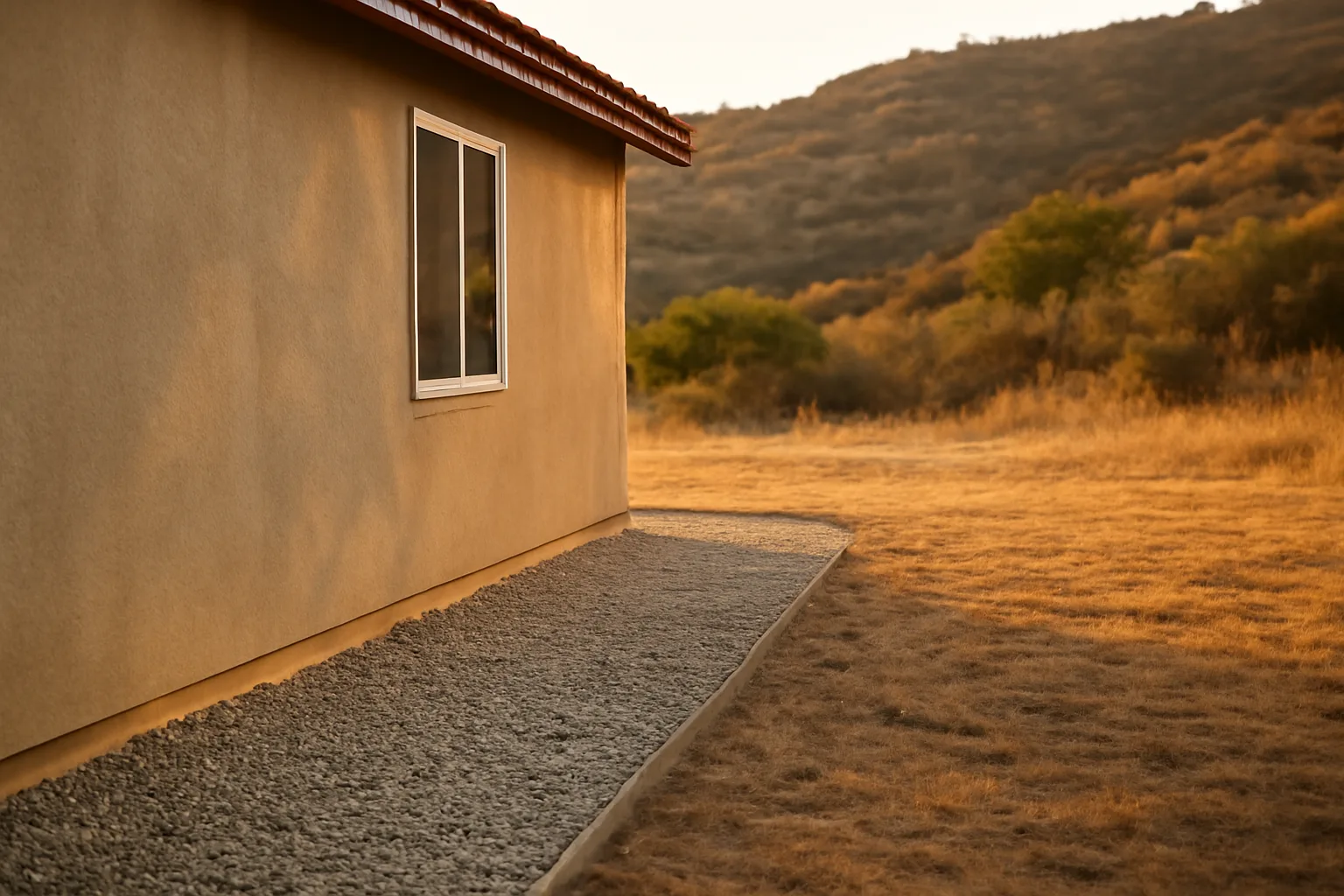
Preparing for a wildfire means doing three things in this order: harden the structure, clear the zones around it, and build a family evacuation and documentation plan. Skipping the order matters, because a perfectly cleared yard around an unhardened roof with open vents still burns from embers landing on the structure itself. Start with Ready.gov's core guidance, which recommends assembling a go-bag with at least a 3-day supply of food and water, copies of insurance documents, medications, and a family communication plan that doesn't depend on cell towers staying up. Ready.gov specifically advises: "Sign up for community alerts in your area and download the FEMA app for emergency alerts". Then work outward from the house: 1. Structure hardening: Class A fire-rated roofing, ember-resistant vents (1/8 inch mesh minimum), enclosed eaves, dual-pane tempered windows. 2. Zone 0 (0-5 ft): no combustible mulch, no wood fencing touching the house, gravel or hardscape only. 3. Zone 1 (5-30 ft): lawn mowed to 4 inches, 10 feet between tree canopies, no branches within 10 feet of chimney. 4. Zone 2 (30-100 ft): reduced fuel load, scattered vegetation, dead material removed. For structural priorities specifically, see home hardening guidance and defensible space clearing contract basics if you're hiring out the work. Document everything as you go. Photos with timestamps, contractor invoices, before/after shots of cleared zones. This isn't just fire prep, it's the paperwork an insurer or adjuster will ask for later, and it's exactly the kind of file a $99 Wildfire Insurance Survival Kit is built to organize: photo logs, mitigation receipts, and a compliance checklist in one place so you're not scrambling when a non-renewal notice arrives.
How to prevent wildfires (and what actually moves the needle)
Most wildfires in the U.S. are human-caused, not lightning-caused. Research cited by federal fire agencies puts the human-caused share at roughly 85 percent of wildfires nationally, driven by things like unattended campfires, equipment sparks, and debris burning [7]. Preventing wildfires at the individual level is mostly about controlling ignition sources on your own property and being careful with fire in dry conditions, not about some grand strategy. The controllable stuff: never burn debris on red flag warning days, keep chainsaws and mowers off dry grass during peak heat hours (a hot muffler or a rock strike from a mower blade is a common ignition source), extinguish campfires completely (drown, stir, drown again, more than poured-once-and-walk-away), and maintain vehicles and equipment with spark arrestors if you're doing any work in wildland areas. At the community level, prevention means supporting fuel reduction programs, prescribed burns run by CAL FIRE and the U.S. Forest Service, and defensible space compliance among neighbors, because a fire that starts three houses down still reaches you if the whole block is dry brush. CAL FIRE's fire prevention guidance frames it directly: "Defensible space and hardening your home can increase your home's chance of surviving a wildfire". One compliant house next to five noncompliant houses is still at serious risk from radiant heat and ember cast. For a broader look at community-level responsibility, see only you can prevent wildfires.
How to prevent forest fires versus preventing home ignition
Preventing forest fires (large wildland fires in undeveloped areas) and preventing your home from igniting during a wildfire are related but different problems, and conflating them leads to wasted effort. Forest fire prevention is mostly about ignition source control in wildland areas: campfire discipline, equipment spark arrestors, not driving or parking on dry grass, and reporting unattended fires immediately. Home ignition prevention is a structural and landscaping problem, and it's the one that actually determines whether your house survives when a wildfire reaches your neighborhood. Research from the Institute for Business & Home Safety and the National Institute of Standards and Technology has repeatedly found that most home losses in wildfires come from ember ignition, not direct flame contact, meaning a house half a mile from the fire front can still burn from windblown embers landing on a wood-shake roof, in a gutter full of dry leaves, or on debris piled against a vent. That's why Zone 0 (the 0-5 foot ember-resistant zone) is getting so much regulatory attention right now. The forest fire prevention behaviors (campfire safety, no burning on red flag days) matter for community risk. But if you're a homeowner worried about your own insurance non-renewal, the higher-leverage move is closing the embers pathway: enclosed eaves, ember-resistant vents, and a genuinely clean 5-foot zone around the foundation.
How to avoid forest fires and reduce ignition risk near your property
Avoiding forest fires near your own property comes down to fuel management and ignition source control on the land you're responsible for, plus supporting broader fuel reduction in your watershed or forest district. If you own wildland-adjacent acreage beyond your defensible space zones, thinning dense stands, removing ladder fuels (low branches that let ground fire climb into tree canopies), and coordinating with neighbors on shared fuel breaks all reduce the chance a fire starts or spreads on your land. CAL FIRE and most state forestry agencies offer cost-share programs for larger-scale fuel reduction work on private land, often through Fire Safe Councils or Resource Conservation Districts. These programs vary a lot by county and funding cycle, so check with your local fire district or county fire safe council for what's currently available; some years there's meaningful cost-share money, other years the program is paused for budget reasons. The unglamorous but effective habits: mow before 10am in fire season, keep equipment maintained, don't park hot vehicles on dry grass, and report smoke immediately rather than assuming someone else already called it in. None of this is complicated, but it's the difference between a spark that dies out and one that becomes a headline.
How to prepare for forest fires as a household
Household preparation for forest fires (meaning: preparing to evacuate and survive a nearby wildland fire, more than prepping your structure) means building an evacuation plan, a go-bag, and a communication plan before you need them, not during an active evacuation order. Ready.gov recommends practicing your evacuation route with the whole household and identifying at least two ways out of your neighborhood, since a single-road-in community can get gridlocked fast during a real evacuation. Your go-bag should include a minimum 3-day supply of water (one gallon per person per day) and food, copies of ID and insurance documents in a waterproof folder, any medications with an extra week's supply, N95 masks for smoke, and a battery or hand-crank radio. Sign up for your county's emergency alert system directly; don't rely on push notifications alone, since cell towers can go down and PSPS shutoffs can kill power to routers and phone chargers at the worst possible time. If you're in a PSPS-prone utility territory (this is where CPUC oversight actually touches you directly), check your utility's PSPS notification enrollment, since Edison, PG&E, and SDG&E all run separate opt-in alert systems for planned shutoffs tied to high fire-risk weather [1].
Is Santa Barbara safe from fire
No coastal California city is "safe" from wildfire risk in an absolute sense, and Santa Barbara County has a documented history of major fires, including the 1990 Painted Cave Fire and the 2017 Thomas Fire, which at the time was the largest wildfire in modern California history at over 281,000 acres before being surpassed by later fires [8]. The Thomas Fire also triggered the deadly Montecito debris flow in January 2018, a reminder that wildfire risk compounds into secondary hazards like mudslides on burned slopes. Santa Barbara County has significant Wildland-Urban Interface exposure, particularly in the foothill communities (Montecito, Mission Canyon, the Riviera, upper State Street areas) where homes back directly onto chaparral-covered hillsides. CAL FIRE's Fire Hazard Severity Zone maps classify large sections of these foothill areas as Very High severity zones, which triggers the state's 100-foot defensible space requirement under PRC 4291 [2]. The honest answer for anyone asking "is my area safe": check your property's specific Fire Hazard Severity Zone designation on CAL FIRE's FHSZ viewer rather than relying on the city's general reputation. Two houses a half mile apart in Santa Barbara County can have very different risk classifications depending on slope, vegetation, and distance from wildland fuel.
How can we prevent forest fires as a community
Community-level forest fire prevention works through three channels: coordinated fuel reduction across property lines, shared evacuation planning, and collective defensible space compliance, since embers and radiant heat don't respect property boundaries. A single noncompliant lot in a Fire Safe Council area can undermine a whole street's mitigation work, which is why some California counties have moved toward area-wide inspection sweeps rather than complaint-driven enforcement. Fire Safe Councils, which exist in most high-risk California counties, coordinate neighborhood chipper days, group fuel-break projects, and grant applications for larger fuel reduction work that no single homeowner could fund alone. If your neighborhood doesn't have one, starting a conversation with neighbors and your county fire department is a genuinely useful first step, more useful than most individual purchases you could make. At the policy level, community prevention also means supporting utility vegetation management (the CPUC-regulated piece) and prescribed fire programs, both of which reduce the fuel available for a fire to spread through a community even if an ignition happens. None of this is fast. Fuel reduction and prescribed burn programs work on multi-year cycles, and the payoff shows up as fires that stay smaller and slower, not as a dramatic single event.
What documentation should you send your insurer after mitigation work
After completing defensible space clearance or home hardening work, send your insurer dated photos of each zone, contractor invoices or receipts, and any inspection certificate from your local fire department, ideally organized by zone (0-5 ft, 5-30 ft, 30-100 ft) so an underwriter can match your work to the specific credit categories in California's Safer from Wildfires regulation [5]. A cover letter referencing the specific mitigation actions taken, dated to match your photos, helps. Insurers under the CDI regulation are required to have a process for homeowners to request mitigation discounts and reconsideration of non-renewal, but they are not required to reinstate coverage automatically just because you did the work; you have to submit documentation and request review yourself. We don't negotiate with insurers, file claims on your behalf, or promise coverage, discounts, or reinstatement. What you can control is having a clean, dated, organized record ready to send. That's the entire function of a defensible-space documentation system: not persuasion, just proof. This is genuinely useful groundwork whether or not you ever use a paid tool to organize it.
Frequently asked questions
When does the California defensible space law go into effect?
It's already in effect. PRC 4291 has required 100 feet of defensible space around structures in State Responsibility Areas since January 1, 2005. The newer Zone 0 (0-5 foot ember-resistant zone) rule is in phased rollout through the Board of Forestry, with some counties adopting it locally ahead of the statewide timeline.
What fire-safe home rules take effect in 2026?
There's no single new 2026 statewide law. What continues in 2026 is phase-in of Zone 0 ember-zone regulations by county, ongoing Chapter 7A ignition-resistant construction requirements for new builds and major remodels in WUI areas, and insurer mitigation-discount programs under the 2022 Safer from Wildfires regulation.
Why won't people follow the defensible space law in California?
Cost, labor, and low awareness of enforcement. Clearing 100 feet on a brush-heavy lot can cost thousands, and some CAL FIRE inspection data shows first-pass compliance in the 40 to 60 percent range in high-hazard counties. Compliance improves after follow-up notices, but insurers now treat non-renewal risk as immediate, unlike historically slower county enforcement.
How do I prepare for a wildfire?
Harden your structure first (Class A roof, ember-resistant vents, enclosed eaves), then clear defensible space zones out to 100 feet, then build a household evacuation plan with a 3-day go-bag, insurance documents, and county emergency alert enrollment. Ready.gov recommends practicing your evacuation route and having two ways out of your neighborhood.
How can I help prevent wildfires?
Control ignition sources: no debris burning on red flag days, maintain equipment spark arrestors, drown campfires completely, and don't drive or park on dry grass. About 85% of wildfires are human-caused, so individual ignition discipline is genuinely the highest-leverage prevention action available to most people.
Is Santa Barbara safe from wildfire?
No area with chaparral hillsides nearby is fully safe. Santa Barbara County has had major fires including the 2017 Thomas Fire (281,000+ acres) and the 1990 Painted Cave Fire. Foothill communities like Montecito sit in CAL FIRE-mapped Very High Fire Hazard Severity Zones. Check your specific property's FHSZ designation rather than the city's general reputation.
Does the CPUC regulate defensible space requirements?
No. The CPUC regulates investor-owned utility wildfire mitigation plans, vegetation clearance around power lines, and PSPS shutoff programs under SB 901. Defensible space law (PRC 4291) is enforced by CAL FIRE and local fire departments, a completely separate regulatory track from CPUC oversight.
What is Zone 0 and when is it required?
Zone 0 is the 0-5 foot ember-resistant zone immediately around a structure, added by AB 3074 (2020). It requires removing combustible mulch, storage, and vegetation directly against the house. The Board of Forestry is finalizing statewide regulations; some counties have adopted local Zone 0 ordinances ahead of the state timeline, so check locally.
How do I prevent forest fires versus protecting my own home?
Forest fire prevention is ignition control in wildland areas (campfire safety, equipment spark arrestors). Protecting your home is a structural problem: most home losses come from windblown embers landing on vulnerable roofs, vents, or debris near the foundation, not direct flame contact, per IBHS and NIST research.
What should I put in a wildfire go-bag?
Ready.gov recommends a minimum 3-day supply of water (one gallon per person per day) and food, copies of ID and insurance documents, a week of medications, N95 masks, a battery or hand-crank radio, and a family communication plan that doesn't depend on cell service staying up.
What documentation do insurers want after defensible space work?
Dated photos of each defensible space zone, contractor invoices, and any fire department inspection certificate, organized to match the mitigation categories in California's Safer from Wildfires regulation. Insurers must offer a discount request process but won't reinstate coverage automatically; you have to submit proof and request review yourself.
Can my local fire district have stricter rules than state law?
Yes. PRC 4291 sets the 100-foot statewide minimum, but individual counties and fire districts can adopt stricter local ordinances, especially around Zone 0 implementation timing. Always confirm current requirements with your specific local fire district rather than relying on the state minimum alone.
Are wildfires mostly caused by humans or lightning?
Mostly humans. Federal wildfire agencies cite roughly 85% of wildfires nationally as human-caused, from unattended campfires, equipment sparks, downed power lines, and debris burning, versus lightning-caused ignitions, which tend to be more concentrated in remote, less populated areas.
Sources
- CPUC, Wildfire Mitigation Plans (SB 901): CPUC reviews annual utility Wildfire Mitigation Plans under SB 901
- California Public Resources Code Section 4291: 100 feet of defensible space required around structures, in effect since 2005
- California Board of Forestry and Fire Protection, Zone 0 rulemaking: Zone 0 ember-resistant zone regulations are in phased development
- California Building Standards Commission, Chapter 7A: Ignition-resistant construction requirements for WUI new construction
- California Department of Insurance, Safer from Wildfires regulation: Insurers must offer mitigation discounts for documented defensible space and hardening work
- CAL FIRE / Legislative Analyst's Office, defensible space compliance review: Initial defensible space inspection compliance rates in high-hazard areas
- USDA Forest Service / National Interagency Fire Center wildfire statistics: Roughly 85 percent of wildfires are human-caused
- CAL FIRE, Thomas Fire incident record: Thomas Fire burned over 281,000 acres, largest in modern California history at the time