Last updated 2026-07-25
TL;DR
Embers, not flame fronts, ignite most homes in wildfires. Vents, roof valleys, gutters, and anything flammable within 5 feet of the house are the top failure points. Fixes include ember-resistant vents, metal gutter guards, and clearing the "zone 0" ring around the foundation. California's new zone 0 rule is expected to start enforcement in 2026.
What is ember fire protection and why does it matter more than flames?
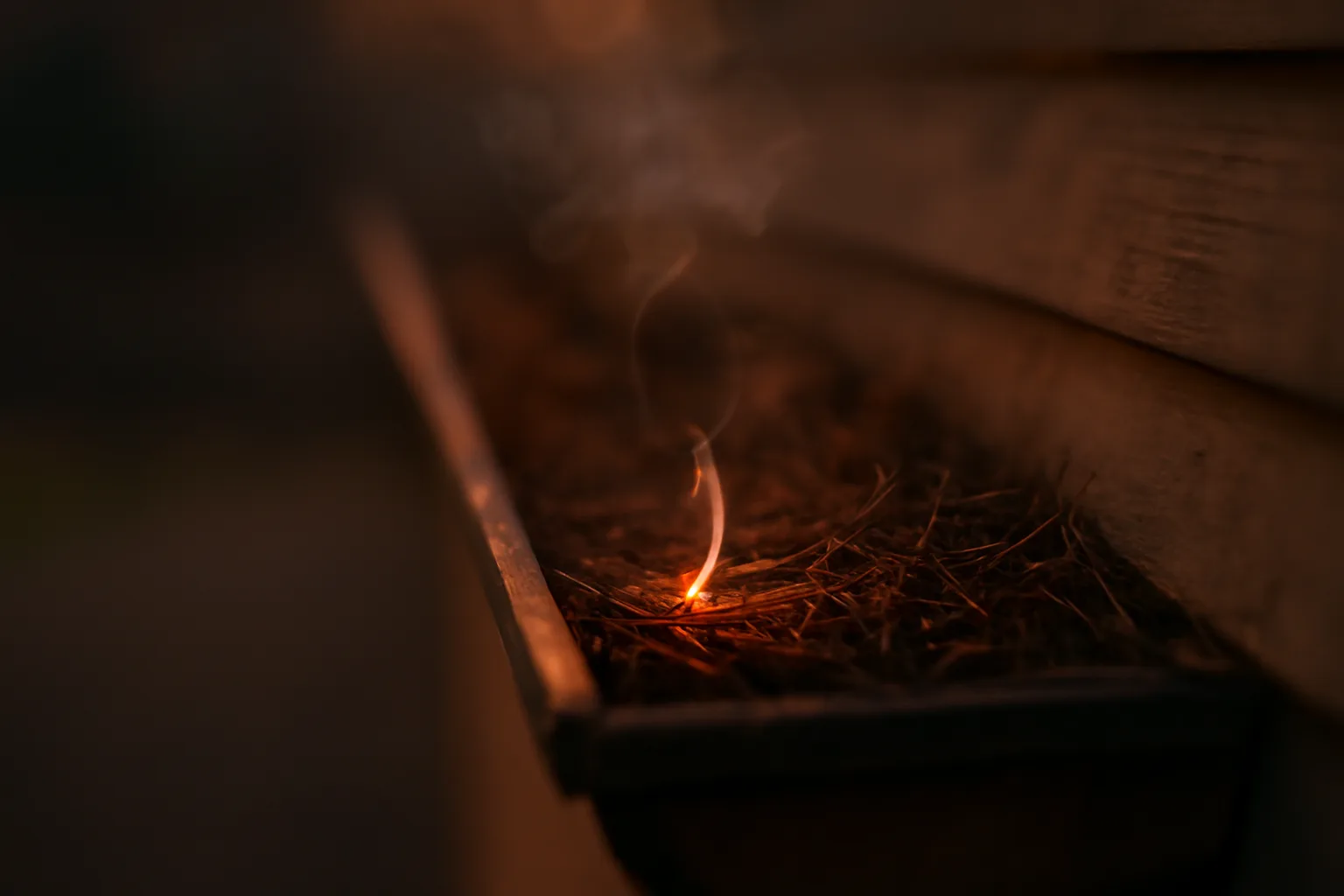
Ember fire protection means hardening a house against wind-blown embers, the burning bark, needles, and debris that a wildfire throws ahead of itself, sometimes a mile or more downwind. It matters because embers, not the wall of flame you see on the news, cause most home losses in wildfires. CAL FIRE's own guidance is blunt about this: "Embers are a leading cause of home ignitions during wildfires". Research from the Insurance Institute for Business & Home Safety (IBHS) backs this up, finding that homes often ignite from embers landing in gutters, on roofs, or against siding long after the main fire front has passed through the area. This matters for how you spend money. A homeowner who clears brush 100 feet out but leaves a plastic gutter guard and an open foundation vent has done maybe half the job. Embers don't need a wall of flame to reach your house. They just need wind, a few minutes of ignition, and something flammable to land on. The practical upshot: ember protection is cheap compared to full defensible space clearing, and it's often the difference between a house that survives and one that doesn't when the same fire passes two identical-looking homes on the same street.
Where do embers actually get into a house?
Embers exploit small gaps, most homeowners never think to check. The usual entry points, in rough order of how often they show up in post-fire investigations, are vents, roof valleys and gutters, decks and the space underneath them, and anything flammable touching the exterior wall. Vents are a big one. Standard attic and foundation vents have mesh openings that let embers pass straight through into insulation and framing. Ember-resistant vents use a finer mesh (typically 1/16 inch, per California's Chapter 7A building code requirements) or a baffle design that blocks direct ember entry while still allowing airflow [1]. Gutters clogged with dry leaves and pine needles are essentially kindling boxes bolted to your roofline. An ember landing in a gutter full of debris can ignite the fascia board and roof edge, areas that are hard to see burning until it's well underway. Decks, especially wood decks with open space underneath, collect blown debris and embers in that gap. IBHS testing has shown that combustible material stored under a deck, or attached fencing that runs right up to the house, gives embers a direct path to ignite the structure itself. Finally, anything flammable within a few feet of exterior walls (mulch beds, stored firewood, patio furniture cushions, a dry welcome mat) can catch from a single ember and then ignite siding, window frames, or eaves directly.
What is "zone 0" and why is it the priority?
Zone 0 is the 5-foot ring immediately around your house's foundation, and it's the single highest-priority area for ember protection because it's where a small ember fire becomes direct structure ignition. CAL FIRE defines this as the "ember-resistant zone" and recommends it be kept clear of anything combustible. That means no bark mulch, no wood fencing attached directly to the house, no firewood stacks, no dry vegetation, and ideally no combustible siding materials extending into that zone. Gravel, pavers, or bare mineral soil are the standard recommendations. California has been moving to make zone 0 clearance legally required, more than recommended. Under Assembly Bill 3074 (2020), the State Board of Forestry and Fire Protection was directed to develop regulations for this ember-resistant zone. As of this writing, the Board has been working through the formal rulemaking process, and enforcement dates have shifted more than once. Homeowners in California should check the current status directly with the Board of Forestry and Fire Protection or their local fire district, since the exact effective date is a moving target. If you're doing one thing this year, do zone 0. It's the cheapest, fastest defensible space work with the highest payoff, and it doesn't require a contractor for most of the work (raking mulch back, moving firewood, pulling weeds against the foundation).
When does the California defensible space law go into effect?
California's core defensible space law, Public Resources Code 4291, has been in effect for years and currently requires 100 feet of defensible space clearance around structures in State Responsibility Areas [2]. That part isn't new and isn't changing in timing. What's newer and still moving is the zone 0 (0-5 foot ember-resistant zone) regulation created under AB 3074. That law directed the Board of Forestry and Fire Protection to adopt regulations, and the Board's rulemaking timeline has been pushed back multiple times since 2020. Various public statements and draft rule packages have referenced a 2025 or 2026 target for enforcement, but as of this writing no final adopted regulation with a locked enforcement date has been confirmed publicly by the Board. Here's the honest state of things: the 100-foot general defensible space law is enforceable now, has been for years, and gets checked during CAL FIRE and local fire department inspections. The new zone 0 specific rule is still working through the regulatory process. If a letter from your insurer or fire district references a 2026 deadline, treat it as the current best estimate but confirm with your local fire district or the Board of Forestry directly, because the exact date has moved before. [Guided fill-in: check with [your local fire district name] for the specific enforcement date and inspection schedule that applies to your address, since SRA, LRA, and local ordinance requirements can differ.]
What fire-safe rules take effect for homes in 2026?
Several states have rules and programs converging around 2025-2026, though the details differ a lot by state and none of them are perfectly locked yet. In California, the zone 0 ember-resistant zone regulation under AB 3074 has been the most talked-about looming requirement, though as covered above, the exact enforcement date has shifted. Oregon's wildfire risk map and defensible space requirements, created under Senate Bill 762 (2021), have gone through their own bumpy rollout, including a full map withdrawal and restart after public pushback in 2022. Oregon Department of Forestry has continued refining the risk classification system since [3]. Colorado doesn't have a single statewide defensible space mandate comparable to California's; wildfire mitigation rules there are set more at the county and fire district level, so "what takes effect in 2026" really depends on which Colorado county you're in. Arizona similarly leaves most defensible space and building requirements to counties and fire districts rather than a single statewide 2026 deadline. The safest approach if you've gotten a letter mentioning a 2026 requirement: call the specific agency named in the letter (state fire marshal, local fire district, or your insurer) and ask them to point you to the actual regulation text and its current effective date. Rules in this space have a track record of slipping by a year or more.
Why won't people follow the defensible space law in California?
Cost, labor shortage, and confusion about what's actually required are the three real reasons compliance rates lag, based on the patterns fire agencies and researchers have documented. It's rarely that people don't care about wildfire risk. Cost is real. Clearing 100 feet of defensible space on a sloped, brush-heavy lot can run into thousands of dollars if you're hiring a contractor rather than doing it yourself, and vegetation grows back, so it's not a one-time expense. For homeowners already facing insurance non-renewal and higher premiums, an additional few thousand dollars for clearing work competes with other financial pressure. Labor and equipment access is a bottleneck too, particularly in rural areas where there simply aren't enough tree services, chipping crews, or contractors to go around during peak fire-season demand. Confusion is underrated as a factor. The rules differ by whether you're in a State Responsibility Area or Local Responsibility Area, whether your county or fire district has added stricter local ordinances on top of the state minimum, and whether recent legislative changes (like the zone 0 rule still in rulemaking) actually apply yet. A homeowner reading three different sources online can come away with three different understandings of what's required and by when. CAL FIRE inspections do result in citations for non-compliance, and repeat non-compliance can affect insurance eligibility, but enforcement capacity varies a lot by county, and some homeowners have reasonably (if not always accurately) bet that enforcement in their specific area is light.
How do you prevent wildfires and forest fires in the first place?
Most wildfires start from human causes, not lightning, which means basic prevention habits matter more than people assume. National Interagency Fire Center data consistently shows the large majority of wildfires nationwide are human-caused, through things like unattended campfires, equipment sparks, downed power lines, and debris burning that gets away from the person doing it [4]. The practical prevention steps that actually move the needle: never leave a campfire unattended and make sure it's fully out (cold to the touch) before leaving, avoid mowing or using power equipment on dry grass during red flag warning days, check local burn ban status before any debris burning, maintain vehicles and equipment (dragging trailer chains and dry grass under a hot exhaust are both documented ignition sources), and report any unattended fire or smoke immediately rather than assuming someone else already has. Ready.gov's wildfire prevention guidance emphasizes checking with your local fire department about current conditions and restrictions before doing anything involving fire or spark-producing equipment outdoors. That's a genuinely useful habit, most people skip it because it takes an extra phone call or website check. At a community level, coordinated defensible space work across a neighborhood does more than any single house doing it alone, since embers and radiant heat from a neighbor's burning structure or vegetation can ignite yours even if your own property is perfectly hardened.
How should you prepare for a wildfire before it happens?
Wildfire preparation has two tracks that both matter: hardening your house against ignition, and having your evacuation and documentation ready before you need it. Doing only one leaves a real gap. For the house itself, the priority order based on where ignitions actually happen is: clear zone 0 (the 5-foot ring), install ember-resistant vents, clean gutters and roof valleys regularly during fire season, and remove anything flammable touching exterior walls or under decks. Ready.gov's checklist also recommends keeping a garden hose long enough to reach all sides of the house and knowing where your gas shutoff valve is. For documentation and evacuation, build a go-bag with copies of insurance policies, ID, medications, and a home inventory (photos or video of every room, including closets and garages, dated and stored somewhere other than the house itself, like cloud storage or a relative's place). This inventory is what you'll actually need if you do have to file a claim later, and it's far easier to shoot two minutes of video walking through your house today than to reconstruct a room-by-room list from memory after a loss. This is genuinely one of the few places we'll mention it directly: the $99 Wildfire Insurance Survival Kit is built around exactly this documentation gap, giving homeowners a structured way to capture home inventory, policy details, and defensible space records before a fire, rather than scrambling after a non-renewal letter or an evacuation order. We don't negotiate with insurers or file claims for you; the kit just gets your own documentation organized so you're the one holding the paperwork when you need it. For a broader look at hardening priorities beyond embers, our guide on fire safe landscaping in California next to your house covers plant selection and zone spacing in more depth.
Is Santa Barbara safe from fire?
No area in Santa Barbara County's wildland-urban interface is "safe" from fire in an absolute sense, and the county's own history makes that clear. Santa Barbara has been hit repeatedly by major wildfires, including the 1990 Painted Cave Fire and the 2017 Thomas Fire, which at the time was the largest wildfire in modern California history by acreage, burning over 281,000 acres according to CAL FIRE's incident records [5]. The Thomas Fire was also followed by the January 2018 Montecito debris flow, a deadly reminder that wildfire risk in this region compounds with post-fire flood and mudslide risk on burned, denuded hillsides. Much of Santa Barbara County, particularly foothill and canyon communities like Montecito, Mission Canyon, and the San Roque area, sits in a State Responsibility Area or a local Very High Fire Hazard Severity Zone as mapped by CAL FIRE [6]. That designation triggers the 100-foot defensible space requirement under PRC 4291 and generally correlates with harder insurance markets. If you own property in Santa Barbara's foothill zones, check your specific parcel against CAL FIRE's Fire Hazard Severity Zone viewer rather than relying on general reputation, since risk varies block by block depending on slope, vegetation type, and prevailing wind exposure during Santa Ana wind events, which have historically driven the county's worst fires.
What can homeowners realistically do to prevent forest fires near their community?
Individually, the biggest lever homeowners have is reducing ignition sources on their own property and reporting problems fast, since most forest fires start small and human-caused. Community-level prevention adds a second, often more effective, layer. At the household level: keep vehicles and equipment maintained (a dragging chain or bad muffler is a documented ignition source), don't burn debris on windy or red-flag days, fully extinguish any outdoor fire, and keep matches, fireworks, and other ignition sources away from dry vegetation. At the neighborhood level, coordinated action does more than individual effort. Fire-adapted community programs, including CAL FIRE's Fire Safe Council network and the national Firewise USA program run by the National Fire Protection Association, organize neighborhood-wide clearing days, shared chipping services, and joint vent-retrofit programs that lower cost per household [7]. Reporting matters more than people think. If you see unattended fire, smoke with no obvious source, or downed power lines during dry, windy conditions, calling it in immediately (911, not a "someone else probably already did" assumption) is one of the highest-value five-minute actions available to any resident of a fire-prone area.
What does an ember-resistant vent actually look like, and is it worth the cost?
An ember-resistant vent uses fine mesh (1/16 inch or smaller per California's Chapter 7A wildland-urban interface building code) or a baffled, non-mesh design to physically block embers while still letting attics and crawlspaces breathe [1]. Standard hardware-store vents typically use 1/4 inch mesh, wide enough for embers to pass straight through. Retrofit cost runs roughly $150 to $400 per vent installed, depending on vent size, roof access, and whether it's a straightforward swap or requires framing work, though exact pricing depends heavily on your local contractor market and the number of vents your house has (older homes can have a dozen or more foundation and attic vents). Is it worth it? For a house in a Very High Fire Hazard Severity Zone, yes, this is one of the highest-value retrofits per dollar spent, right alongside zone 0 clearing. Vents are a documented, well-understood entry point for embers into attic and crawlspace insulation, and once an ember ignites insulation inside a wall or attic cavity, it's burning somewhere you can't see or reach with a garden hose. California's Chapter 7A code has required ember-resistant vents on new construction and major remodels in Wildland-Urban Interface Fire Areas for years now [1]. Retrofitting an existing older home isn't mandated the same way in most jurisdictions, but insurers increasingly ask about it during inspections, and some insurance programs offer premium consideration for documented Chapter 7A-equivalent retrofits. Check with your specific insurer or your state's FAIR Plan program for current details, since these vary by carrier and change often.
What's the fastest, cheapest ember protection project a homeowner can do this weekend?
Clean your gutters and rake back mulch from the foundation. Those two tasks take an afternoon, cost nothing beyond a ladder and gloves you probably already own, and address two of the most commonly documented ignition points in post-fire home loss investigations. After that, in rough order of cost-effectiveness: move firewood stacks at least 30 feet from the house, swap bark mulch near the foundation for gravel or pavers within the 5-foot zone 0 ring, trim any vegetation touching exterior walls or overhanging the roof, and check that deck skirting or lattice isn't leaving open combustible storage space underneath. None of this replaces full defensible space clearing out to 100 feet where required by law, or professional vent retrofits, but it's real progress that costs a weekend and some sweat rather than a contractor invoice. For a full walkthrough of hardening priorities by budget and urgency, see our guide on defensible space and home hardening basics. If you're dealing with an insurance non-renewal letter specifically, our related guides on house fire documentation and what happens during fire at a house events cover what insurers and adjusters actually look for after the fact, which is useful context for prioritizing your prevention spending now.
Frequently asked questions
When does the California defensible space law go into effect?
The core 100-foot defensible space law (Public Resources Code 4291) has been in effect for years and applies now in State Responsibility Areas. A newer zone 0 (0-5 foot ember-resistant zone) rule created under AB 3074 has been in rulemaking with the Board of Forestry and Fire Protection, with enforcement timelines discussed for 2025-2026, but no confirmed final date as of this writing. Check bof.fire.ca.gov for current status.
Why won't people follow the defensible space law in California?
Cost of clearing (which can run thousands of dollars and requires repeating annually), limited contractor and equipment availability in rural areas, and confusion over which rules apply (state vs. local, SRA vs. LRA) are the main documented reasons. It's rarely a lack of concern about wildfire risk, it's usually money, labor access, or unclear requirements.
How do you prevent wildfires?
Most wildfires are human-caused, so prevention starts with basics: fully extinguish campfires, avoid outdoor burning or spark-producing equipment on dry, windy, or red-flag days, maintain vehicles and machinery to avoid sparks, and report unattended fires or smoke immediately. Check current local restrictions with your fire department before any outdoor burning.
How do you prepare for a wildfire?
Harden your house (clear the 5-foot zone 0 ring, install ember-resistant vents, clean gutters), and separately prepare an evacuation go-bag with ID, medications, insurance documents, and a photo or video home inventory stored off-site. Ready.gov recommends knowing your gas shutoff location and keeping a hose that reaches every side of the house.
How do you prevent forest fires?
Same principles as wildfire prevention generally: avoid unattended campfires, don't burn debris in dry or windy conditions, maintain equipment to prevent sparks, and report unattended fire or suspicious smoke right away. Community-level programs like Firewise USA and local Fire Safe Councils add coordinated clearing and reporting that individual homeowners can't achieve alone.
How do you avoid forest fires?
Avoiding forest fires mostly means avoiding the human ignition sources that start most of them: unattended campfires, hot equipment or dragging chains on dry grass, fireworks, and debris burning during dry or windy conditions. Checking local burn restrictions before any outdoor fire activity is the single most skipped, most useful habit.
How do you prepare for forest fires as a homeowner?
Combine home hardening (ember-resistant vents, cleared zone 0, gutter maintenance) with an evacuation plan and documentation kit (insurance policy copies, ID, home inventory video). Coordinate with neighbors on shared defensible space clearing where possible, since ember exposure from an unmanaged neighboring property can undermine your own hardening work.
What fire-safe rules take effect for homes in 2026?
California's zone 0 ember-resistant zone rule under AB 3074 has been discussed for 2025-2026 enforcement but isn't finalized as of this writing; confirm with the Board of Forestry and Fire Protection. Oregon, Colorado, and Arizona largely set defensible space and building rules at the state agency, county, or fire district level rather than one national 2026 deadline, so check your specific jurisdiction.
Is Santa Barbara safe from fire?
No. Santa Barbara County has a documented history of major wildfires, including the 1990 Painted Cave Fire and the 2017 Thomas Fire (over 281,000 acres, per CAL FIRE), plus the deadly 2018 Montecito debris flow that followed. Much of the county's foothill area sits in a Very High Fire Hazard Severity Zone; check your specific parcel on CAL FIRE's FHSZ map.
How can we prevent forest fires as a community?
Community prevention works better than individual effort alone: neighborhood clearing days, shared chipping services, and joint vent-retrofit programs through groups like Firewise USA or local Fire Safe Councils lower costs and close gaps that one household's hardening can't fix. Fast reporting of unattended fires or smoke is the other high-value community action.
What are ember-resistant vents and do I really need them?
Ember-resistant vents use fine mesh (1/16 inch or smaller under California's Chapter 7A code) or baffled designs to block embers from entering attics and crawlspaces while still allowing airflow. If you're in a Very High Fire Hazard Severity Zone, they're one of the highest-value retrofits available, typically $150 to $400 per vent installed.
What is zone 0 and why does it matter more than the 100-foot clearance?
Zone 0 is the 5-foot ring immediately around your foundation, and it matters most because it's where an ember fire becomes direct structure ignition. CAL FIRE recommends keeping it free of mulch, firewood, and attached wood fencing. The broader 100-foot clearance reduces flame intensity approaching the house, but zone 0 stops the final, most dangerous few feet.
Sources
- California Building Standards Commission, Chapter 7A (Materials and Construction Methods for Exterior Wildfire Exposure): Ember-resistant vent mesh size requirements (1/16 inch) for Wildland-Urban Interface Fire Areas
- California Legislature, Public Resources Code Section 4291: 100-foot defensible space clearance requirement in State Responsibility Areas
- California Legislature, Assembly Bill 3074 (2020): Directed Board of Forestry and Fire Protection to develop zone 0 ember-resistant zone regulations
- National Interagency Fire Center, Wildland Fire Statistics: Majority of wildfires nationwide are human-caused, not lightning-caused
- CAL FIRE, Thomas Fire incident archive: Thomas Fire (2017) burned over 281,000 acres, largest California wildfire on record at the time
- CAL FIRE, Fire Hazard Severity Zone Viewer: Santa Barbara County foothill communities mapped in Very High Fire Hazard Severity Zones
- National Fire Protection Association, Firewise USA program: Neighborhood-level wildfire prevention and mitigation program structure