Last updated 2026-07-26
TL;DR
No house in California is truly fireproof, but ember-resistant vents, a Zone 0 (0-5 ft) noncombustible perimeter, and Class A roofing cut structure loss risk dramatically. California's new Zone 0 ember-resistant zone regulation (Gov. Code 51182) is expected to take effect in 2026 for many properties, though CAL FIRE has repeatedly delayed the formal rule text.
Can a house actually be fireproof in California?
No. Nobody in fire science uses the word "fireproof" without a wince. What exists is "fire-resistant" or "ignition-resistant" construction, and the difference matters because it changes what you spend money on. CAL FIRE's own research arm, working with the Insurance Institute for Business & Home Safety (IBHS), has found that most homes lost in wildfire don't burn because a wall of flame rolled through. They ignite from embers, sometimes landing an hour or more after the fire front passed, catching in gutters, vents, mulch beds, or a wood fence that then walks fire straight to the siding. IBHS research on the 2018 Camp Fire and other California wildfires found ember exposure, not direct flame contact, causes the majority of home ignitions in these events. That's actually good news for homeowners. You can't stop a firestorm. You can absolutely stop an ember from finding thirty seconds of fuel on your property. The realistic goal isn't "fireproof house." It's a home that survives an ember storm even if nobody is there to put out a spot fire in the mulch. So when this article says "fireproof," read it as shorthand for hardened, ember-resistant construction plus a managed perimeter. That's the actual product. It's also, not coincidentally, the exact framework insurers and CAL FIRE now use to decide who keeps or gets back coverage.
When does the California defensible space law go into effect?
California's core defensible space law, the 100-foot clearance requirement, has been in effect for years already. It's codified in Public Resources Code 4291 and Government Code 51182, requiring 100 feet of defensible space (or to the property line, whichever is less) around structures in State Responsibility Areas and designated Very High Fire Hazard Severity Zones [1]. If you got an inspection letter, this is very likely the standard being applied. What's newer, and what causes the confusion, is Zone 0. In 2020, the legislature passed AB 3074, which added a requirement for an "ember-resistant zone" within 0 to 5 feet of structures, on top of the existing 5-30 foot (Zone 1) and 30-100 foot (Zone 2) requirements [2]. AB 3074 directed the State Fire Marshal, in consultation with CAL FIRE's Board of Forestry, to develop regulations defining exactly what's allowed in that 5-foot ring. Those regulations have been delayed multiple times. As of this writing, the Board of Forestry and Fire Protection has circulated draft Zone 0 regulatory language, and CAL FIRE and the Office of the State Fire Marshal have both indicated an effective date sometime in 2026 for at least a first phase, likely targeting the highest-risk Very High Fire Hazard Severity Zones first [2] [3]. Because this rulemaking keeps shifting, check your local fire district's current bulletin or CAL FIRE's Zone 0 page before you spend money assuming an exact date. Your fire district may also be ahead of the state and already enforcing something close to Zone 0 standards. Fill in for your property: [Guided: check with ______ (your local fire district or fire safe council) for the current Zone 0 enforcement date and whether your parcel is in a Very High FHSZ.]
What fire-safe home rules take effect in 2026?
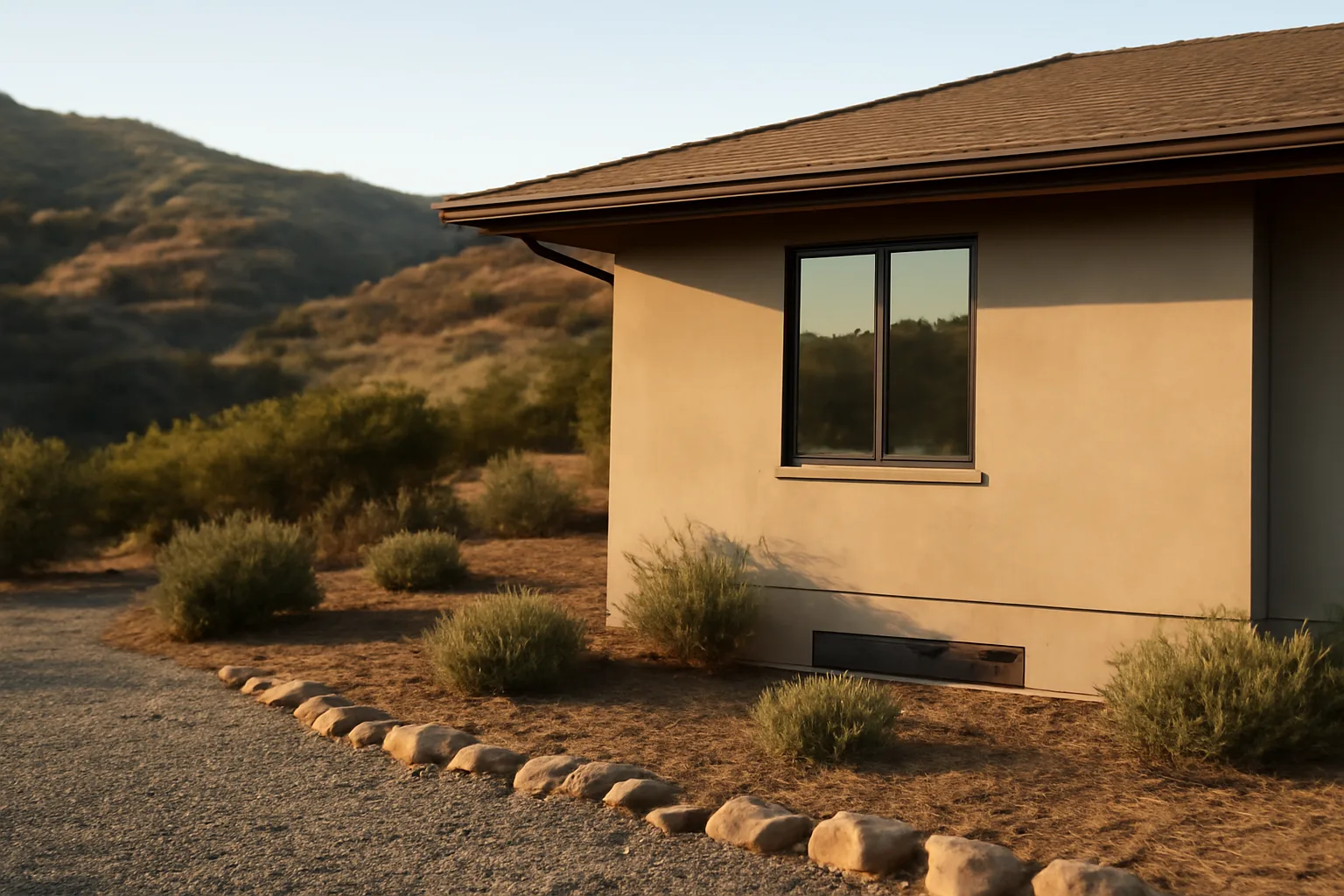
The headline 2026 rule is Zone 0, the ember-resistant zone within 5 feet of the house, patio, and attached structures like decks. Draft guidance from CAL FIRE and the Board of Forestry describes Zone 0 as requiring noncombustible surfacing (gravel, pavers, concrete, bare soil) with no combustible mulch, no wood fencing attached to the house, and very limited, well-spaced vegetation, generally low, irrigated, and nonwoody [2] [3]. Here's the honest state of it: the exact regulatory text (what counts as "noncombustible," whether potted plants are allowed, how attached wood fences must be treated) was still being finalized in draft form as of the Board of Forestry's most recent workshops. CAL FIRE's public messaging has focused on the concept and a phased 2026 rollout for high-hazard zones, with broader compliance following in subsequent years, but you should treat any specific compliance date for your county as provisional until your local jurisdiction or fire district confirms it [2]. A few things are close to certain regardless of the final text: - Attached wood fencing within 5 feet of the house will need to be replaced or separated with a noncombustible gate/section.
- Bark and wood mulch right against the foundation will need to go, replaced with gravel, rock, or hardscape.
- Combustible items stored under decks or against walls (firewood stacks, propane tanks, rattan furniture) will need to move outside Zone 0. Fill in for your property: [Guided: note your fire district's current Zone 0 draft requirements and any grace period, e.g., "______ County Fire, effective ______, grace period through ______."] If you want the fuller zone-by-zone breakdown of the 0-5, 5-30, and 30-100 foot rings, see defensible and the landscaping specifics in fire safe landscaping California next to house.
Why won't people follow the defensible space law in California?
This isn't a mystery, and it isn't really about ignorance. CAL FIRE inspection data and multiple county compliance reports point to three recurring reasons, and none of them is "people don't care about wildfire." Cost is the biggest one. Removing mature trees, regrading slopes, replacing a wood fence, and hauling brush isn't cheap, and a lot of the properties under the strictest 100-foot rule are on large, wooded, or steep lots where the work is genuinely expensive. A homeowner facing a $3,000-$15,000 clearing bill on a fixed income doesn't skip it out of denial; they skip it because the money isn't there this year. Second is enforcement inconsistency. Defensible space inspections are done by CAL FIRE in State Responsibility Areas and by local fire departments elsewhere, and capacity varies enormously by county. Some counties inspect every flagged parcel annually; others are years behind on backlog. When enforcement is spotty, the law feels optional, especially to a homeowner who's never actually been visited. Third, and this one gets underplayed: aesthetics and shade. People bought a house because of the oak canopy or the privacy hedge, and "remove everything within 5 feet" or "limb up that tree" feels like it's asking them to give up the reason they live there. That's a real trade-off, not a character flaw, and it's part of why the Zone 0 rule has been controversial enough to delay repeatedly. None of this changes the practical bottom line: if your county or your insurer is asking for documentation of defensible space work, having it done and photographed is what keeps or restores your policy. Waiting doesn't make the requirement disappear; it usually makes the eventual bill and the coverage gap bigger.
How to prepare for a wildfire (a real action list, not a poster)
Preparing for wildfire has two tracks that people conflate and shouldn't: hardening your house so it can survive without you, and getting your household ready to evacuate safely. Do both, in this rough order. Structure hardening, cheapest to most expensive: 1. Clean gutters and roof valleys of debris (free, do it twice a year). 2. Install 1/8-inch metal mesh over foundation and attic vents to block ember intrusion (roughly $200-$800 in materials for most homes). 3. Replace wood mulch within 5 feet of the house with gravel or rock ($300-$1,500 depending on bed size). 4. Remove or replace attached wood fencing near the structure with a noncombustible section. 5. Upgrade to a Class A fire-rated roof if you're re-roofing anyway; don't rip off a good roof just for this. 6. Enclose open eaves and under-deck areas with ignition-resistant material. Ready.gov's wildfire preparedness guidance recommends creating defensible space and hardening your home specifically against embers, and keeping an emergency kit and evacuation plan ready before fire season, not during it. Household readiness:
- Build a go-bag per person: medications, copies of ID and insurance documents, phone chargers, a change of clothes, cash.
- Photograph and video every room and your exterior, including the roof and vents, before fire season starts. This is the single most useful thing you can do for a future insurance claim and it costs nothing but an afternoon.
- Sign up for your county's emergency alert system (most CA counties run one; check yours specifically).
- Know two evacuation routes out of your neighborhood, not one. For documentation specifically built around insurer requirements after a non-renewal notice, our $99 one-time Wildfire Insurance Survival Kit walks you through photographing defensible space zones and vent retrofits in the format insurers actually ask for. We don't file claims or contact your insurer on your behalf; you prepare and send your own documentation.
How to prevent wildfires (and what's actually in your control)
Most wildfire prevention advice online is aimed at forest visitors, not homeowners, so it's worth separating the two. As a homeowner, your prevention job is mostly about not being an ignition source and not being fuel. CAL FIRE data consistently shows humans cause the large majority of California wildfires, not lightning [4]. That means prevention starts with boring stuff: don't mow dry grass midday, don't drag trailer chains, keep vehicles off dry roadside grass (catalytic converters run hot enough to ignite it), and follow local burn permit rules for any debris burning. On your own property, prevention and defensible space are the same activity described two ways. Removing dead vegetation, spacing shrubs, and keeping the area under trees clear of "ladder fuels" doesn't just protect your house in someone else's fire; it also stops a spark on your property (a mower, a grill, a downed power line) from becoming a wildfire that spreads to neighbors. A few concrete habits:
- Store firewood at least 30 feet from structures, per CAL FIRE's defensible space guidance for Zone 2 [1].
- Keep a hose connected and accessible during red flag warning days.
- Check with your local fire district before any outdoor burning; many CA counties suspend burn permits entirely during fire season.
- Report unattended campfires or suspicious smoke immediately rather than assuming someone else called it in.
How to prevent forest fires and how to avoid forest fires
These two phrasings usually mean the same underlying question, and the honest answer is: individuals can reduce risk, but they can't prevent forest fires in any absolute sense, especially given how many are climate and fuel-load driven now. What you can control is your own ignition risk and your own property's role in spread. The U.S. Forest Service and CAL FIRE both point to the same handful of high-frequency causes: unattended or improperly extinguished campfires, equipment and vehicle sparks, downed power lines, and arson. "Only you can prevent forest fires" (the Smokey Bear line) is really about the first category, personal ignition sources, because that's the category where individual behavior has measurable effect [5]. Practical steps if you spend time in wildland areas:
- Drown, stir, and feel campfire ash before leaving; "cold to the touch" is the actual standard, not "stopped smoking."
- Avoid parking on dry grass.
- Carry a shovel and water if you're doing any spark-producing work (grinding, welding, target shooting) on wildland-adjacent land, some counties require this by law during fire season.
- Follow local fire restriction levels, which change through the season and are usually posted by the managing agency (National Forest, BLM district, or CAL FIRE unit) rather than a single statewide number. If you want the deeper background on Smokey Bear's actual campaign and messaging, see only you can prevent wildfires.
How to prepare for forest fires as a nearby homeowner
If you live near wildland, whether that's a National Forest boundary, BLM land, or unmanaged open space, your preparation is really the same defensible space and hardening work covered above, applied with extra urgency because you're closer to fuel. The added layer for wildland-adjacent homes is awareness of fire behavior in your specific terrain. Fire moves faster uphill, so a home above a canyon or slope faces higher ember and flame exposure than one below or on flat ground; CAL FIRE's defensible space guidance explicitly notes that homes on slopes may need wider clearance on the downhill/uphill side than the standard 100 feet suggests [1]. Practical additions for wildland-adjacent properties:
- Extend Zone 2 vegetation thinning further on the uphill side if your lot backs to a slope.
- Keep a defensible, cleared access path for fire equipment to reach your structure; a locked gate or overgrown driveway can keep engines from protecting a home that would otherwise survive.
- Register for reverse-911 or your county's wireless emergency alerts specifically, more than general news alerts, since wildland fires can move faster than news coverage.
- Know your evacuation trigger point in advance (a specific ridge visible from your property, a specific smell or ash fall) rather than waiting for an official order that may come late in a fast-moving fire.
Is Santa Barbara safe from fire?
No California community backed against chaparral and canyon terrain is "safe" from fire in any absolute sense, and Santa Barbara County's own history argues against complacency. The Thomas Fire (2017) burned into Santa Barbara County and triggered the Montecito debris flow disaster days later, killing 23 people, one of the deadliest wildfire-adjacent disasters in recent California history [6]. The Jesusita Fire (2009) and Tea Fire (2008) both burned into the Santa Barbara foothills and destroyed homes in the same wildland-urban interface neighborhoods that still exist today. What's true is that specific neighborhoods within Santa Barbara carry very different risk levels depending on proximity to the foothills and canyon terrain. CAL FIRE's Fire Hazard Severity Zone maps for Santa Barbara County show large areas of Very High and High severity zoning specifically in the foothill and canyon-adjacent neighborhoods (Mission Canyon, Riviera, San Roque foothills, parts of Montecito), while flatter areas closer to the ocean carry lower zone designations [7]. If you're evaluating a specific Santa Barbara property, the useful question isn't "is Santa Barbara safe" but "what Fire Hazard Severity Zone is this parcel in," which you can check directly on CAL FIRE's FHSZ viewer [7], plus whether the home has had a defensible space inspection in the last three years.
How can we prevent forest fires as a community, more than individually?
Individual defensible space work matters, but CAL FIRE and university fire researchers are increasingly clear that neighborhood-level participation is what actually changes outcomes in a wildfire event, because embers don't respect property lines. One un-hardened home with a wood fence and dry landscaping in an otherwise well-prepared block can become the ignition point that burns the whole street. This is the logic behind Firewise USA, a National Fire Protection Association program that certifies neighborhoods (not individual homes) that organize collective defensible space and hardening work. California has hundreds of Firewise-recognized communities, and CAL FIRE actively promotes participation because coordinated fuel reduction across adjoining lots is measurably more effective than isolated compliance . Practical community-level actions:
- Form or join a local Fire Safe Council; many California counties have one, and they often coordinate grant-funded chipper days and shared clearing contractors, which brings per-property cost down significantly.
- Push for coordinated brush clearing along shared fence lines and easements, since defensible space stops working if your neighbor's overgrown lot sits five feet from your cleared one.
- Support local vegetation management districts, which some counties use to fund larger-scale fuel breaks beyond what individual defensible space parcels can achieve. For comparisons of how other wildfire-prone states structure this kind of shared work (some, like Washington, run state-supported clearing contract programs), see wildfire defensible space clearing contracts Washington State DNR.
What hardening upgrades matter most if you got a non-renewal letter?
| Ember-resistant vent mesh (1/8 inch) | $200-$800 | Blocks the #1 documented ignition pathway | |
|---|---|---|---|
| Zone 0 noncombustible surfacing | $300-$2,000 | Directly maps to the incoming 2026 state standard [2] | |
| Gutter and roof debris clearing | Free-$300 | Cheap, high-visibility in photo documentation | |
| Defensible space brush clearing (Zone 1/2) | $1,500-$8,000+ | Required by PRC 4291; most-cited inspection failure [1] | |
| Class A roof upgrade | $8,000-$25,000+ | Only worth it if re-roofing anyway | For a house-fire specific breakdown of what inspectors and adjusters look for after an actual fire event, house fire and fire at a house cover the aftermath side of this in more detail. Whatever you do, photograph it before and after with a timestamp, and keep receipts. Insurers and FAIR Plan underwriters respond to documented compliance, not verbal assurance, and "I cleared the brush last spring" without photos is functionally the same as not having done it at all from an underwriting standpoint. This is exactly the gap our $99 Wildfire Insurance Survival Kit is built to close: a structured way to document Zone 0-2 compliance and hardening upgrades in the format insurers ask for. We don't contact your insurer or file claims on your behalf; you send your own documentation, we just help you build it right. |
If your insurer sent a non-renewal or inspection letter, the fastest path back to insurability (or to a new policy elsewhere) is documented compliance with the specific items your letter or inspection cited, not a general remodel. Insurers and the CAL FIRE-informed underwriting models they use tend to weight four things heavily: roof material and condition, vent screening, the 0-5 foot zone around the structure, and overall defensible space compliance out to 100 feet [1]. Priority order if you're working with limited budget and limited time before a renewal deadline: | Upgrade | Rough cost | Why it matters to underwriters |
Frequently asked questions
When does the California defensible space law go into effect?
The core 100-foot defensible space law (PRC 4291) has been in effect for years already. The newer Zone 0 ember-resistant zone rule (Gov. Code 51182, from AB 3074) is expected to start taking effect in 2026 for high-hazard areas, though CAL FIRE and the Board of Forestry have delayed final regulatory text multiple times, so confirm your exact date with your local fire district.
Why won't people follow the defensible space law in California?
Mostly cost (clearing and hardening can run thousands of dollars), inconsistent enforcement across counties, and reluctance to remove mature trees or hedges people value for shade and privacy. It's rarely about not caring; it's a real trade-off between expense, aesthetics, and a law that's enforced unevenly county to county.
How to prevent wildfires as a homeowner?
Remove dead vegetation, clear defensible space zones, screen vents with 1/8-inch mesh, avoid parking on dry grass, and follow local burn restrictions. CAL FIRE data shows most California wildfires are human-caused, so avoiding ignition sources on your own property matters as much as hardening your house.
How to prepare for a wildfire if I live in a high-risk zone?
Harden your home against embers (vents, roof, Zone 0 clearance), build a go-bag with documents and medications, photograph your property for insurance purposes, know two evacuation routes, and sign up for your county's emergency alert system before fire season starts, not during an active fire.
How to prevent forest fires?
Individuals can't prevent forest fires outright, but most are human-caused, so drowning campfires fully, avoiding sparks from equipment on dry vegetation, not parking on dry grass, and following local fire restrictions address the majority of preventable ignition sources, per CAL FIRE and U.S. Forest Service data.
How to avoid forest fires while camping or hiking?
Fully extinguish campfires (stir, drown, feel for heat), never leave a fire unattended, avoid using equipment that sparks near dry brush, and check current fire restriction levels for the specific National Forest, BLM, or CAL FIRE unit you're in, since restrictions change through the season.
How to prepare for forest fires if I live near wildland?
Do the same defensible space and vent-hardening work as any wildfire-prone home, but extend clearance on slopes since fire moves faster uphill. Keep access roads clear for fire equipment, register for wireless emergency alerts, and set a personal evacuation trigger point rather than waiting for an official order.
What fire-safe home rules take effect in 2026 in California?
The main one is Zone 0, requiring noncombustible surfacing and very limited vegetation within 5 feet of structures, under Gov. Code 51182 (AB 3074). CAL FIRE and the Board of Forestry have indicated a phased 2026 start for high-hazard zones, but final regulatory text was still in draft form as of the most recent public workshops, so confirm locally.
Is Santa Barbara safe from fire?
No, not in any absolute sense. Santa Barbara County has been hit by major fires including the Thomas Fire (2017), Jesusita Fire (2009), and Tea Fire (2008), and CAL FIRE maps large portions of the foothill and canyon neighborhoods as Very High Fire Hazard Severity Zones. Risk varies sharply by neighborhood within the city.
How can we prevent forest fires as a neighborhood, more than individually?
Join or form a local Fire Safe Council, coordinate brush clearing across adjoining property lines, and pursue Firewise USA recognition through the National Fire Protection Association. Embers don't respect property lines, so one un-hardened home can undo a neighborhood's collective defensible space work.
Can any house actually be fireproof in a wildfire?
No. Fire scientists use "ignition-resistant" or "fire-hardened" rather than fireproof, because no material or design guarantees survival in every fire. IBHS research on California wildfires found most home losses come from ember ignition rather than direct flame contact, which is why ember-blocking upgrades matter more than trying to make a home literally fireproof.
What's the cheapest wildfire hardening upgrade with the biggest impact?
Ember-resistant 1/8-inch metal mesh over vents, typically $200-$800 in materials for most homes. IBHS and CAL FIRE research both identify ember intrusion through vents as one of the most common home ignition pathways, making this one of the highest-value, lowest-cost upgrades available.
Does defensible space clearing guarantee my insurance stays active?
No. Defensible space and hardening work improve your risk profile and give you documentation to submit, but insurers and California's FAIR Plan make coverage decisions based on their own underwriting criteria. This isn't insurance or legal advice; documenting your work and sending it to your insurer is something you do yourself.
Sources
- California Public Resources Code Section 4291: 100 feet of defensible space (or to the property line) required around structures in SRA and VHFHSZ
- California Government Code Section 51182 / AB 3074 (2020): Ember-resistant Zone 0 (0-5 ft) requirement added to state defensible space law, regulations pending
- California Board of Forestry and Fire Protection, Zone 0 rulemaking materials: Zone 0 regulatory language and effective date development, targeting 2026 phased rollout
- CAL FIRE, Wildfire Prevention information: Most California wildfires are caused by human activity rather than natural causes
- USDA Forest Service, Smokey Bear campaign history: Human-caused ignition sources like campfires and equipment are primary preventable wildfire causes
- CAL FIRE, Fire Hazard Severity Zone Viewer: Santa Barbara County foothill and canyon neighborhoods mapped as Very High Fire Hazard Severity Zones
- National Fire Protection Association, Firewise USA program: Firewise USA certifies neighborhoods for coordinated defensible space and hardening participation