Last updated 2026-07-25
TL;DR
A fire resistant home in California combines ember-resistant materials (Class A roof, dual-pane tempered windows, metal vents), a five-foot noncombustible Zone 0 buffer, and maintained defensible space out to 100 feet. State Zone 0 regulations (Government Code 51182) are still pending final adoption by the Board of Forestry, with enforcement expected no earlier than 2026 for existing homes in high-severity zones.
What actually makes a home fire resistant in California?
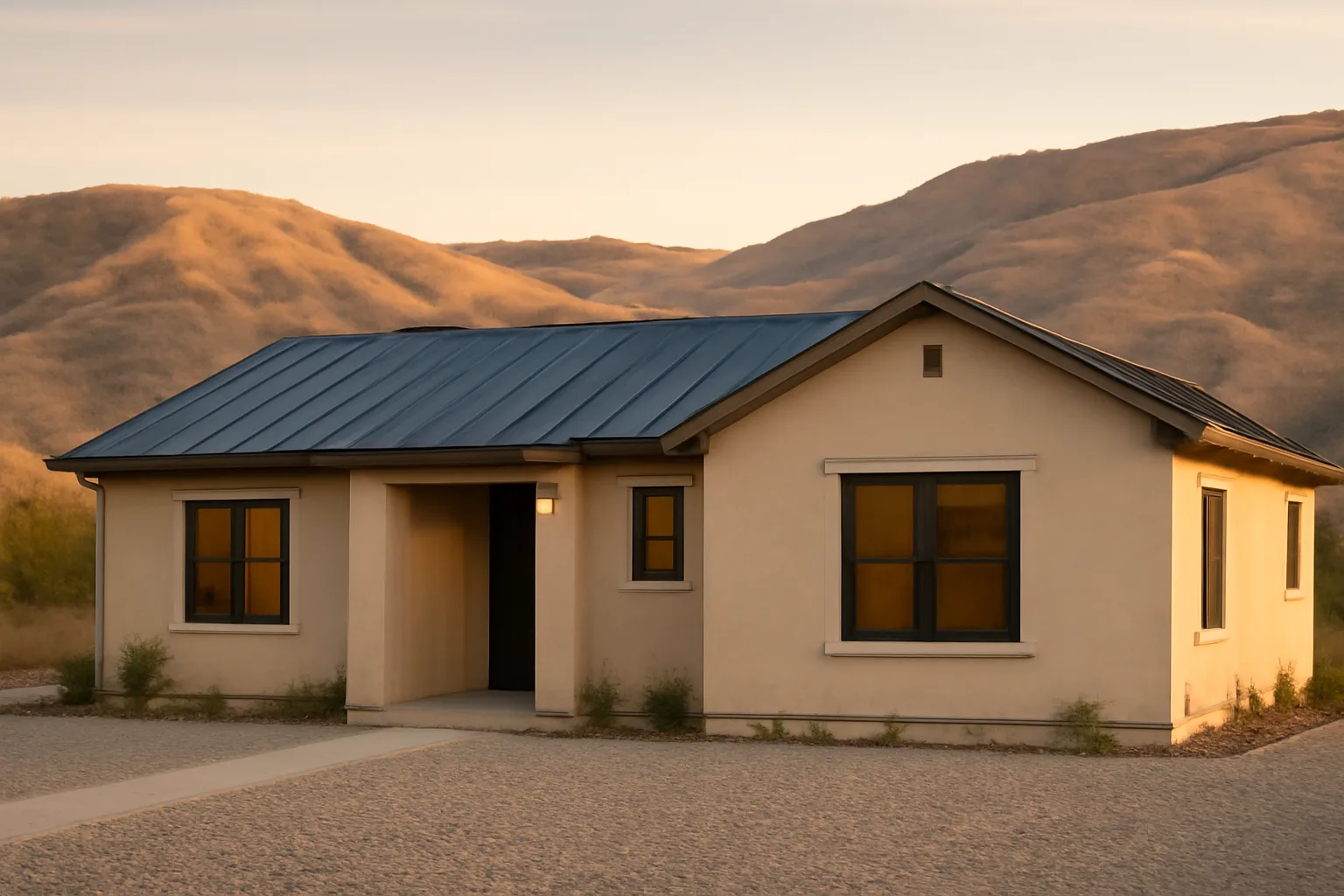
A fire resistant home survives wildfire mainly by stopping embers, not by shrugging off a wall of flame. Research from the Insurance Institute for Business & Home Safety (IBHS) and the U.S. Forest Service has found that embers, not the fire front itself, ignite most homes lost in wildfires, entering through vents, landing on roofs, or catching debris in gutters and against siding. That means the highest-value upgrades are boring: a Class A fire-rated roof, ember-resistant vents (1/8 inch metal mesh, or better, vents tested to the state's SFM 12-7A-1 standard), dual-pane windows with at least one tempered pane, and noncombustible siding or soffits. CAL FIRE's Ready for Wildfire program calls this combination of home hardening plus defensible space the two pillars of wildfire survivability, and says homes built or retrofitted to current Chapter 7A standards "can dramatically increase the chance of survival" during an ember storm [1]. The order of operations matters. Most fire-adaptation experts recommend closing ember entry points first (vents, roof, gutters), then working outward on defensible space, because a home with a good roof but flammable mulch against the foundation is still a target. If you're budgeting a multi-year project, hardening the structure envelope first buys more protection per dollar than landscaping alone, at least in the first year or two. For a room-by-room look at where houses actually catch fire and what stops it, see our guide on house fire causes and prevention.
When does the California defensible space law go into effect?
California's core defensible space law, the 100-foot clearance requirement under Public Resources Code 4291, has been in effect since 2005 and applies now, not in some future year. If you own a home in a State Responsibility Area (SRA) or a Very High Fire Hazard Severity Zone (VHFHSZ) within a Local Responsibility Area, you are already required to maintain 100 feet of defensible space around structures, or to the property line if it's closer [2]. The part people confuse with "a new 2026 law" is Zone 0, the five-foot ember-resistant zone immediately around structures. Assembly Bill 3074 (2020) directed the Board of Forestry and Fire Protection to write regulations defining what's allowed in that zone, but as of this writing, those regulations have not been finalized. The Board's own rulemaking updates have pushed the timeline multiple times; a formal draft went out for public comment, and CAL FIRE has said final regulations are expected to take effect no earlier than 2026, with a compliance grace period likely for existing homes. So: the 100-foot defensible space law is already the law. Zone 0 is the pending rule people are asking about, and enforcement dates keep sliding. Don't wait for the final Zone 0 language to act. The draft standard bans combustible mulch, stored firewood, and most plantings within five feet of your walls, so pulling that material now costs you nothing if the rule changes slightly later, and it removes real ember-catch risk today.
What fire-safe rules take effect in 2026?
The honest answer is that nobody outside the Board of Forestry knows the exact effective date yet, and any article that gives you a firm month is guessing. What's confirmed: Zone 0 regulations under Government Code Section 51182 (as amended by AB 3074) are in active rulemaking, targeting existing and new homes in Very High Fire Hazard Severity Zones, and CAL FIRE's public materials describe an effective timeline in the 2026 range for full adoption [3]. Separately, California's building code already requires Chapter 7A ignition-resistant construction (fire-rated roofing, tempered glass, ember-resistant vents) for new construction and major remodels in VHFHSZ areas, and that requirement is not new for 2026, it has applied to permitted new builds since the 2008 code cycle [4]. What you should actually do: check your local jurisdiction's building and fire department page for the specific compliance deadline in your fire district, since some counties (parts of San Diego, Santa Barbara, and the Sierra foothills) have moved ahead of the state with their own defensible space or vegetation ordinances. Ask your local fire marshal's office directly which version applies to your parcel; state rules set the floor, not the ceiling.
Why won't people follow the defensible space law in California?
Compliance with PRC 4291 is inconsistent, and the reasons aren't mysterious: cost, labor, and confusion about what's actually required. A 2020 Legislative Analyst's Office review of California's wildfire programs found that local defensible space inspection rates and enforcement capacity vary widely by county, with many fire districts too understaffed to inspect every parcel annually, let alone follow up on violations [5]. For homeowners, the friction is often practical. Clearing 100 feet on a sloped, wooded lot can mean hiring a crew, and cost estimates from University of California Cooperative Extension wildfire programs put mechanical vegetation clearing at roughly $1,000 to $3,000 per acre depending on terrain and vegetation density, though brushy or steep parcels run higher [6]. Renters and older homeowners on fixed incomes often can't absorb that cost in one year, so work gets deferred, then forgotten. There's also a genuine information gap. Many residents think defensible space just means "cut the grass," not realizing it involves specific zone-based rules: Zone 1 (0-30 feet, remove dead vegetation, space canopy), Zone 2 (30-100 feet, reduce fuel continuity), and now Zone 0 (0-5 feet, near-zero combustibles). Without a clear checklist, people do a partial job and assume they're compliant. Finally, some homeowners simply don't believe an inspector will show up, and in many rural SRA counties, that skepticism is not unfounded given inspection staffing levels documented by the LAO. That doesn't mean skipping the work is smart. Insurers increasingly cross-reference defensible space compliance with underwriting decisions, independent of whether CAL FIRE ever knocks on your door.
How do you prepare for a wildfire, practically?
Preparing for a wildfire means doing three things in parallel, months before smoke is on the horizon: harden the structure, maintain defensible space, and build an evacuation plan with a go-kit. Ready.gov's wildfire preparedness guidance breaks this into "before," "during," and "after" phases, and stresses that most of the effective work happens in the "before" phase, since there's no time to install ember-resistant vents once a red flag warning is issued. A practical prep sequence looks like this: - Sign up for your county's emergency alert system and know your evacuation zone designation.
- Build or refresh a go-bag: medications, copies of ID and insurance documents, a change of clothes, phone chargers, cash.
- Photograph and inventory your home's exterior and interior (useful for both hardening records and insurance claims later).
- Clear Zone 1 and Zone 2 vegetation per PRC 4291, then address Zone 0 near the foundation.
- Check and clean gutters and roof valleys of dry leaves and needles, ideally every fall before Santa Ana or Diablo wind season.
- Move firewood stacks, propane tanks, and combustible patio furniture out of the 5-foot zone. For documentation, keep dated photos of your cleared zones and any hardening work (new vents, roof replacement receipts). If you ever face a nonrenewal notice, this is the paper trail an insurer or a state complaint process will want to see. We built a survival kit builder tool at DefensibleHome specifically to organize this documentation into an insurer-ready packet; it's a one-time $99 tool, not a subscription, and it doesn't file anything with your insurer on your behalf. You send your own documentation.
How to prevent wildfires (and what's actually in your control)
Roughly 95 percent of wildfires in California are human-caused, according to CAL FIRE, from things like equipment sparks, unattended campfires, downed power lines, and vehicle exhaust systems parking on dry grass. That statistic matters because it reframes "preventing wildfires" from an abstract climate problem into a set of specific, avoidable ignition sources. At the individual level, prevention looks like: never mowing dry grass in the heat of the day (a hot mower blade or rock strike is a classic ignition source), maintaining spark arrestors on chainsaws and generators, fully extinguishing campfires and drowning the coals (more than dousing the flame), pulling trailer chains up so they don't drag sparks on pavement, and reporting downed power lines immediately rather than waiting. At the community level, prevention means supporting fuel reduction projects, defensible space compliance among neighbors (a single unmaintained lot can undermine a whole block's hardening work), and utility infrastructure hardening, since power line failures caused some of California's most destructive fires, including the 2018 Camp Fire, per Cal Fire's investigation findings [7]. None of this eliminates wildfire risk. Lightning-caused fires and fires that start on remote public land are outside anyone's individual control. But the human-caused share is large enough that basic caution meaningfully moves the needle, and it's the one lever every homeowner actually has.
How to prevent forest fires when you're recreating or living near wildland
Forest fire prevention for campers, hikers, and rural residents comes down to fire discipline: know local burn restrictions, carry the right tools, and never assume "it's just a small fire." The U.S. Forest Service and CAL FIRE both publish seasonal fire restriction maps; check them before any outdoor burning, campfire, or even target shooting, since incendiary ammunition and steel-core rounds have started wildfires on public land in dry conditions. Specific habits that matter: keep campfires small and within a ring, never leave them unattended, and drown, stir, and feel for heat before walking away, per Smokey Bear's official extinguishing guidance from the Forest Service [8]. If you tow anything with chains, secure them so they don't drag and spark on asphalt. If you live adjacent to forest or wildland-urban interface, treat your own defensible space work as forest fire prevention too, since fuel continuity from wildland into your yard is exactly how forest fires become house fires. For landscaping choices that reduce this continuity, our guide on fire safe landscaping in California next to a house covers plant selection and spacing specifics county by county.
Is Santa Barbara safe from fire?
No part of Santa Barbara County is fully safe from wildfire, and large sections of the foothills and back-country communities sit inside CAL FIRE's Very High Fire Hazard Severity Zone maps, the same designation that triggers Chapter 7A construction rules and PRC 4291 defensible space requirements [9]. The county has a documented history of major fires, including the 1990 Painted Cave Fire and the 2017 Thomas Fire, which at the time was the largest wildfire in modern California history by acreage, followed by the deadly Montecito debris flow in January 2018 [10]. That said, "not safe" doesn't mean uniquely dangerous compared to other WUI communities in the state. Coastal, flatter neighborhoods in the city of Santa Barbara itself carry lower wildfire hazard scores than the foothill and mountain communities (Montecito, Mission Canyon, the San Marcos foothills), because hazard severity is driven by terrain, fuel type, and wind exposure, not by city limits. If you're evaluating a specific address, check the exact parcel against CAL FIRE's FHSZ viewer rather than relying on the city's general reputation; two houses a half mile apart can carry very different hazard ratings. Insurers underwrite at the parcel level for exactly this reason, and Santa Barbara County has seen elevated non-renewal activity in its VHFHSZ foothill zones specifically, not countywide.
How can we prevent forest fires as a community, more than individually?
Community-level forest fire prevention works through coordinated fuel breaks, shared defensible space compliance, and Firewise USA-style neighborhood programs, because a single untreated lot or a shared fence line of dry brush can undo a whole street's hardening work. The National Fire Protection Association's Firewise USA program, recognized and supported by CAL FIRE, organizes neighborhoods to do joint chipping days, shared vegetation removal, and coordinated ember-zone cleanup, which tends to be cheaper per household than solo contracts [11]. Local fire safe councils, which exist in most California counties, often coordinate grant-funded fuel reduction on shared or adjacent parcels, something an individual homeowner usually can't access alone. If your neighborhood doesn't have one, starting a group conversation with immediate neighbors about synchronized clearing schedules is a low-cost, high-value move, since fire spreads lot to lot regardless of who owns which parcel. At a policy level, supporting utility undergrounding or vegetation management around power infrastructure, and backing local fuel break maintenance funding at planning commission meetings, moves the needle more than any single home's landscaping choices. Wildfire behavior in wind-driven events is a landscape-scale problem; individual home hardening controls whether your house survives an ember storm, but community-scale fuel management controls whether the fire reaches your street at all.
What does a full fire resistant retrofit actually cost?
| Ember-resistant vents (per vent) | $10-$50 | High | |
|---|---|---|---|
| Gutter guards / metal gutters | $5-$15 per linear foot | Moderate | |
| Class A roof replacement | $8,000-$25,000+ | High | |
| Dual-pane tempered windows | $500-$1,500 per window | Moderate-High | |
| Zone 0 clearing/hardscaping (5 ft) | $500-$3,000 (DIY to contracted) | High | |
| Defensible space clearing (per acre, Zones 1-2) | $1,000-$3,000 | High (fire spread, not ember) | Most homeowners can't do all of this in one budget cycle, and that's fine. Vents and gutters first (cheap, high ember-risk reduction), then Zone 0 clearing (mostly labor, not materials), then the roof and windows when they're due for replacement anyway. Trying to do a full retrofit at once, especially chasing a specific insurer's checklist, often costs more than phasing it over two or three years around already-planned maintenance. |
Costs vary enormously by house size, existing materials, and region, but rough ranges from CAL FIRE's home hardening guidance and University of California wildfire program cost studies give a usable starting point: ember-resistant vent retrofits run roughly $10 to $50 per vent installed, a Class A roof replacement runs from about $8,000 to $25,000+ depending on square footage and material (metal or tile costs more than treated shingle), and dual-pane tempered window replacement runs $500 to $1,500 per window installed [1] [6]. | Upgrade | Typical cost range | Ember-risk reduction |
How does home hardening connect to keeping or regaining insurance?
California's FAIR Plan and admitted insurers increasingly ask for documented evidence of defensible space and hardening work, more than a verbal assurance, when deciding on renewal or new coverage. The California Department of Insurance's Safer from Wildfires regulation (effective 2022) requires insurers to give discounts or recognition for specific mitigation actions, including Zone 0 measures, ember-resistant vents, and Class A roofing, when calculating wildfire risk scores [12]. That regulation doesn't guarantee a renewal, and DefensibleHome doesn't negotiate with insurers, file claims, or promise coverage outcomes on your behalf. What it does mean practically: if you do hardening work, document it. Dated photos, contractor invoices, before-and-after shots of cleared zones, and a written log of maintenance dates form the packet an insurer's underwriting team or the FAIR Plan's inspection process will actually look at. The defensible space zones framework (Zone 0 through Zone 2) maps directly onto what insurers are now scoring, so organizing your documentation by zone, rather than as a random pile of receipts, tends to make a stronger case. If you're rebuilding this packet from scratch after a non-renewal letter, our $99 Wildfire Insurance Survival Kit builder organizes exactly this kind of documentation into a structured, dated packet you send yourself; we don't submit anything to your carrier or promise a specific outcome.
Frequently asked questions
When does the California defensible space law go into effect?
The 100-foot defensible space requirement under Public Resources Code 4291 has been law since 2005 and applies now. The newer Zone 0 (5-foot ember-resistant zone) regulations are still in rulemaking by the Board of Forestry and Fire Protection, with enforcement expected no earlier than 2026 for existing homes.
Why won't people follow the defensible space law in California?
Cost, labor availability, and inconsistent enforcement are the main reasons, according to a 2020 Legislative Analyst's Office review. Clearing 100 feet on a wooded or sloped lot can run $1,000-$3,000 per acre, and many rural fire districts lack staff to inspect every parcel, so compliance gaps persist even though the law is on the books.
How do I prevent wildfires around my own property?
Maintain defensible space per PRC 4291, keep spark arrestors on equipment, fully extinguish campfires, avoid mowing dry grass mid-day, and report downed power lines immediately. About 95 percent of California wildfires are human-caused according to CAL FIRE, so avoiding ignition sources is the single biggest lever an individual has.
How do I prepare for a wildfire if I get an evacuation warning?
Know your evacuation zone, keep a go-bag with medications, ID copies, and chargers ready, and have your insurance documents and home inventory photos saved off-site or in the cloud. Ready.gov recommends doing this preparation well before fire season, since there's no time to gather documents once evacuation orders are issued.
How can we prevent forest fires as a neighborhood or community?
Coordinate shared vegetation clearing, join or start a Firewise USA-recognized group (supported by CAL FIRE), and support local fire safe council fuel reduction grants. A single untreated lot can undo a street's hardening work, so community-level coordination matters as much as individual defensible space compliance.
Is Santa Barbara safe from fire?
No, not fully. Much of Santa Barbara County's foothill and back-country terrain sits in CAL FIRE's Very High Fire Hazard Severity Zone, and the county has a documented history of major fires including the 1990 Painted Cave Fire and 2017 Thomas Fire. Coastal flat neighborhoods carry lower hazard scores than foothill communities like Montecito.
What fire-safe rules take effect in 2026 in California?
Zone 0 ember-resistant zone regulations under Government Code 51182, directed by Assembly Bill 3074, are expected to take effect around 2026, though the Board of Forestry has not finalized a firm date. Chapter 7A ignition-resistant construction rules for new builds have applied since 2008 and are not new.
What is Zone 0 and how is it different from defensible space?
Zone 0 is the proposed 5-foot ember-resistant buffer immediately around a structure, banning most combustible mulch, plants, and stored materials. Defensible space under PRC 4291 covers the broader 100-foot area (Zones 1 and 2) focused on reducing fuel continuity and fire spread, more than ember ignition.
How much does it cost to make a home fire resistant in California?
A phased retrofit typically ranges from a few hundred dollars for vent and gutter fixes to $8,000-$25,000+ for a full Class A roof replacement, plus $1,000-$3,000 per acre for defensible space clearing. Most homeowners spread this over two to three years around planned maintenance rather than doing it all at once.
Does home hardening actually help with insurance renewal?
It can help, though it's not guaranteed. California's Safer from Wildfires regulation (effective 2022) requires insurers to factor in documented mitigation like Zone 0 compliance, ember-resistant vents, and Class A roofing when scoring wildfire risk. Insurers still make individual underwriting decisions; documentation with dated photos and receipts strengthens your case.
How to prevent forest fires while camping or recreating on public land?
Check current fire restrictions before any burning, keep campfires small and attended, and drown, stir, and feel coals before leaving, per Forest Service extinguishing guidance. Avoid parking hot vehicles on dry grass, secure trailer chains so they don't drag sparks, and avoid incendiary ammunition during dry, high-wind conditions.
What percentage of California wildfires are human-caused?
CAL FIRE data indicates roughly 95 percent of wildfires in California are human-caused, from sources like equipment sparks, unattended campfires, vehicles, and power line failures. This is why individual prevention habits, more than landscaping and structural hardening, materially reduce overall wildfire risk statewide.
What's the single most important upgrade for a fire resistant home?
Most wildfire researchers point to ember-resistant vents and a Class A roof as the highest-value upgrades, since embers, not direct flame contact, ignite most homes lost in wildfires according to IBHS research. Closing these entry points before addressing landscaping tends to produce the biggest survivability gain per dollar spent.
Sources
- CAL FIRE, Ready for Wildfire - Home Hardening: Home hardening combined with defensible space increases survivability during ember storms
- California Public Resources Code Section 4291: 100-foot defensible space requirement for structures in SRA and VHFHSZ areas
- California Government Code Section 51182: Statutory basis directing defensible space and ember-resistant zone requirements
- California Building Code, Chapter 7A (Title 24): Ignition-resistant construction requirements for new construction in Very High Fire Hazard Severity Zones since the 2008 code cycle
- California Legislative Analyst's Office, Improving California's Forest and Wildfire Resilience: Local defensible space inspection rates and enforcement capacity vary widely by county
- UC Cooperative Extension, wildfire fuel reduction cost guidance: Mechanical vegetation clearing costs roughly $1,000 to $3,000 per acre depending on terrain and density
- CAL FIRE, Camp Fire investigation findings: Power line infrastructure failure caused the 2018 Camp Fire
- USDA Forest Service / Smokey Bear, campfire safety guidance: Drown, stir, and feel for heat before leaving a campfire
- CAL FIRE, Fire Hazard Severity Zone Viewer: Santa Barbara County foothill areas are designated Very High Fire Hazard Severity Zone
- CAL FIRE, Thomas Fire incident archive: The 2017 Thomas Fire was the largest wildfire in modern California history by acreage at the time
- National Fire Protection Association, Firewise USA program: Firewise USA organizes neighborhood-level coordinated fuel reduction and defensible space efforts
- California Department of Insurance, Safer from Wildfires regulation: Insurers must recognize specific wildfire mitigation actions, including Zone 0 and Class A roofing, in underwriting