Last updated 2026-07-25
TL;DR
Fire resistant home design means Class A roofing, ember-resistant vents, non-combustible siding within 5 feet of the house, and dual-pane tempered windows, backed by 100 feet of managed defensible space. California's Zone 0 ember-resistant rule targets 2026 rulemaking, not full statewide enforcement yet. No single upgrade guarantees survival; the combination does most of the work.
What makes a home design fire resistant?
A fire resistant home design reduces the chance that embers, radiant heat, or direct flame contact ignite the structure during a wildfire. It is not one product. It is a system: the roof, vents, siding, windows, deck, and the ground within 5 feet of the foundation all have to work together, because wildfires kill homes through the weakest link, not the average. CAL FIRE's research and multiple post-fire investigations (including analysis after the 2007 Witch Creek Fire and the 2018 Camp Fire) point to embers, not flame fronts, as the primary way homes ignite. Embers can travel over a mile ahead of a fire. That means a house can burn down in a neighborhood the fire front never reaches, just from a windblown ember landing in a gutter full of dry leaves or sneaking through a vented soffit. The practical implication: fire resistant design prioritizes stopping small ignitions before they need firefighting. A Class A roof, ember-resistant vents, and a clean 5-foot zone around the foundation matter more than almost any single "fireproof" material claim you'll see marketed. Insurers and building officials increasingly agree, which is why some of these features now show up in inspection checklists tied to renewal decisions.
What are the core building components of a fire resistant home?
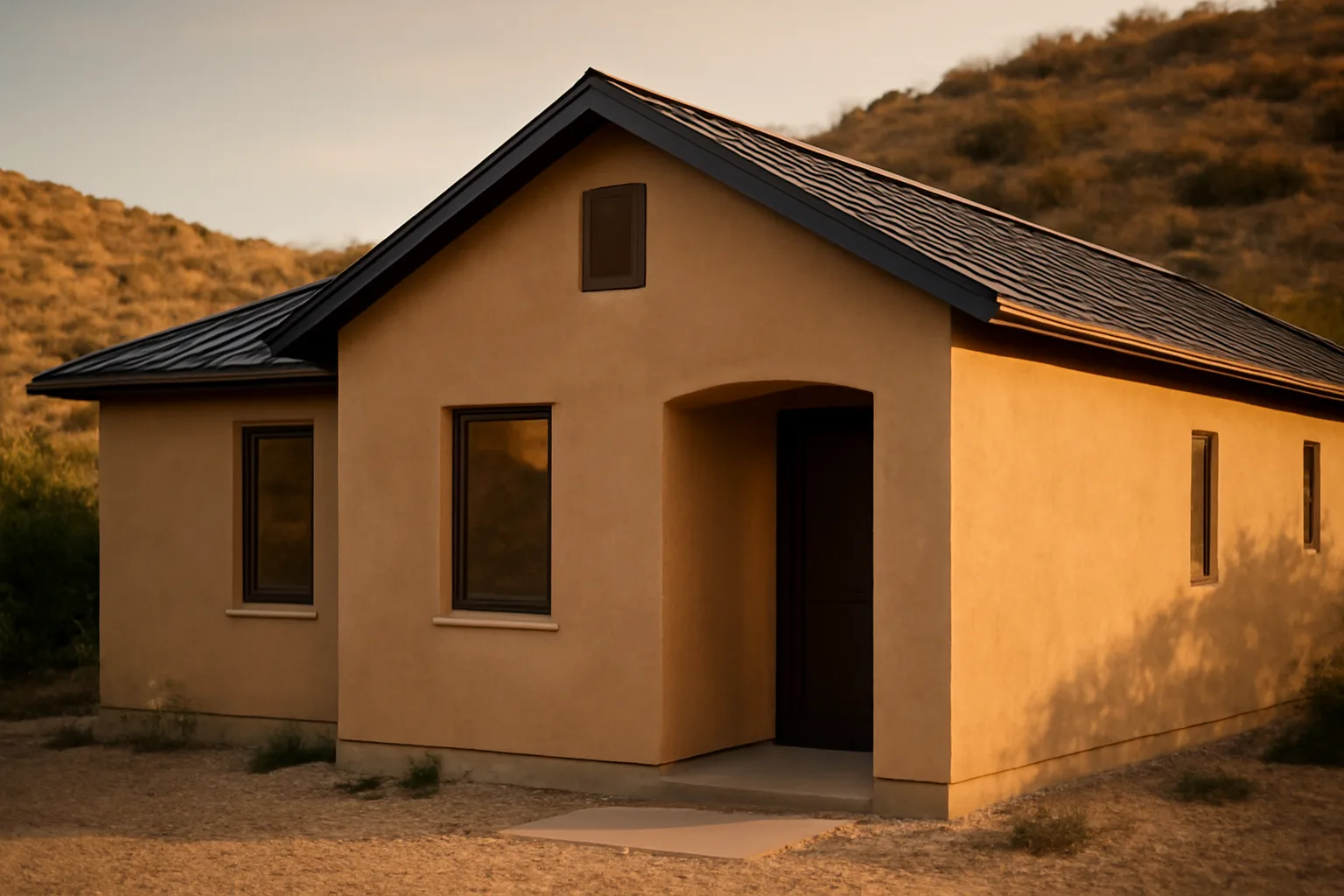
Six components do most of the work: roof, vents, siding/exterior walls, windows, decks, and gutters. Get these six right and you've addressed the pathways embers and heat actually use to get inside a structure. Roofing. Class A fire-rated roofing (asphalt composition shingles, concrete or clay tile, metal) is required in California's Wildland-Urban Interface (WUI) building code for new construction and major remodels in high or very high fire hazard severity zones, under California Building Code Chapter 7A. Wood shake roofs, even treated ones, are the single worst common roofing choice in fire-prone areas. Vents. Standard attic and foundation vents are basically ember mail slots. Ember-resistant vents with 1/8-inch metal mesh, or vents rated to keep flame and embers out under the WUI code's SFM 12-7A-1 testing standard, close this gap. Retrofitting typically runs $20 to $80 per vent depending on size and style, plus install labor. Siding and exterior walls. Non-combustible or ignition-resistant siding (stucco, fiber cement, treated wood meeting ignition-resistant standards) matters most in the first 5 feet from the foundation, sometimes called "Zone 0." Vinyl siding can melt and expose sheathing; wood siding without treatment is the highest-risk common choice. Windows. Dual-pane windows with at least one tempered pane resist heat-cracking far better than single-pane glass. When glass cracks or falls out under radiant heat, it opens a direct path for embers and flame into the living space. Decks. Decking attached directly to the house needs non-combustible material (composite rated for ignition resistance, or metal) for at least the first few feet, and the space underneath needs to be enclosed or cleared, since debris accumulation under decks is a common ignition point. Gutters. Metal gutters with leaf guards, kept clear, prevent the classic ember-plus-dry-leaves ignition combo at the roofline. For a broader look at what inspectors and adjusters check at the structure itself, see house fire and fire at a house.
When does the California defensible space law go into effect?
California's core defensible space law, requiring 100 feet of defensible space (or to the property line) around structures in State Responsibility Areas and some Local Responsibility Areas, has been in effect since 2005 under Public Resources Code Section 4291 [1]. It is not new. What's changing is enforcement detail and a newer, stricter zone right at the house. The law's text is direct: a person who owns, leases, controls, operates, or maintains a building in a State Responsibility Area "shall at all times maintain defensible space of 100 feet from each side and from the front and rear of the structure" [1]. The 100 feet is split into two zones: Zone 1 (0 to 30 feet, lean/clean/green, remove dead vegetation) and Zone 2 (30 to 100 feet, reduced fuel volume, spacing between plants and trees). What's newer is Zone 0, the "ember-resistant zone" within 5 feet of structures, created by California law (AB 3074, signed in 2020, codified as Public Resources Code Section 4291(a)) directing the Board of Forestry and Fire Protection to develop regulations [2]. As of early 2026, CAL FIRE and the Board have been working through rulemaking on the specific Zone 0 requirements; homeowners in high-risk zones should check CAL FIRE's Defensible Space page directly for the current adopted regulation text and any compliance deadline, since rulemaking timing has shifted more than once. Don't assume Zone 0 is optional just because the formal regulation is still catching up to the statute; many local fire districts already enforce ember-resistant-zone concepts through inspection. For the specific plant spacing and clearance numbers homeowners actually need to implement Zone 1 and Zone 2, see fire safe landscaping california next to house and defensible.
What fire safe home rules take effect in 2026?
The honest answer: it depends on your fire district, and the state-level Zone 0 rule is the main one to watch. CAL FIRE and the Board of Forestry have been developing formal Zone 0 ember-resistant zone regulations under the authority granted by AB 3074, with the target date for adoption discussed publicly as 2025 to 2026 in various Board of Forestry meeting materials [2]. Because rulemaking timelines slip, homeowners should check the current status on CAL FIRE's official defensible space program page rather than relying on any single article's date claim. Separately, California's WUI building code (Chapter 7A, referenced above) continues to apply to new construction, additions, and substantial remodels in Fire Hazard Severity Zones, and individual counties periodically update local ordinances with stricter timelines than the state minimum. Some California counties (Los Angeles, Ventura, Marin, among others) already have local defensible space or hardening ordinances that go beyond PRC 4291. Outside California, other states are moving on similar timelines. Oregon's SB 762 (2021) created a statewide wildfire risk mapping and defensible space framework, with implementing rules and a wildfire hazard map that has been revised multiple times after public pushback; check Oregon Department of Forestry's wildfire program page for the current map status [3]. Colorado and Arizona do not have a single statewide defensible space statute as sweeping as California's; requirements are set mostly at the county and fire-district level, which is why this article treats local mitigation rules as a fill-in rather than a fixed number. Fill in your local rule: Check with [your county fire marshal or local fire protection district] for defensible space clearance distances, permit requirements for exterior retrofits, and any local deadline tied to insurance inspection cycles.
Why won't people follow the defensible space law in California?
Cost, labor availability, and enforcement gaps are the three real reasons, not ignorance of the law. CAL FIRE inspection data and multiple post-fire assessments have found compliance rates well below 100% even in high-hazard zones, and it's rarely because homeowners haven't heard of the requirement. Cost is the biggest one. Clearing 100 feet of defensible space around a rural property with dense brush can run into thousands of dollars if you hire a contractor, and tree removal, stump grinding, and chipping add up fast. Retrofitting vents, siding, and roofing on an older home easily runs into five figures. For homeowners already facing a non-renewal notice, spending money on hardening can feel like throwing good money after bad if the insurer drops them anyway. Labor availability matters too, especially after a major fire event, when every landscaping and tree service crew in the region is booked out for months. Rural and elderly homeowners sometimes physically cannot do the clearing work themselves and can't find or afford contractors. Enforcement is inconsistent. CAL FIRE and local fire departments are required to conduct defensible space inspections, but staffing shortages mean many properties go years without a physical inspection, and penalties for non-compliance, where enforced, are often modest compared to the cost of compliance. Some homeowners also object on aesthetic or ecological grounds, not wanting to remove mature trees or native vegetation, which sometimes conflicts with strict Zone 1 clearing guidance. None of this means skipping the work is a good bet. It just explains why compliance lags the law. For a practical breakdown of doing the clearing work in phases as budget allows, see defensible.
How to prevent wildfires: what actually reduces ignition risk?
Preventing wildfires at the community level is mostly about eliminating human-caused ignition sources, since roughly 84% to 90% of wildfires in the U.S. are started by people, according to a National Park Service and U.S. Forest Service analysis of ignition data (the widely cited figure comes from a 2017 study published in the Proceedings of the National Academy of Sciences analyzing over 1.5 million government fire records) [4]. Debris burning, equipment sparks, unattended campfires, discarded cigarettes, and downed power lines account for most of these. At the individual level, the highest-leverage actions are: never burn debris on windy or red-flag-warning days, keep vehicles and equipment off dry grass (catalytic converters and dragging chains ignite grass fires routinely), maintain spark arrestors on chainsaws and other outdoor power equipment, and fully extinguish campfires (drown, stir, drown again, and check for heat with the back of your hand before leaving). Utilities and public agencies handle the power-line and infrastructure side, but homeowners in high-risk areas can also push for or support Public Safety Power Shutoff programs and vegetation management around power lines on their own property. Ready.gov's wildfire preparedness guidance recommends signing up for local emergency alerts, knowing at least two evacuation routes from your neighborhood, and keeping a go-bag ready during fire season as baseline prevention-adjacent steps everyone should take. For a community awareness angle, see only you can prevent wildfires.
How to prepare for a wildfire before it happens
Preparing for a wildfire means having your defensible space done, your home hardened, your documents backed up, and your evacuation plan rehearsed, all before a red flag warning, not during one. Waiting until smoke is visible cuts your options down to almost nothing. Ready.gov's wildfire checklist recommends: create and maintain defensible space, use fire-resistant building materials, assemble an emergency supply kit with at least a 3-day supply of food and water, and make a family communication and evacuation plan. FEMA and Ready.gov also recommend having a "go bag" packed with medications, copies of insurance documents, identification, and a list of emergency contacts, stored somewhere you can grab it in under two minutes. Documentation is the part homeowners skip most often and regret most after a loss. Before fire season, walk through your home with a phone camera and record video of every room, every closet, and your exterior hardening features (roof, vents, defensible space), with a timestamp. Store the video off-site (cloud backup, email to yourself, or a drive at a relative's house). This isn't a substitute for insurance, but it's the single easiest thing you can do to speed up any documentation you'd need to prepare for your own insurer later. We do not file claims or negotiate with insurers on your behalf; the documentation is yours to keep and share as you see fit. This is genuinely where a structured kit helps, because most people don't think to photograph attic vent screens or keep receipts for the Class A roof install until it's too late to go back and get them. DefensibleHome's $99 one-time Wildfire Insurance Survival Kit is built around exactly this gap: a guided checklist for documenting your hardening work and home inventory before you need it, not after.
How to prevent forest fires and how to avoid forest fires
Preventing forest fires (as distinct from home ignition) mostly comes down to fire-safe behavior in wildland areas: check local fire restrictions before camping or burning, use established fire rings, keep campfires small, never leave a fire unattended, and fully drown and stir campfire ash until it's cold to the touch. The U.S. Forest Service's "smokey" campaign guidance and CAL FIRE both emphasize that a fire isn't truly out until you can hold your hand in the ashes [5]. Avoiding forest fires as a driver or equipment operator means: don't park or idle vehicles over dry grass, tow chains should never drag on pavement (sparks from dragging metal are a known ignition source for roadside grass fires), and target shooting is restricted or banned entirely in many national forests during high fire danger, since bullet fragments and steel-core ammunition can spark ignitions. During red flag warnings (issued by the National Weather Service when conditions of low humidity, high wind, and dry fuels combine), the safest move is simply to avoid any spark-producing activity outdoors: no mowing dry grass, no angle grinding, no debris burning, no fireworks. Most local fire agencies publish a burn-ban status page during fire season; check it before doing any yard work involving equipment.
How to prepare for forest fires as a nearby resident
If you live adjacent to wildland, not deep in it, preparation is a hybrid of home hardening and community awareness. Everything in the defensible space and hardening sections above applies, but you should add a specific focus on evacuation logistics, since forest-adjacent neighborhoods often have limited road access. Know your neighborhood's official evacuation zone designation if your county uses one (many California and Colorado counties now have zone-based evacuation systems tied to a Genasys or similar reverse-911 alert system). Sign up for text and phone alerts through your county's emergency management office, since relying on word of mouth or a TV alert during an active fire is too slow. Keep your vehicle's gas tank at least half full during fire season and park facing outward, so you're not maneuvering in a hurry if evacuation is ordered. Have a paper map of at least two evacuation routes, since cell networks and GPS can fail during a major incident. Coordinate with neighbors on shared access roads. Rural roads with a single egress point are a known bottleneck in fire evacuations, and if your road has fuel buildup or is narrow, raising it with your local fire district or road association before fire season is far more useful than doing it during an evacuation order.
Is Santa Barbara safe from fire?
No area in California's coastal or foothill wildland-urban interface is "safe" from fire in an absolute sense, and Santa Barbara County has direct, repeated experience with major wildfires, including the 1990 Painted Cave Fire, the 2008 Tea Fire, and the 2017 Thomas Fire, which at the time was the largest wildfire in modern California history by acreage before being surpassed by later fires [6]. The Thomas Fire also triggered the January 2018 Montecito debris flow, a secondary disaster that killed 23 people, a stark reminder that wildfire risk in this region doesn't end when the flames are out. Santa Barbara sits against steep, chaparral-covered foothills with a Mediterranean climate: hot, dry summers, occasional Santa Ana/sundowner wind events, and dense native brush that is naturally fire-adapted and periodically needs to burn. That combination is part of why CAL FIRE's Fire Hazard Severity Zone maps designate large portions of the Santa Barbara foothills and surrounding unincorporated areas as High or Very High. Homeowners in and around Santa Barbara, Montecito, and similar foothill communities should treat defensible space and home hardening as non-optional, not because the area is uniquely doomed, but because it has a documented, repeating fire history and the terrain (steep slopes, wind-driven fire behavior) makes fires here move fast once started. Check CAL FIRE's Fire Hazard Severity Zone viewer for your specific parcel rather than relying on general reputation about the area.
How can we prevent forest fires as a community?
Community-level prevention works best when it combines coordinated fuel reduction, strict adherence to local burn restrictions, and neighborhood-wide home hardening, because a single unhardened home in a subdivision can ignite neighboring homes even if everyone else did the work. Fire doesn't respect property lines once it starts moving structure to structure. Firewise USA, a National Fire Protection Association program, organizes neighborhoods into recognized communities that commit to annual risk assessments and coordinated defensible space work; there are over 1,500 recognized Firewise USA sites across the country as of recent NFPA program data. Joining or starting a Firewise group is one of the more effective community-level actions available to homeowners, since it creates social pressure and shared resources (chipper days, group contractor rates) that individual households rarely get on their own. Supporting or voting for local fuel management funding (prescribed burns, mechanical thinning on adjacent public land) also matters, since much of the fuel load driving the worst fires sits on land homeowners don't control. CAL FIRE's Vegetation Management Program and similar state programs partner with private landowners on prescribed fire and fuel breaks, but funding and staffing for these programs vary year to year and by district. At minimum, community prevention means: reporting downed power lines immediately, not waiting to see if someone else calls it in, respecting local burn bans without exception, and supporting evacuation route maintenance (keeping shared roads clear of overhanging brush) as a shared responsibility, more than a personal one.
How much does fire resistant home hardening actually cost?
| Ember-resistant vent retrofit (per vent) | $20 to $80 material, more with install | Easiest high-impact fix | |
|---|---|---|---|
| Class A roof upgrade (per sq ft, full re-roof) | $6 to $12 more than standard | Best done at natural re-roof timing | |
| Non-combustible siding, first 5 ft (per linear ft) | $15 to $40 | Stucco or fiber cement common choices | |
| Dual-pane tempered window replacement (per window) | $400 to $1,200 | Varies heavily by size and frame material | |
| Metal gutter guards | $5 to $15 per linear ft | Reduces ember-plus-debris ignition risk | |
| Professional defensible space clearing (per acre, dense brush) | $1,000 to $5,000+ | Highly dependent on terrain and vegetation density | The honest advice: don't try to do everything in one season unless you're already mid-remodel. Prioritize vents and gutters first (cheap, high impact), then the first 5 feet around the foundation (Zone 0 concept), then roofing at your next natural re-roof cycle, then windows and full siding replacement as budget allows. This phased approach also tends to line up well with what many insurers' inspection checklists actually score. |
Costs vary enormously by home size, age, and how much of the retrofit you can phase over multiple years, but rough per-item ranges give a useful planning baseline. These are general contractor and materials estimates gathered from CAL FIRE's home hardening guidance and typical WUI retrofit project scopes, not a quote for your specific home . | Upgrade | Typical cost range | Notes |
Frequently asked questions
When does the California defensible space law go into effect?
The core 100-foot defensible space requirement under Public Resources Code Section 4291 has been law since 2005. The newer Zone 0 ember-resistant zone rule (within 5 feet of structures) was created by AB 3074 in 2020, and CAL FIRE and the Board of Forestry have been finalizing specific Zone 0 regulations, with adoption discussed for 2025-2026; check CAL FIRE's site for current status.
Why won't people follow the defensible space law in California?
Mostly cost and labor shortages, not lack of awareness. Clearing dense brush over 100 feet can cost thousands, retrofitting vents and siding runs into five figures, and post-fire contractor availability gets scarce. Inconsistent enforcement (inspection staffing shortages) also means many non-compliant properties simply never get checked.
How do I prevent wildfires from starting on my own property?
Never burn debris on windy or red-flag days, keep spark arrestors on all outdoor power equipment, don't park vehicles on dry grass, and fully drown and stir any campfire ash until cold. About 84-90% of U.S. wildfires are human-caused, per PNAS-published federal ignition data, so individual behavior matters a lot.
How do I prepare for a wildfire if I get an evacuation warning?
Have a packed go-bag with medications, IDs, and insurance documents ready before fire season starts. Know two evacuation routes, keep your gas tank above half full, sign up for county emergency alerts, and photograph your home's interior and exterior hardening features now, stored off-site, per Ready.gov's wildfire guidance.
What fire safe home rules take effect in 2026?
California's Zone 0 ember-resistant zone regulation (5 feet around structures) is the main state-level rule in active rulemaking targeting 2025-2026 adoption, under authority from AB 3074. Local fire districts and counties often set their own stricter timelines; check with your county fire marshal for confirmed local deadlines.
Is Santa Barbara safe from fire?
No coastal or foothill area of Santa Barbara County is fully safe from fire. The region has a documented history including the 1990 Painted Cave Fire, 2008 Tea Fire, and 2017 Thomas Fire, and CAL FIRE maps much of the surrounding foothill terrain as High or Very High Fire Hazard Severity Zone.
How can we prevent forest fires as a community, more than individually?
Join or form a Firewise USA group (over 1,500 recognized nationwide) for coordinated fuel reduction and shared contractor resources, support local prescribed burn and fuel break funding, report downed power lines immediately, and enforce burn bans without exception during red flag warnings.
What is Zone 0 and how is it different from regular defensible space?
Zone 0 is the 5-foot ember-resistant zone immediately around a structure, created under California's AB 3074. It requires non-combustible materials and minimal vegetation right at the foundation, stricter than the broader Zone 1 (0-30 ft) and Zone 2 (30-100 ft) defensible space rules under PRC 4291.
What roofing material is actually fire resistant?
Class A fire-rated materials: asphalt composition shingles, concrete or clay tile, and most metal roofing, all required for new construction in California's high fire hazard zones under Building Code Chapter 7A. Untreated wood shake is the highest-risk common roofing choice and should be replaced first if you have it.
Do ember-resistant vents really make a difference?
Yes. CAL FIRE and post-fire investigations consistently identify vents as a top ember entry point into attics and crawlspaces. Retrofitting with 1/8-inch mesh or SFM 12-7A-1 rated vents costs roughly $20 to $80 per vent and is one of the highest-value, lowest-cost hardening upgrades available.
How much defensible space clearing does California actually require?
100 feet from structures, or to the property line if it's closer, under Public Resources Code Section 4291, split into Zone 1 (0-30 ft, lean/clean/green) and Zone 2 (30-100 ft, reduced fuel volume). This applies in State Responsibility Areas and many Local Responsibility Areas with local ordinances.
What should I photograph before fire season for insurance purposes?
Video-walk every room and closet, plus exterior hardening features like your roof, vents, siding, and defensible space clearing, with a visible timestamp. Store the video off-site (cloud or emailed to yourself). This is documentation only; you'll still handle any claim or communication with your own insurer directly.
Sources
- California Public Resources Code Section 4291: 100 feet of defensible space is required around structures in State Responsibility Areas
- California Assembly Bill 3074 (2020): AB 3074 directed the Board of Forestry and Fire Protection to develop ember-resistant Zone 0 regulations
- Oregon Legislature, Senate Bill 762 (2021): Oregon SB 762 created a statewide wildfire risk mapping and defensible space framework
- Balch et al., Proceedings of the National Academy of Sciences (2017): Roughly 84 to 90 percent of U.S. wildfires are started by people, based on analysis of over 1.5 million government fire records
- CAL FIRE, Thomas Fire incident information: The 2017 Thomas Fire was the largest wildfire in modern California history by acreage at the time
- National Fire Protection Association, Firewise USA program: Over 1,500 communities are recognized as Firewise USA sites nationally