Last updated 2026-07-25
TL;DR
Fire-resistant home renovation means replacing the roof, vents, and first 5 feet around the foundation with noncombustible materials, since research shows embers entering through vents and igniting mulch or debris cause most home losses, not direct flame contact from the fire front.
What does fire-resistant home renovation actually mean?
Fire-resistant home renovation means changing the materials and gaps on your house so wind-driven embers can't get in and ignite it. It is not the same thing as defensible space, which is about clearing vegetation around the house. Renovation is about the structure itself: the roof, the vents, the siding, the windows, the deck. The research behind this is pretty clear and it's counterintuitive to most people. Homes usually don't burn because a wall of flame rolls through the yard like in a movie. They burn because embers, sometimes traveling a mile or more ahead of the fire front, land in a vulnerable spot and smolder until something catches. The Insurance Institute for Business & Home Safety (IBHS) and USDA Forest Service researcher Jack Cohen have documented this ember-driven ignition pattern for decades. That changes the renovation priority list. Instead of asking "how do I stop the fire," the better question is "where can an ember land and start something." Vents, roof valleys, gutters full of leaves, the gap under a wood deck, mulch touching siding. Those are the renovation targets, and they're usually cheaper to fix than people assume once you're not trying to rebuild the whole house. For a broader look at how this fits into overall structure vulnerability, see our guide on house fire risk factors and how insurers score them.
What are the highest-priority renovations for a wildfire-prone home?
| Vent retrofit (per vent) | $150 to $400 | High | |
|---|---|---|---|
| Class A roof replacement | $8,000 to $25,000+ | Very high | |
| Zone 0 gravel/hardscape (5 ft perimeter) | $1,500 to $6,000 | Very high | |
| Dual-pane tempered windows | $700 to $1,500 per window | Moderate to high | |
| Fiber-cement or stucco siding | $6 to $12 per sq ft installed | Moderate | |
| Enclosed eaves | $10 to $25 per linear foot | Moderate | |
| Metal gutter guards | $7 to $20 per linear foot | Low to moderate | These are national contractor-estimate ranges, not a quote from any single supplier, and they vary a lot by region and material choice. Get three local bids before you commit. |
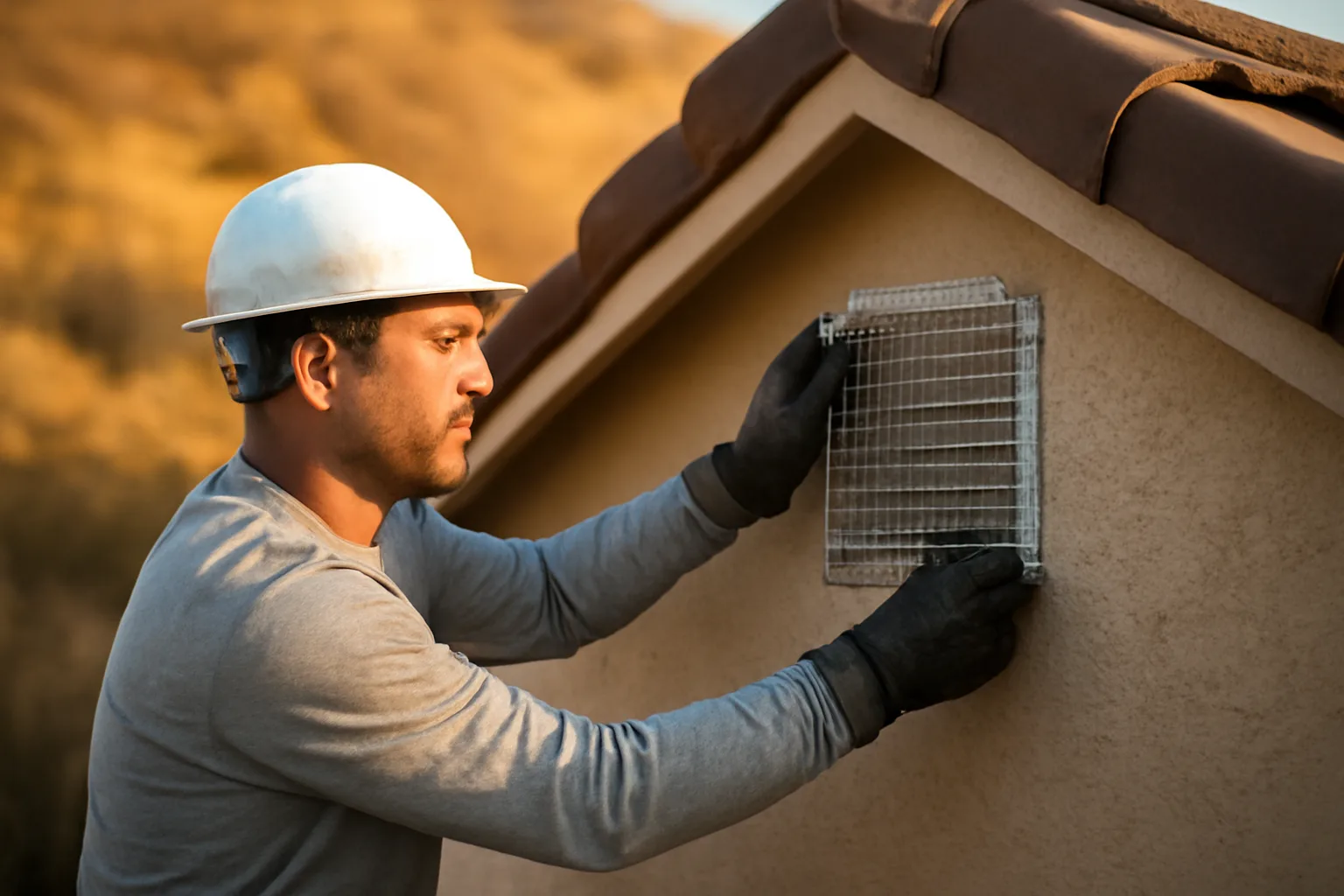
Start with the roof, the vents, and the five feet closest to the foundation. In that order. If you only have budget for one project this year, it's the vents, because they're the cheapest fix with the biggest ember-intrusion payoff. Roofing: Class A fire-rated roofing (asphalt composition shingle, metal, tile, or slate) is the single biggest factor in whether a home survives an ember storm, according to CAL FIRE's Wildland-Urban Interface Building Standards guidance. If you have wood shakes, that's the top of your list, full stop. Vents: Attic, foundation, and eave vents are chimney-shaped invitations for embers. Retrofitting with 1/8-inch corrosion-resistant metal mesh, or better, an ember- and flame-resistant vent rated to a standard like California's State Fire Marshal SFM 12-7A-1, closes that gap for a few hundred dollars per vent [1]. Zone 0 (the first 5 feet): California's new ember-resistant zone rule (more on timing below) requires noncombustible material within 5 feet of the structure, no bark mulch, no wood fencing attached to the house, no combustible furniture cushions left out during fire season [2]. Here's a rough cost and impact comparison homeowners in wildfire zones are actually working with: | Renovation | Typical cost range | Ember-intrusion impact |
When does the California defensible space law go into effect?
California's existing 100-foot defensible space requirement under Public Resources Code 4291 has been in effect for years and applies to homes in State Responsibility Areas and some Very High Fire Hazard Severity Zones [3]. That part isn't new. What's new, and what people mean when they ask this question in 2025 and 2026, is the Zone 0 "ember-resistant zone" rule. CAL FIRE and the Board of Forestry were directed under California SB 63 (2020) to develop regulations for a 0-to-5-foot ember-resistant zone immediately around structures [4]. The Board of Forestry finalized draft regulations, and CAL FIRE's own timeline has stated an intended effective date around 2025, with active enforcement phased in afterward and homeowner compliance expected by 2026 for many jurisdictions. Honestly, the exact enforcement date has moved before and could move again, since it depends on final rulemaking and local fire agency adoption. The one stable fact: check your local fire district's defensible space page directly, because the requirement is layered (state baseline plus whatever your county or fire protection district adds). [Guided fill-in: contact ______ County Fire / Fire Protection District for your local Zone 0 enforcement date and any local amendments.] Don't wait for the exact enforcement date to start the work. If you're getting non-renewal notices now, insurers are already asking about Zone 0-adjacent conditions during inspections.
What fire-safe rules for homes take effect in 2026?
The honest answer is: it depends heavily on your state and even your specific fire district, and 2026 dates are still being finalized in some places. Here's what's actually confirmed or strongly expected as of this writing. California: The Zone 0 ember-resistant zone standard (SB 63 rulemaking) is the big one, with CAL FIRE indicating phased compliance timelines that push into 2026 for many property types, especially existing homes (new construction in high-hazard zones has generally faced earlier compliance dates than remodels) [4]. Oregon: Following the 2020 Labor Day fires, Oregon passed SB 762, which directed the Oregon Department of Forestry to build a statewide wildfire risk map and defensible space code framework. Implementation has been contentious and delayed after public pushback over the risk map itself, and Oregon has revised its approach multiple times, so check the Oregon State Fire Marshal's current guidance rather than assuming a fixed 2026 date [5]. Colorado: Colorado doesn't have one statewide mandatory defensible space law, it's largely handled by county and local fire authority ordinances, so "2026 rules" really means whatever your county wildfire mitigation code says. Check with your county's wildfire mitigation or planning department. Arizona: Similarly no single statewide mandatory retrofit law, defensible space and building requirements come through county codes and the Arizona State Forestry Division's guidance for high-risk communities. [Guided fill-in: your fire district is ______, confirm current mitigation deadlines directly with ______ before budgeting your renovation timeline.]
Why won't people follow the defensible space law in California?
This gets asked a lot, and the honest reasons aren't laziness, they're cost, capacity, and confusion. A 2020 survey-based study published in the International Journal of Wildland Fire found that homeowner compliance with defensible space requirements is inconsistent even in high-hazard areas, and researchers have repeatedly identified cost of vegetation removal, lack of enforcement follow-through, and unclear property-line responsibility (who clears the shared slope between two lots) as recurring barriers. There's also a real capacity problem. In parts of California, there simply aren't enough licensed tree crews and chipping services to serve every property owner who wants to comply during the narrow spring window before fire season. Rural and elderly homeowners are disproportionately affected, since heavy brush clearing on a slope isn't a DIY job for most 70-year-olds. Enforcement is uneven too. CAL FIRE and local fire departments do inspections, but resources vary hugely by county, and a warning letter with no follow-up doesn't create much pressure to act. Insurers, ironically, have become a stronger enforcement mechanism than the government in a lot of areas, because a failed defensible space inspection now can mean a non-renewal letter regardless of what the fire department does. If you got that non-renewal letter, the renovation work matters just as much as, if not more than, the vegetation clearing, because insurers increasingly ask about roofing material, vent screening, and siding, more than brush distance.
How do you prevent wildfires from starting on your own property?
Most ignitions near homes aren't from the wildfire itself, they're from things people do on their own land: equipment sparks, debris burning, dragging trailer chains, and downed power lines. CAL FIRE's public wildfire prevention guidance lists equipment use, campfires, and debris burning as leading human-caused ignition sources, and recommends avoiding mowing dry grass during peak heat hours, keeping vehicles off dry vegetation, and maintaining spark arrestors on chainsaws and other combustion equipment [6]. A few concrete habits actually move the needle: mow before 10am when grass is damp with dew, never on windy afternoons; keep a shovel and water source nearby during any outdoor equipment use in fire season; and don't burn debris piles without checking local burn permit rules and weather red-flag warnings. On the renovation side, this connects directly to structure hardening. A spark-ignited grass fire near your foundation behaves exactly like an ember storm event: it tests your vents, your Zone 0 clearance, and your siding material. The same fixes that protect against wildfire embers protect against a mower spark igniting your own dry lawn edge.
How do you prepare for a wildfire if you live in a high-risk zone?
Preparation splits into three buckets: the house, the go-bag, and the paperwork. Most guides only cover the first two. For the house: complete defensible space clearing per your local rules, harden the structure per the priority list above (roof, vents, Zone 0), and clear gutters and roof valleys of debris at least twice a year, more if you have conifers nearby. For the go-bag: Ready.gov recommends a household emergency kit with at least a 3-day supply of water (one gallon per person per day) and nonperishable food, a battery or hand-crank radio, flashlight, first aid kit, and a way to charge phones. In a fast-moving wildfire evacuation, add your medications, pet supplies, and important documents to that list, since you may only get minutes of notice. For the paperwork: this is the piece people skip until it's too late. Before fire season, photograph every room, your roof, your defensible space work, and your major systems (HVAC, electrical panel, water heater). Insurers evaluating a claim or a renewal decision want to see dated proof of what you did and what you owned, more than your memory of it. This is exactly the gap our $99 Wildfire Insurance Survival Kit is built to close: a structured way to document your home, your hardening work, and your inventory before you need it, so you're not scrambling to reconstruct records during an active evacuation or a denied claim. We don't file claims for you, we just help you build the documentation you'd send your insurer yourself.
How do you prevent forest fires and avoid forest fires when you're outdoors?
Forest fire prevention for individuals mostly comes down to fire source control: campfires, cigarettes, vehicles, and equipment. The U.S. Forest Service's Smokey Bear program (still the primary federal public-awareness campaign after 80 years) recommends drowning, stirring, and feeling campfire ashes cold before leaving a site, and never leaving a campfire unattended even for a few minutes [7]. A few specific, boring-but-effective rules: don't park on dry grass (catalytic converters run around 500 to 900 degrees Fahrenheit and are a documented ignition source for roadside grass fires), check local fire restrictions before any outdoor burning, and avoid fireworks entirely in wildland-adjacent areas regardless of state legality, since illegal fireworks use is a recurring cause of wildland fire starts nationally per National Interagency Fire Center incident data. If you smoke, use a proper receptacle, not the ground, and never toss a cigarette from a moving vehicle. It sounds obvious. It's still one of the most common preventable ignition sources reported by state forestry agencies during red-flag warning periods.
How can communities prevent forest fires at a larger scale?
Individual home hardening matters, but forest fire prevention at the community level is mostly about fuel management and coordinated clearing, not any single house. Community Wildfire Protection Plans (CWPPs), developed under the federal Healthy Forests Restoration Act of 2003, let communities identify high-risk fuel zones and prioritize thinning and prescribed burn projects with federal and state cost-share support [8]. Coordinated neighborhood defensible space matters more than any one property doing it alone, since a fire doesn't stop at a property line. If your neighbor's dry brush pile sits ten feet from your fence, your Zone 0 work barely helps. Some fire districts and HOAs have started running shared chipper-day programs to lower the cost barrier for whole neighborhoods to clear at once, which studies from University of California Cooperative Extension have found increases participation compared to individual mandates alone [9]. If you're organizing at the HOA or street level, our guide on wildfire defensible space clearing contracts covers how group contracts work in practice, even outside Washington state, since the contract structure translates well.
Is Santa Barbara safe from fire, and how do coastal California zones fare?
No California coastal community, including Santa Barbara, is "safe" from wildfire in any absolute sense, and Santa Barbara County has a documented history of severe fire events, including the 1990 Painted Cave Fire and the 2017 Thomas Fire, which at the time was the largest wildfire in modern California history by acreage before later fires surpassed it [10]. What matters more than the city name is your specific parcel's location relative to the wildland-urban interface. CAL FIRE's Fire Hazard Severity Zone maps, updated periodically and viewable through the CAL FIRE FHSZ Viewer, show that large sections of the hills above Santa Barbara (Montecito, San Roque, the foothill communities) sit in Very High or High Fire Hazard Severity Zones, while flatter coastal-plain neighborhoods closer to the ocean generally carry lower designations [11]. If you own property anywhere in Santa Barbara County, check your specific parcel against the current FHSZ map rather than relying on the town's general reputation, since risk varies block by block, not city by city. The same logic applies to any wildfire-prone metro area in CA, CO, OR, or AZ.
What should a fire-resistant renovation checklist look like room by room?
Here's a practical order of operations if you're renovating with a fixed budget and want the highest ember-resistance return per dollar spent. Exterior envelope first: Class A roof, ember-resistant vents, noncombustible or fire-resistant siding (fiber cement, stucco, or ignition-resistant treated wood), enclosed eaves (boxed rather than open rafter tails), and dual-pane windows with tempered outer glass, since single-pane glass can crack from radiant heat and let embers straight into the house. Zone 0 next: noncombustible ground cover within 5 feet, no combustible fencing attached directly to the house (use a metal gate section as a transition instead), and store firewood, propane tanks, and combustible furniture outside that zone. Decks and attachments: any wood deck attached to the house is a documented major vulnerability, per IBHS testing, since embers accumulate underneath and in gaps between boards; consider enclosing the underside with fire-resistant material or replacing decking with a noncombustible composite rated for wildfire exposure. Details that get skipped: gutter guards (metal, not plastic), spark arrestors on chimneys, and closing off any gap where combustible eave vents meet the roofline. For a full comparison of hardening approaches across product categories, see our defensible space and structure hardening comparison guide, and for landscaping choices near the foundation, see fire-safe landscaping in California next to house.
How do you document renovation work for your insurer?
Insurers evaluating non-renewal or reinstatement decisions want dated, specific proof, not a general claim that you "did the work." Photograph before-and-after shots of the roof, vents, and Zone 0 perimeter, keep contractor invoices and material spec sheets (the ember-resistant vent's rating label, the roofing product's Class A certification), and save any inspection report from your local fire department if one was issued. Many insurers in FAIR Plan states now accept a wildfire mitigation form similar to the one used in California's FAIR Plan Wildfire Mitigation Discount program, which asks for specifics like roof material, defensible space zone compliance, and vent type . Filling that out accurately, with photo backup, is the single most useful thing a homeowner can do after a non-renewal notice, even though we can't tell you it guarantees reinstatement, since that decision sits entirely with the insurer. We're not a public adjuster and we don't file claims on your behalf or promise any specific coverage outcome. What we do help with is organizing your own documentation, room by room, so when you do send something to your insurer or agent, it's complete and dated instead of scattered across old text messages and a shoebox of receipts.
What does a realistic renovation budget and timeline look like?
For a mid-size single-family home (1,800 to 2,400 sq ft) doing a full ember-resistance retrofit, expect somewhere between $15,000 and $45,000 total depending on how much of the roof, siding, and vent work you need versus already have in decent shape. If your roof is already Class A rated, your number drops fast, since roofing is the biggest line item. Timeline-wise: vent retrofits and Zone 0 gravel work can usually happen in a week or two with the right contractor. A full roof replacement typically takes 3 to 10 days depending on size and material, but scheduling a roofer during peak wildfire-prep season (spring, before fire season starts) can mean a 4 to 8 week wait, so book early. Here's the sequencing that makes financial sense for most homeowners: do Zone 0 and vent retrofits first (cheap, fast, high impact), then budget separately for the roof replacement as a bigger project, ideally timed to when you'd need a new roof anyway for age or damage reasons. Don't rip out a functional 10-year-old roof just for the fire rating if it's already Class A; check the product spec before assuming you need to replace it.
Frequently asked questions
When does the California defensible space law go into effect?
The core 100-foot defensible space law (Public Resources Code 4291) is already in effect and has been for years. The newer Zone 0 ember-resistant zone rule under SB 63 is in phased rulemaking, with CAL FIRE indicating enforcement stretching into 2025 and 2026 for many property types. Check your local fire district for the exact date that applies to your parcel.
Why won't people follow the defensible space law in California?
Cost, labor shortages, and unclear enforcement are the main reasons, according to wildland fire compliance research. Clearing steep, brush-heavy lots is expensive and physically demanding, licensed crews are in short supply during the spring compliance window, and enforcement follow-through varies widely by county, which reduces the pressure to comply even after a warning notice.
How do you prevent wildfires from starting near your home?
Control ignition sources: keep equipment spark arrestors maintained, mow dry grass only in early morning when it's damp, never park hot vehicles on dry vegetation, and follow local burn permit rules. CAL FIRE identifies equipment use and debris burning as leading human-caused wildfire ignition sources, so managing those habits reduces risk directly.
How do you prepare for a wildfire evacuation?
Ready.gov recommends a household kit with at least 3 days of water (one gallon per person per day), nonperishable food, a flashlight, radio, and first aid supplies. Add medications, pet supplies, and copies of key documents. Also complete defensible space clearing and structure hardening in advance, since prep work matters more than last-minute packing.
How do you prevent forest fires while camping or hiking?
Fully drown, stir, and feel campfire ashes cold before leaving, per U.S. Forest Service Smokey Bear guidance. Never leave a fire unattended, don't park on dry grass, check local fire restrictions before any burning, and dispose of cigarettes in a proper receptacle rather than the ground.
How can communities prevent forest fires beyond individual homes?
Community Wildfire Protection Plans, authorized under the federal Healthy Forests Restoration Act of 2003, let neighborhoods coordinate fuel thinning and prescribed burns with cost-share funding. Shared chipper-day programs and coordinated defensible space clearing across property lines are more effective than individual homeowners acting alone, since fire doesn't respect fence lines.
What fire-safe home rules take effect in 2026?
It varies by state. California's Zone 0 ember-resistant zone standard is expected to phase toward broader compliance around 2025 to 2026. Oregon, Colorado, and Arizona largely rely on county or local fire district ordinances rather than one statewide 2026 deadline, so confirm directly with your local fire authority.
Is Santa Barbara safe from fire?
No coastal California community is fully safe from wildfire. Santa Barbara County has a documented history of major fires, including the 1990 Painted Cave Fire and 2017 Thomas Fire. Risk varies by parcel: hillside and foothill neighborhoods generally carry Very High or High Fire Hazard Severity Zone designations, while flatter coastal areas are typically lower risk.
What is the single most cost-effective fire-resistant renovation?
Retrofitting vents with ember-resistant, corrosion-resistant metal mesh (around 1/8-inch) typically costs $150 to $400 per vent and closes one of the most common ember-entry points into a home, according to IBHS and CAL FIRE wildland-urban interface research. It's usually the highest-impact, lowest-cost fix available.
Do I need a Class A roof if my current roof isn't damaged?
Not necessarily right away, but if you have wood shakes or shingles, that's a high-priority replacement regardless of condition, since CAL FIRE guidance identifies roofing material as one of the biggest factors in structure survival during ember exposure. If your roof is already Class A rated, you likely don't need to replace it early.
Does defensible space clearing replace the need for structure hardening?
No. Defensible space (vegetation clearing) and structure hardening (roof, vents, siding, Zone 0 materials) address different vulnerabilities and insurers increasingly check both. A cleared yard with an unretrofitted vented attic can still lose the house to an ember that gets inside through the vent.
How much does a full fire-resistant home renovation cost?
For a typical 1,800 to 2,400 square foot home, a full ember-resistance retrofit (roof, vents, Zone 0, some siding work) generally runs $15,000 to $45,000, depending heavily on whether the roof already meets Class A rating. Vent and Zone 0 work alone can often be done for $2,000 to $8,000.
What should I document before a wildfire season for insurance purposes?
Photograph your roof, vents, Zone 0 perimeter, and any hardening work with dates, and keep contractor invoices and product spec sheets showing fire ratings. Insurers reviewing non-renewal or reinstatement decisions want specific, dated proof, not a general description of work completed.
Sources
- California Office of the State Fire Marshal, SFM 12-7A-1 Vent Standard: Ember- and flame-resistant vents are tested and rated under California State Fire Marshal standard SFM 12-7A-1
- California Board of Forestry and Fire Protection, Zone 0 Ember-Resistant Zone Rulemaking: California's Zone 0 rule requires noncombustible material within 5 feet of a structure and is in active rulemaking with phased compliance dates
- California Public Resources Code Section 4291: California's 100-foot defensible space requirement is established under Public Resources Code 4291
- California Senate Bill 63 (2020): SB 63 directed CAL FIRE and the Board of Forestry to develop the Zone 0 ember-resistant zone regulation
- Oregon Senate Bill 762 (2021): Oregon SB 762 directed the state to develop a wildfire risk map and defensible space code framework following the 2020 Labor Day fires
- CAL FIRE, Wildfire Prevention public guidance: Equipment use, debris burning, and campfires are leading human-caused wildfire ignition sources identified by CAL FIRE
- USDA Forest Service, Smokey Bear Campfire Safety: Campfires must be drowned, stirred, and felt cold before being left unattended to prevent wildfire ignition
- Healthy Forests Restoration Act of 2003: The Healthy Forests Restoration Act of 2003 authorizes Community Wildfire Protection Plans for coordinated fuel management
- University of California Cooperative Extension, wildfire preparedness outreach research: Coordinated neighborhood programs increase defensible space participation compared to individual mandates alone
- National Interagency Fire Center / CAL FIRE incident archives, Thomas Fire: The 2017 Thomas Fire in Santa Barbara and Ventura counties was the largest wildfire in modern California history at the time
- CAL FIRE Fire Hazard Severity Zone Viewer: Fire Hazard Severity Zone designations vary by specific parcel, with hillside communities near Santa Barbara mapped as Very High or High risk