Last updated 2026-07-25
TL;DR
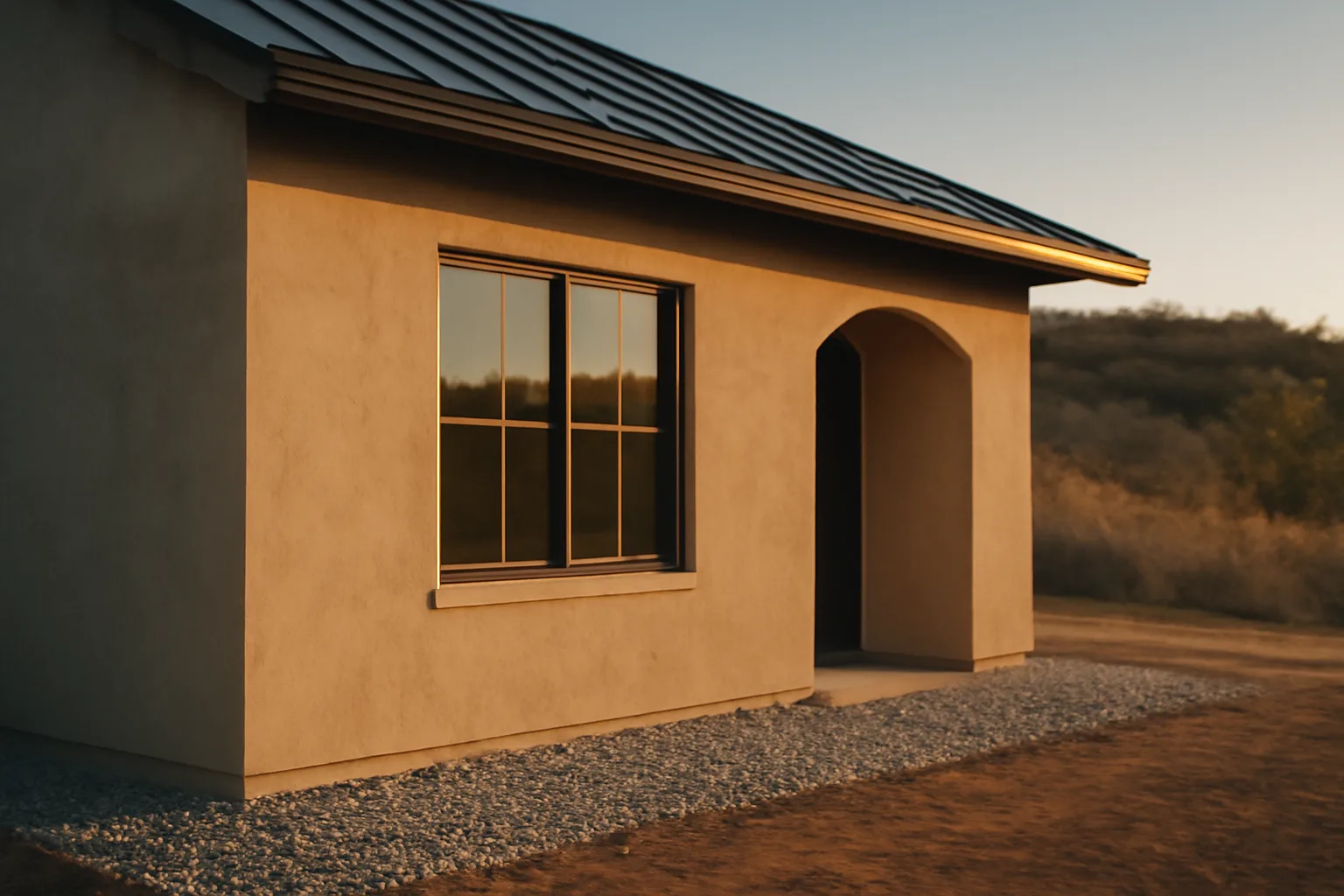
Building a fire resistant home means treating embers as the enemy, not flames. Prioritize a Class A roof, ember-resistant vents, enclosed eaves, dual-pane windows, and a noncombustible 5-foot zone around the foundation. CAL FIRE research shows most home ignitions during wildfires come from wind-blown embers landing on vulnerable materials, not direct flame contact.[1]
What actually makes a home fire resistant?
A fire resistant home is built and maintained so that wind-blown embers, radiant heat, and direct flame contact are far less likely to ignite it. That's the whole game. Most people picture a wall of fire rolling over a house. In reality, the research says embers do most of the damage. The Insurance Institute for Business & Home Safety (IBHS) and CAL FIRE both point to embers, sometimes traveling a mile or more ahead of a fire front, as the dominant cause of home ignition during wildfires. Embers land in gutters full of dry leaves, sneak through unscreened attic vents, ignite mulch pushed against siding, or find gaps under a wood deck. None of that requires flames anywhere near your property line. So "fire resistant" isn't one product. It's a system: a noncombustible roof, protected vents, tight eaves, dual-pane windows, noncombustible siding low on the wall, and a clean zone immediately around the foundation. Miss one weak link and embers exploit it. This is why insurers and fire marshals increasingly ask for documentation of the whole envelope, more than "do you have a metal roof." If you want a plain-English rundown of what a fire actually does to different parts of a structure, our house fire piece walks through failure points room by room.
What is Zone 0 and why does it matter more than landscaping alone?
Zone 0 is the 5 feet immediately surrounding your house, and California's newest defensible space law requires it to be nearly free of anything combustible, no mulch, no wood fencing attached to the house, no stored firewood, no plants directly against the wall. Assembly Bill 3074 (2020) directed CAL FIRE to develop these ember-resistant zone regulations, though as of 2025 the specific Zone 0 regulations have not yet been finalized or taken effect statewide. [1] Here's the confusion that trips people up: California's general defensible space law (100 feet of clearance in two zones) has been in effect for years under Public Resources Code 4291, but the stricter "ember-resistant zone" (Zone 0) rules authorized by AB 3074 are still in the regulatory process. CAL FIRE's Board of Forestry has been working through rulemaking, and the agency's own guidance describes Zone 0 as "an emerging best practice" that homeowners can adopt now even before it's mandatory. Practically, treat Zone 0 as urgent regardless of the legal timeline. It's the cheapest, highest-leverage work you can do: pull mulch back to gravel or pavers, move firewood stacks at least 30 feet away, trim any branches overhanging the roof, and swap wood fencing for metal or masonry in the last 5 feet where it meets the house. For a full walk-through of what belongs and doesn't belong in this zone, see fire safe landscaping California next to house.
When does the California defensible space law go into effect?
| 100-ft defensible space (Zones 1 & 2) | In effect | Public Resources Code 4291 |
|---|---|---|
| Annual defensible space inspections (high-risk areas) | In effect in many jurisdictions | Local fire agency / CAL FIRE |
| Zone 0 ember-resistant zone (0-5 ft) | Rulemaking in progress, not finalized statewide | AB 3074 (2020) |
The 100-foot defensible space requirement under Public Resources Code 4291 is already in effect and has been enforced by CAL FIRE and local fire agencies for years; it requires clearing flammable vegetation in two zones extending up to 100 feet from structures, or to the property line, whichever is closer. [2] The newer Zone 0 (ember-resistant zone) regulations from AB 3074 are a separate, additional requirement still moving through rulemaking as of 2025, with no statewide enforcement date finalized yet. CAL FIRE's own defensible space page states the law requires "clearing flammable vegetation and other combustible growth from at least 100 feet around the home," split into Zone 1 (0-30 feet, more aggressive clearing) and Zone 2 (30-100 feet, reduced fuel spacing). [2] That part isn't coming, it's here, and it's been enforceable since the law's amendments took effect in 2005 for the 100-foot standard. For Zone 0 specifically, don't wait for a mandate. Insurers are already asking about ember-resistant zones on inspection forms in high-risk ZIP codes, and getting ahead of a rule that's clearly coming is cheaper than a rushed retrofit later. Check your specific fire district's current requirements, since some local jurisdictions have already adopted stricter standards than the state floor. [Add your local fire district's defensible space ordinance here]. A rough timeline for readers tracking this: | Requirement | Status | Authority |
Why won't people follow the defensible space law in California?
The honest answer is a mix of cost, labor, aesthetics, and simple lack of awareness that enforcement has teeth. CAL FIRE inspection data over the years has repeatedly found large shares of properties in the wildland-urban interface out of compliance on first inspection, and the agency has said publicly that lack of defensible space is one of the most common factors in home losses it investigates after major fires. A few real reasons people skip it: Cost and labor. Clearing 100 feet of brush on a sloped, oak-covered lot isn't a weekend project. Contractors for vegetation management can run $1,000 to $5,000+ depending on lot size and terrain, and many older or fixed-income homeowners simply can't absorb that. They love their landscaping. Mature trees and dense hedges took decades to grow. Being told to remove or thin them near the house feels like an attack on the property, not a safety measure, even when the science is clear that flammable vegetation touching the structure is a major ignition pathway. They don't think it'll happen to them. This is the big one. Fire risk feels abstract until a neighbor loses a house or an insurer sends a non-renewal letter. Behavioral research on wildfire mitigation consistently finds that perceived risk, not actual risk, predicts whether people act. Enforcement is spotty. Not every county has the staff to inspect every property every year, so some homeowners correctly calculate the odds of getting cited are low, even though the odds of a fire are not. None of this changes the physics. Uncleared defensible space is one of the most fixable risk factors a homeowner controls, and it's usually far cheaper than the roof or siding retrofits we cover below.
What roofing and siding materials actually resist fire?
| Metal roofing | Class A, doesn't ignite, can still transfer heat at seams | $$$ | |
|---|---|---|---|
| Concrete/clay tile | Class A, very durable, heavy (check structural support) | $$$ | |
| Class A asphalt shingles | Class A rated assembly, most affordable option | $ | |
| Untreated wood shake | Not fire resistant, banned in many WUI zones | N/A | |
| Fiber cement siding | Noncombustible, good ember resistance | $$ | |
| Stucco | Noncombustible, widely used in CA new construction | $$ | |
| Vinyl siding | Melts/deforms under heat, not recommended in high-risk zones | $ | If you're rebuilding after a loss or doing new construction, this is the point to get it right the first time. Retrofitting a roof later costs far more than specifying it correctly during a rebuild. |
Class A fire rated roofing (asphalt composition shingles rated Class A, metal, concrete tile, or clay tile) is the single highest-impact upgrade for wildfire resistance, according to IBHS research and CAL FIRE building guidance. Class A means the roof assembly has passed the most stringent fire test rating under ASTM E108 / UL 790 standards, covering resistance to flame spread, burning brands, and intermittent flame exposure. Siding matters almost as much. Wood shingle and wood board siding are among the most common wildfire ignition points because embers accumulate in gaps, cracks, and at the base where siding meets the ground. California's Chapter 7A building code (part of the California Building Code, applicable in Wildland-Urban Interface Fire Hazard Severity Zones) requires ignition-resistant construction materials for exterior walls, including approved fire-retardant treated wood, fiber cement, stucco, or noncombustible materials like metal or masonry. [3] Here's a rough comparison of common materials: | Material | Fire performance | Relative cost |
What about vents, windows, and eaves?
Ember-resistant vents, dual-pane tempered glass windows, and boxed-in (soffited) eaves close off the three most common entry points for embers into a structure's interior and attic space. IBHS testing has repeatedly shown that open eaves and standard mesh vents allow embers to accumulate and ignite insulation or debris inside the attic, often the actual cause of total home loss even when the exterior survives initial exposure. Vents: Standard 1/4-inch or 1/8-inch mesh vents look like they'd stop embers, but they don't reliably. California's Chapter 7A code requires vents in new construction within Fire Hazard Severity Zones to be labeled as meeting ASTM E2886 ember and flame intrusion testing, or to use 1/8-inch corrosion-resistant metal mesh at minimum, with many jurisdictions now requiring the more rigorous ember-tested product line. [3] Windows: Single-pane windows can crack from radiant heat alone, well before flame contact, creating an opening for embers and fire to enter the living space. Dual-pane windows with at least one tempered glass pane perform significantly better under radiant heat exposure in IBHS and CAL FIRE testing. Eaves: Open eaves expose the rafter tails and attic vents directly to ember accumulation from below. Boxing them in (soffited eaves) with noncombustible material removes that pocket. Decks: Add this to the list even though it's not technically part of the envelope. Combustible decking directly attached to the house, especially with storage underneath, is a documented ignition pathway. Chapter 7A requires ignition-resistant decking materials in high-risk zones. [3]
How do I prepare for a wildfire if I already live in a high-risk area?
Preparing for a wildfire means doing the structural hardening above where you can afford it, maintaining defensible space every year (more than once), and having an evacuation and documentation plan ready before you get the warning. Ready.gov's wildfire preparedness guidance breaks this into before, during, and after phases, and the "before" work is what actually saves the house. Ready.gov recommends assembling a go-bag with medications, important documents, and supplies for at least 72 hours, signing up for local emergency alerts, and knowing at least two evacuation routes out of your neighborhood in case one is blocked by fire or traffic. Before fire season starts each year: Redo Zone 0 and Zone 1 clearing. Dead grass and dry mulch accumulate every single year, so a one-time clearing doesn't hold. Clean gutters and roof valleys of leaf litter and pine needles, prime ember-catching real estate. Check that vents haven't lost their mesh screening or gotten damaged. Move propane tanks, firewood, and anything flammable at least 30 feet from structures. Photograph your home's exterior, roof, and any hardening upgrades. This documentation matters twice: once for your own records if you ever need to demonstrate mitigation work to an insurer, and once simply so you know what "normal" looks like if you need to assess damage later. We do not file claims or represent anyone in dealings with their insurance company; that documentation is yours to keep and share as you see fit. For a broader look at what preparedness actually means at the property level beyond just the structure itself, defensible covers the zone-by-zone breakdown.
How can we prevent forest fires and wildfires from starting in the first place?
Most wildfires in the US are human-caused, not lightning-caused, which means prevention is mostly about controlling ignition sources: campfires, equipment sparks, vehicle exhaust on dry grass, fireworks, and debris burning. The National Interagency Fire Center and US Forest Service data consistently attribute roughly 85-90% of wildfires to human causes in a given year, though the exact percentage varies by year and region. Simple prevention habits that actually move the needle: fully extinguish campfires (drown, stir, drown again, until cold to the touch), never park vehicles on dry grass (catalytic converters run over 500°F), avoid outdoor burning on Red Flag Warning days, maintain spark arrestors on chainsaws and equipment, and follow local fireworks restrictions, which are often outright bans in wildfire-prone counties during fire season. Smokey Bear's long-running "Only you can prevent wildfires" campaign, run by the US Forest Service and the Ad Council since 1944, exists because individual behavior really is the biggest lever here. If you want the deeper history and current campaign guidance, we cover it in only you can prevent wildfires. At a community level, coordinated vegetation management (thinning shared open space, maintaining roadside clearance, and enforcing local burn bans) matters more than any single homeowner's actions. Fire doesn't respect property lines, so a fire-hardened house surrounded by unmanaged wildland fuel is still at serious risk. This is part of why some states have moved toward permitted, contractor-run clearing programs; Washington's DNR, for example, runs wildfire defensible space clearing contracts that homeowners and communities can use.
What new fire-safe building codes take effect in 2026?
As of this writing, no single nationwide "2026 fire code" is set to take effect; fire-safe building requirements are set state by state and often county by county, and homeowners should check with their specific state fire marshal and local building department for the current effective dates in their jurisdiction. California's Chapter 7A WUI building standards are already in effect for new construction and major remodels in designated Fire Hazard Severity Zones, and have been periodically updated through the state's triennial building code cycle (the California Building Standards Commission updates the full code roughly every three years). [3] Some things worth tracking rather than assuming: California's Zone 0 (AB 3074) ember-resistant zone rule is still in rulemaking as covered above; watch CAL FIRE's Board of Forestry and Fire Protection page for the finalized regulation and effective date. Colorado passed wildfire mitigation and building code legislation in recent sessions aimed at high-risk areas; check the Colorado Division of Fire Prevention and Control for current adopted standards in your county. Oregon's statewide wildfire risk map and defensible space code requirements (under Senate Bill 762, passed in 2021) have gone through multiple revisions after public pushback on risk classifications; check Oregon Department of Forestry for the current map and requirements. Arizona doesn't have a statewide WUI building code equivalent to California's Chapter 7A; requirements are set locally, so check with your county or municipal building department. [Insert your specific fire district or county's 2026 code adoption status and effective date here, since this varies significantly by jurisdiction and changes year to year.]
Is Santa Barbara safe from fire, and how do I check my own area's risk?
No area in California's wildland-urban interface, including Santa Barbara, is "safe" from fire risk in an absolute sense; Santa Barbara County has experienced multiple major destructive fires in the past two decades, including the Thomas Fire (2017) and the Jesusita Fire (2009), and much of the county's foothill and mountain-adjacent communities sit within CAL FIRE-designated Very High Fire Hazard Severity Zones. [4] The honest way to answer "is my area safe" isn't a yes/no, it's checking your specific parcel against CAL FIRE's Fire Hazard Severity Zone (FHSZ) maps, which are published by CAL FIRE and are the same maps insurers and local building departments use to determine whether Chapter 7A construction standards and defensible space enforcement apply to your property. [5] CAL FIRE updated its FHSZ maps in 2024 for State Responsibility Area lands, expanding the footprint of Very High zones in many counties, including parts of Santa Barbara County. You can look up your specific address on CAL FIRE's FHSZ viewer to see your zone designation. If you're in a Moderate, High, or Very High zone, Chapter 7A construction rules and the 100-foot defensible space law both apply to your property, regardless of how the neighborhood "feels." This is really the underlying answer to every version of "is [my town] safe from fire": check the map, not the reputation. Fire doesn't care that a town has good weather or ocean views.
What does a full fire-hardening retrofit actually cost, and where should I start?
A full wildfire-hardening retrofit (Class A roof, ember-resistant vents, enclosed eaves, dual-pane windows, noncombustible siding, and Zone 0/1 clearing) commonly runs anywhere from $15,000 to $75,000+ depending on home size, existing materials, and region, though costs vary enormously based on what you're starting with. Homes that already have stucco and a composition shingle roof need far less work than a home with wood shake siding and open eaves. If money forces you to sequence the work, here's the order that gives you the most risk reduction per dollar, based on where embers actually cause ignitions per IBHS and CAL FIRE research: 1. Zone 0 clearing (5 feet around foundation): cheapest, highest immediate impact, often under $500-$1,500 in labor and materials. 2. Vent replacement with ember-resistant, tested vents: relatively low cost per vent, high impact given how common vent-based ignition is. 3. Gutter guards and roof valley cleaning: cheap, ongoing maintenance item, not a one-time fix. 4. Roof replacement to Class A material, if not already compliant: the biggest single expense, but also the biggest single risk reducer. 5. Siding replacement or fire-retardant treatment on the lowest few feet of wall. 6. Window upgrades to dual-pane: often bundled with energy-efficiency rebates, worth checking your state or utility for incentives that offset cost. For readers dealing with a non-renewal letter right now and needing to move fast on documentation rather than full construction, that's a different problem than a ground-up rebuild, and it's where a lot of our other coverage on inspections and insurer documentation comes in.
What should I put together before an insurance inspection or non-renewal deadline?
Before an insurance inspection or in response to a non-renewal notice, gather dated photos of your roof, vents, siding, defensible space zones, and any completed mitigation work, plus receipts or contracts for that work, organized in a format an underwriter can review quickly. Insurers in California, Colorado, Oregon, and Arizona increasingly use standardized wildfire mitigation checklists (often aligned with the IBHS Wildfire Prepared Home standard) to decide on renewal, and incomplete or disorganized documentation is a common reason homeowners get rejected on paperwork grounds rather than actual risk. This is genuinely where a lot of homeowners get stuck: they've done real mitigation work, but they can't produce it in a form that matches what the underwriter's checklist is asking for, and the clock is running on a 30-60 day non-renewal window. We built the $99 Wildfire Insurance Survival Kit for exactly that gap. It's a one-time purchase that walks you through organizing your own defensible space photos, mitigation receipts, and roof/vent documentation into the format insurers actually ask for, so you're not scrambling the week before a deadline. To be clear: we don't file claims on your behalf or promise any discount or reinstatement. You prepare and send your own documentation; we just make sure it's complete and organized. If you're facing a deadline, start at /survival-kit-builder.
Frequently asked questions
When does the California defensible space law go into effect?
The core 100-foot defensible space law (Public Resources Code 4291) is already in effect and has been enforced for years. The newer Zone 0 ember-resistant zone rule from AB 3074 (2020) is still in CAL FIRE rulemaking as of 2025, with no finalized statewide effective date yet. Check your local fire district for any earlier local adoption.
Why won't people follow the defensible space law in California?
Cost of clearing (often $1,000-$5,000+ per property), reluctance to remove mature landscaping, low perceived personal risk, and spotty local enforcement all contribute. CAL FIRE has cited lack of defensible space as a common factor in home losses it investigates, but awareness of the law's teeth remains uneven across counties.
How do I prevent wildfires from starting near my property?
Fully extinguish campfires, avoid parking on dry grass, follow Red Flag Warning burn restrictions, maintain equipment spark arrestors, and follow local fireworks bans. Human activity causes the large majority of wildfires nationally, according to US Forest Service and National Interagency Fire Center data, so controlling ignition sources matters as much as hardening structures.
How do I prepare for a wildfire if I get an evacuation warning?
Have a go-bag ready with medications and documents for 72+ hours, know at least two evacuation routes, sign up for local emergency alerts, and photograph your property's exterior and mitigation work beforehand, per Ready.gov's wildfire preparedness guidance. Do this well before fire season, not when smoke is visible.
How can we prevent forest fires at the community level?
Coordinated vegetation management on shared open space, enforced local burn bans during high-risk periods, and community chipping or debris programs matter more than any single homeowner's actions, since fire spreads across property lines. Programs like Washington DNR's defensible space clearing contracts help coordinate this at scale.
What fire-safe building codes take effect in 2026?
There's no single national 2026 fire code. California's Chapter 7A WUI standards are already in effect and updated on a roughly triennial cycle. Colorado, Oregon, and Arizona each set requirements at the state or county level separately; check your state fire marshal's office for your jurisdiction's current adopted code and any 2026 updates.
Is Santa Barbara safe from fire?
No area in California's wildland-urban interface is fully safe from fire risk, and Santa Barbara County has had multiple major fires including the 2017 Thomas Fire and 2009 Jesusita Fire. Much of the county's foothill area sits in CAL FIRE Very High Fire Hazard Severity Zones. Check your specific address on CAL FIRE's FHSZ map rather than relying on general reputation.
What is the single most effective fire-resistant upgrade for a home?
A Class A rated roof combined with ember-resistant vents is generally considered the highest-impact combination, since IBHS and CAL FIRE research shows embers entering through vents or igniting roofing materials are among the most common home ignition pathways in wildfires, more common than direct flame contact.
Does a metal roof alone make a home fireproof?
No. A metal roof is Class A rated and won't ignite, but a home with a metal roof and open eaves, unscreened vents, wood siding, and mulch against the foundation is still highly vulnerable to ember intrusion through those other pathways. Fire resistance requires the whole envelope, not one material.
How much does it cost to make an existing home fire resistant?
A full retrofit (roof, vents, eaves, windows, siding, defensible space) commonly runs $15,000 to $75,000 or more depending on starting materials and home size. Zone 0 clearing alone can cost under $1,500 and is the highest-impact low-cost step, while roof replacement is usually the largest single expense.
What is Zone 0 in wildfire defensible space rules?
Zone 0 is the 5-foot ember-resistant zone immediately around a structure, required to be nearly free of combustible material: no mulch, wood fencing attached to the house, stored firewood, or plants touching the wall. It's authorized under California's AB 3074 (2020) but still in CAL FIRE rulemaking as of 2025.
Are vinyl or wood siding safe in high fire-risk areas?
Neither performs well. Vinyl siding melts and deforms under radiant heat; wood siding is a documented ignition point where embers accumulate in gaps and cracks. California's Chapter 7A code requires ignition-resistant materials like fiber cement, stucco, or noncombustible options in Wildland-Urban Interface Fire Hazard Severity Zones for new construction and major remodels.
Sources
- California Legislature, Assembly Bill 3074 (2020): AB 3074 directed CAL FIRE to develop ember-resistant zone (Zone 0) regulations
- California Public Resources Code Section 4291: Statutory requirement for 100 feet of defensible space clearance in two zones
- California Building Code, Chapter 7A (Materials and Construction Methods for Exterior Wildfire Exposure): Chapter 7A requirements for ignition-resistant siding, decking, and ember-resistant vents in WUI zones
- CAL FIRE, Thomas Fire incident information: Thomas Fire (2017) as a major destructive fire affecting Santa Barbara County
- CAL FIRE, Fire Hazard Severity Zone maps: Fire Hazard Severity Zone maps used to determine Chapter 7A and defensible space applicability by parcel
- US Forest Service / National Interagency Fire Center, wildfire statistics: Majority of US wildfires are human-caused rather than lightning-caused