Last updated 2026-07-25
TL;DR
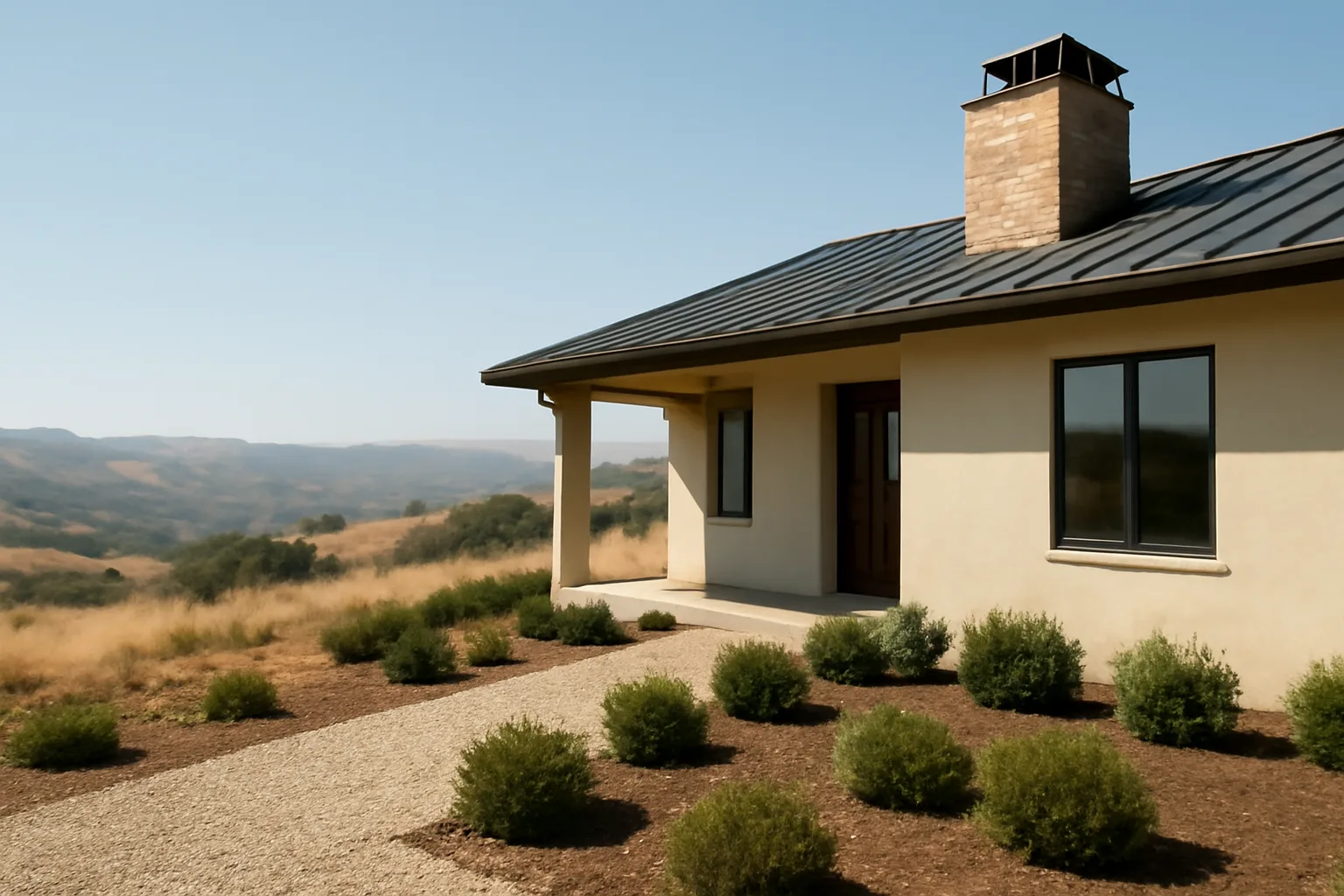
Defensible space is the area around a structure, typically 0 to 100 feet, where vegetation and combustible material are managed to slow a fire's approach and give firefighters room to defend the home. California law (Public Resources Code 4291) breaks it into three zones: 0-5 ft (ember-resistant), 5-30 ft (lean and clean), 30-100 ft (reduced fuel). Insurers now check for it before renewing policies.
What does "defensible space" actually mean?
Defensible space is the ring of managed land around a house, typically measured out to 100 feet, where a property owner has thinned or removed the vegetation and debris that let a wildfire spread fast and burn hot. It's not a lawn ordinance. It's a physical buffer designed to do two things: slow down flame and radiant heat before it reaches the structure, and give firefighters a place to stand and work if they decide the house is worth defending. CAL FIRE defines it plainly: defensible space is "the buffer you create between a building on your property and the grass, trees, shrubs, or any wildland area that surround it". That buffer removes or reduces flammable vegetation so a fire has less to burn as it approaches, and so embers landing near the house find less fuel waiting for them. Most homes that burn in wildfires don't go up because a wall of flame rolled over them. They ignite from embers, sometimes ones that traveled a mile or more ahead of the main fire, landing in dry leaves against a fence, in a gutter full of pine needles, or under a wood deck. Defensible space and home hardening work together: one buys distance and time, the other removes the ignition points embers rely on.
What are the three defensible space zones in California?
| Zone 0 | 0-5 ft from structure | Ember-resistant zone: no combustible mulch, plants, or stored items touching the house | |
|---|---|---|---|
| Zone 1 | 5-30 ft from structure | Lean, clean, and green: remove dead vegetation, space out shrubs, keep grass low | |
| Zone 2 | 30-100 ft from structure | Reduced fuel zone: thin trees and brush, remove ladder fuels, keep debris cleared | Zone 0 is the newest and strictest concept. CAL FIRE's guidance describes it as the area where homeowners should have "nothing that can burn" directly against the structure, including bark mulch, wood fencing attached to the house, and stored firewood [2]. Zone 1 asks for a 6-foot minimum spacing between tree canopies and a lean canopy-to-ground clearance so fire can't climb from grass to shrub to tree. Zone 2 is looser but still requires cutting annual grass to 4 inches or less and removing dead branches and leaf litter. For exact spacing rules on your property, check with your local fire district; requirements can shift based on slope, wind exposure, and local ordinance. Fire-safe landscaping guidance for California homes covers plant selection zone by zone. |
California law (Public Resources Code Section 4291) requires defensible space out to 100 feet from a structure, or to the property line, whichever is closer, and CAL FIRE breaks that distance into three zones with different rules for each [1]. | Zone | Distance | Core requirement |
When does the California defensible space law go into effect?
Public Resources Code Section 4291, the underlying defensible space statute requiring the 100-foot clearance, has been in effect since it was last substantially amended in 2004, and it already applies statewide to homes in State Responsibility Areas and designated Very High Fire Hazard Severity Zones [1]. That part isn't new. What's newer, and still catching people off guard, is Zone 0. The California legislature passed Assembly Bill 3074 in 2020, which added the ember-resistant zone (0-5 feet) concept to state law, but it explicitly delayed enforcement until the Board of Forestry and Fire Protection adopted implementing regulations [3]. That rulemaking has taken years. As of this writing, the Board has been working through the formal regulatory process, and CAL FIRE's own materials describe Zone 0 as a strong recommendation homeowners should adopt now, ahead of it becoming a mandatory, enforceable standard [2]. That's the honest, frustrating answer: there is no single fixed date yet when Zone 0 becomes enforceable statewide. Homeowners should check CAL FIRE's Defensible Space page and their local fire district directly for the current status, because the timeline has moved before and will likely move again. Don't wait for the enforcement date to act. Insurers are already asking about Zone 0 compliance during inspections, well ahead of any state mandate.
What fire-safe home rules take effect in 2026?
This is genuinely a moving target, and the honest answer depends on which state and which specific rule you mean. There isn't one national "2026 fire code" that applies everywhere. In California, the most-watched pending change is the Zone 0 ember-resistant zone becoming a mandatory requirement rather than a recommendation, tied to the Board of Forestry and Fire Protection's rulemaking under AB 3074 [3]. Some reporting and legislative discussion has floated 2026 timelines for various pieces of this, but as of publication no final adopted regulation has locked in a universal enforcement date. Check the Board of Forestry's rulemaking page and your county's building department before assuming a specific date applies to you. Other states are moving on their own tracks. Oregon's defensible space and home hardening code requirements, tied to Senate Bill 762 (2021), have been phased in through wildfire risk mapping and county-level adoption, with some pieces still rolling out [4]. Colorado and Arizona largely regulate defensible space at the county and fire-district level rather than through one statewide code, so "2026 rules" in those states means checking your specific county wildland-urban interface code. The practical move: don't wait on legislation to decide your priorities. Zone 0 clearance, ember-resistant vents, and a Class A roof rating are worth doing regardless of when a law forces your hand, because they're also what insurers are scoring you on right now.
Why won't people follow the defensible space law in California?
Cost, labor, and aesthetics are the three real reasons, and none of them are irrational even if the fire risk math says otherwise. Clearing brush on a sloped, half-acre lot is physical work that costs real money if you hire it out. Estimates for professional brush clearance and defensible space work commonly run from several hundred dollars for a small, easy lot to several thousand dollars for larger or steep parcels with heavy fuel loads; costs vary hugely by region, slope, and vegetation type, so get a local quote rather than trusting a national average. Retired homeowners and people on fixed incomes often can't absorb that as a one-time hit, especially if it's competing with a mortgage, property tax, or the same insurance premium spike that triggered the inspection letter in the first place. There's also a mismatch between what the law asks and what people value about their property. Mature trees and privacy hedges took decades to grow. Being told to thin canopy spacing or remove a tree touching the roofline feels like an attack on the reason they bought the place. And enforcement has historically been inconsistent: CAL FIRE and local fire agencies do inspections, but full compliance checks on every parcel in a Very High Fire Hazard Severity Zone every year simply isn't staffed anywhere in the state. When the perceived odds of being checked are low and the cost of compliance is high, plenty of people gamble. The irony is that skipping the work is now more likely to cost money than doing it, just through a different channel: insurance non-renewal instead of a fire code citation.
How do I prepare for a wildfire, step by step?
Preparing for a wildfire has two tracks that run at the same time: get the property into defensible shape, and get your household and documentation ready to evacuate on short notice. On the property side, start close to the house and work outward, because that's also the order embers attack in. Clear Zone 0 first (nothing combustible within 5 feet of any exterior wall), then Zone 1 (dead vegetation, low canopy clearance, 30 feet out), then Zone 2 out to 100 feet if your lot allows it [1]. Clean gutters and roof valleys of leaf litter, since that's a classic ember catch point. Move firewood stacks and propane tanks away from the structure. On the household side, Ready.gov recommends building a go-bag with at least three days of supplies, a family communication plan, and a list of what to grab in the last five minutes if evacuation is ordered: medications, documents, pets, chargers. Photograph every room and your exterior defensible space work now, before a fire, because that documentation becomes evidence for insurance claims and for any future coverage application. This is where a lot of homeowners get caught flat: they do the mitigation work but never document it, so when an insurer asks for proof, there's nothing to show. Our $99 Wildfire Insurance Survival Kit is built around exactly that gap: a structured way to photograph, log, and organize your defensible space and hardening work into a packet you can hand an insurer or adjuster. We don't file claims or negotiate with insurers on your behalf; you prepare and send your own documentation.
How can we prevent wildfires and forest fires?
Prevention splits into two categories that get confused constantly: stopping fires from starting, and stopping fires from spreading once they've started. Defensible space is entirely about the second category. It does nothing to prevent ignition, and that distinction matters because a lot of people assume clearing brush around their house also reduces regional wildfire risk. It doesn't, directly, though thinning fuel loads at a landscape scale (which agencies like the U.S. Forest Service and CAL FIRE do through prescribed burns and mechanical thinning) does reduce fire intensity and spread across larger areas. For ignition prevention, the numbers are sobering: roughly 85 to 90 percent of wildfires in the U.S. are human-caused, according to figures cited by the National Park Service and echoed across federal fire agencies, from unattended campfires, discarded cigarettes, equipment sparks, and debris burning gone wrong [5]. That means the single biggest lever any individual has isn't landscaping, it's behavior: fully extinguishing campfires (stir, drown, stir again), not driving or parking on dry grass where a hot undercarriage can ignite it, following local burn permit rules, and maintaining equipment like chainsaws and mowers that can throw sparks in dry conditions. At the property level, prevention and defensible space blend together. Keeping Zone 0 clear also lowers the odds that a stray ember from a neighbor's fire, a vehicle, or a power line failure finds fuel right next to your walls. Power line and utility equipment failures are a well-documented ignition source in California specifically; several of the state's largest fires in the past decade were traced to utility equipment, which is part of why utilities now conduct Public Safety Power Shutoffs during high wind and low humidity events.
How do I prepare for a forest fire if I live near wildland, more than near a subdivision?
Living directly adjacent to wildland, rather than in a suburban WUI (wildland-urban interface) subdivision, means your defensible space math changes and your evacuation math gets tighter. The 100-foot rule under PRC 4291 is a minimum, not a ceiling, and CAL FIRE guidance notes that homes on steep slopes or surrounded by dense, continuous fuel may need clearance beyond 100 feet, since fire moves faster uphill and radiant heat travel distance increases with slope [1]. If your property backs directly onto national forest, BLM land, or unmanaged private timber, talk to your local fire district about whether your specific parcel needs an extended buffer, and ask your neighbors to coordinate, since one property's Zone 2 often overlaps physically with the next lot's Zone 1. Evacuation timing is the other piece that's different out here. Subdivision residents often get 30 to 60 minutes of formal warning through reverse-911 or wireless emergency alerts. Homes at the end of a single dirt access road, miles from the nearest paved route, may have far less real margin once a fire crosses into the canyon or drainage they sit in, regardless of what the official alert timeline suggests. Ready.gov's wildfire guidance recommends identifying two evacuation routes in opposite directions before fire season starts, specifically because a single-road-out situation is a known failure mode in rural and forest-adjacent properties.
How do I prevent forest fires and avoid causing one myself?
Most of what an individual homeowner or camper can control comes down to fire source discipline, not landscaping. Fully drown and stir campfires until they're cold to the touch, more than no-flame; a campfire that looks out can reignite hours later if buried coals are still hot, which is a documented cause of escaped campfires. Follow local burn day and permit restrictions for yard debris; many counties suspend all outdoor burning during red flag warnings regardless of whether you hold a permit. Equipment matters more than people expect. Mowing dry grass with metal blades, using angle grinders or welding equipment outdoors, or dragging trailer chains that spark on pavement have all caused documented wildfire ignitions, which is why several California counties restrict specific outdoor equipment use during high fire danger periods. Vehicles parked with hot exhaust or catalytic converters over dry grass are a similarly well-known ignition source. None of this is exotic advice. It's closer to "don't be the spark" than to complicated fire science, and it costs nothing, unlike a lot of the structural mitigation work this article otherwise covers.
Is Santa Barbara safe from fire?
No California coastal community, including Santa Barbara, is safe from fire in the sense of being exempt from wildfire risk, and the area's own fire history makes that clear rather than theoretical. Santa Barbara County has burned repeatedly and severely: the Thomas Fire (2017) burned over 280,000 acres and was, at the time, the largest wildfire in modern California history, and it was followed just weeks later by the Montecito debris flow, a disaster directly caused by the burned, denuded hillsides losing their ability to hold soil during heavy rain [6]. The Jesusita Fire (2009) and the Tea Fire (2008) both burned into Santa Barbara neighborhoods directly, destroying homes in the foothill areas that press up against Los Padres National Forest. What makes Santa Barbara specifically vulnerable is the same thing that makes it desirable: homes built directly against steep, chaparral-covered hillsides, with sundowner winds (a local downslope wind pattern) that can turn a small fire into a fast-moving one with little warning. The city and county both fall under California's Very High Fire Hazard Severity Zone mapping in the hillside areas, which is CAL FIRE's own designation, not a media label [1]. If you own property in the Santa Barbara foothills, Montecito, or similar terrain, defensible space compliance isn't a bureaucratic hoop, it's addressing the exact risk pattern that has already destroyed homes there twice in the last two decades.
How does defensible space affect my home insurance?
Insurers in California, Colorado, Oregon, and Arizona increasingly treat defensible space and home hardening as underwriting criteria, more than fire-safety nice-to-haves, and a non-renewal or new inspection letter is often the first concrete signal a homeowner gets that their property scored poorly. California's insurance regulator has pushed the opposite direction too: under a regulatory framework tied to the state's Safer from Wildfires initiative, insurers are required to give discounts for documented mitigation work, including defensible space compliance and specific hardening measures, when calculating wildfire risk scores . That's meaningful because it means the work isn't just defensive (avoiding non-renewal), it can actively lower premiums, though the discount amount and exact qualifying measures vary by carrier. The practical problem most homeowners hit isn't doing the work, it's proving they did it. An inspector or algorithm assessing your property from aerial imagery or a drive-by can't see that you cleared Zone 0 last spring if you didn't document it. Photos with timestamps, receipts for brush removal or vent screening, and a written log of what was done and when turn "we think we're compliant" into something you can actually hand to an insurer or adjuster. That documentation gap is the whole reason we built the $99 Wildfire Insurance Survival Kit, a structured way to organize defensible space and hardening proof into one packet. To be clear: we don't negotiate with insurers, file claims on your behalf, or promise any specific coverage outcome or discount. You prepare the documentation and you send it.
What's the difference between defensible space and home hardening?
Defensible space is about the land around the house. Home hardening is about the house itself, specifically the materials and construction details that determine whether an ember that reaches the structure can actually ignite it. CAL FIRE's hardening guidance covers the specific weak points: Class A fire-rated roofing, ember-resistant vents (mesh no larger than 1/8 inch), dual-pane tempered windows, and non-combustible siding or a 6-inch "vertical clearance" of noncombustible material at the base of walls [2]. A perfectly cleared Zone 0 doesn't help much if the house has open eave vents that let embers straight into the attic, which is one of the most common ignition points documented in post-fire assessments. The two work together and neither substitutes for the other. Defensible space reduces the number and intensity of embers and flame reaching the house; hardening reduces the odds that the embers that do arrive find something to ignite. Insurers increasingly score both. For a full walkthrough of hardening priorities and rough costs, see house fire risk factors and what actually stops them and what defensible space compliance looks like in practice.
Frequently asked questions
When does the California defensible space law go into effect?
The core 100-foot defensible space requirement (PRC 4291) is already in effect statewide in State Responsibility Areas and Very High Fire Hazard Severity Zones. The newer Zone 0 ember-resistant zone (0-5 feet) was added by AB 3074 in 2020 but awaits final Board of Forestry regulations before it's mandatory; check CAL FIRE's site for the current status, since the timeline keeps shifting.
Why won't some homeowners follow California's defensible space law?
Cost, labor, and attachment to mature landscaping are the main reasons. Professional brush clearance can run from a few hundred to several thousand dollars depending on lot size and slope, and enforcement has historically been inconsistent, so many homeowners gamble on not being inspected rather than paying upfront.
How do I prevent wildfires from starting near my property?
Roughly 85-90% of U.S. wildfires are human-caused, per the National Park Service, mostly from unattended campfires, discarded cigarettes, equipment sparks, and debris burning. Fully drown campfires, follow local burn permit rules, avoid parking on dry grass, and keep mowers and chainsaws maintained to reduce spark risk during dry, windy conditions.
How do I prepare for a wildfire if I get an evacuation warning?
Have a go-bag ready with three days of supplies, medications, and documents (Ready.gov's standard recommendation), know two evacuation routes in opposite directions, and photograph your property and defensible space work in advance so you have documentation ready if you need to file an insurance claim later.
How can we prevent forest fires at the community level, more than individually?
Community-level prevention includes coordinated fuel breaks between neighboring properties, prescribed burns and mechanical thinning by agencies like CAL FIRE and the U.S. Forest Service, enforcing local burn permit and red flag warning restrictions, and utility company Public Safety Power Shutoffs during high wind, low humidity conditions.
What fire-safe home rules take effect in 2026?
No single nationwide 2026 rule exists. California's pending Zone 0 mandatory enforcement (under AB 3074 rulemaking) is the most-watched change but has no fixed adopted date yet. Oregon's SB 762 code requirements are phasing in by county. Check your state fire marshal and local fire district directly rather than relying on a single date.
Is Santa Barbara safe from wildfire risk?
No. Santa Barbara County has burned repeatedly, including the 280,000+ acre Thomas Fire in 2017 and fires that reached city neighborhoods in 2008 and 2009. Hillside areas fall under CAL FIRE's Very High Fire Hazard Severity Zone designation, meaning the risk is officially mapped, more than anecdotal.
What are the three defensible space zones?
Zone 0 (0-5 feet from the structure) requires an ember-resistant area with nothing combustible touching the house. Zone 1 (5-30 feet) requires lean, clean, low vegetation with spaced canopies. Zone 2 (30-100 feet) requires reduced fuel load with thinned brush and cleared debris, per CAL FIRE's defensible space framework.
Does defensible space actually lower my insurance premium?
It can. California's regulatory framework requires insurers to factor documented mitigation, including defensible space compliance, into wildfire risk scoring and offer discounts for qualifying work. The exact discount and qualifying measures vary by carrier, so ask your insurer directly what documentation they need.
How is defensible space different from home hardening?
Defensible space manages the land and vegetation around a house to slow fire and reduce embers reaching it. Home hardening changes the structure itself (roofing, vents, windows, siding) so that embers which do arrive can't ignite the building. Insurers and fire agencies recommend doing both, since one without the other leaves a gap.
Who enforces defensible space requirements in California?
CAL FIRE and local fire districts and departments conduct defensible space inspections, particularly in State Responsibility Areas and Very High Fire Hazard Severity Zones. Enforcement capacity varies significantly by county and district, which is part of why compliance has historically been inconsistent statewide.
Do I need defensible space if I live in a subdivision, not near wildland?
Requirements depend on your specific zone designation, more than how the neighborhood feels. Many suburban WUI subdivisions still fall inside Very High Fire Hazard Severity Zones or State Responsibility Areas and are legally required to maintain defensible space. Check your parcel's zone status with your local fire department or CAL FIRE's mapping tools.
Sources
- California Public Resources Code Section 4291: 100-foot defensible space clearance requirement and zone structure
- CAL FIRE, Zone 0 Ember-Resistant Zone Guidance: Zone 0 requirements for ember-resistant area 0-5 feet from structure
- California Legislature, Assembly Bill 3074 (2020): Zone 0 ember-resistant zone added to law, enforcement pending Board of Forestry regulations
- Oregon State Legislature, Senate Bill 762 (2021): Oregon wildfire risk mapping and defensible space code requirements phased in by county
- CAL FIRE, Thomas Fire Incident Archive: Thomas Fire burned over 280,000 acres in 2017
- California Department of Insurance, Safer from Wildfires: Insurers required to factor documented wildfire mitigation into risk scoring and discounts