Last updated 2026-07-25
TL;DR
Defensible space theory holds that dividing the land around a structure into zones, immediate (0-5 ft), intermediate (5-30 ft), and extended (30-100 ft), and reducing fuel in each zone dramatically raises a home's odds of surviving a wildfire. California law (PRC 4291) requires 100 feet of defensible space where feasible. It's not a guarantee, but CAL FIRE and post-fire studies consistently tie ignition-resistant space to survival.
What is defensible space theory, exactly?
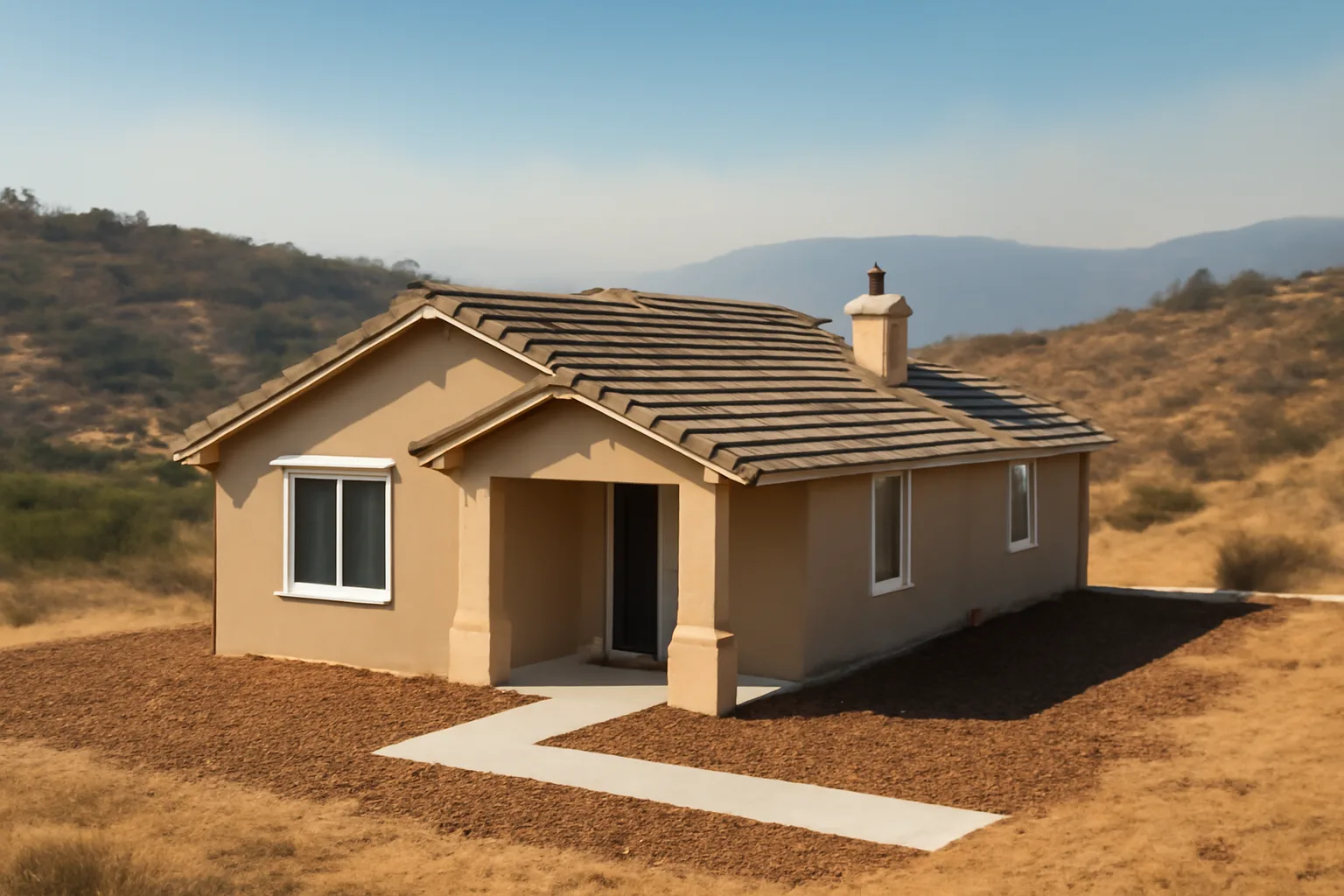
Defensible space theory says a home's survival in a wildfire depends less on the fire itself and more on what's sitting next to the house when embers arrive. The idea started in urban crime prevention (architect Oscar Newman coined "defensible space" in a 1972 book about housing design and territorial control) and got adapted by fire agencies in the 1980s and 90s into something much more literal: cleared, managed land around a structure that keeps flame and radiant heat far enough away that the building doesn't ignite. CAL FIRE defines it plainly: defensible space is "the buffer you create between a building on your property and the grass, trees, shrubs, or any wildland area that surrounds it". The theory isn't that you stop a wildfire. You can't. It's that you change the outcome for one specific structure by controlling fuel, spacing, and vegetation type in the zone immediately around it. The research backing this is not new. A CAL FIRE and USFS-influenced body of post-fire assessments, going back to the 2007 Angora Fire and reinforced by more recent Camp Fire and Marshall Fire analyses, keeps finding the same pattern: homes with cleared space and hardened materials survive at meaningfully higher rates than homes without either. It's not one variable. It's defensible space plus home hardening, working together, that shows up again and again in the data.
How does defensible space actually work (the zone system)?
| Zone 0 | 0-5 ft | Eliminate ember ignition points | |
|---|---|---|---|
| Zone 1 | 5-30 ft | Break up flame contact, remove ladder fuels | |
| Zone 2 | 30-100 ft | Slow fire spread, reduce radiant heat | For the practical clearing and spacing specs by zone, see defensible and the landscaping specifics at fire safe landscaping California next to house. |
Defensible space works by breaking the area around a home into concentric zones, each with different clearing and spacing rules, because fire behaves differently at 5 feet than it does at 80 feet. California's model, used by CAL FIRE and adopted (with local tweaks) across most Western fire codes, breaks it into three zones. Zone 0 (0 to 5 feet from structures): the ember-resistant zone. As of California's phased rollout, this is the strictest zone, aiming for noncombustible surfaces immediately against the house, no mulch, no shrubs touching siding, no woodpiles against walls. Zone 1 (5 to 30 feet): remove dead vegetation, space out shrubs and trees, keep grass mowed to 4 inches or less, and get rid of "ladder fuels" (low branches and brush that let ground fire climb into tree canopy). Zone 2 (30 to 100 feet): thin trees so canopies don't touch, remove dead and downed material, and maintain wider spacing between clumps of vegetation. | Zone | Distance from structure | Primary goal |
When does the California defensible space law go into effect?
The baseline defensible space requirement, 100 feet of clearance around structures in State Responsibility Areas, has been law since 2005 under Public Resources Code 4291, which was expanded from a prior 30-foot standard [1]. That part isn't new and isn't changing. What is new, and where the confusion comes from, is Zone 0. Assembly Bill 3074 (2020) directed the Board of Forestry and Fire Protection to develop ember-resistant zone regulations for the 0-5 foot area closest to structures [2]. The Board has been through a multi-year rulemaking process, and as of this writing the Zone 0 regulation has not taken final effect statewide; CAL FIRE's public guidance has repeatedly noted the ember-resistant zone requirement is "pending" adoption, with implementation dates having slipped multiple times since the original 2023 target. Check the Board of Forestry's current rulemaking status page before assuming a specific date applies to you, because this is a moving target and your county may have already adopted stricter local versions ahead of the state timeline. Don't wait for the ink to dry on Zone 0 to start clearing it anyway. Insurers doing wildfire risk scoring are already penalizing homes with mulch, shrubs, or woodpiles touching the siding, regulation or not.
What fire-safe home rules take effect in 2026?
Nobody should treat 2026 as a hard, single national date, because fire-safe requirements are set state by state and, within California, phased by the Board of Forestry's own rulemaking calendar, not a fixed calendar year written into statute. What's true is that several tracks are converging around this period: California's Zone 0 ember-resistant zone rule remains in active rulemaking, some local jurisdictions (parts of the Wildland-Urban Interface in Southern California) have already adopted 0-5 foot noncombustible zone requirements ahead of the state, and insurers in CA, CO, OR, and AZ are independently tightening wildfire underwriting criteria on their own timelines regardless of what the state mandates. The honest answer: check your specific county or fire district's current adopted code before making claims about a 2026 deadline, because "the state law" and "my local ordinance" are often not the same rule. [Guided fill-in: contact your county fire marshal's office or local fire protection district to confirm the current Zone 0 and defensible space ordinance dates that apply to your parcel.] What is safe to say: if you're in a California SRA or a locally designated Very High Fire Hazard Severity Zone, plan for stricter noncombustible-zone rules to phase in over the next few years, and get ahead of them rather than waiting for enforcement.
Why won't people follow the defensible space law in California?
Compliance with PRC 4291 is inconsistent, and the reasons aren't mysterious: cost, labor, aesthetics, and enforcement gaps all play a part. Clearing 100 feet of brush on a sloped, wooded lot can run into thousands of dollars if you hire it out, and many rural and older homeowners are on fixed incomes. Some people also just like their mature trees and shaded yards and see defensible space rules as forcing an ugly, barren look next to the house, even though modern guidance allows well-spaced, low-fuel landscaping rather than bare dirt. Enforcement is real but uneven. CAL FIRE and local fire agencies conduct defensible space inspections, and noncompliance can lead to citations, but agencies don't have the staffing to inspect every parcel every year, so a lot of properties simply don't get checked in a given season. A 2021 Legislative Analyst's Office report on wildfire noted that SRA fire prevention fee collection and inspection capacity have both been persistent funding and staffing challenges for the state [3]. There's also a documented gap between knowing the rule and acting on it. Post-fire interviews and university extension surveys (UC Cooperative Extension has published several) consistently find homeowners who knew about defensible space requirements but didn't act because they assumed "it won't happen to my house" or didn't know where to start, which is a psychology problem as much as a policy one. If you're the person who got the non-renewal letter, this article and a checklist like only you can prevent wildfires are meant to close exactly that action gap.
How to prevent wildfires (what actually reduces ignition risk)?
You can't stop lightning or a downed power line, but you can dramatically cut the odds that a spark near your property turns into a home-destroying fire. Preventing wildfires at the individual level comes down to three things: reducing ignition sources, reducing fuel continuity, and hardening the structure itself. Reducing ignition sources means no debris burning on red flag days, keeping equipment (chainsaws, mowers, grinders) away from dry grass during fire season, maintaining spark arrestors on ATVs and outdoor equipment, and not parking hot vehicles on dry vegetation, a genuinely common ignition cause CAL FIRE flags every year. Reducing fuel continuity is the defensible space work itself: breaking up the unbroken path of grass, brush, and trees that lets a ground fire become a house fire. Ready.gov's wildfire prep page recommends removing dead vegetation and creating "a defensible space of at least 30 feet around your home" as the baseline action for every household in a wildfire-prone area. Hardening the structure covers roofing material, vents, siding, and window glazing, since embers landing on a home, not direct flame contact, cause most structure losses in wildfires according to CAL FIRE's home hardening guidance [4]. See house fire for how structure fires specifically start and spread once ignition happens.
How to prepare for a wildfire?
Preparing for a wildfire means having your defensible space done before fire season starts, plus a go-bag, an evacuation plan, and your documentation ready, because you may get 10 minutes of notice, not 10 hours. Ready.gov recommends assembling an emergency kit with water, medications, important documents, and a battery radio, and knowing two ways out of your neighborhood in case one route is blocked. Beyond the go-bag, preparation includes photographing your home's exterior and interior, and your defensible space work, before fire season, so you have dated proof of conditions if you ever need it for insurance purposes. This documentation step is separate from any insurance claim or negotiation. You're just building your own record. Sign up for local emergency alerts (most counties run a reverse-911 or Everbridge-based system) and know your evacuation zone designation ahead of time. Waiting to look this up during an actual evacuation order costs minutes you don't have.
How to prevent forest fires and how to avoid forest fires?
Forest fire prevention at the visitor and land-manager level is mostly about ignition control: fully extinguish campfires (drown, stir, drown again, per the classic Smokey Bear guidance), never leave a fire unattended, check local fire restrictions before using any open flame or fireworks, and avoid driving or parking on dry grass where a hot undercarriage can ignite vegetation. The U.S. Forest Service's long-running message is essentially the origin of the phrase quoted in your search: "Only you can prevent wildfires" is the actual Smokey Bear campaign slogan, first used in this form in 1947 and still the Forest Service's core public messaging today. For a homeowner near forested land, avoiding forest fires close to your property overlaps heavily with defensible space work: dead and down fuel removal, spacing trees so canopy fire can't jump easily, and keeping a cleared perimeter that a ground fire has to cross before it reaches structures. If you manage a larger forested parcel, contract-based fuel reduction work is common in some states; for a sense of how these contracts and costs are structured outside California, see wildfire defensible space clearing contracts washington state dnr.
How to prepare for forest fires as a homeowner near wildland?
If your property backs onto forest or wildland, your prep list is defensible space theory applied at full scale: 100 feet of graduated clearance (where terrain allows), ember-resistant construction near the house, and a realistic evacuation plan that accounts for narrow forest roads getting congested fast. CAL FIRE's guidance for homes adjacent to wildland specifically calls out maintaining "the greatest defensible space possible" on steep slopes, since fire moves faster uphill, and recommends extending clearance beyond the standard 100 feet on lots with grades over 20%. If your lot is steep and forested, don't assume the standard zone widths are enough; talk to your local fire district about slope-adjusted requirements. Also worth doing: know your fuel type. Homes surrounded by dense conifer forest face different embers and fire behavior than homes in chaparral or grassland, and your clearing priorities (canopy spacing vs. ground fuel removal) should reflect that. A local CAL FIRE unit or county fire department can tell you which fuel model applies to your parcel.
Is Santa Barbara safe from fire?
No California community backed by chaparral-covered hills, including Santa Barbara, is "safe" from wildfire in any absolute sense, and the city's own history proves it. The 1990 Painted Cave Fire destroyed over 400 structures in the Santa Barbara foothills in a matter of hours, and the 2017 Thomas Fire, at the time the largest wildfire in modern California history by acreage, burned to the edge of Montecito and directly preceded the deadly January 2018 Montecito debris flow that killed 23 people, a disaster caused by the fire-scarred, denuded slopes above town [5]. Santa Barbara County is largely within State Responsibility Area and Very High Fire Hazard Severity Zone designations in its foothill communities, meaning the 100-foot defensible space law under PRC 4291 applies directly to a large share of homes there [1]. Insurers have responded accordingly; Santa Barbara and Montecito have both seen elevated non-renewal activity in recent years as carriers reassess WUI exposure. The honest framing: Santa Barbara is not more dangerous than other chaparral-adjacent California communities, but it is not safe either, and the terrain (steep canyons that funnel wind and fire uphill) makes it a genuinely high-consequence location when a fire does start. If you're there, defensible space isn't optional risk management, it's close to the single most useful thing you can control.
How can we prevent forest fires at a community level?
Community-level forest fire prevention works best when it's coordinated, more than individual homeowners doing their own thing in isolation, because fire doesn't respect property lines and one uncleared lot can undermine a whole block's work. Firewise USA, a National Fire Protection Association program, recognizes communities that organize collective fuel reduction, shared chipper days, and neighborhood-wide defensible space standards, and NFPA data has repeatedly shown that coordinated neighborhood mitigation outperforms scattered individual effort . Practical community actions: shared brush clearing days, HOA-enforced defensible space standards (many HOAs in WUI areas now write PRC 4291 compliance into their covenants), joint funding for chipping services since hauling green waste is often the most expensive part of clearing, and coordinated evacuation planning with the local fire district. County-level prescribed burn programs and fuel break projects, run by CAL FIRE and the U.S. Forest Service, are the larger-scale version of the same idea: break up fuel continuity across a landscape, more than around one house. If you want to push your neighborhood toward this, your local CAL FIRE unit or county fire safe council is the starting point; most counties have one, and they often have grant funding available for chipping or fuel break projects that individual homeowners can't access alone.
What should you actually do this weekend?
Start with Zone 0, even though the statewide regulation is still pending, because it's cheap and it's the highest-value five feet on your property: pull mulch and plants back from the foundation, move firewood and propane tanks away from the house, and clear anything flammable off the deck and out from under it. Then walk your Zone 1 (5-30 feet) with a simple checklist: mow dry grass to 4 inches, remove dead branches and pine needles from the roof and gutters, and cut back any branch touching or overhanging the roofline. This is a Saturday's worth of work on most suburban lots. Document everything as you go. Dated photos of your cleared zones, your roof material, your vents, and your address numbering are exactly the kind of evidence insurers and fire inspectors want to see, and it's the same documentation a homeowner needs after a non-renewal letter to show good-faith mitigation. DefensibleHome's $99 Wildfire Insurance Survival Kit is built around exactly this: a structured way to document your defensible space and hardening work so you have an organized, insurer-ready file instead of a phone full of random photos. Start at /survival-kit-builder if you want the templated version instead of building your own from scratch.
Frequently asked questions
When does the California defensible space law go into effect?
The core 100-foot defensible space requirement (PRC 4291) has been law since 2005. The newer Zone 0 ember-resistant zone rule (0-5 feet from structures), created by AB 3074 in 2020, is still going through Board of Forestry rulemaking and has not taken final statewide effect as of this writing; check your county's current adopted ordinance for local dates.
Why won't people follow the defensible space law in California?
Cost, labor, aesthetics, and uneven enforcement all contribute. Clearing a wooded lot can cost thousands of dollars, agencies lack staff to inspect every parcel yearly, and surveys from UC Cooperative Extension and post-fire interviews find many homeowners know the rule but assume their home won't be the one that burns.
How do I prevent wildfires around my own property?
Reduce ignition sources (no debris burning on red flag days, keep equipment off dry grass), reduce fuel continuity through zoned defensible space clearing, and harden your structure with ember-resistant vents, Class A roofing, and noncombustible materials near the foundation. CAL FIRE's guidance treats these as one combined system, not separate options.
How should I prepare for a wildfire evacuation?
Build a go-bag with water, medications, and documents, know two evacuation routes out of your neighborhood, and sign up for your county's emergency alert system before fire season starts. Ready.gov recommends having this plan finalized in advance, not improvised during an active evacuation order.
How can we prevent forest fires when hiking or camping?
Fully extinguish campfires by drowning, stirring, and drowning again, never leave a fire unattended, check current local fire restrictions before any open flame, and don't park or drive on dry grass where a hot exhaust or undercarriage can ignite vegetation. Most ignitions near recreation areas trace back to abandoned or improperly extinguished fires.
What fire-safe home rules take effect in 2026?
There's no single national 2026 deadline. California's Zone 0 ember-resistant zone rule is in active, multi-year rulemaking, some counties have adopted stricter local rules ahead of the state, and insurers are independently tightening wildfire underwriting on their own schedules. Confirm current requirements with your county fire marshal rather than assuming one fixed date.
Is Santa Barbara safe from fire?
No. Santa Barbara's foothill communities sit in State Responsibility Area and Very High Fire Hazard Severity Zones, and the region has a documented history including the 1990 Painted Cave Fire and the 2017 Thomas Fire, which preceded the deadly 2018 Montecito debris flow. Defensible space compliance there is a serious priority, not a formality.
What is the difference between defensible space and home hardening?
Defensible space is managing the land and vegetation around a structure in zones out to 100 feet. Home hardening is upgrading the structure itself, roofing, vents, siding, windows, so embers that land on or near it can't ignite it. CAL FIRE treats them as complementary, not interchangeable.
How wide does defensible space need to be in California?
California's PRC 4291 requires up to 100 feet of defensible space around structures in State Responsibility Areas, split into Zone 1 (0-30 feet) and Zone 2 (30-100 feet), plus the newer Zone 0 (0-5 feet) ember-resistant standard now in rulemaking. Steeper slopes may require extended clearance beyond 100 feet.
Does defensible space guarantee my house won't burn?
No. Nothing guarantees a home survives a wildfire. Post-fire studies consistently show homes with proper defensible space and hardened construction survive at meaningfully higher rates than homes without either, but extreme fire behavior, wind-driven embers, and fire district specifics mean no single measure is a guarantee.
Who enforces defensible space requirements?
CAL FIRE and local fire departments or fire protection districts conduct defensible space inspections in California, and can issue citations for noncompliance under PRC 4291. Enforcement capacity varies significantly by county, and rules differ by local fire district, so always confirm requirements with your specific jurisdiction.
What's the fastest, cheapest defensible space improvement I can make?
Clear Zone 0 first: pull mulch, plants, and stored items away from the foundation within 5 feet, move firewood and propane tanks off the house, and clear debris from the roof, gutters, and under the deck. It's mostly labor, not money, and it addresses the area where most ember ignitions start.
Sources
- California Public Resources Code Section 4291: 100 feet of defensible space required around structures in State Responsibility Areas
- California Legislature, Assembly Bill 3074 (2020): Directive to the Board of Forestry and Fire Protection to create ember-resistant Zone 0 regulations
- California Legislative Analyst's Office, Wildfire Prevention Funding Report: State fire prevention fee collection and inspection capacity face persistent funding and staffing challenges
- CAL FIRE, Home Hardening: Embers landing on a home, not direct flame contact, are the primary cause of most structure losses in wildfires
- National Fire Protection Association, Firewise USA: Firewise USA recognizes communities for coordinated, neighborhood-level wildfire fuel reduction