Last updated 2026-07-25
TL;DR
Wildfire house protection comes down to three things: a non-combustible zone within 5 feet of the house, cleared vegetation out to 100 feet, and hardened building materials (Class A roof, ember-resistant vents, tempered windows). California's updated Zone 0 rules are in rulemaking now, with enforcement expected no earlier than 2026. None of this guarantees a renewed policy, but it's the same checklist most inspectors use.
What actually protects a house from wildfire?
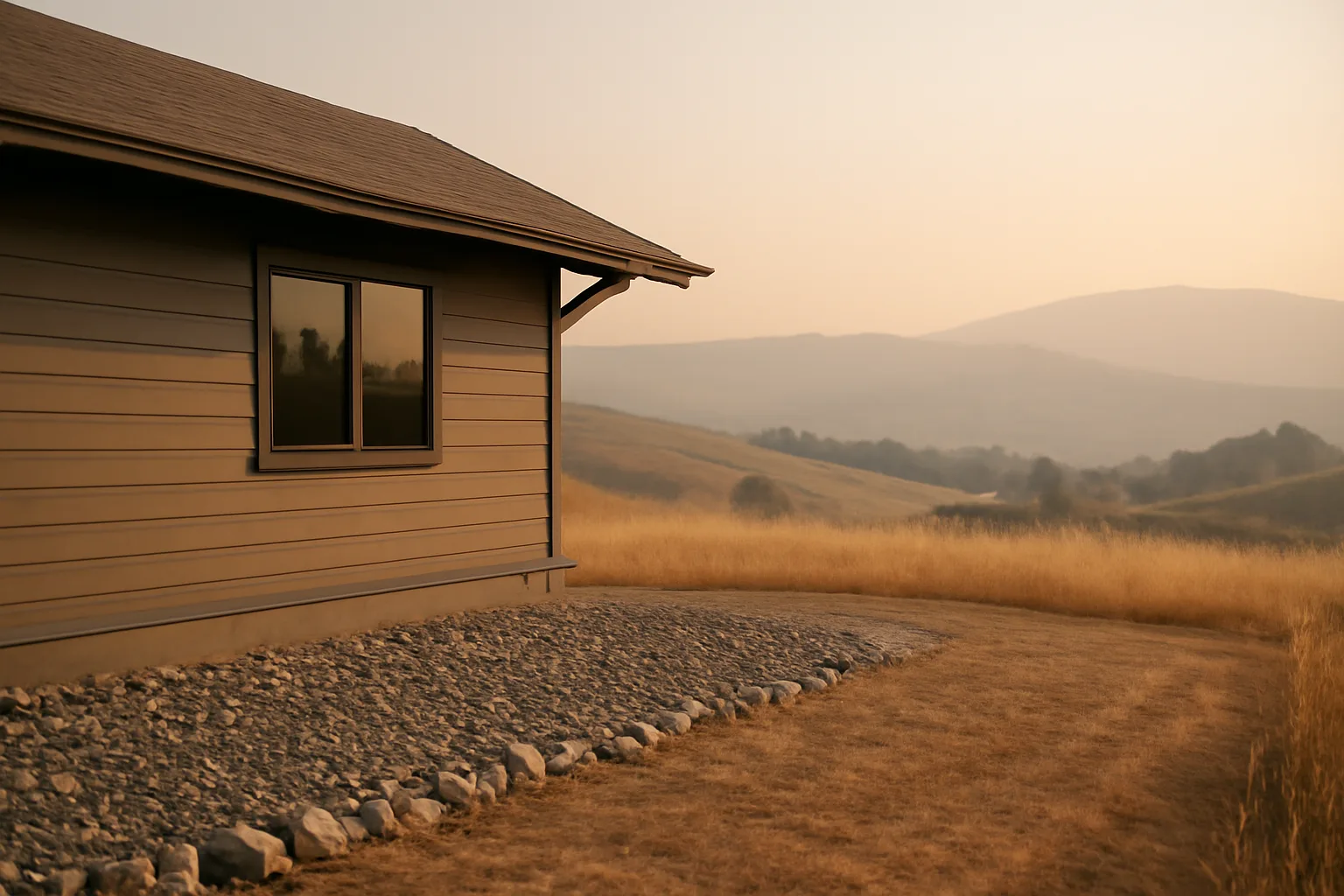
Three things, in order of importance: what's touching the house, what's near the house, and what the house is made of. Most homes that burn in wildfires don't burn because a wall of flame rolled through. They burn because embers, sometimes flying a mile or more ahead of the fire front, land in a gutter full of dry leaves, a woodpile against the siding, or a vent with no mesh screen. CAL FIRE's own research summary states that "most homes ignite from small flames and embers, not the wall of flame typically associated with a wildfire". That's why the defensible space model splits the yard into zones instead of treating "clear brush" as one job. Zone 0 (0 to 5 feet from the structure) needs to be essentially non-combustible: no mulch, no shrubs touching siding, no stored firewood. Zone 1 (5 to 30 feet) needs widely spaced, low-fuel plants and no ladder fuels connecting ground to tree canopy. Zone 2 (30 to 100 feet) is about reducing fuel continuity, not clearing to bare dirt. On the structure itself, the building code equivalent is Chapter 7A of the California Building Code, which governs ignition-resistant construction in Wildland-Urban Interface fire areas: Class A roofing, ember-and-flame-resistant vents, dual-paned tempered glass, and non-combustible siding or soffit assemblies [1]. If you're starting from zero, the fastest wins are usually vents (cheap, high impact) and gutter/roof debris removal (free, takes an afternoon). The slowest and most expensive is often full siding replacement, so triage matters. For a broader walkthrough of the zone system itself, see defensible space zones, and for what a specific house fire scenario looks like when these gaps go unaddressed, see house fire.
When does the California defensible space law go into effect?
California's basic defensible space law (100 feet of clearance around structures) has been in effect since 2005 under Public Resources Code 4291, so if you're in a State Responsibility Area, it already applies to you [2]. What's newer, and still moving, is Zone 0. Assembly Bill 3074 (2020) directed the Board of Forestry and Fire Protection to write ember-resistant zone regulations for the 0-to-5-foot area around homes in the wildland-urban interface [3]. That rulemaking has taken years longer than originally planned. As of the Board's public materials, the ember-resistant zone (Zone 0) regulation is still in the formal rulemaking process, with the Board targeting adoption and a phased implementation timeline that state officials have publicly discussed as starting no earlier than 2026 for existing homes, pending final rule language and an official effective date [4]. The honest answer if a reader asks "when does this go into effect": the 100-foot Zone 1/Zone 2 clearance law is active right now. The new Zone 0 ember-resistant standard is not yet final law as of this writing, and the exact enforcement date depends on the Board of Forestry's completed rulemaking, which you can track directly on their site [4]. Don't wait for the deadline. Insurers and inspectors are already scoring Zone 0 informally during wildfire risk assessments, even where it isn't yet mandatory.
What fire-safe home rules take effect in 2026?
Nothing statewide is locked in as "effective 2026" yet with full legal certainty, and that's worth being blunt about. What's true: the Board of Forestry and Fire Protection has been working toward a Zone 0 ember-resistant zone regulation under AB 3074, and public Board meeting materials and state fire officials have referenced 2026 as a plausible target window for phased implementation, starting with the highest-risk zones [4]. Separately, insurance-side changes are already active. California's Sustainable Insurance Strategy, finalized through Department of Insurance rulemaking, ties insurers' ability to use catastrophe modeling in rate-setting to their writing more policies in wildfire-distressed areas, with implementation unfolding through 2025 and into 2026 [5]. That's a market mechanism, not a building code, but it changes what insurers ask for on inspections. What to actually do: don't wait for a specific 2026 date to appear in statute. Treat Zone 0 (non-combustible 0-5 feet) as already best practice, because that's what CAL FIRE's Ready for Wildfire guidance recommends today regardless of enforcement timing. Check your local fire district or state fire marshal's office for the current status of adoption in your specific area: [fill in local fire district / county fire marshal contact and current defensible space ordinance link here].
How to prepare for a wildfire (before, during, after)
Before: harden the structure and clear defensible space per the zone system above, build a go-bag, and know two evacuation routes, not one. Ready.gov recommends preparing an emergency supply kit with water (one gallon per person per day for several days), medications, copies of important documents, and a battery or hand-crank radio. During an active warning: if you're told to evacuate, go. Don't wait to see how bad it gets. Before leaving, if time allows, close all windows and doors, remove flammable curtains, shut off gas at the meter, and leave exterior lights on so firefighters can see the house in smoke. Move patio furniture and doormats inside or far from the structure; they're common ember-catchers. After: don't re-enter until officials clear the area. Photograph everything from the outside first, then document interior conditions, before you touch or move anything, in case you need it for an insurance claim later. This is where a lot of homeowners lose ground. If your insurer non-renewed you before the fire, you still need your own dated, timestamped documentation of the home's condition and mitigation work, because you're the one responsible for building that record, not the insurer. A practical middle step a lot of people skip: documenting your defensible space work and hardening upgrades *before* any fire, with dated photos and receipts. That's the exact gap the $99 Wildfire Insurance Survival Kit is built to close, it's a one-time document builder, not a claims or negotiation service. We don't file claims or talk to your insurer for you. You prepare the record; you send it.
How to prevent wildfires from starting near your home
Most wildfires near homes aren't started by lightning. Federal data consistently shows humans cause the large majority of wildfires nationally, and CAL FIRE's incident data attributes most California wildfire ignitions to human activity: equipment sparks, unattended campfires, vehicle exhaust on dry grass, and downed power lines [6]. At the household level, prevention looks boring and specific: don't mow dry grass in the afternoon heat (mower blades hitting rock throw sparks), keep chainsaws and trimmers away from dry vegetation when possible, don't park hot vehicles on dry grass, and never leave a campfire unattended even for ten minutes. If you're doing any spark-producing work (grinding, welding, mowing) on your property during red flag warning days, stop. Check your local fire weather forecast; National Weather Service red flag warnings mean low humidity, high wind, and dry fuels have combined into conditions where a small spark becomes a fast-moving fire. Defensible space itself is a prevention tool too, more than a survival one. A property with continuous dry brush against a fence line is a wildfire's easiest path into a neighborhood. Breaking that fuel continuity on your own lot protects your neighbors as much as it protects you. See fire safe landscaping next to your house for plant-by-plant guidance on what to remove and what's safer to keep.
How to prevent forest fires (and how that's different from home protection)
Forest fire prevention and home wildfire protection overlap but aren't the same job. Forest-level prevention is about fuel loads across large landscapes: prescribed burns, mechanical thinning, and forest management on public and private timberland. That work is largely done by agencies (US Forest Service, CAL FIRE, state forestry departments) and it operates on a different scale and timeline than what a homeowner does in their own yard. What individuals can actually control: campfire discipline (drown, stir, feel, repeat, per Smokey Bear and Forest Service guidance), never leaving fires unattended, checking local burn ban status before any outdoor burning, and reporting smoke or fire immediately rather than assuming someone else already called it in. "Only you can prevent wildfires" isn't just a slogan; it names the actual cause pattern, since human-started ignitions dominate the statistics [6]. For more on the difference between fuel-reduction work at the forest scale and defensible space at the property scale, see defensible space.
How to avoid forest fires as a homeowner living near wildland
If you live at the wildland-urban interface, "avoiding" a forest fire mostly means reducing your household's chance of being the ignition source, and reducing your property's ability to carry fire once one starts nearby. Specific steps: keep a 100-foot fuel-reduced zone if you're in a State Responsibility Area (required under PRC 4291) [2], store firewood and propane tanks at least 30 feet from structures, keep your roof and gutters free of pine needles and leaf litter (a five-minute job with an outsized payoff), and maintain a cleared access path for fire apparatus if your driveway is long or narrow. Local fire districts often have their own defensible space checklists that go beyond the state minimum: [fill in local fire district defensible space ordinance/checklist link here]. A lot of homeowners in Sonoma, Napa, and the Sierra foothills have learned this the hard way: the house that survives on a block that burns is rarely the biggest or newest one. It's usually the one with a clean roof, screened vents, and nothing flammable in the first 5 feet.
Is Santa Barbara safe from fire?
No California coastal city, including Santa Barbara, is fully "safe" from wildfire, and the record backs that up. The Thomas Fire (2017) burned into Santa Barbara County and was followed weeks later by the Montecito debris flow, which killed 23 people after rain hit the fire-scarred hillsides above the town [7]. Before that, the 1990 Painted Cave Fire destroyed over 600 structures in the Santa Barbara foothills in a matter of hours. Santa Barbara's geography (steep chaparral-covered foothills directly above dense residential neighborhoods, combined with seasonal Sana Ana/sundowner winds) is close to a textbook wildfire-urban interface risk profile. That doesn't mean every neighborhood carries equal risk; a flat lot mid-city with irrigated landscaping on all sides is meaningfully different from a hillside home backing onto open chaparral in Montecito or the San Roque foothills. If you own property in or near Santa Barbara's foothill communities, check your parcel's designation using CAL FIRE's Fire Hazard Severity Zone viewer, which maps state and local responsibility areas down to the parcel level . That map, not general reputation, is the honest answer to "is my specific property safe."
How can we prevent forest fires at the community level?
Individual defensible space work only goes so far if the house next door is untouched. Community-level prevention works through a few mechanisms that actually move the needle: Firewise USA recognition (a National Fire Protection Association program that organizes neighborhoods around shared mitigation standards), coordinated fuel breaks along shared property lines, and community chipper days that make it cheap or free to dispose of cleared brush, which removes the biggest excuse for not doing the work . Local fire districts and county fire safe councils often run cost-share programs for fuel reduction on adjoining private lots, since a fuel break only works if it's continuous. If your HOA or neighborhood hasn't looked into Firewise USA status, that's worth a conversation, since it can also factor into how some insurers view aggregate community risk, separate from individual policy underwriting. For a homeowner-to-homeowner starting point: organize one chipper day, get three neighbors to do Zone 0 work the same month you do, and share contractor contacts. Vegetation clearing crews are often cheaper per property when multiple neighbors book the same week. If you're in Washington State specifically, there are structured programs for this; see wildfire defensible space clearing contracts, Washington State DNR for how that state runs cost-share clearing work.
Why won't people follow the defensible space law in California?
Compliance with Public Resources Code 4291 is inconsistent, and CAL FIRE's own inspection data shows it. In post-fire assessments and pre-fire defensible space inspections, CAL FIRE has repeatedly found significant portions of inspected properties out of full compliance with the 100-foot clearance requirement, with non-compliance rates commonly cited in the 30 to 50 percent range depending on the county and year of the survey . The reasons aren't mysterious once you talk to homeowners (or, more honestly, once you look at what the work actually requires): cost is the biggest one. Full defensible space work on a wooded acre-plus lot can run into the thousands of dollars if you're hiring a crew, and that's before any structural hardening. Second is confusion: many homeowners genuinely don't know their exact zone boundaries or which specific plants and materials count as compliant, because the rule is written at a state level but enforced with local variation. Third, and underrated, is inertia bias: people who haven't experienced a close call tend to treat the risk as abstract until a neighbor's house burns. Enforcement itself is uneven too. Some counties do annual inspections with real follow-up; others are stretched thin and only inspect after a complaint or a fire. None of that changes your actual risk exposure. If your insurer already sent a non-renewal or inspection letter, the compliance gap between what's legally required and what actually gets done is exactly the gap that's costing people their coverage.
How do you document defensible space work for an insurer?
Insurers and their inspectors want to see specific, dated evidence, not a general impression that "we did some clearing." At minimum: date-stamped photos of all three zones (0-5 ft, 5-30 ft, 30-100 ft) taken from multiple angles, receipts or invoices from any contractor work, a copy of your local fire district's defensible space inspection certificate if one was issued, and photos of specific hardening features (Class A roof material, ember-resistant vent screens, gutter guards). This is documentation you build and keep, not something your insurer builds for you. Public adjusters and attorneys negotiate claims; that's a different service and not what this is about. What actually helps here is having your own organized, dated file ready before you ever need it, whether that's for a renewal application, an appeal of a non-renewal, or a claim after a fire. The $99 Wildfire Insurance Survival Kit exists for exactly this: a structured way to compile photos, receipts, and inspection notes into one document. It doesn't file claims, negotiate with insurers, or promise reinstatement, and nobody can promise you that. It just makes sure the record exists and is organized when you need it. For the specific inspection checklist most insurers and fire marshals use, see inspections and the base zone guide at defensible space zones.
Frequently asked questions
When does the California defensible space law go into effect?
The core 100-foot defensible space requirement (Public Resources Code 4291) has applied to State Responsibility Area properties since 2005. The newer Zone 0 ember-resistant zone rule, from AB 3074, is still in Board of Forestry rulemaking as of this writing, with 2026 discussed as a possible phased start; check the Board's site for the finalized date [5][6].
Why won't people follow the defensible space law in California?
Cost, confusion about zone boundaries, and low perceived personal risk are the main reasons. CAL FIRE inspection data has found non-compliance rates commonly in the 30 to 50 percent range in surveyed areas, varying by county and enforcement level [14]. Full clearance work can cost thousands on larger wooded lots, which is a real barrier for many homeowners.
How do I prevent wildfires from starting on my property?
Avoid mowing dry grass in afternoon heat, never leave campfires unattended, keep spark-producing tools away from dry vegetation, and don't operate equipment outdoors during red flag warnings. Most wildfires are human-caused, per federal and CAL FIRE incident data, so household spark discipline matters as much as landscaping [9].
How do I prepare my house for a wildfire?
Harden the structure (Class A roof, ember-resistant vents, tempered windows), clear the three defensible space zones out to 100 feet, and build a go-bag with water, medications, and document copies per Ready.gov guidance [2][3][8]. Do this before a warning, not during one.
How can I prevent forest fires near my community?
Organize shared chipper days, coordinate fuel breaks with neighbors so clearing is continuous across property lines, and look into Firewise USA recognition through the National Fire Protection Association. Individual defensible space work loses effectiveness if adjoining lots stay untouched [13].
What fire-safe home rules take effect in 2026?
Nothing is fully finalized in statute yet. California's Zone 0 ember-resistant zone regulation under AB 3074 is in Board of Forestry rulemaking, with 2026 mentioned as a plausible phased implementation target. Separately, insurance rate-setting changes under the state's Sustainable Insurance Strategy are rolling out through 2025-2026 [6][7].
Is Santa Barbara safe from fire?
No, particularly in foothill and hillside neighborhoods. The 1990 Painted Cave Fire destroyed over 600 structures there, and the 2017 Thomas Fire led directly to the deadly 2018 Montecito debris flow. Check CAL FIRE's Fire Hazard Severity Zone map for your specific parcel rather than relying on general reputation [10][11][12].
What is Zone 0 and why does it matter more than the rest of the yard?
Zone 0 is the 0-to-5-foot area immediately around your house, and it's where most home ignitions actually start, from embers landing on mulch, in gutters, or against siding. CAL FIRE guidance recommends making this zone essentially non-combustible: no mulch, no shrubs touching the house, no stored firewood [1][2].
What's the difference between defensible space and home hardening?
Defensible space is vegetation and fuel management around the property (the three zones out to 100 feet). Home hardening is building material and construction choices on the structure itself, like Class A roofing and ember-resistant vents, governed in California by Building Code Chapter 7A [3].
Can documenting my mitigation work get my insurance policy reinstated?
There's no guarantee. Documentation doesn't force reinstatement or a discount; it gives you an organized, dated record to send with a renewal application or appeal. We don't negotiate with insurers or file claims. You prepare the documentation and submit it yourself.
How much does defensible space clearing typically cost?
It varies widely by lot size, vegetation density, and region, and there's no single reliable national figure. Hiring a crew for a wooded acre-plus lot can run into the low thousands of dollars; a small suburban lot with light brush might cost a few hundred. Get local quotes rather than relying on a national average.
Do I need a permit to clear defensible space around my house?
Usually not for basic vegetation clearing and pruning, but larger tree removal, work near protected species habitat, or work in certain coastal or hillside zones can require local permits. Check your specific fire district or county planning office before major clearing: [fill in local fire district permit contact/link here].
What should I do first if I got a wildfire insurance non-renewal letter?
Read the letter for the specific stated reason (often defensible space, roof material, or brush proximity), address that specific issue first, then document the fix with dated photos and receipts. Check if your state FAIR Plan is an option while you shop for standard coverage.
Sources
- California Building Standards Commission, CBC Chapter 7A: building material requirements for structures in Wildland-Urban Interface fire areas
- California Public Resources Code Section 4291: 100-foot defensible space clearance requirement around structures in State Responsibility Areas since 2005
- California Assembly Bill 3074 (2020): directive for Board of Forestry and Fire Protection to develop ember-resistant Zone 0 regulations
- California Board of Forestry and Fire Protection, Zone 0 Rulemaking: Zone 0 ember-resistant zone regulation status and phased implementation timeline
- California Department of Insurance, Sustainable Insurance Strategy: rulemaking tying catastrophe modeling use to insurers writing more policies in wildfire-distressed areas, implementation through 2025-2026
- CAL FIRE, Wildfire Statistics and Reports: majority of California wildfires are human-caused
- National Fire Protection Association, Firewise USA: Firewise USA program organizes neighborhoods around shared wildfire mitigation standards