Last updated 2026-07-25
TL;DR
Southern California Edison equipment has been linked to some of the state's most destructive fires, including the 2017 Thomas Fire and 2018 Woolsey Fire. SCE now faces billions in liability and has expanded power shutoffs and grid hardening. Homeowners in its service area should assume utility ignition risk is real and build defensible space now, since PSPS events and equipment failures aren't going away.
What is SCE's role in California's wildfires?
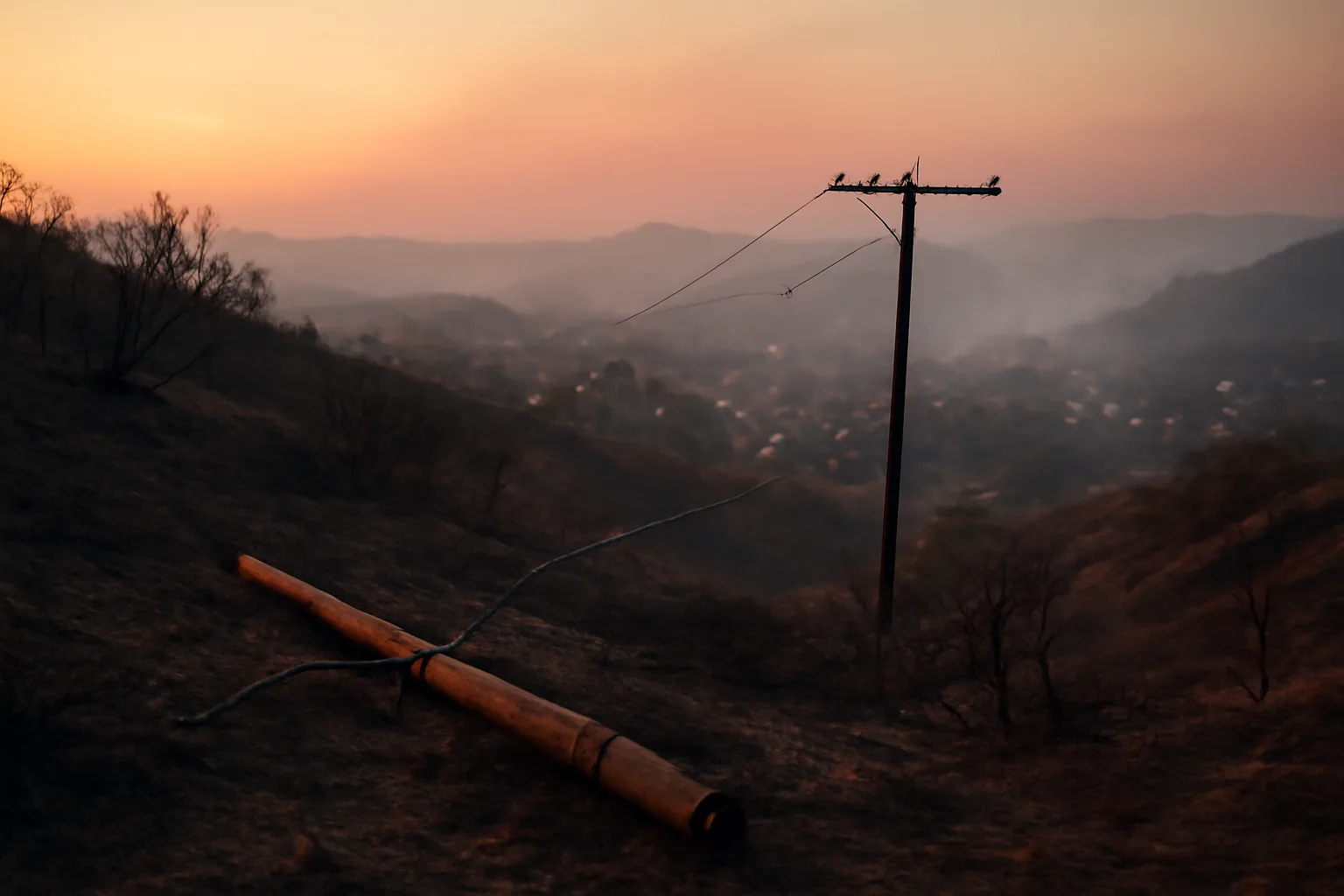
Southern California Edison (SCE) is the investor-owned utility serving about 15 million people across a 50,000-square-mile territory in central, coastal, and Southern California [1]. Its power lines run through some of the most fire-prone terrain in the country, including the Santa Monica Mountains, the Santa Ynez foothills, and the San Bernardino National Forest. Utility equipment, downed lines, arcing conductors, transformers contacting vegetation, has been a documented ignition source in several of California's largest fires. SCE has publicly acknowledged its equipment was involved in igniting the 2017 Thomas Fire, which burned about 281,893 acres across Ventura and Santa Barbara counties and was, at the time, the largest wildfire in modern California history [2]. SCE also confirmed its equipment was associated with the 2018 Woolsey Fire, which destroyed 1,643 structures and killed three people in Los Angeles and Ventura counties [3]. This isn't unique to SCE. PG&E equipment caused the 2018 Camp Fire, the deadliest wildfire in California history with 85 civilian fatalities, according to CAL FIRE's investigation [4]. The pattern across utilities is the same: aging infrastructure, high winds, dry vegetation, and decades of buildup in the wildland-urban interface. If you live in SCE's service territory, that history matters less as blame and more as a planning fact: utility-ignited fires are a real, recurring risk category you should plan around, not a one-time anomaly.
When does the California defensible space law go into effect?
California's core defensible space requirement, 100 feet of vegetation clearance around structures (or to the property line, whichever is closer), has been law since 2005 under Public Resources Code Section 4291 [5]. That part isn't new and isn't changing in 2026. What is changing is enforcement and detail. CAL FIRE's updated defensible space regulations, developed under SB 63 (2023) and related rulemaking, create a more specific "Zone 0" ember-resistant zone within 5 feet of structures. CAL FIRE's own guidance describes the intent plainly: "Zone 0... is the most important zone for reducing the vulnerability of your home during a wildfire". The Board of Forestry and Fire Protection has been working through the formal rulemaking process for Zone 0 regulations, with an original target of January 1, 2023 that slipped, and current state guidance points to enforcement dates in 2025 into 2026 depending on finalization and local adoption timelines. Because this rule applies through CAL FIRE and local fire districts, the exact effective date and enforcement mechanism in your area is something you should confirm directly. [Fill in: confirm your local fire district's Zone 0 enforcement date and inspection schedule with your county fire marshal or CAL FIRE unit office.] Until Zone 0 is formally enforced everywhere, the safest approach is to treat the 5-foot ember zone as already required. Waiting for an enforcement deadline to do the work is how people end up scrambling after a non-renewal letter.
Why won't people follow the defensible space law in California?
Cost, inconvenience, and disbelief are the three real reasons, not ignorance of the law. A lot of homeowners know Section 4291 exists and still don't comply, or comply partially. Cost is the biggest barrier. Clearing 100 feet of vegetation on a hillside lot, removing ladder fuels, limbing up trees, and replacing bark mulch with gravel in the ember zone can run from a few hundred dollars in DIY labor to several thousand dollars for professional clearing on larger or steeper lots. There's no single national price study, but county-level defensible space assistance programs consistently describe costs as a major reason for noncompliance, which is part of why some counties offer chipper days and cost-share programs. Second, defensible space work is disruptive. It means cutting down trees people planted decades ago, removing shrubs that provide privacy, and changing how a yard looks and feels. Many homeowners underestimate their personal fire risk, especially in areas that haven't burned in living memory, a bias fire researchers see repeatedly in wildfire risk perception studies. Third, enforcement has historically been inconsistent. CAL FIRE and local fire departments are responsible for inspections, but staffing and inspection cadence vary a lot by jurisdiction. Some counties inspect every parcel; others rely on complaints or post-fire audits. That unevenness has taught some homeowners, wrongly, that the rule is optional. [Fill in: check whether your local fire district conducts routine defensible space inspections or complaint-based ones, and what the citation process looks like.] The irony is that noncompliance is now a direct driver of insurance non-renewals. Insurers increasingly use defensible space documentation, sometimes via aerial imagery or third-party inspection reports, as part of underwriting. If you're already facing a non-renewal letter, this is the point of maximum control: fixing defensible space is one of the few things fully in your hands.
How do power lines and SCE equipment actually start fires?
Most utility-caused wildfires start through one of a handful of mechanical failure modes: a conductor breaking and arcing, vegetation contacting an energized line, equipment failure during high wind events, or a pole or crossarm failing structurally. CAL FIRE's investigation into the Thomas Fire found the cause to be electrical power lines owned and operated by SCE [2]. High wind events are the common trigger. Santa Ana and sundowner winds in Southern California can exceed 60-70 mph in some canyon and foothill areas, enough to snap branches into lines or blow debris into equipment that's otherwise been maintained properly. That's why SCE, like PG&E and San Diego Gas & Electric, has adopted Public Safety Power Shutoffs (PSPS): proactively cutting power in high-risk conditions to reduce ignition risk, even though it means outages for tens of thousands of customers at a time. SCE has also committed significant capital to grid hardening, replacing bare wire with covered conductor, undergrounding lines in the highest-risk areas, and installing weather stations and high-definition cameras to detect ignitions faster. These are utility-side mitigations. They reduce risk but don't eliminate it, and they don't do anything for fires that start from other sources: campfires, equipment sparks, arson, or lightning.
How to prevent wildfires
There's no single fix, but the highest-value actions fall into three buckets: reducing ignition sources, hardening structures, and maintaining defensible space. CAL FIRE and the U.S. Forest Service both frame prevention as shared responsibility between utilities, agencies, and individual property owners. On the individual side, the actions with the best evidence behind them are: maintaining the 5-foot ember-resistant zone around your home (Zone 0), keeping gutters and roofs free of dry leaves and needles, using ember-resistant vents, and avoiding outdoor burning or equipment use (mowers, chainsaws, grinders) during red flag warning days. The Insurance Institute for Business & Home Safety's wildfire research consistently finds that embers, not direct flame contact, are the primary way homes ignite during wildfires, often landing hundreds of feet ahead of the fire front. At the community level, prevention means coordinated defensible space (a single unmaintained lot can undermine a whole street's protection), maintained fire roads and evacuation routes, and utility infrastructure investment. This is genuinely a collective-action problem: your defensible space work is undermined if your uphill neighbor's isn't done, and vice versa. For deeper detail on which structural upgrades matter most, see our guide to fire safe landscaping in California next to your house and our breakdown of defensible space zone requirements.
How to prepare for a wildfire
Preparation splits into three phases: before fire season, during a red flag warning or evacuation watch, and during an active evacuation order. Ready.gov's wildfire guidance recommends building an emergency supply kit, creating a family communication plan, and knowing two ways out of your neighborhood before you need them. Before fire season (do this every spring): clear Zone 0 within 5 feet of your home, trim tree limbs to 10 feet from chimneys and 6 feet from the ground, clean gutters and roof valleys, store firewood at least 30 feet from structures, and photograph your home's exterior, interior, and major possessions for insurance documentation. This last step matters more than most people realize: post-fire claims move faster and get valued more accurately when you have dated, thorough photo and video evidence from before the loss. During a red flag warning: pack go-bags for every family member and pet, back your car into the driveway facing out, close all windows and doors (but leave them unlocked for firefighter access), and move flammable outdoor furniture and doormats inside or away from the house. During an evacuation order: leave immediately when told to. Don't wait to see how bad it gets. CAL FIRE and county sheriffs consistently report that delayed evacuations are a major factor in fire fatalities. If you haven't already, building a documentation packet before you're forced to evacuate is the single most useful thing you can do this weekend. That's the gap our $99 Wildfire Insurance Survival Kit is built to close: a structured way to photograph, log, and organize your home's condition and defensible space work so you have it ready if an insurer sends a non-renewal or inspection letter, or if you ever need to document a loss. We don't file claims or negotiate with insurers; you send your own documentation.
How to prevent forest fires and how to avoid forest fires
Most forest fires (as distinct from wildland-urban interface fires near homes) start from human activity: unattended campfires, discarded cigarettes, vehicle exhaust or dragging chains sparking on dry grass, fireworks, and equipment use. The National Interagency Fire Center and U.S. Forest Service both note human-caused ignitions account for the large majority of wildfires nationally, though lightning-caused fires tend to burn more total acreage in some western states because they often start in remote, hard-to-reach terrain. The prevention steps individuals can control: fully extinguish campfires (drown, stir, drown again, until cold to the touch), never park hot vehicles on dry grass, avoid using mowers or power tools on high wind or red flag days, follow local fireworks bans (many California counties ban all fireworks, including "safe and sane" varieties, during fire season), and report unattended fires or suspicious smoke immediately. If you're recreating in forested public land, check current fire restrictions before you go. The Forest Service and CAL FIRE post current restriction levels by unit, and these change fast during dry years.
How to prepare for forest fires
Preparing for forest fires near your property overlaps heavily with wildfire preparation but has some specific additions if you border wildland: maintain a wider defensible space buffer if your local fire district recommends it (some go beyond the standard 100 feet on steep slopes or in high-fuel areas), keep a chainsaw and hand tools ready for clearing a fallen tree from your evacuation route, and know your local fire district's specific rules, since they vary by county and even by fire protection district within a county. [Fill in: confirm your specific local fire district's defensible space distance requirements, slope adjustments, and inspection contact information.] Sign up for your county's emergency alert system (most California counties use Genasys or CodeRED-based systems) and don't rely solely on push notifications, since cell service often degrades during major fires. A battery-powered NOAA weather radio is a reasonable backup. For a broader walkthrough of hardening priorities by zone, our defensible space guide breaks down what changes at 5 feet, 30 feet, and 100 feet from the structure.
What fire-safe home rules take effect in 2026?
The clearest 2026-relevant change is the phased rollout of CAL FIRE's Zone 0 ember-resistant zone regulations, which were developed under SB 63 and apply to structures in the State Responsibility Area and some Local Responsibility Areas with very high fire hazard severity zones. As of publication, the Board of Forestry has continued refining the specific technical standards (what materials qualify, whether existing landscaping needs replacement, how it applies to attached structures like decks and fences), so exact enforcement dates differ by area. Separately, insurers operating in California are adjusting underwriting in response to Insurance Commissioner Ricardo Lara's Sustainable Insurance Strategy, which took effect through a series of regulations finalized in 2024 and continuing into 2025-2026, allowing insurers to use forward-looking catastrophe models in exchange for writing more policies in high-risk areas [6]. This is a regulatory shift, not a building code, but it directly affects whether your home is insurable and at what price, which is arguably more urgent for most readers than the Zone 0 compliance date itself. [Fill in: check with your county building department whether local Wildland-Urban Interface (WUI) building code updates (Chapter 7A of the California Building Code) apply to any remodel or rebuild you're planning, since these are enforced at the point of permitting, not retroactively on existing homes.] If your home predates Chapter 7A enforcement in your jurisdiction, you're not required to retrofit to current ember-resistant vent and roofing standards, but insurers are increasingly asking about these features anyway, and Zone 0 compliance likely will be checked regardless of your home's age.
Is Santa Barbara safe from fire?
No part of Santa Barbara County is fully safe from fire, and large parts of it sit in CAL FIRE-designated Very High Fire Hazard Severity Zones, particularly the foothill communities of Montecito, Mission Canyon, and the areas above the 101 corridor. The 2017 Thomas Fire burned into Santa Barbara County and was followed just weeks later by the January 2018 Montecito debris flow, which killed 23 people after rain fell on the Thomas Fire burn scar . That sequence, fire followed by catastrophic mudflow, illustrates a compounding risk pattern specific to steep coastal foothill terrain: the fire itself isn't the only danger; the aftermath on burned slopes is too. Santa Barbara city proper, closer to the coast and with more urban density, faces meaningfully lower wildfire risk than the foothill and canyon communities, but "safe" is relative. Wind-driven fires in the region have historically moved fast through chaparral and can threaten areas that haven't burned in decades. The Sycamore Fire (1977), Painted Cave Fire (1990), Jesusita Fire (2009), and Thomas Fire (2017-2018) all threatened or reached Santa Barbara-area neighborhoods. If you live in or near Santa Barbara County's foothill communities, defensible space and structure hardening matter more, not less, because of the debris-flow risk that follows major fires on steep terrain. Local fire districts here often have stricter clearance expectations than the statewide minimum given the terrain. [Fill in: confirm current fire hazard severity zone designation for your specific Santa Barbara County parcel via your county's GIS parcel viewer or local fire department.]
How can we prevent forest fires? What actually works at scale
At scale, the interventions with the strongest evidence are prescribed burning and mechanical fuel reduction, utility grid hardening, and stricter building codes in the wildland-urban interface. None of these are things an individual homeowner controls directly, but understanding them helps you evaluate whether local agencies are doing their part. Prescribed burns and mechanical thinning reduce the fuel load that lets fires grow explosively. California and federal agencies have significantly ramped up prescribed fire acreage in recent years as part of the state's wildfire and forest resilience action plan, though targets have consistently outpaced actual acres treated due to funding, staffing, and narrow weather windows for safe burning. Utility hardening (covered conductor, undergrounding, faster fault detection) reduces one major ignition category but is capital-intensive and slow to roll out across tens of thousands of miles of line. Building codes matter enormously for outcomes even when they don't prevent ignition. Chapter 7A of the California Building Code, covering ember-resistant vents, non-combustible roofing, and dual-pane tempered glass windows, has been shown in post-fire assessments (including CAL FIRE and Insurance Institute for Business & Home Safety analyses of the 2018 Camp Fire and other events) to correlate strongly with survival rates for homes built or retrofitted to current standards versus older construction. For your own property, the realistic answer is: you can't stop a forest fire from starting, but you have real control over whether your home survives one. That's the entire logic behind defensible space and home hardening work, and it's worth reading through our guides on fire at a house survival factors and only you can prevent wildfires for the individual-responsibility side of this.
What should you do if you got a non-renewal or inspection letter?
First, read the letter carefully for the specific reason cited, defensible space deficiency, roof condition, brush density, distance to wildland, since insurers are required in many cases to specify it. Second, document your property's current condition thoroughly with dated photos and video before you do any work, so you have a clear before-and-after record. Third, complete any defensible space work the letter references and keep receipts, contractor invoices, and photos of completed work. California's FAIR Plan exists as an insurer of last resort for homes that can't get standard coverage, but it's not a substitute for maintaining defensible space, since even FAIR Plan and surplus lines carriers factor in mitigation when pricing and renewing policies. Some homeowners successfully get standard coverage reinstated after documented mitigation work; others end up on FAIR Plan with a supplemental policy. Either path is smoother with organized documentation of what your home actually has, not what you remember doing three years ago. We don't negotiate with insurers, file claims on your behalf, or promise coverage or reinstatement. What we do is help you build the packet, photos, receipts, a clear log of mitigation work, so you can send it yourself with confidence it's complete.
Frequently asked questions
When does the California defensible space law go into effect?
The core 100-foot defensible space requirement (Public Resources Code Section 4291) has been law since 2005. The newer Zone 0 ember-resistant zone rule, covering the 5 feet closest to structures, is being phased in through CAL FIRE and Board of Forestry rulemaking with enforcement dates varying by jurisdiction into 2025 and 2026. Confirm your local fire district's timeline directly.
Why won't people follow the defensible space law in California?
Cost, disruption, and inconsistent enforcement are the main reasons. Clearing vegetation properly can cost hundreds to thousands of dollars, removes established landscaping people like, and enforcement has historically varied a lot between counties, some inspect every parcel, others rely on complaints, which has led some homeowners to treat the rule as optional.
How to prevent wildfires from starting near my home?
Maintain the 5-foot ember-resistant zone, avoid outdoor burning or power tool use on red flag warning days, keep gutters and roof clear of debris, and check that vents are ember-resistant. Most home ignitions during wildfires come from wind-blown embers landing on flammable material near the structure, not direct flame contact.
How do I prepare for a wildfire evacuation?
Build a go-bag for every household member and pet, know two evacuation routes, back your car into the driveway during red flag warnings, and photograph your home and belongings for insurance documentation before fire season starts. Ready.gov recommends a family communication plan since cell networks often degrade during major fires.
What causes most forest fires?
Human activity causes the large majority of wildfires nationally, unattended campfires, discarded cigarettes, equipment sparks, and vehicle-related ignitions. Lightning causes a smaller share of fires but often burns more total acreage in remote western terrain because those fires are harder to reach and suppress quickly.
Is Santa Barbara safe from wildfire?
No, particularly the foothill communities of Montecito and areas above the 101 corridor, which sit in Very High Fire Hazard Severity Zones. The 2017 Thomas Fire and the deadly 2018 Montecito debris flow that followed it show both the direct fire risk and the compounding post-fire mudslide risk on steep burned terrain.
What fire-safe home rules take effect in 2026?
CAL FIRE's Zone 0 ember-resistant zone regulations, developed under SB 63, are being phased in with enforcement varying by fire district. Separately, California's Sustainable Insurance Strategy continues rolling out insurance underwriting changes into 2026 that affect what mitigation insurers expect. Confirm both with your local fire district and insurer.
Did SCE equipment really cause major California wildfires?
Yes. SCE has acknowledged its equipment was involved in igniting the 2017 Thomas Fire (281,893 acres) and confirmed association with the 2018 Woolsey Fire (1,643 structures destroyed, 3 deaths). CAL FIRE's investigations documented electrical equipment as a contributing ignition source in both events.
What is a Public Safety Power Shutoff (PSPS) and why does SCE do it?
A PSPS is a proactive outage utilities call during extreme fire weather (high winds, low humidity, dry fuels) to reduce the chance their equipment sparks a fire. SCE, PG&E, and SDG&E all use PSPS events, which can affect tens of thousands of customers at once and typically last from hours to a few days.
How can I tell if my home is in a high fire hazard severity zone?
CAL FIRE maintains Fire Hazard Severity Zone maps by jurisdiction, viewable through CAL FIRE's FHSZ viewer tool for State Responsibility Areas and Local Responsibility Areas. Your county assessor or building department can also confirm your parcel's designation, which affects both building code requirements and insurance underwriting.
What's the difference between defensible space and home hardening?
Defensible space is vegetation and fuel management around your property, cleared zones at 5, 30, and 100 feet. Home hardening is physical construction changes to the structure itself: ember-resistant vents, non-combustible roofing, dual-pane windows, and enclosed eaves. Both matter; research shows they work together, not as substitutes for each other.
Can I get insurance reinstated after a non-renewal for wildfire risk?
Sometimes, if you complete and document the specific mitigation the insurer cited, defensible space clearing, roof or vent upgrades, brush removal. There's no guarantee, and some homeowners end up on California's FAIR Plan instead. Keep thorough dated photos and contractor receipts of all completed work regardless of which path you take.
Sources
- Southern California Edison, About Us: SCE serves about 15 million people across a roughly 50,000-square-mile territory
- CAL FIRE, Thomas Fire Incident Information: The 2017 Thomas Fire burned approximately 281,893 acres and was linked to SCE electrical equipment
- CAL FIRE, Woolsey Fire Incident Information: The 2018 Woolsey Fire destroyed 1,643 structures and killed 3 people
- CAL FIRE, Camp Fire Investigation Findings: CAL FIRE's investigation found PG&E equipment caused the 2018 Camp Fire, which killed 85 people
- California Public Resources Code Section 4291: California law requires 100 feet of defensible space clearance around structures in State Responsibility Areas
- California Department of Insurance, Sustainable Insurance Strategy: California's Sustainable Insurance Strategy allows insurers to use catastrophe modeling in exchange for expanding coverage in high-risk wildfire areas