Last updated 2026-07-25
TL;DR
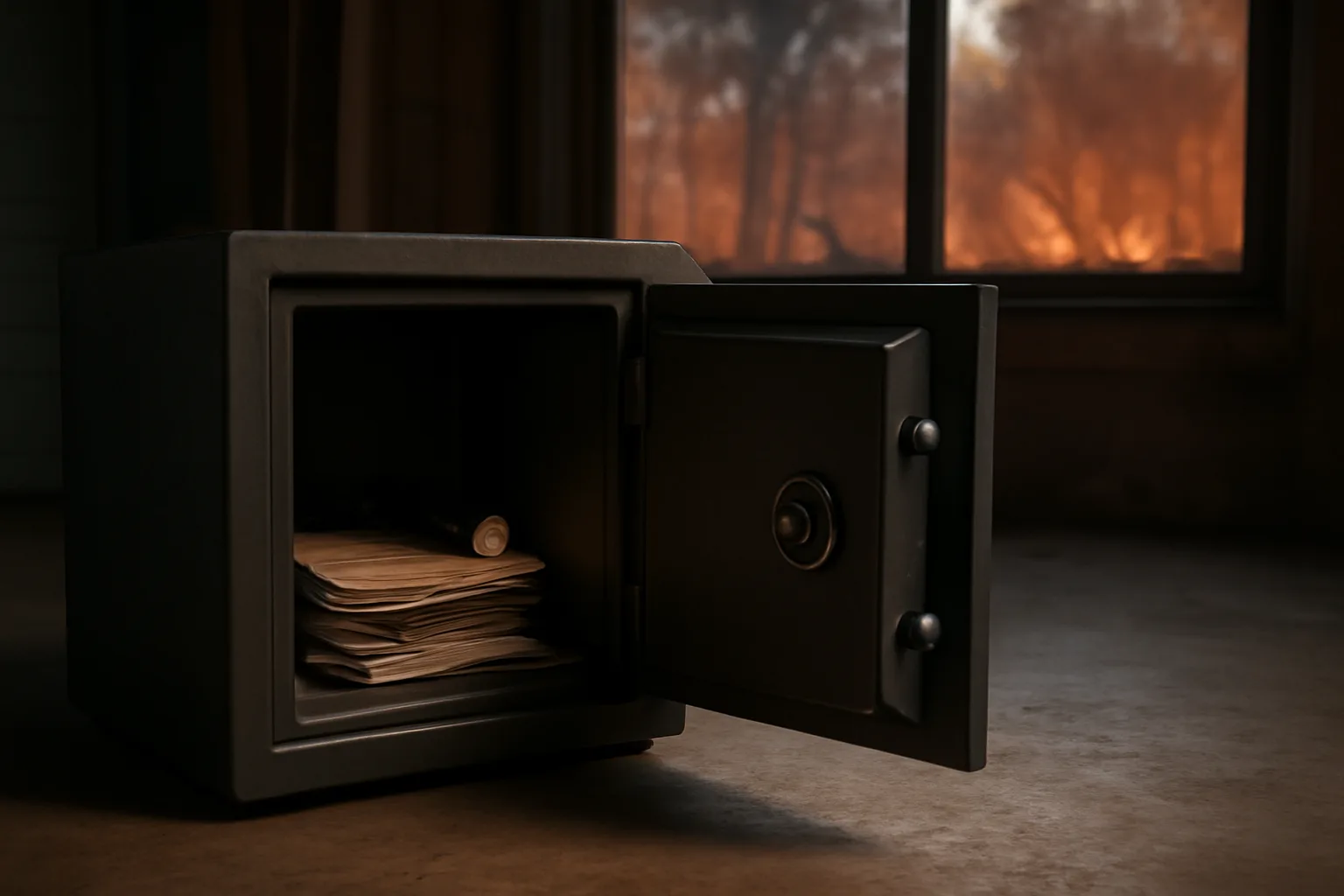
A fire resistant locker (rated 30-120 minutes at 1550°F+ under UL 72) protects guns, cash, and documents from house fires, but it won't survive prolonged wildfire exposure or ember intrusion the way a defensible-space and hardened-home plan will. Use one for irreplaceable papers and valuables, not as your main wildfire strategy.
What is a fire resistant locker, and does it actually work?
A fire resistant locker is a steel cabinet or gun safe lined with fire-rated insulation (usually gypsum board, ceramic fiber, or a composite) designed to keep interior temperatures below the point where paper chars (about 350°F) or guns and ammo degrade, for a set amount of time during a structure fire. The rating system that matters is UL 72, the Underwriters Laboratories standard for fire resistance of safes and file containers. A safe labeled "UL Class 350, 1-Hour" means UL tested it in a furnace at roughly 1700°F and confirmed the interior stayed under 350°F for at least an hour. You'll see ratings from 30 minutes up to 4 hours, and some safes carry both a fire rating and an impact rating (drop test after burning, since floors collapse in real fires). Here's the honest caveat: most consumer gun safes sold as "fireproof" are not independently tested to UL 72. Many use a manufacturer's own internal test or no test at all, just insulation marketed as fire resistant. If the listing doesn't cite a UL certificate number or an equivalent independent lab (like ETL or Intertek), treat the fire claim as unverified. RSR (Residential Security Resource) and industry guides note that budget "fireproof" safes in the $200-$600 range often fail well before their stated time in real fire tests, because the door seals warp and let heat in around the edges. So yes, a genuinely UL 72-rated locker works, within its rated time and temperature. A cheap import stamped "fireproof" on the box may not.
What should go in a fire resistant locker for wildfire prep?
Prioritize things you cannot easily replace and that fire, water, and looting can all destroy: original property deeds, passports, birth and marriage certificates, insurance policy declarations pages, medical records, external hard drives with photo backups, and a small amount of cash. Firearms and ammunition deserve their own rated safe, both for fire protection and for the security requirements many states and insurers expect. Ammunition in particular should sit in a UL-rated container because unrated boxes can let heat build enough to cook off rounds inside, which is a documented hazard insurers ask about during underwriting. Don't rely on the locker as your only copy of anything. Photograph or scan every document and store a duplicate off-site or in cloud storage before fire season starts. Ready.gov's family preparedness guidance recommends keeping both physical and digital copies of financial and legal documents, plus a list of medications and emergency contacts, in a portable, grab-and-go format in addition to any fixed safe.
Will a fire safe survive a wildfire, more than a house fire?
Probably not as well as you'd hope, and this is the gap most homeowners miss. UL 72 tests simulate a structure fire in a furnace over a fixed duration, not the sustained, repeated ember exposure and radiant heat of a wildland-urban interface fire, which can burn hotter and longer as a home's contents fuel it for hours. When a house burns fully to the studs in a wildfire, interior temperatures can exceed 1800-2000°F and persist far past a 1-hour or even 2-hour rating, especially if the safe sits under collapsing framing or near burning furniture. CAL FIRE's structure ignition research shows most home losses in wildfires come from embers entering vents, gaps, and eaves rather than direct flame contact, meaning the safe often ends up inside a fully involved structure fire, not a brief wildfire pass-through. The realistic takeaway: a fire resistant locker buys you a real, tested window of protection, and for a typical kitchen or garage fire that gets extinguished in 20-40 minutes, it likely does its job. For a total-loss wildfire where firefighters can't reach the structure for hours, treat the safe as a backup, not a guarantee. Off-site or cloud copies of your most critical documents are the real insurance policy.
How much does a fire resistant locker cost?
| Basic fire document box (uncertified) | $30-$80 | Manufacturer claim, often untested | |
|---|---|---|---|
| UL 72 fire file safe (small, 30-60 min) | $150-$400 | Independently tested | |
| UL 72 gun safe, 1-hour rated | $800-$2,500 | Independently tested | |
| Commercial/TL-rated fire+burglary safe | $2,500-$8,000+ | UL 72 plus tool-resistance rating | A rough rule from the safe industry: expect to pay roughly double for a genuinely UL-certified fire rating compared to an uncertified competitor of similar size. That premium buys documented lab testing, more than marketing copy. |
Prices scale with rated time, size, and whether it's UL certified. | Type | Typical price range | Fire rating |
How to prepare for a wildfire beyond a fire safe
A locker protects paper and metal. It does nothing to keep your house from igniting in the first place, which is the bigger risk in wildfire country. CAL FIRE and Ready.gov both frame wildfire prep around three layers: defensible space around the structure, home hardening (materials and gaps that stop embers), and an evacuation plan with a go-bag. Ready.gov's wildfire guidance specifically recommends assembling an emergency kit with water, medications, important documents, and a way to charge phones, and having it ready before an evacuation order arrives. For the structure itself, CAL FIRE's home hardening guidance focuses on ember-resistant vents, non-combustible roofing and siding within 5 feet of the house (Zone 0), and clearing dead vegetation, since embers, not flame fronts, cause most home ignitions. If you haven't mapped your property into defensible space zones yet, see defensible for how the zone system works, and fire safe landscaping California next to house for what to plant or remove closest to your walls.
How to prevent wildfires and forest fires (what actually reduces risk)
Most wildfires start from human activity, not lightning. The U.S. Forest Service and National Interagency Fire Center attribute roughly 85-90% of wildfires nationally to human causes: unattended campfires, equipment sparks, debris burning, and downed power lines, depending on year and region. At the household level, prevention means: never burning debris on windy or red-flag days, keeping mowers and trimmers off dry grass during peak heat, maintaining vehicle spark arrestors if you drive off-road, and reporting downed lines immediately rather than waiting. Smokey Bear's "Only You Can Prevent Wildfires" campaign, run by the Forest Service since 1944, exists because individual ignition sources, more than fuel load, drive a large share of fire starts. See only you can prevent wildfires for the specific do's and don'ts by activity. At the community level, prevention looks like coordinated fuel reduction: clearing dead brush along shared property lines, maintaining defensible space contracts with neighbors, and supporting local fuel-break projects. In Washington state, for example, DNR runs cost-share programs for landowners doing this work; see wildfire defensible space clearing contracts Washington state DNR if you're in a shared-risk neighborhood there.
When does the California defensible space law go into effect?
California's core defensible space law, Public Resources Code 4291, already applies today. It requires property owners in State Responsibility Areas and designated Wildland-Urban Interface zones to maintain 100 feet of defensible space around structures (or to the property line, whichever is closer), split into Zone 0 (0-5 feet, ember-resistant) and Zone 2 (30-100 feet, reduced fuel) [1]. The part still pending is Zone 0's specific ember-resistant material requirements. CAL FIRE and the Board of Forestry have been developing detailed Zone 0 regulations (no combustible mulch, no wood fencing attached to the house within 5 feet, etc.) under SB 63 (2023) and related rulemaking, with adoption originally targeted for 2023 and pushed back repeatedly. As of the most recent public updates, the Board of Forestry's Zone 0 regulations were still in the formal rulemaking process, without a final locked-in enforcement date; homeowners should check the Board of Forestry and Fire Protection's current rulemaking page for the live status rather than relying on any single announced date, since it has shifted before [2]. Guided fill-in: your specific fire district or county may already require Zone 0 compliance ahead of the state timeline, or may have local ordinances stricter than PRC 4291. Confirm with ______ (your local fire department or fire safe council) before assuming the state minimum is all you owe.
What fire safe home rules take effect in 2026?
Nothing at the state level is confirmed as a hard 2026 deadline as of this writing; California's Zone 0 ember-resistant zone rules have been discussed for phased implementation, with earlier drafts referencing a 2023 target that slipped, and later legislative and Board of Forestry timelines discussed a 2025-2026 window for new construction and eventually existing homes in high-risk areas [2]. Because this keeps moving, don't plan around a specific date you saw in a news article. Instead, plan around the actual rule text once adopted: CAL FIRE's Board of Forestry publishes proposed regulations and comment periods publicly, and your homeowners insurer (or a FAIR Plan inspector) may enforce elements of it earlier through underwriting requirements regardless of the state's formal effective date. Guided fill-in: check with ______ (your county fire marshal or building department) for whether local Zone 0 material rules already apply to your address, since several high-risk counties adopted stricter local ordinances well ahead of the state rulemaking.
Why won't people follow the defensible space law in California?
Cost, confusion, and inspection capacity all play a part. Clearing 100 feet of vegetation on a sloped, wooded lot can run into thousands of dollars in contractor labor, and low-income and elderly homeowners in fire-prone counties often can't absorb that cost without assistance. CAL FIRE's own defensible space inspection data shows compliance is uneven: statewide inspection programs have historically found meaningful percentages of inspected properties out of full compliance on first inspection, particularly around Zone 0 debris and vegetation clearance, though exact statewide compliance rates vary by year and county and CAL FIRE doesn't publish one single national number every year, so check your county's local report for current figures. Other reasons homeowners cite: they don't know the rule applies to them (renters, absentee owners, new buyers), they disagree that clearing native vegetation helps (a genuine ecological debate in some chaparral and oak woodland regions), or they simply haven't been inspected yet and assume no news means no violation. Enforcement also varies: some counties issue warnings and reinspection windows, others move faster to citations, so perceived risk of penalty differs a lot by jurisdiction.
Is Santa Barbara safe from fire?
No. No area in California's wildland-urban interface is "safe" from fire risk, and Santa Barbara County has a well-documented history that argues against complacency. The 2017 Thomas Fire burned over 281,000 acres across Ventura and Santa Barbara counties and was, at the time, the largest wildfire in modern California history, later surpassed by others [3]. The subsequent January 2018 debris flow in Montecito, triggered by rain on the Thomas Fire's burn scar, killed 23 people, a grim reminder that wildfire risk doesn't end when the flames go out. Santa Barbara sits in classic chaparral wildland-urban interface terrain: steep canyons, dense brush, and offshore sundowner winds that can push fire downslope fast and unpredictably. CAL FIRE maps much of the county's foothill and canyon areas as Very High Fire Hazard Severity Zone [4]. So the honest answer is: Santa Barbara is not uniquely unsafe compared to other Southern California WUI communities, but it is not safe in any absolute sense either. If you own property there, defensible space compliance and home hardening aren't optional extras, they're the main lever you control.
How to prepare for a wildfire: a practical order of operations
Work from the house outward, because that's how fire actually reaches you. 1. Harden the first 5 feet (Zone 0): remove mulch, dead plants, and stored firewood against the house; check vent screens are ember-resistant mesh, not standard window screen. 2. Clear Zone 1 and 2 per your local requirements (typically 5-30 feet and 30-100 feet); this is where PRC 4291's brush clearance rules apply most directly [1]. 3. Build or update your go-bag and document set: this is where a rated fire locker for the stay-behind copies, plus a portable duplicate set in your car or cloud storage, both matter. 4. Register for local emergency alerts (most counties run reverse-911 or Genasys-style alert systems) and know two evacuation routes, since one may be blocked by fire or traffic. 5. Photograph your home's exterior, interior, and major belongings for insurance documentation before fire season, not during an evacuation. For a full walkthrough of what a go-bag and document kit should actually contain, DefensibleHome's $99 Wildfire Insurance Survival Kit builds a documentation and inventory packet designed to match what insurers ask for after a loss or during a non-renewal review. It doesn't replace a fire safe, and it won't call your insurer or file claims for you; it just gives you a structured way to document what you own and what you've done to harden your home, which you send yourself.
How can we prevent forest fires at the community level?
Individual prevention (careful burning, vehicle spark arrestors, reporting hazards) matters, but a lot of forest fire prevention now happens through coordinated fuel management on public and private land together. The U.S. Forest Service's 10-Year Wildfire Crisis Strategy, launched in 2022, targets fuel treatments (prescribed burns and mechanical thinning) across roughly 50 million acres of federal, state, tribal, and private land in the highest-risk landscapes over a decade [5]. That's a federal-scale answer to a problem that also needs homeowner-scale action: fuel breaks only work if the private land next to them is also maintained. At home, that means participating in your local Fire Safe Council or Firewise USA community if one exists, since these groups coordinate neighborhood-wide clearing that individual defensible space work can't achieve alone. A single hardened home surrounded by unmanaged fuel is still at serious risk from radiant heat and embers generated next door.
How to avoid forest fires when recreating or living in fire country
Most of this is unglamorous but effective: fully extinguish campfires with water (more than dirt) and stir the ashes until cold to the touch, since a campfire that looks out is often still smoldering underneath. Avoid off-road driving or mowing dry grass during red-flag warning days, when wind and low humidity turn any spark into a fast-moving fire. Check local burn permit status before any debris burning; many counties suspend permits entirely during fire season. If you live in a fire-prone area year-round, the avoidance strategy shifts from single actions to systems: maintained defensible space, ember-resistant vents and screens, a metal or Class A fire-rated roof, and enclosed eaves. For a full breakdown of what's actually burning down homes in a wildfire (it's rarely direct flame contact) see house fire and fire at a house for real ignition pathways, and fire safe landscaping California next to house for the planting choices that reduce ember catch right at your walls.
Frequently asked questions
When does the California defensible space law go into effect?
The core law, Public Resources Code 4291 requiring 100 feet of defensible space, is already in effect statewide in State Responsibility Areas and WUI zones. The stricter Zone 0 ember-resistant material rules (0-5 feet from the structure) are still moving through Board of Forestry rulemaking, without a permanently locked final enforcement date as of this writing. Check your county fire department for local status.
Why won't people follow the defensible space law in California?
Cost is the biggest factor, clearing dense brush on sloped lots can run into thousands of dollars. Confusion about who the law applies to (renters, new owners), disagreement over vegetation removal in native chaparral areas, and inconsistent inspection and enforcement across counties also contribute to uneven compliance.
How to prevent wildfires around my own property?
Maintain defensible space in the zones your fire district requires, keep vents ember-resistant, clear dead vegetation and debris regularly, never burn on windy or red-flag days, and maintain spark arrestors on equipment. Most fires start from human activity, so controlling ignition sources on your own land matters as much as clearing fuel.
How to prepare for a wildfire if I get a non-renewal letter?
Document your home's current hardening and defensible space work with photos and dates, get a written defensible space inspection if your county offers one, and address any gaps (Zone 0 clearance, vents, roofing) before reapplying or shopping for new coverage. Keep copies of everything; insurers and FAIR Plans want evidence, more than a claim that you're compliant.
How to prevent forest fires as an individual, more than a homeowner?
Fully extinguish campfires with water and stir until cold, avoid outdoor burning during dry or windy conditions, keep vehicles and equipment free of dragging chains or sparking parts on dry grass, and report downed power lines immediately. The Forest Service and National Interagency Fire Center attribute most wildfires nationally to human-caused ignition, not lightning.
How to avoid forest fires when camping or hiking?
Use established fire rings, keep campfires small, never leave them unattended, and drown, stir, and feel the ashes with your hand before leaving. Check current fire restrictions and red-flag warnings before your trip, since many public lands suspend campfires entirely during high-risk periods.
How to prepare for forest fires if I live near wildland areas?
Build layered defensible space zones per your local fire district, harden your home's vents and roofing against embers, keep a go-bag and duplicate documents ready, and register for local emergency alerts. Coordinate with neighbors or a Firewise USA group, since isolated home hardening matters less if surrounding fuel is unmanaged.
What fire safe rules for homes take effect in 2026?
No single confirmed nationwide 2026 date exists as of this writing. California's Zone 0 ember-resistant zone regulations have discussed phased 2025-2026 windows in draft form, but the Board of Forestry rulemaking has shifted timelines before. Confirm current status with your county fire marshal rather than relying on a specific date from news coverage.
Is Santa Barbara safe from fire?
No, not in any absolute sense. Santa Barbara County sits in Very High Fire Hazard Severity Zone terrain per CAL FIRE mapping and experienced the 281,000-acre Thomas Fire in 2017, followed by a fatal debris flow in January 2018. Homeowners there should treat defensible space and home hardening as essential, not optional.
How can we prevent forest fires at a larger, community scale?
Through coordinated fuel treatment across public and private land, which is the goal of the U.S. Forest Service's 10-Year Wildfire Crisis Strategy targeting roughly 50 million acres of high-risk landscape. At the neighborhood level, Fire Safe Councils and Firewise USA communities coordinate shared clearing that individual homeowners can't achieve working alone.
Do fireproof gun safes actually protect firearms in a house fire?
Only if independently tested to UL 72 or an equivalent standard, and only within the rated time and temperature. Many budget safes marketed as fireproof lack third-party certification and can fail well before their claimed protection window, especially around door seals. Check for an actual UL certificate number before trusting the claim.
Will a fire resistant locker survive a full wildfire, more than a kitchen fire?
It's less certain than for an ordinary structure fire. Wildfires that fully consume a home can exceed 1800-2000°F for hours, well past most UL 72 ratings of 30 minutes to 2 hours. Treat a fire safe as protection for a contained fire, and keep duplicate copies of critical documents off-site or in the cloud.
Sources
- California Public Resources Code Section 4291: 100 feet of defensible space requirement around structures in State Responsibility Areas
- California Board of Forestry and Fire Protection, Zone 0 Rulemaking: Zone 0 ember-resistant zone regulations are in active rulemaking without a finalized permanent effective date
- CAL FIRE, Thomas Fire Incident Archive: the 2017 Thomas Fire burned over 281,000 acres across Ventura and Santa Barbara counties
- CAL FIRE, Fire Hazard Severity Zone Maps: Santa Barbara County foothill and canyon areas are mapped as Very High Fire Hazard Severity Zone
- USDA Forest Service, Confronting the Wildfire Crisis Strategy: the Forest Service's 10-year strategy targets fuel treatment across roughly 50 million acres of high-risk landscape