Last updated 2026-07-25
TL;DR
There's no single product called a "fire protector" that saves a home. Real protection is a system: defensible space zones out to 100 feet, ember-resistant hardening (vents, roof, gutters), and documentation your insurer can verify. CAL FIRE's Zone 0 rule (5 feet, ember-resistant) is in rulemaking now, not yet enforced statewide as of 2025 [1].
What is a "fire protector" for a home, really?
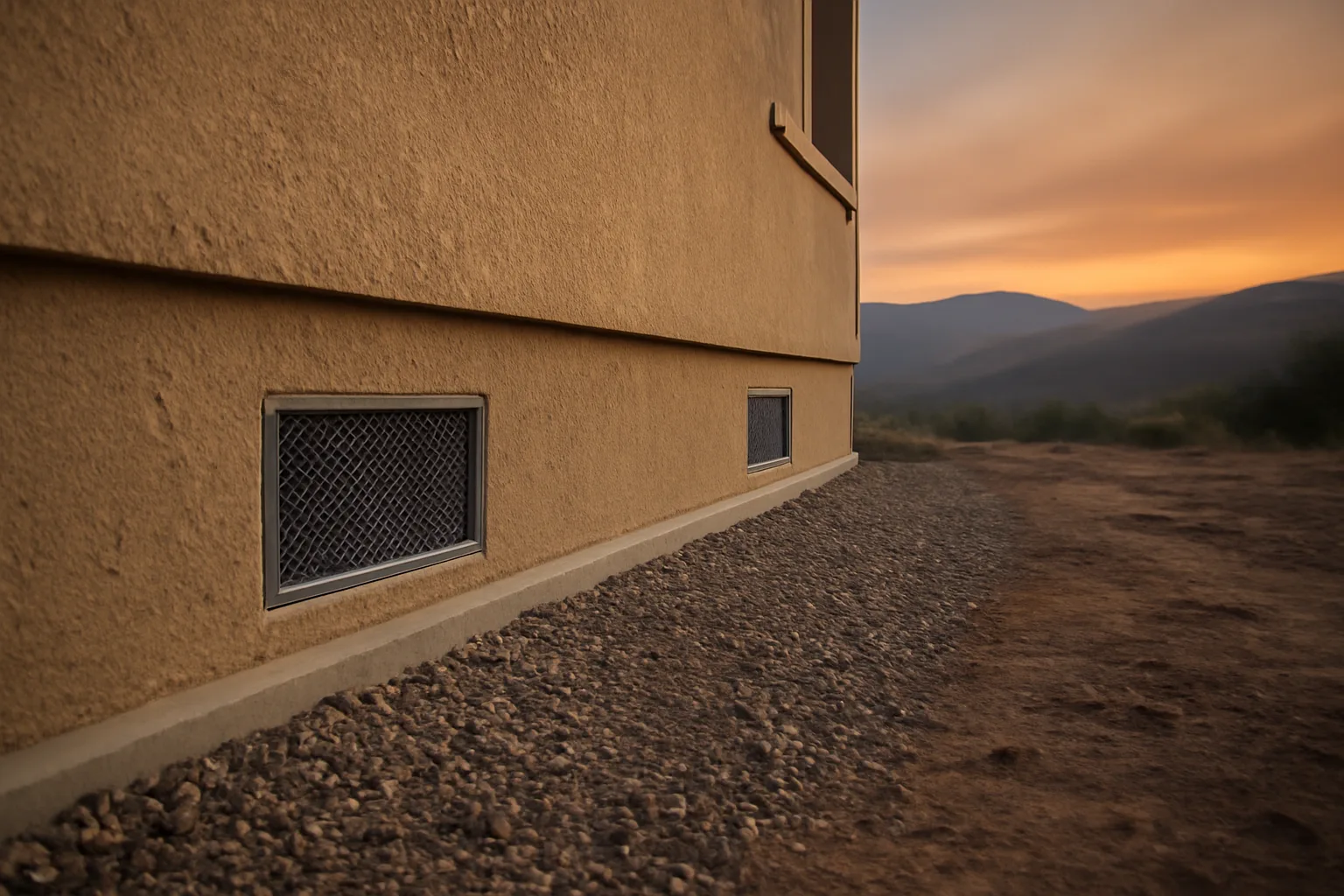
People search "fire protector" expecting a device or a spray-on coating that stops a house from burning. That thing doesn't really exist in a form that works reliably at scale. What actually protects a home in a wildfire is a combination of three things: distance from flammable vegetation and debris (defensible space), a building envelope that resists embers (roof, vents, siding, gutters), and documentation that proves you did the work. CAL FIRE calls this combination "Defensible Space and Home Hardening" in its own literature, and it treats them as inseparable. Their guidance states plainly that "vegetation management alone is not enough to protect a home from wildfire". Embers, not walls of flame, ignite most homes in wildland fires, according to research summarized by the Insurance Institute for Business & Home Safety (IBHS), which found embers and small flames are the primary way homes ignite during wildfires, entering through vents, gaps in decking, and igniting mulch or debris against siding. If you're shopping for "the best fire protector," the honest answer is a checklist, not a product. Fire-resistant vents, Class A roofing, ember-resistant mesh, and a cleared 5-foot zone around the foundation do more than almost anything sold as a single "fire protection" gadget. A wildfire insurance survival kit style approach, where you document each of these steps with dated photos, is what actually helps when an insurer or inspector asks for proof.
When does the California defensible space law go into effect?
California's baseline defensible space law, requiring 100 feet of defensible space around structures in State Responsibility Areas and some local jurisdictions, has been in effect since 2005 under Public Resources Code 4291 [1]. That's not new. What's newer, and what causes confusion, is the "ember-resistant zone" (Zone 0) within 5 feet of structures. Assembly Bill 3074 (2020) directed the Board of Forestry and Fire Protection to develop regulations for this ember-resistant zone, but as of late 2025 those regulations are still moving through formal rulemaking and have not been finalized as enforceable statewide standards [2]. CAL FIRE's public messaging describes Zone 0 as "an active area of code development" and encourages homeowners to start now voluntarily, using their published Zone 0 guidance, rather than wait. So to directly answer the timing question: the 100-foot, three-zone defensible space law has been law since 2005. The 5-foot ember-resistant zone rule was proposed in 2020, and homeowners should watch the Board of Forestry's rulemaking docket for a final effective date rather than assume it's already enforced [2]. Local jurisdictions can and do adopt their own versions earlier, so check your specific fire district's rules.
What fire-safe home rules take effect in 2026?
This is the question people are actually asking when they type "what fire safe for homes take effect in 2026." The honest answer: it depends entirely on jurisdiction, and no single national rule kicks in on a fixed 2026 date. California's Zone 0 ember-resistant zone regulation has been discussed as a potential 2026 or later effective date in draft rulemaking documents, but as of this writing it remains in the regulatory process at the Board of Forestry and Fire Protection, not finalized [2]. Separately, some California insurers are adjusting underwriting standards ahead of any state mandate, and the California Department of Insurance's Safer from Wildfires regulation (effective 2022) already requires insurers to give discounts for mitigation actions like defensible space and hardening, which pushes some of this timeline forward at the insurance level even without a building code deadline [3]. Because rules genuinely differ by state and even by fire district within a state, treat any specific 2026 date you read online as provisional until you confirm it on your state fire marshal's site or your local fire district's page. [Fill in: your local fire district's specific mitigation deadline and citation here.]
Why won't people follow the defensible space law in California?
This isn't really a mystery, and it isn't about ignorance. Cost, labor, and aesthetics are the three real barriers, and CAL FIRE's own inspection data backs that up. CAL FIRE conducts defensible space inspections across State Responsibility Areas, and compliance rates vary widely by county and vegetation type; in many inspected parcels, initial inspections find some level of non-compliance, most commonly related to vegetation spacing and debris removal rather than total neglect. Clearing brush, limbing trees, and replacing landscaping is expensive. A single day of professional brush clearing on a sloped, half-acre lot easily runs $1,500 to $4,000 depending on terrain and vegetation density, and that's not a one-time cost. It needs to happen annually or biannually as vegetation regrows. There's also a real emotional cost. Longtime residents often built their homes specifically for the tree cover and privacy that defensible space rules require removing. Asking someone to cut down mature oaks or clear the manzanita that's been there for 40 years is asking them to change what drew them to the property in the first place. Finally, enforcement is uneven. Many rural parcels get inspected only occasionally, and penalties for non-compliance, while codified under PRC 4291, are inconsistently applied. Without a consistent stick, and with real financial and emotional costs, compliance lags in predictable ways. None of that means the law is wrong. It means the barriers are structural, not informational, and the fix probably needs cost-sharing programs, more than more pamphlets.
How do you prevent wildfires from starting near a home?
Most wildfires near homes start from human activity, not lightning. Ready.gov and CAL FIRE both point to debris burning, equipment sparks, vehicle exhaust on dry grass, and unattended campfires as leading causes. Preventing ignition near your property means controlling these specific risks. Don't mow dry grass midday when temperatures peak; do it early morning when humidity is higher. Keep a shovel and water source at hand when using any spark-producing tool (chainsaws, angle grinders, welding equipment) outdoors. Never park a vehicle with a hot undercarriage on dry grass, that's a documented cause of roadside ignitions in California during red flag conditions. On the vegetation side, prevention overlaps heavily with defensible space work: remove dead and dying vegetation, keep gutters free of dry leaves and needles, and store firewood at least 30 feet from structures per CAL FIRE's zone guidance. None of this is glamorous. It's mowing schedules and gutter cleaning, not high-tech gadgets, and it's genuinely most of what works.
How do you prepare for a wildfire before it happens?
Preparation splits into three buckets: property hardening, evacuation readiness, and paperwork. Skipping any one of them leaves a real gap. On property hardening, Ready.gov's wildfire preparedness guidance recommends creating and maintaining defensible space, using fire-resistant building materials, and keeping an emergency supply kit ready before fire season starts. On evacuation, know two routes out of your neighborhood (not one), and practice them; wildfire evacuations often happen with only minutes of notice, and CAL FIRE's "Ready, Set, Go" program is built around exactly this compressed timeline. The paperwork bucket is the one people skip and regret. Before a fire, photograph every room, your roof, your defensible space clearing, and serial numbers on major appliances and electronics. Store this somewhere off-property (cloud storage, a relative's house, a safe deposit box). Insurers process claims faster with dated proof of mitigation work and home contents, and rebuilding that documentation after a total loss is genuinely one of the hardest parts of the recovery process. This is the specific gap a wildfire insurance survival kit is meant to close: a one-time $99 way to organize photos, receipts, and mitigation proof before you need it, not instead of insurance, but alongside it. To be clear: this kind of documentation helps you support your own claim; it isn't a substitute for working with your insurer, and it doesn't involve anyone negotiating on your behalf or promising a specific payout.
How do you prevent forest fires and how do you avoid them?
"Prevent" and "avoid" point to slightly different concerns: preventing ignition versus avoiding personal harm when a fire is already burning nearby. Both matter. On prevention, the U.S. Forest Service and CAL FIRE both cite human activity as the cause of roughly 85% to 90% of wildfires nationally in various reporting years, with campfires, debris burning, equipment use, and arson as the top categories. The single highest-leverage prevention action for an individual homeowner isn't dramatic: fully extinguish campfires (drown, stir, drown again), don't burn debris on windy or red flag days, and maintain outdoor equipment (mowers, chainsaws) to reduce spark risk. On avoidance (staying safe once a fire is burning nearby), sign up for your county's emergency alert system now, before you need it. Systems vary by state: Californians can check CAL FIRE's "Ready for Wildfire" alerts, and most counties nationwide participate in Wireless Emergency Alerts through FEMA's integrated system. Avoidance also means not driving into smoke-obscured areas to "go check on the house." Visibility and air quality during active fires cause real accidents and real deaths that have nothing to do with flame contact.
How do you prepare for forest fires if you live near wildland areas?
Living in the wildland-urban interface (WUI) changes the math on preparation. You're more than protecting a structure, you're managing an ongoing relationship with fuel load on adjacent land you might not even own. Start with CAL FIRE's three defensible space zones, which apply whether you're in California or use them as a mental model elsewhere: Zone 0 (0-5 feet, ember-resistant, nearly nothing combustible), Zone 1 (5-30 feet, well-spaced and low fuel), and Zone 2 (30-100 feet, reduced fuel with more spacing between trees and shrubs). If you border public land or an undeveloped neighbor's lot, your 100 feet may extend past your property line; CAL FIRE's guidance explicitly allows for this and recommends coordinating with neighbors and land managers. Beyond vegetation, WUI homeowners should also budget for annual maintenance, more than a one-time clearing. Grasses regrow in a season. Pine needle drop is constant in some regions. A five-year fuel reduction plan, with an actual calendar of tasks (spring mowing, fall gutter clearing, biennial tree limbing), beats a single expensive clearing that lapses within 18 months. For structure-level prep specific to WUI exposure, review fire safe landscaping California next to house guidance and defensible space fundamentals, both of which go deeper into zone-specific plant choices and spacing than a general overview can.
Is Santa Barbara safe from fire?
No California coastal or foothill community is "safe" from fire risk in an absolute sense, and Santa Barbara County has direct, recent history proving it. The Thomas Fire (2017) burned over 281,000 acres and was, at the time, the largest wildfire in modern California history, directly threatening Santa Barbara and Ventura County communities and triggering the Montecito debris flow disaster that killed 23 people in January 2018 [4]. The 2009 Jesusita Fire burned over 8,700 acres and destroyed more than 80 homes within Santa Barbara city limits itself [5]. Santa Barbara sits against steep, chaparral-covered foothills with a pattern of Santa Ana/sundowner wind events that push fire downslope toward dense residential areas, essentially the same topographic and climate risk factors seen across much of coastal Southern California. That doesn't mean every Santa Barbara property faces identical risk; a home in a flat, irrigated, low-vegetation part of the city has meaningfully lower exposure than a hillside home in Montecito or the Riviera area bordering open space. If you're evaluating a specific Santa Barbara property, check its designation on CAL FIRE's Fire Hazard Severity Zone maps, which classify parcels as Moderate, High, or Very High within State Responsibility Areas and, as of recent expansions, within some Local Responsibility Areas too. That map, not a general reputation, is the actual answer for any specific address.
How can we prevent forest fires as a community, more than individually?
Individual defensible space matters, but fire doesn't respect property lines, and neighborhood-level coordination changes outcomes in documented ways. A single unmaintained lot with tall dry grass can undermine every neighbor's individual hardening work if it's the ignition point that starts a chain reaction toward a whole block. Firewise USA, a program run by the National Fire Protection Association in partnership with the U.S. Forest Service and state forestry agencies, recognizes communities that organize collective mitigation work, shared chipping days, and coordinated defensible space compliance. As of NFPA's own program reporting, thousands of communities across the U.S. participate, and some insurers reference Firewise recognition as a mitigation factor in underwriting discussions, though this varies significantly by insurer and state and shouldn't be assumed automatic . At a practical level, community prevention looks like: organizing group brush-clearing days (cheaper per household than solo contractor visits), pushing your HOA or fire district for public chipper days so debris removal isn't a financial barrier, and reporting hazardous accumulations on vacant or absentee-owned lots to your local fire marshal, who often has authority to require abatement even on properties you don't own.
What does home hardening actually involve, beyond clearing brush?
| Ember-resistant vent screens (1/8" mesh) | $150-$600 total for a typical home | High, cheap and high-impact | |
|---|---|---|---|
| Gutter guards / cleaning schedule | $200-$1,500 installed | High, prevents common ignition point | |
| Class A roof upgrade | $8,000-$25,000+ | Medium, only if replacing roof anyway | |
| Dual-pane tempered windows | $400-$1,200 per window | Medium, prioritize south/west-facing | |
| Zone 0 non-combustible landscaping (5 ft) | $500-$3,000 depending on scope | High, addresses newest regulatory focus | These are general ranges, not quotes, and vary heavily by region, contractor, and home size. For homes that already have a fire nearby or in the recent past, see fire at a house and house fire for what post-incident documentation and rebuild considerations look like. |
Home hardening is the building-envelope half of the equation, and it's where a lot of homeowners underinvest relative to landscaping. CAL FIRE's hardening guidance lists specific, checkable items: Class A fire-rated roofing, ember- and flame-resistant dual-pane windows (tempered glass on at least one pane), 1/8-inch metal mesh over all vents to block ember intrusion, non-combustible siding materials, and enclosed eaves. Gutters deserve their own mention because they're a documented, common ignition point that isn't intuitive to most homeowners: dry leaves and pine needles sitting in a gutter, combined with an ember landing during a wind event, ignite the roof edge in a way that has nothing to do with the vegetation 30 feet from your house. Here's a rough relative-cost table for common hardening items, useful for prioritizing a limited budget: | Hardening item | Typical cost range | Priority if budget-limited |
How does defensible space work interact with insurance non-renewal notices?
If you've received a non-renewal or a mitigation inspection letter, defensible space and hardening work is the single most direct lever you control. California's Safer from Wildfires regulation, adopted by the Department of Insurance in 2022, requires insurers writing homeowners policies to provide meaningful discounts to policyholders who complete specific wildfire mitigation actions, and requires this to be disclosed in a standardized way [3]. The regulation states insurers must recognize mitigation at the individual structure level, more than the community level, which matters because it means your own defensible space and hardening work, documented, should count even if your broader neighborhood hasn't done collective work [3]. The practical move after a non-renewal letter: complete the mitigation items your letter specifies (or your local fire district's general standard if no specific list was given), photograph and date everything, and keep receipts for contractor work. You send this documentation yourself when you shop for new coverage or appeal to your existing carrier. This process is about assembling your own proof, not negotiation; if a claim or coverage dispute arises, a licensed public adjuster or attorney is the appropriate resource for negotiating with an insurer, and no article or product substitutes for that.
Frequently asked questions
When does the California defensible space law go into effect?
The core 100-foot defensible space law (PRC 4291) has been in effect since 2005. The newer 5-foot ember-resistant "Zone 0" rule was proposed under AB 3074 (2020) but remains in Board of Forestry rulemaking as of 2025, not yet a finalized statewide enforcement date [2][3].
Why won't people follow the defensible space law in California?
Cost, labor, and attachment to existing landscaping are the main reasons. Professional brush clearing can run $1,500-$4,000 per visit on sloped lots and needs repeating annually. Enforcement is also uneven across counties, which reduces the practical pressure to comply [1].
How do I prevent wildfires from starting on my property?
Avoid mowing dry grass midday, extinguish debris burns fully, keep spark-producing tools away from dry vegetation, and never park a hot vehicle on dry grass. Most wildfires are human-caused, so controlling these specific behaviors reduces ignition risk directly [5][1].
How do I prepare for a wildfire if I get an evacuation warning?
Know two evacuation routes in advance, keep a go-bag ready, and have your documentation (photos of your home, mitigation proof, insurance policy) stored off-property or in cloud storage. Ready.gov recommends preparing this before fire season, not during an active warning [5].
What is a defensible space Zone 0 and is it required yet?
Zone 0 is the 0-5 foot ember-resistant area immediately around a structure, required to be nearly free of combustible material. California's Board of Forestry is still finalizing enforceable Zone 0 regulations as of 2025; CAL FIRE recommends starting voluntarily now [1][3].
Is Santa Barbara safe from wildfire?
No California hillside or chaparral-adjacent community is fully safe. Santa Barbara has direct history, including the 2017 Thomas Fire (281,000+ acres) and the 2009 Jesusita Fire (8,700+ acres, 80+ homes destroyed). Risk varies sharply by specific address and CAL FIRE hazard zone designation [6][7].
How can communities prevent forest fires together, more than individual homeowners?
Organized programs like Firewise USA coordinate shared brush-clearing days, chipper events, and neighborhood-wide compliance, which prevents a single unmaintained lot from undermining everyone else's work. Some insurers consider Firewise recognition in underwriting, though this varies by carrier and state [8].
What fire-safe home rules take effect in 2026?
There's no single nationwide 2026 rule. California's Zone 0 ember-resistant zone regulation has been discussed with a possible 2026-or-later effective date in draft rulemaking, but it isn't finalized. Check your state fire marshal and local fire district for confirmed dates specific to your address.
What's the difference between defensible space and home hardening?
Defensible space is vegetation and fuel management around a structure, done in zones out to 100 feet. Home hardening is upgrading the building itself (roofing, vents, windows, siding) to resist ember intrusion. CAL FIRE states both are needed together; neither alone reliably prevents ignition [1].
Does clearing defensible space guarantee my insurance won't be cancelled?
No. Mitigation work can support a discount or help during underwriting review under California's Safer from Wildfires regulation, but it doesn't guarantee renewal or a specific rate. Insurers weigh regional risk models and other underwriting criteria that individual mitigation doesn't fully offset [4].
What's the cheapest, highest-impact wildfire mitigation step for homeowners?
Ember-resistant vent screens (1/8-inch metal mesh) typically cost $150-$600 total and block one of the most common home ignition pathways. Clearing gutters of dry debris is similarly cheap and addresses a documented, frequent ignition point [1].
How often does defensible space need to be redone?
At least annually in most climates, and sometimes twice a year in fast-growing grassland areas. Vegetation regrowth, leaf drop, and seasonal debris accumulation mean a one-time clearing lapses within a year or two without maintenance.
Sources
- California Public Resources Code Section 4291: 100-foot defensible space requirement around structures in State Responsibility Areas, in effect since 2005
- California Board of Forestry and Fire Protection, Zone 0 rulemaking: AB 3074 directed development of ember-resistant Zone 0 regulations, still in active rulemaking as of 2025
- California Department of Insurance, Safer from Wildfires Regulation: Insurers must provide discounts for wildfire mitigation actions including defensible space and hardening, effective 2022
- CAL FIRE, Jesusita Fire incident information: The 2009 Jesusita Fire burned over 8,700 acres and destroyed more than 80 structures in Santa Barbara
- National Fire Protection Association, Firewise USA program: Firewise USA recognizes communities for organized, collective wildfire mitigation work