Last updated 2026-07-25
TL;DR
No, coconut water does not stop fire. It's mostly water and sugar, and the sugar content can actually help a fire burn once the water evaporates. Real wildfire protection comes from defensible space clearing, ember-resistant home hardening, and following your state's fire code, not kitchen liquids.
Does coconut water stop fire, or is this just a myth?
Coconut water does not stop fire. This claim shows up periodically online as a "life hack," usually paired with a video of someone pouring it on a small controlled flame, but it does not hold up under any real fire test. Coconut water is roughly 94-95% water by volume, with the rest made up of natural sugars (mostly sucrose, glucose, and fructose), electrolytes like potassium, and small amounts of other organic compounds. The water fraction can absorb heat and smother a small flame the same way plain tap water would, briefly. But that's water doing the work, not anything special in the coconut water itself. Here's the part that matters for wildfire prep: the sugar in coconut water is combustible. Once the water content boils off, you're left with a sugary residue that can scorch, caramelize, and in a sustained heat source, actually feed combustion rather than stop it. This is true of any sugary liquid, including soda, juice, and sports drinks. None of them are fire suppressants. If anything, dried sugar residue on a surface is a fire performance enhancer, not a fire stopper. So if someone tells you to keep coconut water around as a fire tool, skip it. Plain water, a real fire extinguisher, or a Class K extinguisher (for grease fires) are the tools that actually work. For anything bigger than a stovetop flare-up, none of these household liquids matter anyway. Wildfire protection is won or lost in the weeks and months before a fire starts, through defensible space and home hardening, not with what's in your fridge.
What actually stops or slows a fire at your home?
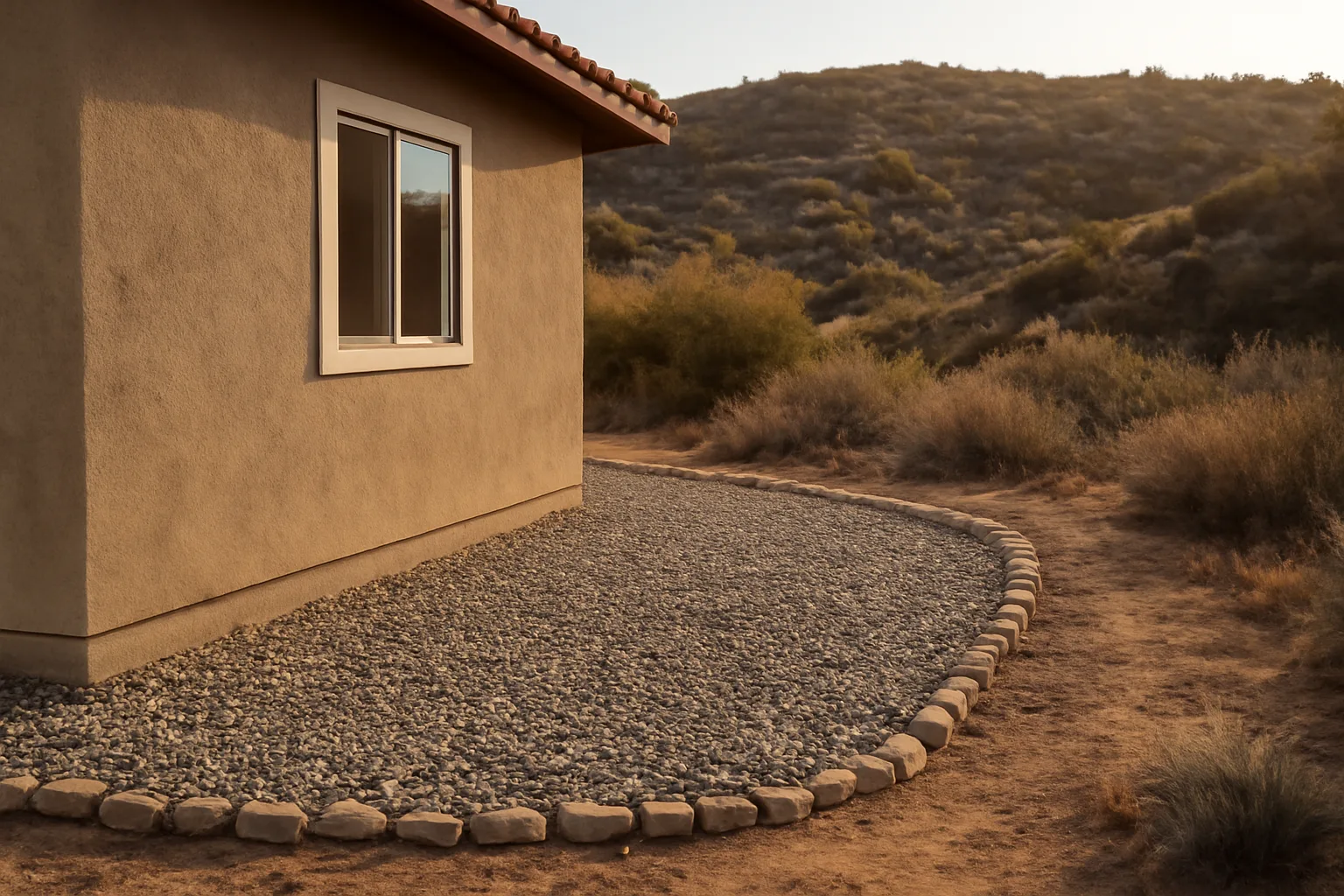
Distance, fuel reduction, and ember-resistant materials stop fires at homes, not liquids poured in the moment. CAL FIRE's defensible space framework breaks your property into zones, and each zone has a specific job in slowing a fire down or stopping embers from finding fuel [1]. Zone 0 (0-5 feet from structures) is the ember-resistant zone. California's Zone 0 regulation, once finalized, will require noncombustible materials immediately next to the home: no bark mulch, no wood piles, no combustible plants touching the siding [1]. Zone 1 (5-30 feet) calls for widely spaced, low-growing, well-irrigated plants. Zone 2 (30-100 feet) focuses on reduced fuel volume and "vertical spacing" so a ground fire can't ladder up into tree crowns [1]. The reason this matters more than any liquid trick: most homes in a wildfire don't burn because a wall of flame rolled over them. They burn because wind-blown embers land in gutters, vents, mulch beds, or under decks and ignite something small that then spreads to the house. The National Fire Protection Association's firewise research on home ignition zones has documented this ember-driven ignition pattern repeatedly in post-fire structure assessments [2]. Stopping ember ignition at the structure is the actual fight. That means metal mesh over vents, Class A roofing, ember-resistant venting, and a clean 5-foot zone, not a bottle of anything. For a working checklist by zone, see defensible space and fire-safe landscaping next to the house.
When does the California defensible space law go into effect?
California's core defensible space law (Public Resources Code 4291) has been in effect for years and currently requires 100 feet of defensible space clearance around structures in State Responsibility Areas and some Local Responsibility Areas classified as Very High Fire Hazard Severity Zones [3]. What's newer, and often confused with a brand-new law, is the Zone 0 ember-resistant zone regulation. CAL FIRE and the Board of Forestry have been developing the Zone 0 regulation (the 0-5 foot noncombustible zone) under SB 63 (2020) and related statute for several years, with an expected effective date that has been pushed back multiple times as the rulemaking process continues [1]. As of the most recent public guidance, CAL FIRE states Zone 0 requirements are still moving through formal rulemaking, and homeowners should check CAL FIRE's defensible space page directly for the current status before assuming a specific date [1]. Because the effective date keeps shifting and enforcement details vary by Fire Safe Council and local jurisdiction, treat any specific "go-live" date you see online as provisional. Check your local fire district's defensible space bulletin for your specific compliance deadline and enforcement date. Some Local Responsibility Area cities and counties have already adopted their own Zone 0-style ordinances ahead of the state rule.
What fire safe rules for homes take effect in 2026?
The honest answer: it depends on your state and district, and the details are still being finalized in several places. California's Zone 0 regulation has been targeted for various effective dates in recent rulemaking cycles, but as of this writing CAL FIRE has not published a single locked-in statewide date for full enforcement [1]. Some jurisdictions are moving faster than the state timeline through local ordinance. Oregon's statewide wildfire risk map and defensible space code work (under SB 762, passed in 2021) has also gone through revisions and delays after public pushback, with the state redoing its risk mapping process [4]. Colorado does not have one statewide defensible space law; wildfire mitigation codes are set county-by-county and by fire district, so "2026 rules" in Colorado really means whatever your county has adopted. Check your state fire marshal's office and your local fire district for the specific 2026 code adoption date and requirements that apply to your address. Don't rely on a blog post, including this one, for your exact compliance deadline. The rules genuinely differ by district, and getting the date wrong on an insurer-facing document can undercut your case.
Why won't people follow the defensible space law in California?
Cost, labor shortages, and confusion about what's actually required are the three biggest reasons compliance lags. A 2021 Los Angeles Times investigation and multiple CAL FIRE inspection reports have found defensible space compliance rates well below 100% in many Very High Fire Hazard Severity Zones, with inspectors citing incomplete brush clearance, stored firewood too close to structures, and overgrown vegetation as the most common violations. Some of this is genuinely expensive. Clearing steep, brush-heavy lots can run into thousands of dollars in contractor fees, and rural and lower-income homeowners are disproportionately represented in high-severity zones. Some of it is bandwidth: elderly homeowners on fixed incomes, or people who inherited a rural property, may not have the physical ability or knowledge to do the clearing themselves. And some of it is just not knowing. Many people genuinely don't know their zone classification, don't know the 100-foot rule exists, or assume a single trim of the lawn counts as compliance. CAL FIRE offers free defensible space evaluations in many counties specifically to close this knowledge gap [1]. There's also an enforcement gap. PRC 4291 gives local fire agencies authority to inspect and cite noncompliant properties, but staffing for proactive inspection varies enormously by county, so enforcement in practice is uneven. For DIY vs. contractor clearing costs and permitting help, see wildfire defensible space clearing contracts.
How to prevent wildfires (and how to prevent forest fires)
Most wildfires and forest fires in the U.S. are human-caused, and the single biggest prevention lever is controlling ignition sources, not water or firebreaks alone. Roughly 85 to 90 percent of wildland fires in the U.S. are started by people, according to the U.S. Forest Service, through things like unattended campfires, downed power lines, equipment sparks, discarded cigarettes, and arson. Practical prevention steps that actually move the needle: - Never leave a campfire unattended, and drown, stir, and drown again until it's cool to the touch (ready.gov's wildfire guidance specifically recommends this drown-stir-drown-feel method) [5].
- Avoid mowing dry grass or using power equipment (chainsaws, grinders, mowers) during red flag warning days; a hot muffler or metal-on-rock spark is a common ignition source.
- Don't park or idle vehicles over dry grass; catalytic converters run at several hundred degrees Fahrenheit.
- Follow local burn permit rules exactly, and check for burn bans before any debris burning.
- Maintain defensible space around structures so an ignition, wherever it starts, has less fuel to spread through [1]. None of this is exotic. It's mostly discipline around heat sources and fuel. The only you can prevent wildfires campaign, run by the USDA Forest Service and Ad Council since 1944, exists because human-caused ignition is genuinely the most controllable variable in this whole problem.
How to avoid forest fires when you're outdoors or living near one
Avoiding forest fires as an individual comes down to fire-source discipline in the field and defensible space at home. If you're camping, hiking, or working in forested land, check current fire restrictions before you go; many national forests post real-time fire danger ratings and temporary burn bans during dry season. If you live adjacent to forest or wildland, your personal risk reduction looks a lot like the defensible space zones already discussed: clear needles and leaves from gutters and roof valleys, keep firewood stacks at least 30 feet from structures, and don't let dead vegetation build up against fences (fences act as fuel wicks that carry fire straight to a house) [1]. A detail people miss: fences, sheds, and decks are common weak points. A wood fence touching your house is functionally an extension cord for fire. CAL FIRE's Zone 0 guidance specifically flags attached combustible fencing as a top-priority fix [1]. See fire at a house for a walkthrough of which structural attachments matter most.
How to prepare for a wildfire (and how to prepare for forest fires)
| Clear Zone 0 (0-5 ft) of combustibles | Before fire season, re-check every spring | CAL FIRE [1] | |
|---|---|---|---|
| Clean gutters and roof valleys of debris | Spring and fall | CAL FIRE [1] | |
| Trim tree limbs 10 ft from chimney/roofline | Annually | CAL FIRE [1] | |
| Build a go-bag with documents, meds, chargers | Once, refresh yearly | Ready.gov [5] | |
| Photograph home exterior and contents | Before season starts | Insurance documentation | |
| Know two evacuation routes out of your area | Once, review yearly | Ready.gov [5] | |
| Sign up for local emergency alerts | Once | County emergency management | This is also the point where insurance documentation matters. If you've gotten a non-renewal notice or a wildfire risk inspection letter, insurers and FAIR Plans increasingly want photo evidence of defensible space compliance, more than a verbal claim that you've done the work. Building a dated, organized packet (property photos by zone, receipts for clearing work, vent screen upgrades) is something you assemble yourself; this is not something an agent or public adjuster does for you, and it's not a substitute for your policy's actual claims process. If you want a structured way to build that documentation packet without guessing what underwriters look for, our $99 Wildfire Insurance Survival Kit walks through exactly what to photograph and log by zone. |
Preparing for a wildfire means doing the defensible space and home hardening work before fire season, and having a documented evacuation and insurance plan ready before you need it. Ready.gov's wildfire preparedness guidance breaks this into three buckets: know your risk, prepare your home, and have a go-plan [5]. A working pre-season checklist: | Task | Timing | Source |
How can we prevent forest fires as a community, more than individually?
Community-level forest fire prevention works through shared fuel breaks, coordinated brush removal, and neighborhood-wide compliance, because a single hardened home surrounded by unmanaged neighboring lots still burns. CAL FIRE and USDA Forest Service guidance consistently show that fire behavior in a neighborhood is a function of the whole block's fuel load, more than one property [1]. Firewise USA, a National Fire Protection Association program, organizes neighborhoods into recognized communities that coordinate defensible space work, host chipping days, and apply for shared mitigation grants. This matters because a single unmitigated lot next to yours (dead brush, a wood pile against a fence, unmanaged eucalyptus) can undo your own hardening work if embers ignite that fuel and jump the property line. Local Fire Safe Councils in California often run chipper programs and cost-share grants specifically because individual compliance is cheaper and more likely when the whole block does it together. If your neighborhood doesn't have one, that's often the highest-leverage thing to organize before spending more money on your own property alone.
Is Santa Barbara safe from fire?
No area in California's wildland-urban interface, including Santa Barbara, is "safe" from fire risk, though risk varies sharply by specific neighborhood and terrain. Santa Barbara County has experienced several major destructive wildfires in the past two decades, including the Thomas Fire (2017, which burned over 281,000 acres and was, at the time, the largest wildfire in modern California history) and the subsequent Montecito debris flow that killed 23 people in January 2018 . CAL FIRE's Fire Hazard Severity Zone maps classify large parts of the Santa Barbara foothills and adjacent unincorporated areas as Very High Fire Hazard Severity Zone, which triggers the 100-foot defensible space requirement under PRC 4291 [3]. Coastal, flatter parts of the city proper carry lower wildfire hazard ratings, but embers and smoke exposure aren't limited by municipal boundaries during a major wind-driven fire event. Check CAL FIRE's Fire Hazard Severity Zone viewer for your specific address to get an accurate hazard classification rather than relying on the city's general reputation. Santa Barbara is a useful example precisely because risk within the same city varies enormously block to block depending on slope, vegetation type, and distance to wildland.
What household materials actually help in a fire emergency?
A real fire extinguisher rated for the fire type, a fire blanket, and working smoke alarms are the tools that matter, not liquids from the pantry. For grease and cooking fires, a Class K extinguisher is correct; for electrical fires, never use water (of any kind, coconut or otherwise) because water conducts electricity and can cause electrocution or make the fire worse. For general home fires, a multipurpose ABC-rated extinguisher covers ordinary combustibles, flammable liquids, and electrical fires. The National Fire Protection Association recommends at least one extinguisher per floor, placed near exits so you're moving toward safety while using it, not deeper into the building. None of this applies at wildfire scale. Once a wildfire reaches your property line, extinguishers and garden hoses are not a survival strategy; evacuation per local authority orders is. The home hardening and defensible space work described above is what determines whether the structure survives after you've already left. See house fire for structural fire response basics separate from wildfire prep.
Frequently asked questions
Does pouring coconut water on a fire actually put it out?
Only in the same limited way any water-based liquid does: the water content can cool and smother a very small flame briefly. But coconut water contains natural sugars that leave a combustible residue once the water evaporates, so it's not a reliable extinguishing agent and offers no advantage over plain water or a real extinguisher.
When does the California defensible space law go into effect?
The base defensible space law (PRC 4291, 100-foot clearance in Very High Fire Hazard Severity Zones) is already in effect and has been for years. The newer Zone 0 (0-5 ft noncombustible zone) regulation is still in CAL FIRE's rulemaking process; check CAL FIRE's defensible space page for the current effective date before assuming a specific year.
Why don't more Californians comply with defensible space law?
Cost of clearing brush-heavy lots, physical inability for elderly or disabled homeowners, uneven local enforcement, and simple lack of awareness of the 100-foot rule are the main reasons. CAL FIRE offers free evaluations in many counties to help close the knowledge gap, and some Fire Safe Councils run cost-share clearing programs.
How do I prevent wildfires from starting near my property?
Never leave campfires unattended, avoid mowing dry grass or running power equipment on red flag warning days, don't park over dry grass, follow local burn permit rules, and maintain defensible space so any spark has less fuel to catch. An estimated 85 to 90 percent of U.S. wildland fires are human-caused, per U.S. Forest Service data.
How do I prepare for a wildfire if I live in a high-risk zone?
Clear your defensible space zones, harden ember entry points (vents, gutters, roof valleys), build a go-bag with documents and medications, photograph your home for insurance records, and know two evacuation routes. Ready.gov's wildfire guidance recommends doing this before fire season starts, not during a red flag warning.
What fire safe rules for homes take effect in 2026?
This varies by state and district and several rules, including California's Zone 0 regulation, are still being finalized. There's no single nationwide 2026 rule. Check your state fire marshal's office and local fire district directly for the exact code adoption date and requirements for your address.
Is Santa Barbara safe from wildfire risk?
No, parts of Santa Barbara County, especially the foothills and unincorporated wildland-urban interface areas, are classified Very High Fire Hazard Severity Zone by CAL FIRE. The 2017 Thomas Fire burned over 281,000 acres in the region. Risk varies sharply by specific address; check CAL FIRE's hazard zone viewer for your location.
How can communities prevent forest fires, more than individual homeowners?
Coordinated neighborhood fuel reduction, shared chipper days, and programs like Firewise USA matter because one unmanaged lot can undo a neighbor's hardening work when embers jump the property line. Local Fire Safe Councils often run cost-share grants specifically to raise block-wide compliance rather than relying on isolated individual effort.
Can I use sugary drinks like soda or sports drinks to put out a fire?
No. Like coconut water, sugary drinks are mostly water with combustible sugar content. They may briefly cool a very small flame the way any liquid would, but the sugar residue left behind after the water evaporates can scorch or feed further burning. Use a real extinguisher instead.
What's the difference between defensible space Zone 0, Zone 1, and Zone 2?
Zone 0 (0-5 ft from structures) requires noncombustible materials immediately next to the home. Zone 1 (5-30 ft) calls for widely spaced, low, irrigated plants. Zone 2 (30-100 ft) focuses on reduced fuel volume and vertical spacing so ground fire can't reach tree crowns. All three come from CAL FIRE's defensible space framework.
Do I need defensible space if I live in a city, not near wildland?
If your property isn't in a State Responsibility Area or a Local Responsibility Area Very High Fire Hazard Severity Zone, PRC 4291's 100-foot requirement may not apply directly. But embers can travel well ahead of a fire front in wind-driven events, so ember-resistant details (vents, gutters, roof material) still reduce risk even outside mapped zones.
What should I photograph for insurance before a non-renewal inspection?
Document all three defensible space zones from multiple angles, vent screens, roof material and condition, gutter cleanliness, any attached fencing or decking, and dated timestamps. This is documentation you prepare and send yourself; it doesn't replace your insurer's actual inspection or claims process, and no product can promise reinstatement or coverage.
Sources
- National Fire Protection Association, Firewise USA and home ignition zone research: Wind-blown embers, not direct flame contact, ignite most structures in wildfires
- California Public Resources Code Section 4291: 100-foot defensible space clearance requirement around structures in State Responsibility Areas
- Oregon State Legislature, Senate Bill 762 (2021): Oregon's statewide wildfire risk mapping and defensible space code framework
- USDA Forest Service, Wildfire Causes and Evaluation fact sheet: The large majority of U.S. wildland fires are started by human activity, per Forest Service fire cause reporting
- CAL FIRE, Thomas Fire incident archive: Thomas Fire burned over 281,000 acres in Santa Barbara and Ventura counties in 2017