Last updated 2026-07-24
TL;DR
No house is 100% fireproof, but "hardened" homes built to California's Chapter 7A code and Zone 0 rules survive wildfires at much higher rates. The real fight is embers, not flame fronts. New CA Zone 0 ember-resistant zone rules were expected to take effect in 2023 via SB 63/AB 3074 but remain delayed pending state fire marshal regulations, with 2026 now the working target for enforcement.
can a house actually be fireproof?
No. There's no such thing as a fireproof house, and any contractor who tells you otherwise is selling something. What exists is "fire hardened" or "fire resistant" construction, which is a different claim. It means the house is built and maintained so that embers and radiant heat, the two things that destroy most homes in wildfires, have almost nothing to grab onto. CAL FIRE's own research and after-action studies of fires like the 2018 Camp Fire and 2017 Tubbs Fire found that homes usually don't burn because a wall of flame rolls over them. They burn because wind-blown embers, sometimes traveling a mile or more ahead of the fire front, land in gutters full of leaves, get sucked under vinyl siding, or ignite a wood fence that then torches the house it's attached to. Insurance Institute for Business & Home Safety (IBHS) research on the 2007 Angora Fire and later fires found that surviving and destroyed homes were often only yards apart, with the difference coming down to roofing material, vents, and what was planted or stacked next to the foundation. So the honest framing is: you're not fireproofing a house, you're removing the things that let embers start a fire on or against it. That's a buildable, insurable, and inspectable standard. "Fireproof" isn't.
what actually makes a home fire resistant?
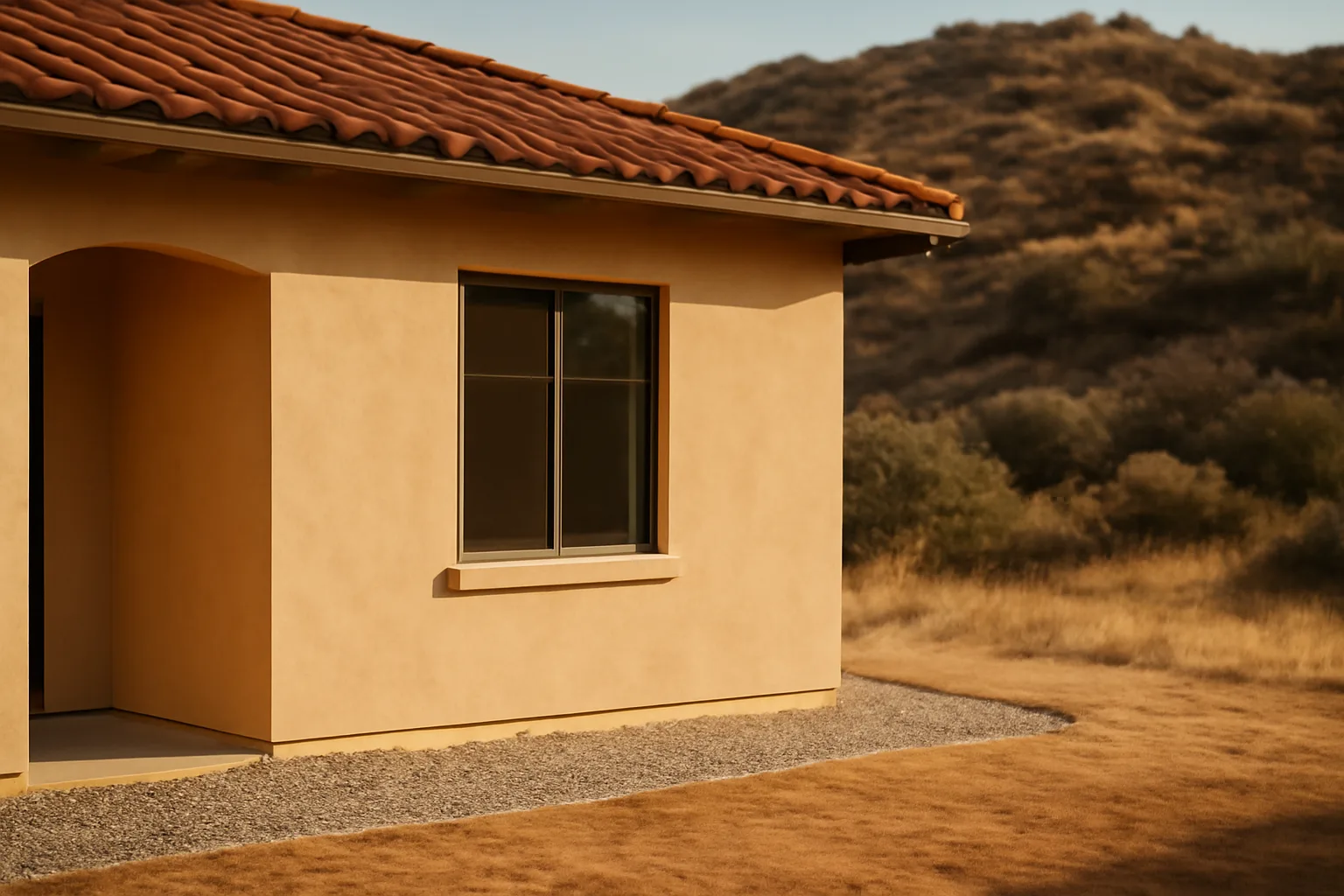
Three systems matter most: the roof, the vents, and the five feet of ground touching the structure. Get those three right and you've addressed most of the ember-ignition pathways researchers have documented. Roofing: Class A fire-rated roofing (asphalt composition shingle, concrete tile, metal) is required in California's Wildland-Urban Interface (WUI) building code, Chapter 7A of the California Building Code [1]. Wood shake roofs are the classic failure point in older WUI homes. Vents: Embers get pulled into attics and crawlspaces through ordinary vents and start fires from the inside, which is why they're so hard to fight. California now requires ember- and flame-resistant vents (1/8 inch mesh minimum, or listed ignition-resistant assemblies) under Chapter 7A [1]. Zone 0, the first 5 feet: This is the newest and most contested piece. SB 9 and the Zone 0 concept require nothing combustible within 5 feet of the structure, no bark mulch, no wood fencing attached to the house, no stored firewood, nothing that lets an ember pile up and smolder against your siding. CAL FIRE's defensible space guidance also covers the broader 0-30 and 30-100 foot zones [2]. For the landscaping specifics next to the house, see fire safe landscaping California next to house. Windows and siding matter too. Dual-pane windows (at least one pane tempered glass) resist radiant heat cracking better than single-pane. Non-combustible or ignition-resistant siding (stucco, fiber cement, treated wood) beats vinyl, which can soften and pull away from a wall under heat well before flame arrives. If you're weighing a full rebuild or retrofit against sale, it helps to compare what "hardened" actually costs versus what non-renewal already costs you. Some homeowners run this comparison before deciding, see defensible for a broader framework on what defensible-space work is worth.
when does the california defensible space law go into effect?
California's core defensible space law, Public Resources Code 4291, has been in effect for years and requires 100 feet of defensible space clearance around structures in State Responsibility Areas (or less if it reaches your property line) [3]. That part isn't new and isn't waiting on anything. What is still pending is Zone 0, the ember-resistant 5-foot zone. AB 3074 (2020) directed the Board of Forestry and Fire Protection to develop these ember-resistant zone regulations, and SB 63 (2023) set an intended effective date of January 1, 2023, later pushed out. As of the most recent Board of Forestry updates, Zone 0 regulations are still in the rulemaking process, with the state indicating a working target around 2026 for adoption and phased enforcement, though exact dates keep shifting as the regulatory text goes through review. The honest answer for a homeowner: the general 100-foot defensible space law (PRC 4291) is already enforceable today, your local fire district can and does write violation notices under it. Zone 0's stricter 5-foot rule is coming, not fully law yet as of this writing, but CAL FIRE recommends doing the work now, since insurers and inspectors are already looking for it ahead of the mandate [2].
why won't people follow the defensible space law in california?
Mostly cost, mostly confusion, and partly the flat-out size of the job. Clearing 100 feet around a home on a wooded acre lot isn't a weekend project, it can mean removing mature trees, regrading slopes, and hauling away tons of vegetation debris, sometimes running into thousands of dollars for larger or steeper parcels. CAL FIRE's own defensible space inspection data shows non-compliance is common enough that the agency runs annual inspection campaigns and still finds a meaningful share of properties out of compliance each year, particularly around vegetation spacing and structure clearance in Zones 1 and 2 [2]. Local fire safe councils and CAL FIRE units report common reasons: homeowners don't know the rule exists until they get a notice, some can't afford tree removal or chipping services, some are physically unable to do the labor themselves (elderly or disabled homeowners), and some genuinely disagree that trees near their house are the risk, especially in areas that haven't burned in living memory. There's also a real trust gap. Some homeowners feel the rule is enforced inconsistently, that a neighbor with worse conditions got no notice while they did. Whether that's true varies by fire district; enforcement resources differ a lot between a well-funded CAL FIRE unit and a small volunteer district. If you got a notice and don't know where to start, the practical fix is triage: do the 5-foot zone around the house first (cheapest, highest ember-reduction value), then the 30-foot zone, then worry about 30-100 feet last. That order matches how CAL FIRE prioritizes ember ignition risk [2], and it's usually how you'd sequence the work in a Wildfire Insurance Survival Kit checklist too, since insurers ask for photo documentation of exactly these zones.
what new fire safe rules take effect in 2026?
The clearest 2026 item on the table is California's Zone 0 ember-resistant zone regulation, which the Board of Forestry and Fire Protection has been developing since AB 3074 (2020) and SB 63 (2023) directed it. Multiple public updates from the Board place adoption and phased implementation around 2025-2026, though homeowners should check the Board of Forestry's current rulemaking page directly since the timeline has slipped before. Separately, insurers operating in California are adjusting under the state's 2024 "Sustainable Insurance Strategy" reforms, which require insurers writing more policies in high-risk wildfire areas in exchange for being allowed to use forward-looking catastrophe models in rate setting, overseen by the California Department of Insurance [4]. That's not a building code, but it directly affects whether hardening your home actually helps you get or keep coverage, since insurers are now supposed to factor in mitigation credit programs like the Safer from Wildfires framework [4]. Oregon, Colorado, and Arizona each have their own timelines and none mirror California's exactly. Oregon's wildfire risk map and defensible space rules under SB 762 have gone through their own revisions after public pushback in 2022; Colorado leaves most defensible space rules to county and local fire district authority rather than one statewide code. Arizona similarly defers heavily to local jurisdiction and the Arizona State Forestry Division for WUI guidance. If you're in one of these states, treat any "2026 deadline" claim skeptically until you confirm it on your state fire marshal's site, because rules genuinely differ by district. [Guided fill-in: check your local fire district's current defensible space ordinance and inspection cycle before assuming a statewide deadline applies to your parcel.]
how to prevent wildfires from starting near your home
Most wildfires near homes start from human causes, not lightning. Ready.gov and CAL FIRE both point to equipment sparks, unattended debris burns, dragging trailer chains, and improperly extinguished campfires as leading causes in WUI areas. Practical prevention steps that actually move the needle: don't mow dry grass midday in fire season (mower blades striking rocks throw sparks), keep debris burns to permitted days with a shovel and water source on hand, maintain spark arrestors on chainsaws and ATVs, and never park a hot vehicle on dry grass, catalytic converters run hot enough to ignite it. Utility-caused fires (downed power lines, tree contact) are also a major category; report sagging lines or trees leaning into power lines to your utility immediately rather than waiting. At the home level, prevention overlaps heavily with hardening: keeping gutters clear, moving woodpiles away from structures, and keeping the area under decks clear removes fuel that turns a nearby ignition into a structure loss. See only you can prevent wildfires for the classic public-awareness angle and how it translates into actual homeowner tasks.
how to prepare for a wildfire before it happens
Preparation splits into three buckets: the house, the go-bag, and the paperwork. Ready.gov's wildfire guidance recommends assembling an emergency kit with at least a 3-day supply of food and water per person, a battery or hand-crank radio, and copies of important documents before fire season starts, not during an evacuation order. For the house: clear the defensible space zones (5, 30, 100 feet as applicable), close up eave and foundation vents with ember-resistant screens, move flammable furniture off wood decks, and know where your gas shutoff valve is. Sign up for your county's emergency alert system; most California counties run these through Genasys or similar reverse-911 platforms, and enrollment isn't automatic in every county. For paperwork, and this is the part people skip until it's too late: photograph every room of your house, your roof, your defensible space zones, and your major possessions before fire season, and store those photos somewhere off-property (cloud backup, email to yourself, a relative's house). If you're ever hit with a claim dispute or a non-renewal after a near-miss fire, dated photo documentation of your home's condition and mitigation work is the single most useful thing you can hand an insurer or adjuster. This is also the exact gap a Wildfire Insurance Survival Kit is built to close: a one-time $99 structured documentation kit that walks you through photographing defensible space zones, vents, roofing, and property condition in the format insurers actually ask for. To be clear, we don't negotiate with insurers, file claims on your behalf, or promise reinstatement or discounts, you send your own documentation, we just help you build it correctly the first time. If you've already been through a fire event or lost a structure, the practical next steps (insurance notification, temporary housing, debris removal permits) are covered in more depth at house fire and fire at a house.
how to prevent forest fires and avoid forest fires
"Preventing forest fires" and "protecting your house from a forest fire" are two different problems, and a lot of homeowner confusion comes from mixing them up. You personally can't prevent a lightning-caused forest fire three ridgelines away. What you can control is your own ignition sources and your home's vulnerability if that fire reaches you. The U.S. Forest Service and Smokey Bear campaign (yes, still active, still the federal messaging arm on this) put the core human-caused prevention rules simply: fully extinguish campfires (drown, stir, drown again, feel for heat with the back of your hand before leaving), don't park on dry vegetation, follow local burn bans during red flag warnings, and check local fire restrictions before any outdoor burning. Nationally, roughly 85-90% of wildland fires are human-caused according to National Interagency Fire Center data cited across federal wildfire agencies, though the exact share varies by year and region. "Avoiding" forest fires as a homeowner really means situational awareness: knowing your area's red flag warning days, having your evacuation route memorized (more than programmed into a phone that might lose signal), and treating any smoke smell during dry, windy conditions as worth checking immediately rather than assuming someone else reported it.
is santa barbara safe from fire?
No coastal California city is "safe" from fire in an absolute sense, and Santa Barbara County has a documented history that argues against complacency. The 1990 Painted Cave Fire destroyed 641 structures in about 90 minutes in the Santa Barbara foothills. The 2017 Thomas Fire, at the time the largest wildfire in modern California history by acreage, burned into Santa Barbara County and triggered evacuations in Montecito, followed weeks later by the January 2018 Montecito debris flow, a post-fire disaster that killed 23 people when burned, denuded hillsides couldn't hold heavy rain [5]. What makes Santa Barbara specifically risky is the same thing that makes it beautiful: steep chaparral-covered foothills directly adjacent to dense residential neighborhoods, combined with sundowner winds, a local downslope wind event that can push fire toward the coast at high speed with little warning, unlike the more predictable offshore Santa Ana pattern further south. If you live in or near Santa Barbara's WUI zones (the foothills above the 101, Montecito, Mission Canyon, San Roque), defensible space and Zone 0 hardening matter more than the region's mild climate might suggest. Check your specific parcel's fire hazard severity zone designation on CAL FIRE's FHSZ viewer rather than relying on general reputation, since risk varies block by block in these foothill communities [2].
how do embers actually ignite a house, step by step?
| 1 | Wind carries embers ahead of the fire front, sometimes over a mile | Your house can ignite before flames ever arrive nearby | |
|---|---|---|---|
| 2 | Embers accumulate in gutters, roof valleys, and against fences/decks | Debris buildup is the single most preventable factor | |
| 3 | Embers enter attic/crawlspace vents or ignite mulch in Zone 0 | Vent screens and 5-foot clearance directly block this step | |
| 4 | Small ignition smolders unnoticed (house is often unoccupied during evacuation) | No one is there to extinguish a small ember fire early | |
| 5 | Fire spreads structure-to-structure via radiant heat or direct flame contact | Home-to-home spacing and neighbor compliance start to matter | This is why a single non-compliant neighbor can put a whole block at risk, and why defensible space law increasingly treats risk as a shared, not purely individual, problem. |
Understanding the failure sequence helps explain why the "fireproof" framing misses the point. IBHS and CAL FIRE research describes a consistent pattern across post-fire home loss studies: | Step | What happens | Why it matters |
Frequently asked questions
when does the california defensible space law go into effect?
The core 100-foot defensible space law (PRC 4291) is already in effect and has been enforced for years. The newer Zone 0 ember-resistant 5-foot rule, directed by AB 3074 and SB 63, was originally targeted for 2023 but is still in rulemaking, with the Board of Forestry and Fire Protection now working toward adoption around 2025-2026. Check the Board's site for the current status.
why won't people follow the defensible space law in California?
Cost, confusion, and physical capacity are the top reasons cited by CAL FIRE and local fire safe councils. Clearing 100 feet of vegetation can cost thousands of dollars and require equipment or contractors many homeowners can't afford or physically manage, and some don't know the requirement exists until they receive a violation notice.
how to prevent wildfires from starting near my property?
Extinguish campfires completely, avoid mowing dry grass midday, keep chainsaws and ATVs fitted with spark arrestors, never park hot vehicles on dry vegetation, and report sagging power lines or trees touching lines to your utility immediately. Most wildland fires are human-caused, so controlling ignition sources on your own property matters.
how do I prepare for a wildfire if I get an evacuation warning?
Have a go-bag with 3 days of food, water, medications, and copies of documents ready before fire season, per ready.gov guidance. Photograph your home and possessions in advance and store the photos off-property. Know your evacuation route and sign up for your county's emergency alert system ahead of time.
how can we prevent forest fires as individuals?
Individuals can't stop lightning-caused fires, but the large majority of wildland fires are human-caused, so following campfire extinguishing rules, obeying local burn bans and red flag restrictions, and maintaining spark arrestors on equipment addresses the ignition sources people actually control.
is Santa Barbara safe from fire risk?
No. Santa Barbara County has a documented history including the 1990 Painted Cave Fire (641 structures destroyed) and the 2017 Thomas Fire, followed by the deadly 2018 Montecito debris flow. Steep chaparral foothills next to dense neighborhoods and local sundowner winds make parts of the county genuinely high-risk despite the mild coastal climate.
what fire safe rules take effect in 2026?
California's Zone 0 ember-resistant zone regulation is the main pending rule, expected to move through adoption and phased enforcement around 2025-2026, though the timeline has already shifted once. Separately, California's 2024 insurance reforms are changing how insurers factor mitigation into wildfire-area coverage decisions.
can a house actually be built completely fireproof?
No. Construction industry and CAL FIRE terminology uses "fire resistant" or "ignition resistant," not fireproof, because no structure can survive direct, sustained flame contact indefinitely. The realistic goal is eliminating ember ignition pathways: roofing, vents, and the 5-foot zone around the structure.
what is Zone 0 and how is it different from defensible space?
Zone 0 is the newest, innermost 5-foot ring around a structure where California rules will require zero combustible materials, no mulch, wood fencing attached to the house, or stored firewood. It's stricter than the broader 30-foot and 100-foot defensible space zones that PRC 4291 has required for years.
what roofing material is required in California wildfire zones?
Chapter 7A of the California Building Code requires Class A fire-rated roofing in Wildland-Urban Interface fire hazard areas, which includes asphalt composition shingle, concrete or clay tile, and metal roofing. Wood shake roofs, common in older homes, do not meet this standard.
does hardening my home actually help with insurance non-renewal?
It can, though results vary by insurer. California's 2024 Sustainable Insurance Strategy requires participating insurers to factor wildfire mitigation, including Safer from Wildfires program compliance, into underwriting in exchange for using forward-looking risk models. Documented mitigation work is also the strongest evidence you can provide if you appeal a non-renewal decision.
how far ahead of a fire can embers actually travel?
Embers have been documented traveling over a mile ahead of an active wildfire front under strong wind conditions, according to CAL FIRE and post-fire research. This is why homes can ignite well before visible flames arrive, and why ember-blocking measures like vent screens matter as much as distance from wildland vegetation.
Sources
- California Building Standards Commission, Chapter 7A WUI code reference (via CAL FIRE): Chapter 7A requires Class A roofing and ember-resistant vents in Wildland-Urban Interface fire hazard areas
- CAL FIRE, Defensible Space (PRC 4291) program page: defensible space zone requirements (0-5, 5-30, 30-100 feet) and annual inspection compliance findings
- California Public Resources Code Section 4291: 100 feet of defensible space clearance required around structures in State Responsibility Areas
- California Department of Insurance, Sustainable Insurance Strategy: 2024 insurance reforms require expanded writing in high-risk areas in exchange for use of catastrophe models, tied to mitigation credit
- U.S. Geological Survey, Montecito debris flow report: January 2018 Montecito debris flow, following the Thomas Fire, killed 23 people