Last updated 2026-07-25
TL;DR
A fire resistant home safe rated UL 350 for 1 hour keeps its interior below 350°F, which protects paper documents but not much else. For real wildfire prep, pair a rated safe with off-site digital backups and a documented home inventory. Most house fires hit peak temps of 1,000-1,200°F, far above what a basic safe survives long-term.
what does a fire resistant safe actually protect against
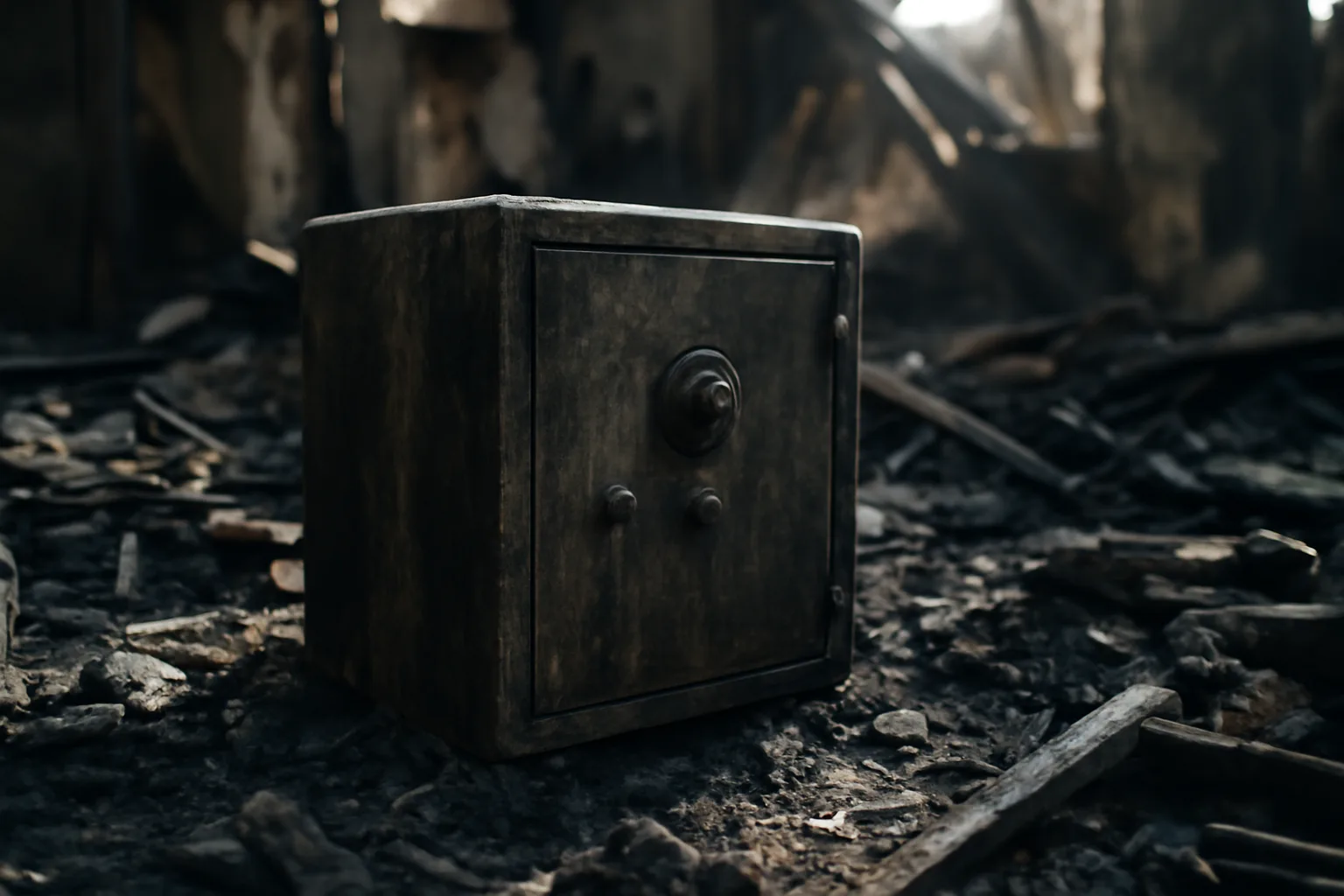
A fire resistant home safe is built to slow heat transfer long enough that paper inside stays below the temperature where it chars, roughly 350°F to 400°F. That's it. It's not a vault, it's not fireproof, and it won't stop a determined house fire that burns for hours. The independent testing body most safes reference is Underwriters Laboratories (UL). UL 72 is the standard for fire-resistive containers, and safes get a class rating like "350-1 hour" or "350-2 hour," meaning the interior stayed under 350°F for that duration during a standardized furnace test. Some safes carry a higher paper rating (350°F) and a separate, stricter rating for media like external hard drives or USB drives (125°F), because digital storage degrades at much lower heat than paper. None of this means the safe survives being buried in structural collapse, dropped two stories when a floor gives way, or soaked by fire hose water for six hours. Those are real failure modes reported by consumer testing groups and fire investigators, and they matter more in a full structure loss than most people assume. If you're rebuilding your wildfire prep from scratch, a safe is one piece of a larger plan that should also include defensible space work around the structure itself, since preventing ignition matters more than protecting what's inside once the house is already burning.
how hot does a house fire actually get, and can a safe survive it
House fires commonly reach 1,000°F to 1,200°F within the room of origin, and flashover, the point where the entire room ignites at once, can happen in under 5 minutes in a modern home with synthetic furnishings [1]. That's dramatically hotter and faster than it was decades ago, because today's furniture and building materials burn hotter and release heat faster than the natural fiber materials common in older homes. A UL 350-rated safe is tested to keep interior temps under 350°F for 1 or 2 hours depending on its class. In a real residential fire, if firefighters arrive and extinguish the blaze within that window, a rated safe genuinely protects paper documents. In a full wildfire-driven structure loss where the home burns for hours before anyone can respond, or where the safe sits in rubble for an extended period, the odds drop. This is worth being honest about: cheap "fireproof" boxes sold at hardware stores for $30-$60 often carry no UL rating at all, or a very short duration rating (30 minutes at low temps). They're fine for keeping papers dry and slightly protected from a kitchen fire. They are not adequate for wildfire risk, where the structure itself may burn for an extended period before anyone can intervene.
what should you actually store in a fire resistant safe
Store what you can't easily replace and what you'd need immediately after a loss: birth certificates, passports, property deeds, insurance policy declarations pages, marriage and divorce records, and a written home inventory with photos. Skip anything that degrades at low heat or that you access daily. A good rule: if a document takes weeks and a government office visit to replace, it belongs in the safe. If it's something you can re-print from an online account in ten minutes, it doesn't need fire protection, it needs a cloud backup. Digital media (external drives, USB sticks) needs a separate media-rated safe or, better, doesn't belong in a physical safe at all. Cloud backup of scanned documents and photos costs a few dollars a month and survives a total loss with zero risk of heat damage. Redundancy matters more than the container. Jewelry and cash are common safe contents too, but understand your insurer may cap cash reimbursement regardless of what burns, and many homeowner policies sublimit jewelry coverage to $1,000-$2,500 unless you've scheduled it separately. A safe protects the physical item; it doesn't increase what your policy pays out.
where should a fire resistant safe be placed in a wildfire-prone home
Ground floor, interior wall, away from windows and exterior doors, is the general guidance fire investigators give, because upper floors can collapse and exterior walls take direct radiant heat first. A concrete slab foundation helps too, since a safe that falls through a burned floor joist system lands harder and may crack open on impact. Avoid closets built into exterior walls if you can help it. In a wildfire event specifically, radiant heat from burning vegetation or a neighboring structure often hits the home's exterior walls and windows first, well before the interior framing catches. An interior, centrally located spot buys the safe (and its rating) the best shot at working as designed. If you're renting or can't bolt a floor safe down, a portable rated fire box (still checking for an actual UL 350 rating on the spec sheet, more than marketing language) stored in an interior closet is a reasonable middle ground.
how to prepare for a wildfire beyond just a safe
A safe protects documents. It does nothing to stop your house from igniting in the first place. Wildfire prep starts outside: clearing vegetation, hardening the home's most vulnerable ignition points (vents, roof edges, decking), and having an evacuation plan you've actually rehearsed. Ready.gov recommends assembling a go-bag with water, medications, copies of key documents, and a battery-powered radio, and having it staged before fire season starts, not during an evacuation order. CAL FIRE's defensible space guidance requires two zones around the home in California: Zone 0 (0-5 feet, the ember-resistant zone) and an extended zone out to 100 feet where vegetation must be thinned and spaced [2]. For the home itself, fire safe landscaping next to the house and general home hardening priorities matter more than any single fireproof container, because most home ignitions during wildfires come from embers landing on or near the structure, not direct flame contact [3]. A safe is cheap insurance for paperwork. Defensible space work is the actual fire prevention. If you got a non-renewal or inspection letter, insurers are increasingly asking for photo documentation of defensible space compliance and home hardening features before they'll write or renew a policy. Building that packet (photos, receipts, a written inventory) is exactly the kind of paperwork a fire safe is meant to protect, and exactly what a $99 Wildfire Insurance Survival Kit is built to organize; we don't file claims or negotiate with insurers, but we help you assemble the documentation you send yourself.
what fire safe rules take effect in 2026
There's no single nationwide "fire safe for homes" law taking effect in 2026; what's changing is state-level building and defensible space code enforcement tied to wildfire risk maps, and it varies significantly by state. California's Chapter 7A building code (fire-resistant construction standards for homes in Wildland-Urban Interface Fire Hazard Severity Zones) has been law since 2008, but enforcement and mapping updates continue to roll out as CAL FIRE revises hazard severity zone maps, with a major statewide map update finalized in 2025 for many local jurisdictions [4]. Separately, California's SB 63 and related defensible space enforcement law (Public Resources Code 4291) has phased-in Zone 0 (ember-resistant zone within 5 feet of structures) requirements that CAL FIRE has been developing regulations for; as of this writing, Zone 0 regulations have not been finalized into a statewide enforceable mandate with a firm 2026 date, and homeowners should check with their local fire district or CAL FIRE's Zone 0 rulemaking page directly rather than rely on a fixed date [5]. Mitigation rules vary by fire district: [confirm current defensible space and structure hardening requirements with your local fire marshal or fire protection district before assuming a statewide deadline applies to your property].
when does the california defensible space law go into effect
California's core defensible space law, Public Resources Code 4291, has been in effect for decades and currently requires 100 feet of defensible space clearance around structures in State Responsibility Areas and designated Wildland-Urban Interface zones, a distance extended from 30 feet under a 2005 amendment (SB 1369) [6]. This is not a new 2026 requirement; it is existing, enforceable law that CAL FIRE and local fire agencies already inspect for. What is newer and still developing is the Zone 0 ("ember-resistant zone," 0-5 feet from structures) regulation directed by Assembly Bill 3074 (2020), which instructed the Board of Forestry and Fire Protection to develop specific ember-zone rules. As of 2024-2025, the Board has been working through the regulatory process, and CAL FIRE's public guidance describes Zone 0 recommendations while final enforceable regulations continue moving through state rulemaking. Homeowners in high-risk zones should treat Zone 0 recommendations as effectively required now, since insurers are already asking about ember-zone clearance in underwriting. Check your specific fire district's current enforcement timeline, because implementation dates and inspection cycles differ by county and by whether your property sits in a State Responsibility Area versus a Local Responsibility Area.
why won't people follow the defensible space law in california, and what actually happens if you don't
Cost, labor, and a mismatch between rules and reality are the three reasons that come up most in CAL FIRE outreach materials and academic wildfire risk research. Clearing 100 feet of vegetation on a hillside lot, especially a large or sloped parcel, can run into thousands of dollars in contractor labor, and many homeowners are older, on fixed incomes, or physically unable to do the clearing themselves [7]. There's also a documented gap between awareness and action. Research on wildfire risk perception (including work published through university extension programs) consistently finds that homeowners often believe defensible space matters for their neighbors' homes more than their own, a bias sometimes called "unrealistic optimism" in the wildfire risk literature . People also underestimate how quickly a fire can move once ember-driven ignition starts on a structure, so clearing feels less urgent than it is. Non-compliance carries real consequences beyond fines. Under California Public Resources Code 4291, failure to maintain defensible space can result in citations, and increasingly it results in insurance non-renewal, since carriers are cross-referencing hazard severity zone maps and, in some cases, requiring proof of compliance before renewing. If you already got a non-renewal letter, the defensible space work you do now is both fire prevention and the evidence you'll want on file the next time you apply for coverage.
how to prevent wildfires and forest fires as a homeowner
You can't prevent a wildfire from starting in wildland, but you can dramatically cut the odds that it destroys your specific structure. Roughly 85% of wildfires nationally are human-caused, according to the National Park Service's wildfire causes data, which includes unattended campfires, debris burning, equipment sparks, and arson . On the home-protection side, ember exposure, not direct flame front contact, is the leading cause of home ignition during wildfires, per research from the National Institute of Standards and Technology and wildfire scientist Jack Cohen's foundational work on home ignition zones [3]. Practical prevention steps that actually move the needle: clear dead vegetation and debris within 5 feet of the structure (Zone 0), remove flammable material from under decks and around foundation vents, install ember-resistant vents, clean gutters of dry leaves, and keep a 100-foot vegetation management zone thinned per CAL FIRE guidance [2]. None of this is glamorous. All of it is more effective than any single product you can buy. Outdoors, if you're burning debris or having a campfire, drown it completely, stir the ashes, and drown again, the same three-step process CAL FIRE and the U.S. Forest Service both recommend for eliminating human-caused ignition . Most forest fires that become catastrophic started as something small and preventable.
how to prepare for a wildfire: the practical checklist
Preparation splits into three buckets: documentation, evacuation readiness, and structure hardening. Do documentation first, because it's the cheapest and fastest. Documentation: photograph every room and your exterior, keep the photos backed up off-site (cloud storage or a drive stored at a different address), and store paper originals of deeds, policies, and IDs in a UL-rated fire safe. Ready.gov recommends keeping physical and digital copies of insurance policies, identification, and financial account information together in a portable, grab-and-go format. Evacuation readiness: know two routes out of your neighborhood, keep your vehicle's gas tank above half during fire season, and have a family communication plan since cell networks can jam during mass evacuations. Ready.gov's guidance specifically recommends designating an out-of-area contact everyone can check in with, since local lines often get overloaded. Structure hardening: this is the slower, more expensive bucket, and it's the one that actually determines whether your house survives. Ember-resistant vents, non-combustible roofing, enclosed eaves, and a 5-foot ember-resistant zone around the foundation are the top priorities cited in CAL FIRE's home hardening guidance [2]. If you've had a recent house fire or watched a neighbor lose their home, use that as the prompt to actually do the hardening work rather than just thinking about it.
is santa barbara safe from fire, and how do i check my own risk
No part of Santa Barbara County is fully "safe" from wildfire risk; large sections of the county, especially foothill and canyon communities like Montecito, Mission Canyon, and the Santa Ynez foothills, sit within CAL FIRE-designated Very High Fire Hazard Severity Zones [4]. The 2017 Thomas Fire and the debris flow that followed in Montecito are a stark reminder that fire risk and its aftermath (mudslides on burned hillsides) can compound. Rather than ask a yes/no question about a whole city, check your specific parcel. CAL FIRE maintains public Fire Hazard Severity Zone viewer maps by address, updated most recently in the 2025 statewide mapping revision, and your county assessor or fire department can confirm which zone your property falls in and what defensible space requirements apply [4]. This same address-level check applies anywhere in CA, CO, OR, or AZ wildfire country. "Is my city safe" is the wrong question; "what hazard zone is my specific address in, and what does that require of me" is the one that gets you a useful answer and, eventually, a defensible insurance application.
how can we prevent forest fires as a community, more than individually
Individual defensible space work only goes so far if your neighbor's untended lot sits 20 feet away. Community-level prevention includes coordinated fuel reduction projects, shared brush clearing days, and pressure on local fire districts to enforce existing vegetation ordinances consistently across a neighborhood, more than cite the compliant homeowners while ignoring the vacant lot next door. Some states have started organizing this more formally. Washington's Department of Natural Resources, for example, runs cost-share and contractor-coordination programs to help neighborhoods tackle defensible space clearing contracts at scale rather than parcel by parcel, which is often more efficient than everyone hiring separate crews. On public land, prevention is largely about human behavior: properly extinguishing campfires, not parking hot vehicles on dry grass, avoiding debris burning on windy days, and reporting unattended fires immediately. The Smokey Bear campaign's core message, that individual caution prevents the majority of ignition sources, remains statistically accurate given that human causes account for the large majority of wildfire starts nationally . It's only you who can prevent wildfires in the sense that ignition prevention is mostly about individual behavior, even though survival of your specific home depends heavily on collective neighborhood-level fuel management too.
Frequently asked questions
When does the California defensible space law go into effect?
California's core defensible space law (Public Resources Code 4291, requiring 100 feet of clearance) has been in effect for years, not a future date. The newer Zone 0 ember-resistant zone rule (5 feet from structures) is still moving through state rulemaking as of 2024-2025; check CAL FIRE's current Zone 0 regulation status and your local fire district for enforcement timing.
Why won't people follow the defensible space law in California?
Cost, physical inability to do the labor, and underestimating personal risk are the main reasons cited in CAL FIRE outreach and wildfire risk research. Clearing 100 feet of vegetation on a large or sloped lot can cost thousands in contractor fees, and many homeowners assume their own property is less at risk than it actually is.
What fire safe rules take effect in 2026?
There's no single nationwide 2026 fire safe law. What's changing is state-by-state: California's hazard severity zone maps were updated in 2025, and Zone 0 ember-zone regulations continue through rulemaking. Check your specific state fire marshal's office and local fire district, since mitigation rules vary by jurisdiction, not by a fixed national date.
Is Santa Barbara safe from fire?
No, large parts of Santa Barbara County, especially foothill communities like Montecito and Mission Canyon, sit in CAL FIRE-designated Very High Fire Hazard Severity Zones. Check your specific address on CAL FIRE's Fire Hazard Severity Zone viewer rather than assuming citywide safety, since risk varies block by block based on terrain and vegetation.
What UL rating should I look for in a fire resistant home safe?
Look for UL 72 certification with a class like "350-1 hour" or "350-2 hour," meaning the interior stays below 350°F for that duration in standardized testing. If you're storing digital media, look for a separate, lower media rating (often 125°F), since drives and USB sticks degrade at much lower temperatures than paper.
Can a fire safe survive a total house fire?
It depends on duration and placement. House fires often hit 1,000-1,200°F, and a UL 350-rated safe is only tested to hold under 350°F for 1-2 hours. If fire crews respond within that window, a rated safe likely protects paper contents. In a prolonged wildfire-driven structure loss, protection is far less certain.
What should I store in a fire resistant safe versus keep elsewhere?
Store irreplaceable paper originals: deeds, passports, birth certificates, insurance declarations pages, and a written home inventory. Skip daily-use documents and skip most digital media unless the safe has a specific media rating. Back up photos and scanned documents to the cloud instead, since that survives a total loss with no heat risk at all.
How to prevent wildfires from starting in the first place?
About 85% of wildfires nationally are human-caused, per National Park Service data, from unattended campfires, debris burning, and equipment sparks. Fully drown and stir campfire ashes, avoid debris burning on windy or dry days, and never park hot vehicles on dry grass. These simple behaviors prevent the majority of ignition sources.
How to prepare for a wildfire if I live in a high-risk zone?
Document your home (photos, off-site backups), assemble a go-bag with copies of key documents per Ready.gov guidance, know two evacuation routes, and harden your structure starting with a 5-foot ember-resistant zone around the foundation. Do documentation first since it's the fastest and cheapest step to complete.
How can we prevent forest fires as a neighborhood, more than individually?
Coordinate fuel reduction across property lines, since one uncleared lot undermines everyone else's defensible space work. Some states, like Washington through its DNR cost-share programs, help neighborhoods hire clearing contractors at scale. Push your local fire district to enforce vegetation ordinances consistently across all properties, not selectively.
Do fire resistant safes protect against water damage from firefighting efforts?
Many UL-rated fire safes also carry a water resistance rating, but check the spec sheet specifically since fire rating and water rating are tested and certified separately. A safe that only carries a fire rating may still let water in during hours of firefighting hose spray, which can damage paper contents even if heat didn't.
Where should I place a fire resistant safe in my home for wildfire protection?
Ground floor, interior wall, away from exterior walls and windows that take direct radiant heat first during a wildfire. Avoid closets built into exterior walls. A centrally located interior spot gives the safe's fire rating the best chance of holding up if the structure around it is compromised.
Sources
- III (Insurance Information Institute), homeowners insurance basics: Standard homeowners policies commonly sublimit jewelry and valuables coverage unless scheduled separately
- USDA Forest Service / Jack Cohen home ignition zone research: Ember exposure, not direct flame contact, is the leading cause of home ignition during wildfires
- CAL FIRE, Fire Hazard Severity Zone Maps: CAL FIRE maintains and updated statewide Fire Hazard Severity Zone maps, including a 2025 revision
- CAL FIRE, Zone 0 Ember-Resistant Zone regulation development: Zone 0 ember-resistant zone regulations are in development following AB 3074 and have not been finalized statewide
- California Public Resources Code Section 4291: PRC 4291 requires 100 feet of defensible space clearance around structures in State Responsibility Areas
- California Legislature, Assembly Bill 3074 (2020): AB 3074 directed the Board of Forestry and Fire Protection to develop Zone 0 ember-resistant zone regulations
- University of California Cooperative Extension, wildfire risk perception research: Wildfire risk perception research documents an optimism bias where homeowners underestimate personal risk