Last updated 2026-07-23
TL;DR
Preparing for a wildfire means three things done in order: clear defensible space (0-100 feet from your house), harden the home itself (roof, vents, siding), and build a go-bag plus evacuation plan. CAL FIRE, Ready.gov, and your state fire marshal all publish free checklists. Start with the roof and the first five feet of dirt around your foundation; that's where most homes actually ignite.
how do you prepare for a wildfire, starting today
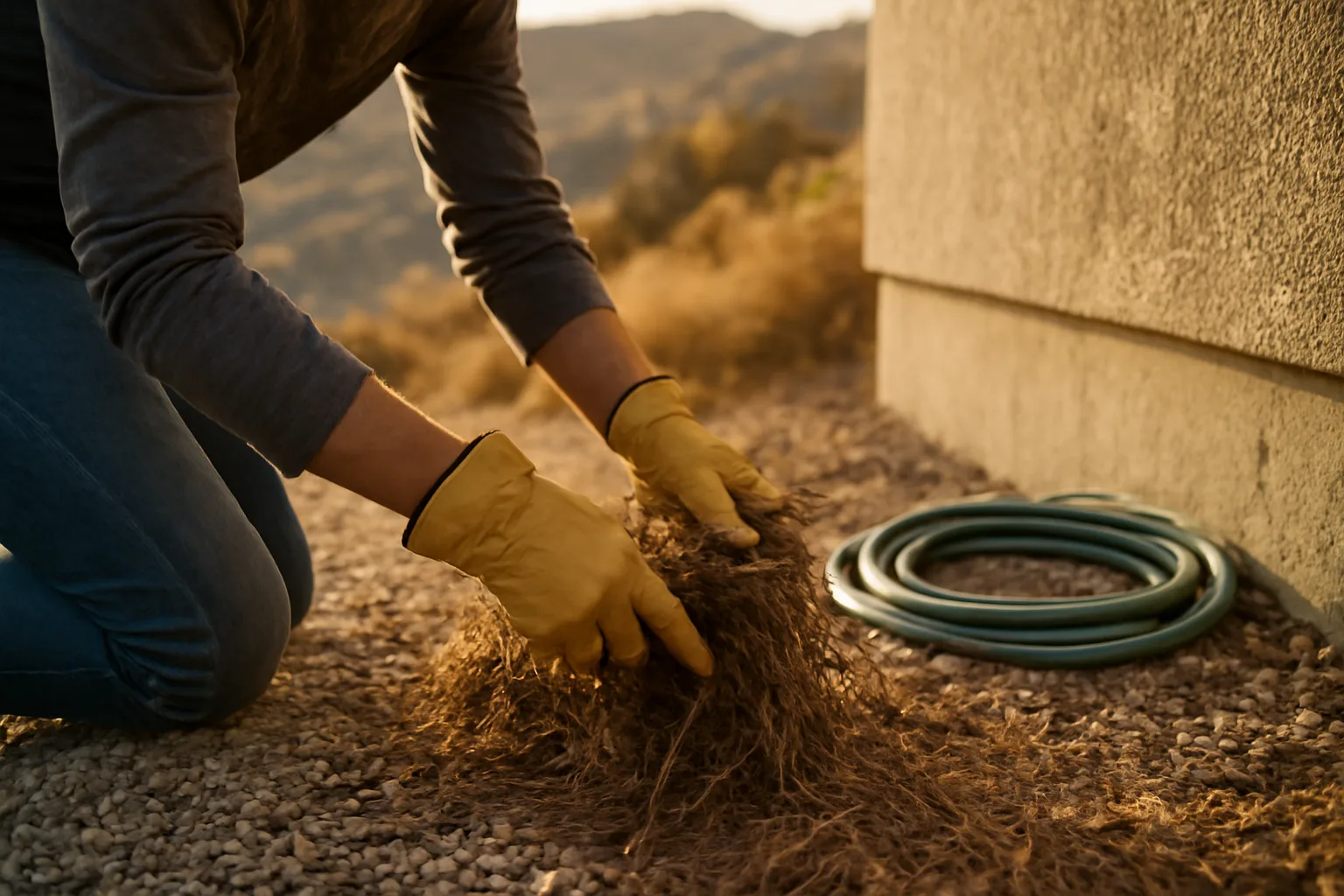
Preparing for a wildfire is not one big project. It's three separate systems that each need attention: the space around your house, the house itself, and your family's exit plan. Do them in that order if you're starting from zero, because defensible space buys the time that lets firefighters save a hardened home, and a hardened home is what survives the embers that defensible space can't stop. CAL FIRE's own research is blunt about this: embers and small flames are the cause of most home ignitions during a wildfire, not the wall of fire itself. That means your gutters, your vents, and the mulch bed against your siding matter as much as, sometimes more than, how close the actual fire gets. Here's the honest order of operations. First, clear the zone within 5 feet of your house down to bare mineral soil, gravel, or hardscape (CAL FIRE calls this Zone 0). Second, work outward to 30 feet and then 100 feet, thinning vegetation and removing ladder fuels. Third, look at your roof, vents, and windows, because embers can travel over a mile ahead of a fire front according to CAL FIRE's ember awareness materials. Fourth, build your go-kit and know your evacuation routes before you need them, per Ready.gov's wildfire guidance. If you've already gotten a non-renewal letter or an inspection notice, you don't have the luxury of doing this over five years. Start with whatever your letter specifically flags, then work through the rest. Insurers and state FAIR Plans increasingly want documentation, more than compliance, so photograph everything as you go.
how to prevent wildfires from starting in the first place
Preventing wildfires is mostly about controlling ignition sources, since the vast majority of wildfires in the U.S. are human-caused, not lightning-caused. The National Interagency Fire Center and multiple state agencies attribute roughly 85-90% of wildfires nationally to human activity, including debris burning, equipment sparks, unattended campfires, and downed power lines, though the exact share shifts year to year and by region [1]. On your own property, the practical prevention steps are narrow and doable: never leave a campfire unattended, don't run mowers or trimmers on dry grass during red flag warnings (the blade can throw sparks), keep chains off the ground when towing, and check with your local fire district before any outdoor burning, because burn permits and burn bans vary by county and change with drought conditions. [Check your local fire district's current burn ban status]. Equipment is an underrated cause. A dragging trailer chain, a lawnmower blade hitting a rock, a chainsaw without a spark arrestor, all of these have started real fires. CAL FIRE's fire prevention page lists defective and dragging equipment as a recurring ignition source in California specifically. Power lines are another one. If you see a downed line or sparking equipment near vegetation, report it to your utility immediately rather than trying to handle it yourself. Several major California wildfires, including some investigated by state agencies, have been traced back to utility equipment failures during high wind events.
how to prepare for a wildfire: the defensible space rules that actually apply to you
| Zone 0 | 0-5 ft from structure | Noncombustible materials only; no mulch, no plants touching the house | |
|---|---|---|---|
| Zone 1 | 5-30 ft | Remove dead vegetation, space out shrubs, keep grass under 4 inches | |
| Zone 2 | 30-100 ft | Reduce continuous fuel, thin trees, remove ladder fuels | Exact spacing distances between shrubs and trees, and what counts as "reduced fuel," vary by local fire district and slope. [Confirm your zone's specific spacing requirements with your local fire department or fire safe council]. Steeper slopes generally require wider clearance because fire moves faster uphill. For a deeper walkthrough of what goes in each zone and what plants are allowed close to the house, see fire safe landscaping next to your house and the general defensible space overview. |
California's defensible space law requires most homeowners in State Responsibility Areas and some Local Responsibility Areas to maintain 100 feet of clearance around structures, broken into zones with different rules, under Public Resources Code Section 4291 [2]. The three zones are roughly: Zone 0 (0-5 feet, ember-resistant zone), Zone 1 (5-30 feet, lean and clean), and Zone 2 (30-100 feet, reduced fuel). The zone breakdown, in plain terms: | Zone | Distance | Main requirement |
when does the california defensible space law go into effect
California's core defensible space requirement under Public Resources Code 4291 has been law for decades and is already in effect statewide in State Responsibility Areas. It isn't a future deadline. It's a current, enforceable requirement with annual inspections in many high-risk counties [2]. What's newer, and still rolling out, is Zone 0. California passed Assembly Bill 3074 in 2020, directing the Board of Forestry and Fire Protection to develop ember-resistant zone regulations for the 0-5 foot area immediately around homes in high fire severity zones [3]. As of this writing, the Board of Forestry has been working through the regulatory process to formally adopt Zone 0 standards, and the practical effective date for enforcement has shifted more than once as the rulemaking proceeds. The honest answer for a homeowner: don't wait for the enforcement date. Insurers, CAL FIRE inspectors, and your own safety don't care whether the regulation is technically final. Clear that 5-foot ring now, because it's cheap, it's fast, and it's the highest-leverage single thing you can do. [Check CAL FIRE's Board of Forestry page for the current Zone 0 adoption status in your county]. If your property sits in a Local Responsibility Area instead of a State Responsibility Area, your city or county may have its own defensible space ordinance with different specifics. [Confirm with your local fire district whether you're in an SRA, LRA, or Federal Responsibility Area, since the applicable rule differs].
why won't people follow the defensible space law in california
Compliance with defensible space rules in California is inconsistent, and the reasons aren't really about ignorance. Cost, labor, and competing priorities are the biggest drags, especially for older homeowners, people on fixed incomes, and absentee landlords who don't see the property daily. Clearing 100 feet of vegetation on a sloped, oak-covered lot can run from a few hundred dollars in DIY labor to several thousand dollars for contractor-cleared land, particularly if trees need removal or chipping. For homeowners already stretched by rising insurance premiums or a non-renewal, spending more money on brush clearance can feel like throwing good money after bad, even though it's often the thing that gets a policy renewed or a FAIR Plan alternative approved. There's also a real gap between "aware of the law" and "understands exactly what compliance looks like on my specific property." The zones sound simple on paper, but homeowners often aren't sure whether a specific oak, a woodpile, or a wooden fence violates the rule. Local fire departments and RVFC (Registered Professional Foresters) inspections exist for this reason, but not every county has enough inspectors to reach every parcel every year. Some homeowners genuinely disagree with removing mature trees or native landscaping they value aesthetically or ecologically. Enforcement in many counties has historically leaned toward warnings rather than fines, which reduces urgency. That's changing as more counties tie code enforcement to insurance-adjacent consequences, but it's been slow.
how to prepare for forest fires if you live near wildland
Preparing for forest fires when you live at the wildland-urban interface means treating your property as part of the forest's fuel system, not separate from it. The same defensible space zones apply, but WUI properties often have more continuous fuel (forest canopy, duff layers, dense understory) right up to the property line, so Zone 2 work matters even more. Things that matter specifically in forested settings: thinning trees so crowns aren't touching (CAL FIRE recommends 10 feet of horizontal spacing between mature tree canopies in Zone 2, though exact spacing guidance varies by slope and vegetation type), removing "ladder fuels" like low branches and shrubs that let a ground fire climb into the canopy, and keeping pine needle and leaf litter cleared from gutters and roof valleys. Woodpiles are a classic mistake. A stack of firewood against the house, or even 10 feet away, is fuel sitting right where embers land. Move it at least 30 feet from any structure per most defensible space guidance, and off bare ground if possible. If you're rural enough that fire department response time is long, your own suppression readiness matters more too: a garden hose long enough to reach your whole perimeter, a water source that doesn't depend on grid power (since pumps often fail when electricity goes out), and a cleared, marked driveway wide enough for a fire engine.
how to avoid forest fires when you're recreating or working outdoors
Avoiding forest fires as an individual mostly comes down to fire discipline around anything hot: campfires, cigarettes, vehicles, and equipment. Douse campfires completely, stir the ashes, and douse again, until they're cool to the touch, more than dark. A campfire that looks out is often still smoldering underneath. Don't park or idle vehicles on dry grass; catalytic converters and exhaust systems run hot enough to ignite dry vegetation in seconds. This is a surprisingly common ignition source cited by multiple state fire agencies during high fire danger periods. Check local fire restrictions before any outdoor burning or fireworks use. Fire restriction levels change with drought conditions, sometimes week to week during peak season, and what was legal last month may not be now. [Check your state or county's current fire restriction level before burning anything outdoors]. If you smoke, don't discard cigarettes from a vehicle window or on dry ground. It sounds obvious, but roadside ignitions from discarded cigarettes are a recurring cause listed by state forestry agencies.
how can we prevent forest fires as a community, more than individually
Community-level forest fire prevention works best when it's coordinated: shared fuel breaks, neighborhood chipper days, and consistent enforcement of defensible space rules across a whole subdivision, more than scattered compliant houses next to overgrown ones. Fire doesn't respect property lines. A homeowner who does everything right on defensible space can still lose their home if the house next door is untouched and close enough for radiant heat or embers to bridge the gap. This is why many Fire Safe Councils and local governments run community chipping programs, cost-shared thinning projects, and neighborhood ambassador programs. Check whether your county has a Fire Safe Council; many offer free or subsidized chipping days that make Zone 2 clearance far cheaper than hiring a contractor solo. Community Wildfire Protection Plans (CWPPs), developed at the county or fire district level, are the formal mechanism for this coordination, identifying shared risk areas and prioritizing fuel reduction projects across jurisdictions. If your neighborhood doesn't have one, that's worth raising with your local fire district or county supervisor. For households further along in the process, understanding your neighbors' clearing contracts and shared vendor options can cut costs. See wildfire defensible space clearing contracts for how this works in practice in Washington State, as a model that other states are adapting.
what fire-safe home rules take effect in 2026
Several states are tightening wildfire building codes with effective dates landing in 2025 and 2026, though the specifics vary significantly by state and even by county, so treat any single date as a starting point to verify locally. In California, the Zone 0 ember-resistant zone regulation from AB 3074 has been in active rulemaking, with the Board of Forestry and Fire Protection working through adoption. The practical enforcement timeline has moved as the process continues, and different high fire severity zone counties may see different rollout timing. [Confirm current Zone 0 enforcement status with the CAL FIRE Board of Forestry page for your county]. Oregon's wildfire risk map and defensible space code requirements, tied to Senate Bill 762 (2021), have also gone through a bumpy rollout, with the original statewide risk map withdrawn in 2022 after public pushback and reissued later with revised methodology. [Check the Oregon State Fire Marshal's current wildfire risk map and code applicability for your address]. Colorado and Arizona don't have a single unified statewide code change comparable to California's; wildfire mitigation rules there tend to run through county or local fire district ordinances instead. [Confirm with your county building department and local fire district whether new wildfire-related code requirements take effect in your area in 2026]. The practical move: don't wait for a specific 2026 date to matter to you. If you're rebuilding, remodeling, or replacing a roof anyway, building to the strictest reasonably-anticipated standard (Class A roofing, ember-resistant vents, noncombustible siding in the first few feet) tends to cost little extra during construction versus retrofitting later.
is santa barbara safe from fire
No area in California's coastal or foothill zones, including Santa Barbara, is meaningfully "safe" from wildfire. The region has a documented history of major fires, and much of the surrounding hillside terrain sits in a State Responsibility Area or a designated Very High Fire Hazard Severity Zone. Santa Barbara County has experienced multiple significant wildfires in the past two decades, including the Thomas Fire (2017), which at the time was one of the largest wildfires in modern California history, and the Jesusita Fire (2009), which burned through neighborhoods in the Santa Barbara foothills. CAL FIRE's Fire Hazard Severity Zone maps show substantial Very High severity zone coverage in the hills above the city. What makes Santa Barbara specifically risky is the combination of steep, chaparral-covered terrain right against dense residential neighborhoods, strong seasonal offshore wind events (sundowner winds), and a long dry season. These are the same ingredients that drive fire behavior in most of California's WUI communities, not something unique to one town. If you own property in or near Santa Barbara, check your specific parcel's Fire Hazard Severity Zone designation on CAL FIRE's map, because that designation, not the city's general reputation, determines your defensible space obligations and often your insurance options too.
what should be in a wildfire go-bag and evacuation plan
A wildfire go-bag should cover the first 72 hours away from home: water, medications, important documents, a change of clothes, chargers, cash, and anything irreplaceable like photos or pet supplies. Ready.gov's general emergency supply guidance recommends at least a three-day supply of food and water per person as a baseline for any disaster kit. Documents matter more in wildfire evacuations than most disasters, because you may not get to come back for weeks, and if the home is a total loss, you'll need proof of what you owned for insurance purposes. Photograph or scan: your policy declarations page, a home inventory (video walkthrough works), ID, deeds or titles, and medical records. Know two evacuation routes out of your neighborhood, not one, since wildfire can close roads unpredictably and wind shifts can change which direction is actually safe. Sign up for your county's emergency alert system; most California, Oregon, Colorado, and Arizona counties run some version of a reverse-911 or app-based alert (Genasys/Zonehaven, CodeRED, or similar), and these are opt-in in many counties, not automatic. This is the point where a lot of homeowners realize the paperwork side is just as much work as the physical prep. That's the specific gap the $99 Wildfire Insurance Survival Kit is built for: a structured way to document your home, gather your policy details, and organize the records an insurer or adjuster will actually ask for, before you're standing in a parking lot after an evacuation trying to remember your policy number. You can start one at /survival-kit-builder.
how do you document your home for insurance before a fire, not after
Documenting your home before a wildfire matters more than after one, because post-fire, you're working from memory and whatever paperwork survived, if any. Insurers and state FAIR Plans (California FAIR Plan, and similar high-risk pools in other states) generally want proof of both the home's condition and its contents. The minimum documentation set: a full video walkthrough of every room including closets and garage, close-up photos of high-value items with serial numbers where visible, a copy of your current policy declarations page, and a written inventory with approximate purchase dates and values. Store copies somewhere other than the house itself: cloud storage, a family member's home, or a safe deposit box. Also photograph your defensible space work as you complete it. If your insurer flagged specific vegetation or roof issues in a non-renewal or inspection letter, dated photos showing the fix are the single best piece of evidence you can hand them, or a public adjuster you hire, or use in an appeal. One caution worth stating plainly: this kind of documentation prep is not the same as insurance advice, claims filing, or negotiation. Nobody selling a document-organizing product, including this one, should be filing your claim or promising a reinstated policy; that's between you, your agent, and your insurer, and in most states, only a licensed public adjuster can legally negotiate a claim on your behalf. Your job, and the job any prep kit should help with, is having your own facts straight before that conversation starts.
what else can I do around the house right now, cheaply
The cheapest, highest-impact wildfire prep steps cost under $200 combined and take a weekend: clean gutters and roof valleys of leaves and needles, move firewood and propane tanks at least 30 feet from the house, clear the 5-foot zone against the foundation down to bare ground or gravel, and screen attic and foundation vents with 1/8-inch metal mesh to block ember entry. Ember-resistant vents specifically matter because CAL FIRE identifies vent openings as a common ember entry point that ignites homes from the inside out. A $15 roll of metal mesh over existing vents is a genuinely cheap fix compared to the alternative. Trim tree branches so nothing overhangs the roof, and keep any tree canopy at least 10 feet from the chimney outlet. Move outdoor furniture cushions and doormats made of synthetic fiber away from entry points during red flag warning days; they're small, but they're exactly the kind of thing an ember ignites first, and a burning doormat against a wood door is a real ignition path. For a broader sense of what a total home-hardening project (roof, siding, windows, vents) costs and where to prioritize spending, see house fire prevention basics and fire at a house response planning, and the general prevention messaging behind only you can prevent wildfires.
Frequently asked questions
When does the California defensible space law go into effect?
The core 100-foot defensible space law (Public Resources Code 4291) is already in effect and has been for years in State Responsibility Areas. The newer Zone 0 (0-5 foot ember-resistant zone) rule from AB 3074 is still going through Board of Forestry rulemaking, with enforcement timing shifting by county; don't wait for a firm date to clear that 5-foot ring.
Why won't people follow the defensible space law in California?
Mostly cost and labor, not ignorance. Clearing 100 feet of vegetation on sloped or wooded lots can run into the thousands of dollars, and homeowners already squeezed by rising premiums often deprioritize it. Confusion about exact zone requirements and inconsistent local enforcement add to the gap between the law and what actually happens on the ground.
How do I prevent wildfires from starting on my own property?
Keep mowers and equipment off dry grass during fire danger days, fully douse campfires and stir the ashes, don't discard cigarettes outdoors, check for burn permits before any outdoor burning, and report downed power lines immediately. Most wildfires are human-caused, so controlling ignition sources is the single biggest lever you have.
How do I prepare for a wildfire if I just got a non-renewal letter?
Start with whatever the letter specifically flags, usually roof material, vegetation clearance, or vent screening. Then work through the standard order: Zone 0 (0-5 feet) first, then Zone 1 and 2 outward, then roof and vent hardening, then your go-bag and documentation. Photograph every fix as you complete it.
What's the difference between preparing for a wildfire and preventing a wildfire?
Prevention is stopping ignitions before they start (campfire discipline, equipment care, burn permits). Preparation is reducing your home's vulnerability and readiness if a fire happens regardless of cause, through defensible space, home hardening, and evacuation planning. You need both, but they're different projects.
How to prepare for forest fires if I live in a rural, wooded area?
Apply the same defensible space zones, but pay extra attention to Zone 2 (30-100 feet): thin tree canopies so they're not touching, remove ladder fuels like low branches and shrubs, and keep firewood at least 30 feet from structures. Also plan for longer fire department response times with your own water source and a clear, marked driveway.
What fire-safe home rules take effect in 2026?
California's Zone 0 ember-resistant zone regulation is in active rulemaking with rollout timing still moving by county. Oregon's wildfire risk map and code requirements under Senate Bill 762 have also had a bumpy rollout. Colorado and Arizona mostly handle this through county-level ordinances, not a single statewide 2026 code.
Is Santa Barbara safe from fire?
No. Santa Barbara has significant Very High Fire Hazard Severity Zone coverage in its foothills per CAL FIRE mapping, and the area has experienced major fires including the 2017 Thomas Fire and 2009 Jesusita Fire. Steep chaparral terrain next to dense neighborhoods and strong seasonal winds keep the risk real regardless of the city's coastal reputation.
How can we prevent forest fires as a neighborhood or community?
Coordinate defensible space work across property lines, since fire doesn't stop at a fence. Join or start a Fire Safe Council, participate in community chipper days, and check whether your county has a Community Wildfire Protection Plan (CWPP) that identifies shared fuel reduction priorities.
What should be in my wildfire go-bag?
A three-day supply of water and food per person, medications, chargers, cash, a change of clothes, and copies of key documents (insurance policy, ID, deeds, home inventory). Ready.gov recommends building this kit before fire season starts, not during an evacuation warning.
How much does defensible space clearing typically cost?
It ranges widely: a few hundred dollars for DIY clearing on a small, flat lot, up to several thousand dollars for contractor-cleared, sloped, or heavily wooded land, especially if tree removal is involved. Many counties have Fire Safe Council chipping programs that reduce this cost significantly.
Do I need a permit to clear vegetation for defensible space?
Usually not for standard trimming and clearing within defensible space zones, but tree removal, especially of protected native species like oaks in some California counties, may require a permit. Check with your county planning department before removing large trees.
What is Zone 0 and why does it matter so much?
Zone 0 is the 0-5 foot ember-resistant zone immediately around a structure, required to be noncombustible (gravel, pavers, bare soil) under California's evolving AB 3074 regulations. CAL FIRE identifies embers, not direct flame contact, as the main cause of home ignitions, making this narrow zone disproportionately important.
Can I do defensible space work myself or do I need a contractor?
Most Zone 0 and Zone 1 work (clearing debris, moving firewood, trimming low branches, screening vents) is doable yourself with basic tools. Zone 2 tree thinning on steep or heavily wooded lots often benefits from a licensed arborist or vegetation management contractor, especially where safety or permits are involved.
Sources
- National Interagency Fire Center, Statistics: Majority of U.S. wildfires are human-caused
- California Public Resources Code Section 4291: Statutory basis for California's 100-foot defensible space requirement
- California Assembly Bill 3074 (2020): Directive for Board of Forestry and Fire Protection to develop Zone 0 ember-resistant zone regulations
- CAL FIRE, Fire Hazard Severity Zone Maps: Very High Fire Hazard Severity Zone designations covering Santa Barbara foothills
- CAL FIRE - Ready for Wildfire: Explains the defensible space zones (Zone 0, Zone 1, Zone 2) that California homeowners are required to maintain around structures.
- CAL FIRE - Ready for Wildfire: Provides guidance on creating a wildfire evacuation plan and what to include in a go-bag.
- FEMA: Recommends documenting home contents and property with photos and videos before a disaster to speed insurance claims.
- California Department of Insurance: Advises homeowners on creating a home inventory and documenting property before a wildfire for insurance purposes.
- National Fire Protection Association (NFPA): Outlines home hardening measures and community-level actions to reduce wildfire risk, aligning with the Firewise USA program.
- National Park Service: Explains common human causes of wildfires and prevention tips for people recreating or working outdoors in wildland areas.