Last updated 2026-07-25
TL;DR
Nothing is truly fireproof, but ember-resistant construction and a clean 5-foot zone stop most home ignitions. California's Zone 0 ember-resistant zone rule (SB 63, Gov. Code 51182(o)) applies to new construction in high fire severity zones starting January 1, 2026, with existing homes to follow on a later timeline set by the Board of Forestry.
Is there such a thing as a truly fireproof building?
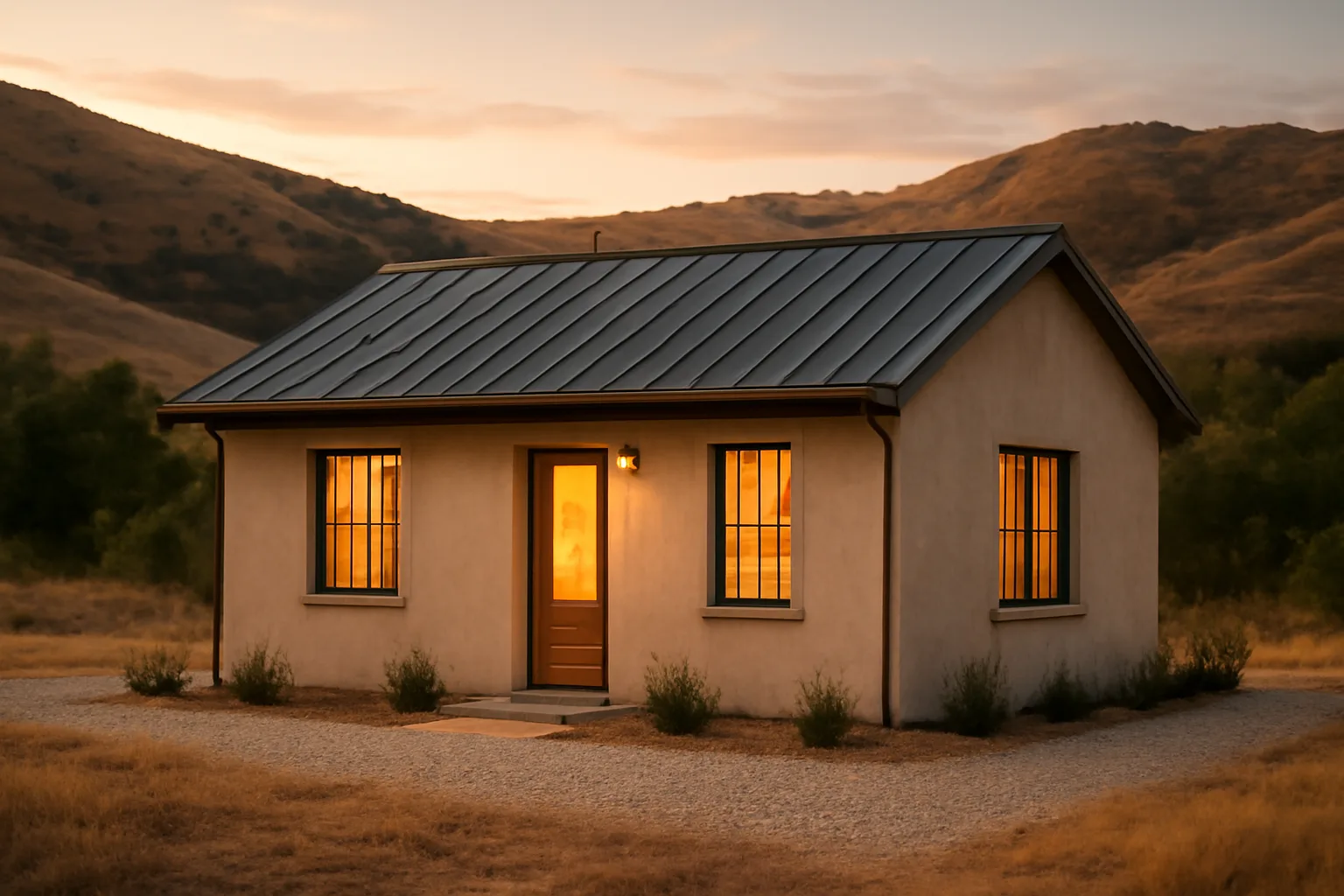
No. Every material fails at some temperature or exposure time, and wildfires generate radiant heat well past what most building materials can take indefinitely. What exists instead is "fire-resistant" or "ignition-resistant" construction, meaning materials and assemblies tested to survive specific exposures for a specific duration. CAL FIRE's Wildland Urban Interface (WUI) building standards, adopted under California Building Code Chapter 7A, require ignition-resistant materials for roofs, vents, siding, decks, and windows in designated fire hazard severity zones. These aren't fireproof claims. A Class A fire-rated roof, for example, is tested under ASTM E108 to resist flame spread and burning brands, but that's a lab test under controlled conditions, not a guarantee against a multi-hour ember storm. The honest framing matters because insurers and inspectors aren't grading your home pass/fail on "fireproof." They're scoring ignition probability. A stucco home with a metal roof, enclosed eaves, and dual-pane tempered windows has a dramatically lower chance of catching fire from embers than an identical home with wood shingles and open eaves, even in the exact same fire. That's the real question to ask a contractor or inspector: not "is this fireproof," but "does this reduce ignition points."
When does the California defensible space law go into effect?
California's core defensible space law (Public Resources Code 4291) has been in effect since long before 2026, requiring 100 feet of defensible space clearance around structures in State Responsibility Areas and some local jurisdictions [1]. What's changing in 2026 is the ember-resistant "Zone 0" requirement. Under SB 63 (2024), signed by Governor Newsom, the state's ember-resistant zone rule, codified at Government Code 51182(o), takes effect for new construction and rebuilds in Very High Fire Hazard Severity Zones on January 1, 2026 [2]. Zone 0 means the 5 feet immediately surrounding a structure must be cleared of combustible mulch, vegetation touching the house, wood fencing attached to the home, and stored combustibles like firewood piles or trash cans. For existing homes, the timeline is murkier and this is where you need to check locally. The Board of Forestry and Fire Protection was directed to develop the specific regulatory standards for Zone 0, and enforcement dates for existing (not new) structures have shifted more than once in legislative discussion. As of this writing, existing home compliance is expected to follow after the new-construction requirement, but the exact date depends on final regulations the Board adopts. Check your local fire district or CAL FIRE unit for the current enforcement date in your area, because this is a guided fill-in that changes by jurisdiction and by year. Separately, Public Resources Code 4291 already requires the broader 100-foot, two-zone defensible space (0-30 feet lean and clean, 30-100 feet reduced fuel) for all applicable properties, and that obligation has been active for years, not new in 2026 [1].
What fire safe rules for homes take effect in 2026?
Three things converge in 2026 for California homeowners: the Zone 0 ember-resistant zone requirement for new construction, continued rollout of updated Fire Hazard Severity Zone maps, and in many counties, tighter local defensible space inspection programs tied to insurance requirements. The Zone 0 rule itself is the big one. It requires removing combustible materials within 5 feet of any structure, including attached wood fencing, combustible mulch, and vegetation overhanging or touching exterior walls [2]. CAL FIRE's own guidance describes the goal plainly: reduce the chance that wind-blown embers, which cause the majority of home ignitions in wildfires, find fuel right against your walls. Separately, many California counties and fire districts are updating local Very High Fire Hazard Severity Zone maps based on CAL FIRE's 2024-2025 mapping updates, which can newly pull properties into WUI code requirements they weren't under before. If your county remapped recently, a home built to older code might now sit in a zone requiring Chapter 7A materials on any future remodel or rebuild. For homeowners in Colorado, Oregon, and Arizona, there's no single 2026 date to point to, because those states don't have one uniform statewide mandate like SB 63. Oregon's defensible space and home hardening code (under SB 762) has been phasing in through its own rulemaking process with the Oregon Department of Forestry, and Colorado's rules are largely county-level or tied to specific wildland-urban interface codes adopted locally. Always confirm with your state fire marshal's office or local fire protection district, since the specific compliance date is a guided fill-in that varies by jurisdiction.
Why won't people follow the defensible space law in California?
Cost, confusion, and inconsistent enforcement are the three real reasons, not stubbornness. A 2021 report to the California legislature on defensible space compliance found enforcement varies widely by jurisdiction, with many fire agencies lacking the staff to do complete annual inspections across their full service area [3]. Cost is real. Removing established landscaping, replacing a wood fence section near the house, or re-mulching with non-combustible material can run from a few hundred dollars for a small lot to several thousand for a property with mature trees and slopes. Homeowners on fixed incomes, especially retirees in fire-prone rural counties, often delay compliance simply because they can't absorb the expense in one year. Confusion is the second driver. The 100-foot rule sounds simple until you're standing in your yard trying to figure out which zone your oak tree falls in, whether your neighbor's fence counts against your clearance, or whether a rule applies to you at all if you're not in a State Responsibility Area. CAL FIRE's defensible space checklist helps, but a lot of homeowners never see it until an inspector hands them one. Third, enforcement has historically been soft. Prior to recent amendments, many counties issued a notice and a follow-up inspection date, but few properties saw real penalties for non-compliance. That's shifting as insurers increasingly tie renewal decisions directly to defensible space compliance, which is arguably doing more to drive behavior than the statute itself ever did. For a step-by-step breakdown of what actually gets checked, see defensible space requirements by zone.
How to prevent wildfires (what actually reduces ignition risk)
Most wildfires near homes start from human causes, not lightning. CAL FIRE reports that the overwhelming majority of California wildfires are human-caused, from equipment sparks, vehicle fires, unattended campfires, and power line failures. Preventing wildfires at the community level means controlling ignition sources; preventing home loss during a wildfire means reducing what's flammable around your structure. The practical list, in order of what actually moves the needle: don't operate mowers, chainsaws, or grinders on dry vegetation during red flag conditions; keep vehicles off dry grass (catalytic converters can ignite it); maintain spark arrestors on equipment; extinguish campfires completely, meaning cold to the touch, more than no visible flame; and check with your utility about power line clearance if you have trees near lines. At the home level, prevention is really defensible space plus hardening, covered in the next sections. The Ready.gov wildfire preparedness page frames it as reducing "the wildfire threat to your home" through defensible space and fire-resistant construction together, not either alone.
How to prepare for a wildfire
Preparation splits into three buckets: the home itself, an evacuation plan, and your documentation. Skipping any one of them leaves a real gap. For the home: clear Zone 0 (0-5 feet) of combustibles, thin Zone 1 (5-30 feet) of ladder fuels and dead vegetation, and manage Zone 2 (30-100 feet) for reduced fuel density, following CAL FIRE's defensible space zone guidance. Clean gutters and roof valleys of pine needles and leaves before fire season; these are common ember catch points. Move firewood stacks at least 30 feet from the house. For evacuation: Ready.gov recommends having a family communication plan and a go-bag ready before fire season starts, not when you smell smoke. Know two routes out of your neighborhood, because a single-exit road can become gridlocked or blocked in a fast-moving fire. For documentation: this is the part most people skip until it's too late. Before a fire, photograph your home's exterior hardening features (roof material, vents, siding), your defensible space clearance, and your possessions room by room. If you're ever dealing with an insurance non-renewal or a post-fire claim, dated photos and a written inventory are the difference between a fast process and a fight. This is also where a lot of homeowners get stuck: they know they should document everything but never build the file. That's the specific gap our $99 Wildfire Insurance Survival Kit is built to close: a structured way to document hardening work, defensible space compliance, and belongings before you need it, so you're the one holding organized records instead of trying to reconstruct them from memory after a loss. Check the survival kit builder if you want a starting template. To be clear: we don't file claims or promise coverage outcomes. We help you build your own file.
How to prevent forest fires and how to avoid forest fires
Forest fire prevention is mostly about ignition control in wildland areas, and it overlaps heavily with campfire and equipment safety. The U.S. Forest Service and CAL FIRE both point to the same short list: fully extinguish campfires (drown, stir, drown again, and confirm cold), never leave a fire unattended, avoid parking or driving on dry grass, and check local burn bans before any debris burning. Debris burning is a bigger factor than people expect. Escaped debris and agricultural burns account for a meaningful share of wildfire starts in rural counties, which is why many California counties require burn permits and specific weather conditions (wind speed, humidity) before allowing outdoor burning at all. If you're asking "how can we prevent forest fires" at a policy level rather than a personal one, the honest answer involves fuel management (prescribed burns, mechanical thinning), power line hardening by utilities, and better land use planning that limits new construction deep in high-risk wildland areas. Individual homeowners don't control those levers directly, but supporting local fuel reduction programs and complying with your own defensible space obligations is the individual contribution that actually compounds across a neighborhood. One un-cleared lot next to compliant homes still gives a fire a foothold, which is part of why California is moving toward mandatory rather than voluntary compliance.
How to prepare for forest fires as a homeowner near wildland
If your property borders forest or wildland rather than a suburban interface, your prep list gets more demanding, not less. The clearance zones stretch further in practice because radiant heat and ember travel both increase with fuel load and slope. CAL FIRE's guidance notes that defensible space needs can extend beyond the standard 100 feet on steep slopes, since fire moves faster uphill and radiant heat travels further on inclines. If your home sits above a canyon or slope, treat the effective defensible space distance as a guided fill-in you confirm with your local fire district, not a fixed number. Practically, this means: thin trees so canopies don't touch (crown separation), remove ladder fuels (shrubs and small trees that let fire climb from ground to canopy), and keep a maintained fuel break if your lot backs directly onto unmanaged wildland. Ongoing maintenance mowing, removing dead brush, cutting back regrowth is arguably more important than the initial clearing, since untended defensible space reverts within one to two growing seasons in most California climates. For landscaping choices that hold up in these zones, see fire safe landscaping California next to house.
Is Santa Barbara safe from fire?
No coastal California city is "safe" from wildfire risk, and Santa Barbara has a documented history that argues strongly against complacency. The 1990 Painted Cave Fire burned through the Santa Barbara foothills, destroying over 400 structures in a matter of hours, and the 2017 Thomas Fire, one of the largest in California history at the time, burned into Santa Barbara and Ventura counties and triggered the deadly Montecito debris flow in January 2018 [4]. Much of Santa Barbara's urban core sits adjacent to the Santa Ynez foothills and chaparral, terrain CAL FIRE maps as Very High Fire Hazard Severity Zone in numerous areas, particularly the hillside neighborhoods above the 101 corridor. Chaparral is genuinely one of the more fire-adapted, fast-burning fuel types in North America; it's built to burn periodically and burns hot and fast when it does. What that means practically for a Santa Barbara homeowner: if your property sits in or near the foothill zone, you should assume you're in a high-risk area regardless of how the neighborhood feels day to day, confirm your specific Fire Hazard Severity Zone designation through CAL FIRE's map viewer, and take Zone 0 and defensible space requirements seriously rather than treating them as rural-only concerns. Coastal fog and ocean proximity do not meaningfully reduce chaparral fire risk once Santa Ana or sundowner wind conditions set in, which is exactly the wind pattern that drove both the Painted Cave and Thomas fires.
What building materials and features actually resist fire best?
| Roof | Wood shingle | Class A metal, tile, or rated composition | |
|---|---|---|---|
| Vents | Open, unscreened | 1/8-inch mesh or ember-resistant baffled vent [5] | |
| Siding | Untreated wood | Stucco, fiber cement, or ignition-resistant siding | |
| Windows | Single-pane | Dual-pane with tempered outer layer | |
| Decking | Untreated wood | Composite or ignition-resistant decking, cleared underneath | |
| Fencing at house | Wood, attached to structure | Non-combustible material or gap from wall (Zone 0) [2] | Windows matter more than people think. Radiant heat from a nearby fire can crack single-pane glass, and once a window fails, embers and flame have a direct path inside. Tempered dual-pane glass holds up substantially longer under the same radiant exposure. |
Roof, vents, and windows do the most work, in roughly that order of importance, based on post-fire damage assessments CAL FIRE and researchers have conducted after major California fires. A Class A fire-rated roof (metal, tile, or rated composition shingle) stops the single biggest historical cause of home ignition: embers landing on a combustible roof. Vents come second because embers that don't ignite the roof often get pulled into attic and crawlspace vents by the pressure differential a fire creates. Ember-resistant vents (1/8 inch mesh, or baffled/rated vent products meeting the State Fire Marshal's approved products list) close that gap [5]. Here's a rough comparison of common exterior features and their ignition vulnerability: | Feature | High risk version | Lower risk version |
Does home hardening actually lower your insurance risk or premium?
It can improve your standing with an insurer, though it rarely guarantees a lower premium or automatic reinstatement, and no legitimate source should promise otherwise. California's FAIR Plan and admitted carriers increasingly reference defensible space and hardening compliance in underwriting decisions, and the state's Safer from Wildfires regulation (adopted by the California Department of Insurance) requires insurers to give discounts or premium credits for specific mitigation actions, including defensible space compliance and Chapter 7A-equivalent home hardening . The regulation itself states insurers must provide "actuarially sound discounts, credits, or other rate differentials" for wildfire mitigation actions taken by policyholders . That's a real requirement, but the size of any discount and whether it's enough to offset a non-renewal risk depends entirely on your specific insurer and policy, which is why this is a guided fill-in you need to confirm directly with your carrier or agent. What you can control is your documentation. If you've done hardening work, roof replacement, vent upgrades, defensible space clearing, keep receipts, before/after photos, and contractor invoices. When you request a Safer from Wildfires discount or respond to a non-renewal notice, that paper trail is what an underwriter actually reviews. We're not a public adjuster and don't file claims on your behalf; the value is in you having a clean, organized file ready to send when it's asked for.
What should you check first if you got a non-renewal or inspection letter?
Read the letter for the specific deficiency cited, more than the fact that you got one. Insurers and fire agencies typically list a reason: defensible space non-compliance, roof condition, vegetation clearance, or brush density within a specific distance. That specific citation tells you exactly what to fix first. Next, confirm your Fire Hazard Severity Zone designation through CAL FIRE's map tool, since the zone determines which rules apply to your property and which state protections (like the Safer from Wildfires discount requirement) you can invoke . Then prioritize in this order: address the specific cited deficiency, complete or verify your 5-foot Zone 0 clearance, confirm your 30-foot lean-and-clean zone, and document everything with dated photos as you go. If your letter came from a fire district rather than an insurer, you likely have a re-inspection date; missing it can escalate to citations in some counties. If it came from your insurer, you typically have a response window (often 30 to 75 days depending on the letter and state) to show compliance or dispute the notice, and that window is itself a guided fill-in you should confirm from your specific letter, since it varies by carrier and by state insurance code.
Frequently asked questions
When does the California defensible space law go into effect?
The core 100-foot defensible space law (Public Resources Code 4291) has been in effect for years already. What's new is the Zone 0 ember-resistant zone rule under SB 63 (Government Code 51182(o)), which applies to new construction and rebuilds in Very High Fire Hazard Severity Zones starting January 1, 2026. Existing home compliance timelines follow later Board of Forestry regulations; confirm the date with your local fire district.
Why won't people follow the defensible space law in California?
Mainly cost and enforcement gaps. A 2021 legislative report found many fire agencies lack staff to inspect every property annually, and removing mature landscaping or replacing fencing can cost thousands for larger lots. Confusion about which zone rules apply also factors in. Insurers tying renewals to compliance is now doing more to drive behavior than the statute's penalties historically did.
How can I prevent wildfires around my property?
Control ignition sources: avoid mowing or using equipment on dry vegetation during red flag warnings, keep vehicles off dry grass, fully extinguish campfires (cold to the touch), and maintain spark arrestors on tools. Around your home, clear Zone 0 (0-5 feet) of combustibles and thin vegetation in Zones 1 and 2, since most home ignitions come from wind-blown embers finding fuel, not direct flame contact.
How do I prepare for a wildfire if I live in a high-risk zone?
Harden your home (Class A roof, ember-resistant vents, dual-pane tempered windows), clear defensible space in the zones CAL FIRE specifies, build a go-bag and two evacuation routes per Ready.gov guidance, and photograph your home's exterior features and belongings before fire season so you have documentation ready if you ever face a claim or non-renewal.
What's the difference between preventing forest fires and preventing home ignition?
Forest fire prevention targets ignition sources in wildland areas: campfires, equipment sparks, debris burns, power lines. Home ignition prevention targets what happens once a fire is already burning nearby, meaning defensible space and ember-resistant construction that stop embers and radiant heat from catching your structure. Both matter, but they're different problems with different fixes.
What fire safe rules for homes take effect in 2026?
California's Zone 0 ember-resistant zone requirement (SB 63) takes effect for new construction and rebuilds in Very High Fire Hazard Severity Zones on January 1, 2026, requiring a cleared 5-foot perimeter around structures. Existing home enforcement dates come later via Board of Forestry rulemaking. Other states like Oregon and Colorado have separate, county- or state-level timelines; check locally.
Is Santa Barbara safe from fire?
No. Santa Barbara's foothill neighborhoods sit adjacent to fire-adapted chaparral and have burned repeatedly, including the 1990 Painted Cave Fire (over 400 structures lost) and the 2017 Thomas Fire. Much of the hillside area is mapped Very High Fire Hazard Severity Zone by CAL FIRE. Coastal fog doesn't meaningfully reduce risk once Santa Ana or sundowner winds set in.
Can any building material actually be fireproof?
No material is truly fireproof; every substance fails under enough heat or time. What exists is fire-resistant or ignition-resistant construction, tested under standards like ASTM E108 for roofing, that survives specific exposures for a set duration. The realistic goal is reducing ignition probability through materials and clearance, not eliminating risk entirely.
What's the single most important home hardening upgrade?
Your roof, based on post-fire damage assessments. A Class A fire-rated roof (metal, tile, or rated composition shingle) addresses the most common historical cause of home ignition: embers landing on combustible roofing. Ember-resistant vents and dual-pane tempered windows are the next priorities after the roof.
Does clearing defensible space guarantee my home survives a wildfire?
No, and no credible source should claim that. Defensible space reduces ignition probability substantially by removing fuel near the structure, but it doesn't guarantee survival against extreme fire behavior, ember storms, or adjacent structures burning. It's risk reduction, not a guarantee, which is also true of every home hardening upgrade.
Will home hardening lower my insurance premium?
It can help, but there's no fixed guarantee. California's Safer from Wildfires regulation requires insurers to offer actuarially sound discounts or credits for specific mitigation actions, including defensible space and hardening compliance. The actual discount size and whether it prevents non-renewal depends on your specific insurer; confirm directly with your carrier or agent.
What should I do first if I get a defensible space inspection or insurance non-renewal letter?
Read it for the specific cited deficiency (roof, vegetation, clearance distance) rather than reacting broadly. Confirm your Fire Hazard Severity Zone through CAL FIRE's map tool, address the cited issue first, then verify your Zone 0 and 30-foot clearance, documenting each fix with dated photos as you go.
Sources
- California Public Resources Code Section 4291: 100-foot defensible space clearance requirement around structures in State Responsibility Areas
- California Government Code Section 51182: Zone 0 ember-resistant zone definition and 5-foot clearance requirement under SB 63
- California Legislative Analyst's Office / State reports on defensible space enforcement: Enforcement of defensible space law varies by jurisdiction due to staffing limits
- California State Fire Marshal, Building Materials Listing Program: Ember-resistant and WUI-rated vent products approved by the State Fire Marshal
- California Department of Insurance, Safer from Wildfires regulation: Insurers must provide discounts or credits for specific wildfire mitigation actions including defensible space and hardening