Last updated 2026-07-25
TL;DR
A fire-resistant home safe protects paper documents (not always electronics or cash) for a set time at a set temperature, usually 350°F for 30 minutes to 2 hours, per UL 72 testing. It buys you time, not immunity, so pair it with off-site backups and a go-bag. It is one small piece of wildfire prep, not a substitute for defensible space or an evacuation plan.
What does a fire-resistant safe actually protect against?
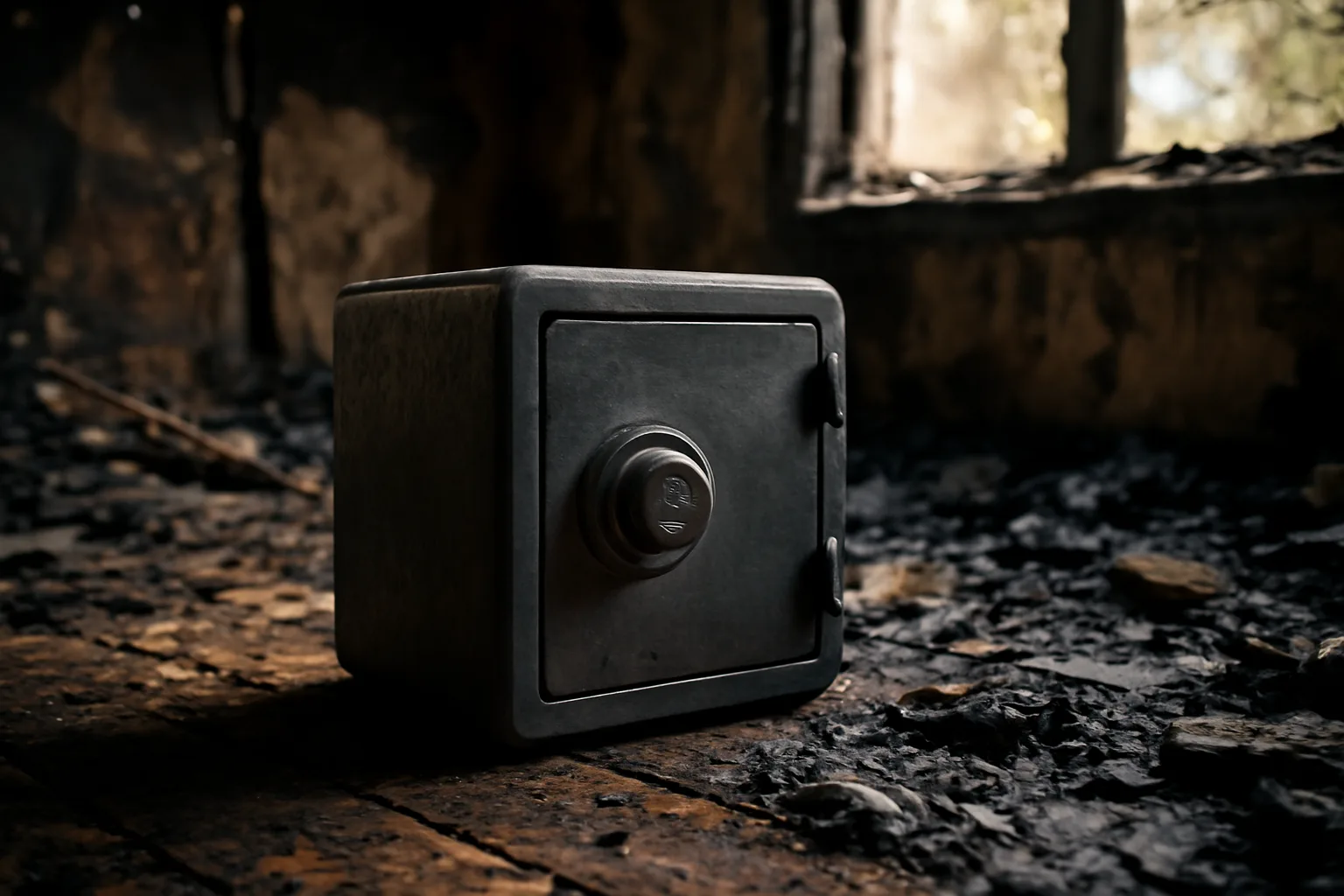
A fire-resistant safe is built to keep the inside cool enough, long enough, that paper doesn't ignite or char while a structure fire burns around it. That's it. It's not fireproof (nothing sold to consumers really is), and the rating tells you a temperature and a time, not a guarantee. Most residential safes marketed as "fireproof" are tested to UL 72, the Underwriters Laboratories standard for fire-resistive containers, or to a similar ETL/ANSI test. A common consumer rating is "350°F for 30 minutes," meaning the interior stayed below 350°F (the point paper starts to scorch and ignite) while the outside was exposed to a much hotter test fire for that duration. Better safes carry 1-hour or 2-hour ratings at the same interior threshold. Here's the part people miss: house fires and wildfire-driven structure fires routinely exceed 1,000°F, and a fully involved residential fire can burn for well over an hour before it's knocked down, longer if firefighters can't reach your street because of road closures or fire behavior. So a 30-minute-rated safe in a wildfire event where your home burns for two hours unattended is a coin flip at best. A 1-hour or 2-hour rated safe, in a fire-resistant location in the house, is a much better bet. Media and electronics have separate, lower thresholds. Digital storage media (thumb drives, hard drives, film) can be damaged starting around 125°F to 150°F, well below the point paper chars. If you want to protect USB drives or external hard drives, you need a safe specifically rated for "media" or "data," which holds interior temps below about 125°F, more than the 350°F paper rating.
What fire rating should I actually buy for a wildfire zone?
| 30-min, 350°F (UL 72 Class 350-30) | $80-$200 | Small house fires with fast response; minimal protection in a slow-burning or unattended fire | |
|---|---|---|---|
| 1-hour, 350°F (UL 72 Class 350-1) | $200-$600 | Most wildfire/WUI households; a reasonable minimum | |
| 2-hour, 350°F (UL 72 Class 350-2) | $500-$1,500+ | Best consumer-grade option; better odds if your home burns unattended for a long stretch | |
| Media/data-rated safe | $150-$500 | Anyone storing USB drives, external hard drives, or film who also wants document protection | Prices are approximate, based on typical retail ranges for major safe brands as of 2024-2025; check current listings before buying. Don't confuse a fire rating with a burglary rating. Many safes marketed for the home are fire-only and can be pried open with a crowbar in under a minute. If you want both, look for a UL-rated combination fire/burglary safe, which costs more but protects the same documents from a break-in and a fire. Weight and anchoring matter too. A safe under about 100 pounds and not bolted down is one a moving crew, or a looter after an evacuation, can just carry out. If theft is a real concern in your area, bolt it to the slab. |
For homes in CAL FIRE-designated Fire Hazard Severity Zones or WUI (wildland-urban interface) areas, buy at minimum a 1-hour, 350°F-rated safe, and go to 2-hour if you can afford it. Look for a UL 72 label, more than a marketing claim of "fireproof." A rough guide on what's worth paying for: | Rating | Typical price range | Good for |
What documents actually belong in a fire safe?
Put in the safe only what you need physically and can't easily re-obtain: your property deed or title, passports, birth and marriage certificates, Social Security cards, insurance policy declarations pages, a written home inventory, and any original wills or trusts (or copies if the originals are with an attorney). Don't put your only copy of anything irreplaceable in a safe that could still be destroyed, lost, or left behind in an evacuation. The better model is: originals in a safe deposit box off-property, working copies in the home safe, and digital scans in cloud storage plus a physical USB drive in your go-bag. FEMA's Ready.gov guidance recommends keeping copies of critical documents both in a fire/waterproof container at home and in a secondary location away from the property, specifically because a single-location strategy fails when the whole property is at risk [1]. For insurance purposes specifically, a written and photographed home inventory matters more than almost anything else in that box. If you have to file a claim after a wildfire, an insurer will ask you to substantiate what you owned and what it was worth. A home inventory with photos, receipts, and serial numbers, updated at least once a year, is the single most useful document you can have ready. If you don't already have one, this is worth doing before fire season, not during an evacuation.
How to prepare for a wildfire beyond the safe box
A fire-resistant safe protects paper. It does nothing for your house, your yard, or your ability to get out safely, so it has to be one line item in a bigger plan, not the plan. Ready.gov's wildfire preparedness guidance breaks this into three buckets: know your risk, make a plan, and take action before fire season starts [1]. Concretely, that means: - Sign up for local emergency alerts (many counties use Genasys or Everbridge-based systems; check your county's Office of Emergency Services page for the specific one).
- Build or review your evacuation plan with two routes out, since one road may be blocked by fire or traffic.
- Pack a go-bag with medications, chargers, a change of clothes, and copies of the same documents in your fire safe, because you may not have time to open the safe when the order comes.
- Photograph your home's exterior and interior, room by room, at least once a year, dated, for insurance documentation.
- Review your defensible space, since CAL FIRE and most western fire agencies require or strongly recommend a minimum of 100 feet of managed vegetation clearance around structures where terrain allows [2]. If you got a non-renewal notice or an inspection letter, the documentation habit matters even more. Insurers increasingly want to see, in writing and photos, that you've done the mitigation work (vent screening, roof material, clearance zones) before they'll reconsider coverage. For a structured way to build that packet, see how defensible space clearing contracts work in states that require documented professional clearing.
When does the California defensible space law go into effect?
California's core defensible space law, Public Resources Code 4291, is already in effect and has been since it was last substantially amended; it currently requires 100 feet of defensible space clearance around structures in State Responsibility Areas and designated Very High Fire Hazard Severity Zones, or to the property line if shorter [2]. This isn't a future law, it's current law, and it's enforced through local fire agency inspections. What is still pending, and causing confusion, is the "Zone 0" ember-resistant zone rule. California Assembly Bill 3074 (2020) directed the Board of Forestry and Fire Protection to develop regulations for a 0-to-5-foot ember-resistant zone immediately around structures, banning combustible materials like mulch, wood fencing attached to the house, and stored items within that band [3]. As of this writing, the Board of Forestry has been working through the rulemaking process, and the effective date has been delayed multiple times; check the Board of Forestry and Fire Protection's current rulemaking page for the specific compliance date in your area, since it varies by local adoption. Don't assume Zone 0 is optional; assume it's coming and start clearing that 5-foot band now. For the exact 100-foot zone breakdown (0-5, 5-30, 30-100 feet) and what's allowed in each, see our guide to defensible space zones. Guided fill-in: Because enforcement and specific compliance deadlines vary by local fire district and county, check with _______ (your local fire district or county fire marshal) for the exact inspection schedule and any local ordinance that's stricter than the state minimum.
What fire safety rules take effect in 2026?
Several California wildfire-related rules are scheduled to phase in around 2025-2026, though exact dates keep shifting as rulemaking finishes, so verify the current status before relying on any specific date. The Zone 0 ember-resistant zone requirement (from AB 3074) has been the most closely watched. The Board of Forestry and Fire Protection's regulatory process has targeted rollout for homes in Very High Fire Hazard Severity Zones, with earlier proposals floating a 2025 or 2026 compliance window for new construction and a later window for existing homes [3]. Because this has already slipped past earlier target dates once, treat any 2026 date you see online as provisional until you confirm it on the Board's own rulemaking page. Separately, California's insurance market has its own 2025-2026 timeline. The California Department of Insurance's Sustainable Insurance Strategy included new rules allowing insurers to use catastrophe modeling in wildfire-zone rate filings, in exchange for expanded FAIR Plan availability and commitments to write more policies in high-risk areas, with phased implementation through 2025 and into 2026 [4]. This is a rate and availability change, not a building code, but it directly affects homeowners fighting non-renewal, since it changes what insurers are allowed to factor into your premium and underwriting decision. If you're trying to track a specific 2026 requirement for your address, the two sources to check directly are the Board of Forestry and Fire Protection for building/vegetation rules and the California Department of Insurance for coverage and rating rules. Local fire district guidance should also be confirmed with _______ (your county fire marshal's office), since some counties adopt stricter local ordinances ahead of the state timeline.
Why won't people follow the defensible space law in California?
Cost, labor availability, and enforcement gaps are the three most cited reasons, based on state audits and fire agency reporting, not any single homeowner survey. This isn't a mystery or a character flaw question, it's mostly logistics. A 2021 California State Auditor report on wildfire mitigation found that CAL FIRE's defensible space inspection program had significant gaps in follow-up enforcement, meaning many properties that failed an initial inspection were never re-inspected to confirm the work got done [5]. Compliance isn't just about willingness, it's about whether a second inspection ever happens. Cost is real too. Clearing 100 feet of defensible space on a sloped, brush-covered lot can run from a few hundred dollars for a small suburban lot to several thousand dollars for larger rural parcels, and that's often an annual or biannual cost since vegetation grows back. For homeowners already facing a non-renewal notice and a spiking premium, finding a few thousand dollars for brush clearing on top of insurance costs is a genuine trade-off, not negligence. There's also a knowledge gap. Many homeowners don't know their parcel is in a State Responsibility Area or a Very High Fire Hazard Severity Zone until they get a letter, and the zone maps themselves have been updated and expanded multiple times, most recently with CAL FIRE's 2025 FHSZ map updates for state responsibility areas. If you don't know the rule applies to you, you're not going to comply with it. Finally, some non-compliance is just disagreement about what counts as "defensible." A homeowner might clear brush but keep a wood fence against the house, not realizing that fence is exactly the kind of Zone 0 fuel connection that lets embers walk fire into the structure. For a plainer breakdown of what belongs in each clearance zone, see fire-safe landscaping next to the house.
How to prevent wildfires and forest fires
Most wildfires in the US, especially in California, are human-caused, not lightning-caused; CAL FIRE and multiple federal sources put the human-caused share at around 85% to 95% of wildfire ignitions nationally, depending on the year and region [6]. That means the biggest lever most people have isn't a law or a safe box, it's behavior. The practical prevention list, drawn from CAL FIRE and Smokey Bear/USDA Forest Service guidance, is short and mostly common sense: - Never leave a campfire unattended, and drown, stir, and feel it cold before leaving, every time [7].
- Don't park or drive vehicles on dry grass; a hot undercarriage can ignite dry vegetation in minutes, and this causes a meaningful share of roadside ignitions during red flag conditions.
- Avoid outdoor equipment use (mowers, chainsaws, grinders) during Red Flag Warning days, when CAL FIRE and the National Weather Service jointly flag conditions of low humidity, high wind, and dry fuels.
- Maintain spark arrestors on ATVs, chainsaws, and other combustion equipment used near dry vegetation.
- Check local burn permit rules before any debris or agricultural burning; many counties suspend all outdoor burning during fire season regardless of permit status. The "how to avoid forest fires" question, when it's about personal risk rather than prevention of ignition, comes down to defensible space and home hardening more than anything else. A National Institute of Standards and Technology (NIST) study of the 2018 Camp Fire in Paradise, California found that ember intrusion through vents, and ignition of adjacent combustible material within 5 feet of structures, were dominant factors in home losses, more than direct flame contact from the main fire front . That's the entire logic behind Zone 0 rules: most homes that burn in wildfires ignite from embers landing near the house, not from the fire itself reaching the walls. Smokey Bear's long-running public message, still maintained by the USDA Forest Service and the National Association of State Foresters, states plainly: "Only you can prevent wildfires" [7], and it's more than a slogan, it reflects the actual ignition data. For a deeper look at personal responsibility and prevention behaviors, see only you can prevent wildfires.
How to prepare for a wildfire: a room-by-room and property checklist
Preparation splits into three timeframes: what you do months before fire season, what you do on a Red Flag Warning day, and what you do in the final hour if an evacuation order comes. Treat these as different checklists, not one long list, because the final-hour version needs to take five minutes, not fifty. Months before fire season:
- Clear defensible space per your zone's requirement (check with _______, your local fire district, for the exact distance and rules that apply to your parcel).
- Install ember-resistant vents or 1/8-inch metal mesh screens on all attic and foundation vents.
- Clear gutters and roof of pine needles and leaf litter; this is one of the single most common ember-ignition points on a home.
- Update your home inventory with photos and receipts, and put copies in your fire-resistant safe and in cloud storage.
- Pack a go-bag with medications, documents, chargers, and a change of clothes for each household member. On a Red Flag Warning day:
- Move patio furniture cushions, doormats, and anything combustible away from the house and off the deck.
- Close all windows and vents you can control.
- Park your car facing out of the driveway, fueled, with the go-bag inside.
- Turn on a battery-powered radio or check your county's alert app; don't rely on cell service alone, since towers can fail. When an evacuation order comes:
- Grab the go-bag and pets first.
- Take the documents you can reach quickly; don't waste time trying to open a safe if seconds matter and the go-bag already has copies.
- Leave lights on inside and a light on outside, close all doors (unlocked, per many fire department guidance, to let firefighters enter if needed), and leave early rather than waiting for a mandatory order if conditions look bad. This is also where a pre-built resource matters, because trying to assemble a document list, an inventory template, and an evacuation checklist for the first time while smoke is visible from your window is a bad system. If you want a done-for-you version of this exact packet, that's what our $99 Wildfire Insurance Survival Kit is built for: templates for the home inventory, a document checklist matched to what insurers actually ask for, and a go-bag list, all as one-time downloads you set up before you need them, not during an evacuation.
Is Santa Barbara safe from fire?
No coastal California city is "safe" from wildfire risk in an absolute sense, and Santa Barbara County specifically sits in one of the more fire-exposed parts of the state due to its chaparral hillsides, dry Sundowner wind events, and history of large fires. The 2017 Thomas Fire, which at the time was the largest wildfire in modern California history, burned into Santa Barbara County and directly preceded the deadly Montecito debris flow in January 2018 that killed 23 people, a disaster caused by rain falling on the fire-denuded hillsides . Santa Barbara County has significant areas mapped as Very High Fire Hazard Severity Zones by CAL FIRE, particularly in the foothill and interface communities like Montecito, Mission Canyon, and the Riviera area. If your property is in one of these zones, the 100-foot defensible space rule under PRC 4291 applies to you directly, and it's worth checking CAL FIRE's FHSZ viewer for your specific parcel rather than assuming based on the city's reputation. The honest answer for anyone asking "is my area safe" is: check the zone map, not the news coverage. A city can have plenty of low-risk flat neighborhoods and also have foothill neighborhoods with serious exposure, and Santa Barbara is a clear example of that split.
How can we prevent forest fires as a community, more than individually?
Individual behavior (extinguishing campfires, avoiding equipment sparks) matters, but community-level prevention leans more on fuel management, building codes, and utility infrastructure than on any single homeowner's actions. This is the level where policy and collective investment actually move the needle. Fuel breaks and prescribed burns, done by state and federal agencies, reduce the continuous fuel load that lets fires spread fast and large; CAL FIRE's Vegetation Management Program and the US Forest Service's prescribed fire programs both operate on this logic, treating tens of thousands of acres per year, though funding and staffing constraints have historically limited the pace relative to the scale of fire-prone landscape . This is slower and less visible than individual defensible space work, but it's arguably more consequential at a landscape scale. Utility infrastructure is a second lever entirely outside individual control. Downed power lines and equipment failures have caused some of the most destructive wildfires in California history, including the 2018 Camp Fire, which Cal Fire's own investigation attributed to Pacific Gas and Electric Company transmission line equipment . Utility undergrounding, vegetation clearance around power lines, and Public Safety Power Shutoff programs are community-level mitigation that individual homeowners can advocate for but can't implement themselves. Building codes are the third lever. California's Chapter 7A building code requirements for new construction in Wildland-Urban Interface zones (ignition-resistant materials, ember-resistant vents, tempered glass) apply at the neighborhood level and raise the fire resistance of an entire block over time as homes are built or remodeled to code, which matters more than any single retrofit since fire spreads structure-to-structure in dense WUI neighborhoods. If you're trying to understand how one burning house fire becomes a neighborhood-level event, or how fire at a house spreads to adjacent structures, this structure-to-structure spread mechanism is the key mechanism, and it's why individual hardening only goes so far without neighborhood-level buy-in.
Where the fire-resistant safe fits in your overall documentation strategy
The safe box is the last 5% of a good wildfire documentation plan, not the first 50%. The bigger lift is building the inventory and photo record in the first place; the safe just protects the physical copy once it exists. If you're facing a non-renewal or an inspection letter right now, insurers and FAIR Plan administrators are going to want to see specific things: proof of defensible space work (photos, contractor invoices, dates), your home's construction details (roof material, vent type, siding), and, if you ever need to file a claim, a pre-loss inventory with values. None of that requires a safe to create, but all of it benefits from being stored somewhere that survives a fire. A reasonable division of labor: keep working copies of your inventory, policy pages, and ID documents in a 1-hour or 2-hour rated fire safe at home. Keep a second set, physical or digital, somewhere off the property entirely, a safe deposit box, a family member's house in another town, or a password-protected cloud folder. Update both at least once a year and after any major purchase or renovation. This whole process, from inventory templates to the specific document checklist insurers ask for after a wildfire claim, is exactly what we built the $99 one-time Wildfire Insurance Survival Kit to handle, so you're not building it from scratch under pressure. To be clear on scope: we don't negotiate with insurers, file claims on your behalf, or promise coverage, discounts, or reinstatement. You prepare the documentation and send it yourself; we just make sure you have the right pieces ready before you need them.
Frequently asked questions
When does the California defensible space law go into effect?
The core law, Public Resources Code 4291, requiring 100 feet of defensible space, is already in effect and has been for years. What's still being finalized is the "Zone 0" 0-to-5-foot ember-resistant zone rule from AB 3074, with a compliance date that has shifted; check the Board of Forestry and Fire Protection's rulemaking page for the current status in your area.
Why won't people follow the defensible space law in California?
Cost, labor to clear brush repeatedly, and enforcement gaps are the main drivers, according to a 2021 California State Auditor report that found CAL FIRE's inspection program had weak follow-up on failed inspections. Some non-compliance is also just not knowing your parcel is in a designated fire hazard zone until a letter arrives.
How to prevent wildfires from starting in the first place?
Extinguish campfires completely before leaving, avoid driving or parking on dry grass, don't use mowers or grinders on Red Flag Warning days, and maintain spark arrestors on outdoor equipment. Roughly 85-95% of wildfires are human-caused, so behavior around ignition sources matters more than most people assume.
How to prepare for a wildfire if I live in a high-risk zone?
Clear defensible space to your local requirement, install ember-resistant vents, keep gutters clear of debris, build a go-bag with documents and medications, and photograph your home for insurance purposes at least once a year. Sign up for county emergency alerts so you get evacuation orders as early as possible.
How to prevent forest fires when I'm out recreating?
Fully drown, stir, and feel campfires cold before leaving, never discard cigarettes on dry ground, follow local burn permit and campfire restrictions (these tighten or suspend entirely during high fire danger), and avoid towing chains that can spark on pavement. Most forest fire ignitions trace back to a specific, preventable human action.
How to avoid forest fires damaging my own home?
Focus on the 0-5 foot zone around your structure first, since NIST's Camp Fire study found ember ignition of combustibles near the house drove most home losses, not direct flame contact. Screen vents with 1/8-inch metal mesh, remove mulch and wood fencing touching the house, and keep the roof and gutters clear of debris.
What fire safety rules take effect in 2026 in California?
The most-watched pending rule is the Zone 0 ember-resistant zone requirement from AB 3074, targeted for phased rollout around 2025-2026, though the date has slipped before. Separately, California's insurance rate and FAIR Plan rules under the Sustainable Insurance Strategy are phasing in through 2025-2026. Confirm current dates on the Board of Forestry and California Department of Insurance sites.
Is Santa Barbara safe from fire?
No area in coastal or foothill Santa Barbara County should be considered fully safe from wildfire; the county has significant Very High Fire Hazard Severity Zone areas, especially in Montecito and foothill communities, and was directly affected by the 2017 Thomas Fire. Check CAL FIRE's FHSZ map for your specific parcel rather than relying on general reputation.
How can we prevent forest fires at a community level?
Prescribed burns and fuel breaks managed by CAL FIRE and the US Forest Service reduce continuous fuel loads at a landscape scale, utility vegetation clearance and undergrounding reduce equipment-caused ignitions, and WUI building codes raise fire resistance across whole neighborhoods over time. These matter more collectively than any single homeowner's actions.
What fire rating should a home safe have for wildfire protection?
Aim for at minimum a 1-hour, 350-degree Fahrenheit UL 72 rating; 2-hour rated safes cost more but perform better in a slow-burning or unattended structure fire, which is common in wildfire events where firefighter access is delayed. If you store USB drives or hard drives, buy a separate media-rated safe holding under about 125 degrees Fahrenheit.
Do fire-resistant safes protect electronics and USB drives?
Standard paper-rated fire safes (350°F for 30-120 minutes) do not reliably protect digital media, which can be damaged starting around 125-150°F. You need a safe specifically labeled for media or data protection if you want to store hard drives, thumb drives, or film alongside your documents.
What documents should go in a fire-resistant safe at home?
Property deed or title, passports, birth and marriage certificates, Social Security cards, insurance declarations pages, a written and photographed home inventory, and copies (not necessarily originals) of wills or trusts. Keep a second copy of all of these somewhere off the property, since the safe protects against fire, not total property loss or theft during evacuation.
Should I buy a fireproof safe or a fire-resistant safe?
No consumer safe is truly fireproof; "fire-resistant" with a UL 72 rating and a specific time/temperature (like 350°F for 1 hour) is the honest and accurate category. Be skeptical of any product marketed as simply "fireproof" without a UL or ETL test rating printed on the label or spec sheet.
Sources
- California Public Resources Code Section 4291: California law requiring 100 feet of defensible space clearance around structures in State Responsibility Areas and Very High Fire Hazard Severity Zones
- California Assembly Bill 3074 (2020), Board of Forestry and Fire Protection rulemaking: AB 3074 directed creation of a Zone 0 ember-resistant zone rule for the 0-5 foot area around structures, with compliance dates still being finalized through rulemaking
- California Department of Insurance, Sustainable Insurance Strategy: California's 2025-2026 insurance rate and FAIR Plan rules allowing catastrophe modeling in exchange for expanded high-risk-area coverage commitments
- California State Auditor, Report 2021-117: Wildfires: State Auditor findings on gaps in CAL FIRE's defensible space inspection follow-up and enforcement
- CAL FIRE, Fire Hazard Severity Zone Maps: CAL FIRE and the Office of the State Fire Marshal's updated Fire Hazard Severity Zone maps for State Responsibility Areas, including Santa Barbara County designations
- CAL FIRE, Vegetation Management Program overview: CAL FIRE's Vegetation Management Program conducts prescribed burning and fuel reduction work across state responsibility areas
- CAL FIRE, Camp Fire cause investigation summary: CAL FIRE's investigation attributed the 2018 Camp Fire's cause to Pacific Gas and Electric Company transmission line equipment