Last updated 2026-07-25
TL;DR
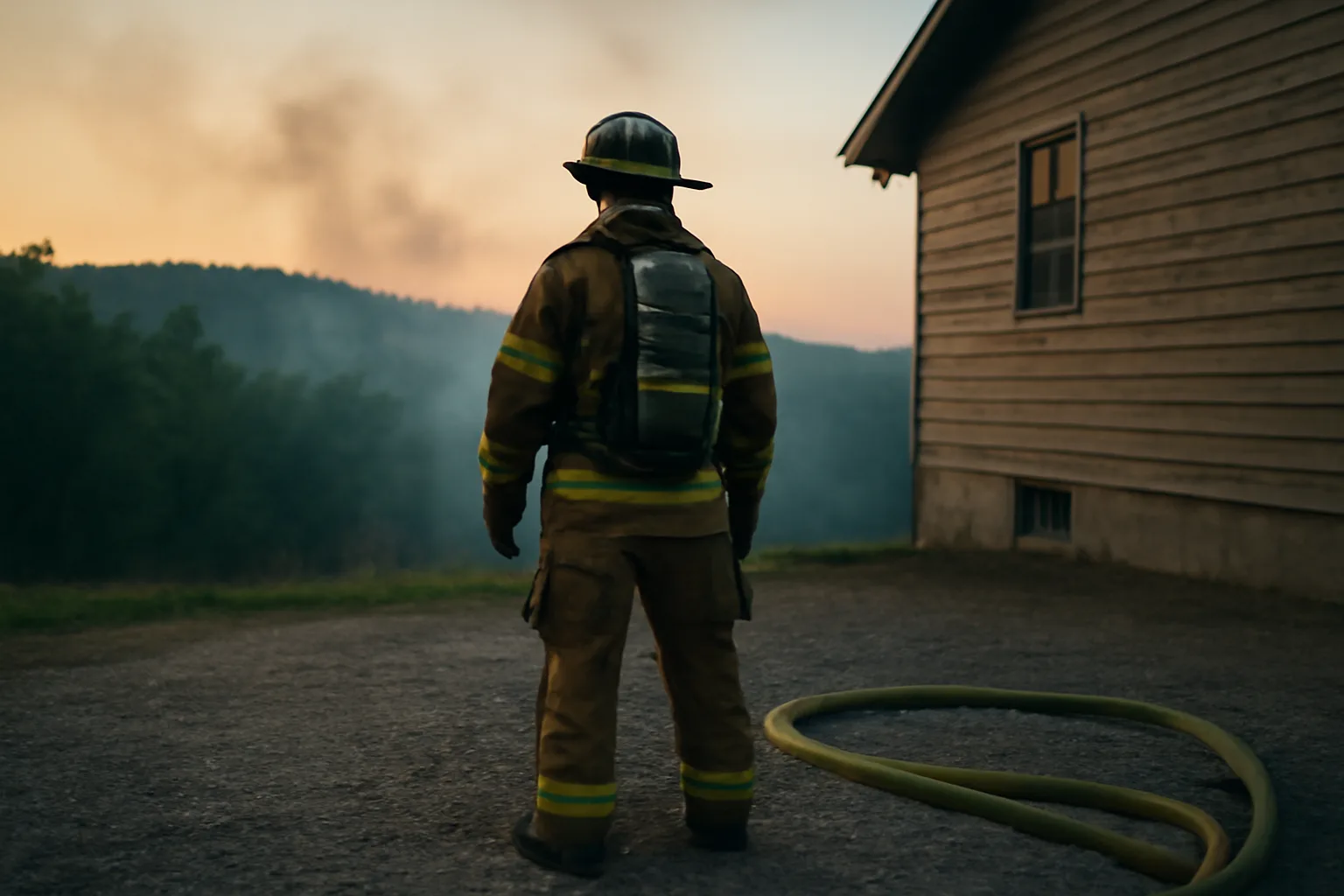
Protecting property requires firefighters to have enough cleared space, water access, and safe egress to actually work a structure. CAL FIRE's standard is 100 feet of defensible space around homes in State Responsibility Areas [1]. Without it, many departments will bypass a house entirely during a fast-moving fire rather than risk crews on an indefensible structure.
What does "protecting property requires firefighters to" actually mean?
It means a blunt operational fact: fire crews triage. During a wildfire, a captain pulling up to your street has seconds to decide whether a house is defensible or not. If there's no clear space around the structure, no way to get a truck in and out, and nothing separating the house from the fuel that's burning, most departments train their crews to skip it and move to the next one. CAL FIRE's public guidance states it plainly: "Defensible space is the buffer you create between a building on your property and the grass, trees, shrubs, or any wildland area that surrounds it" and that this space is what "allows firefighters to do their jobs". The 100-foot standard around homes in State Responsibility Areas isn't a suggestion, it's written into California Public Resources Code Section 4291 [1]. This isn't just about your house surviving. It's about whether a firefighter can safely stand near it long enough to try. A structure surrounded by dense brush with no defensible space puts crews in a position where saving it means risking their lives for a low-odds outcome. Fire agencies increasingly won't make that trade. So when you hear "protecting property requires firefighters to have defensible space, access, and water," that's not marketing language from a mitigation company. It's the literal operational reality behind why some homes burn and the one next door doesn't, even when both were in the fire's path.
When does the California defensible space law go into effect?
California's core defensible space law (100 feet of clearance under Public Resources Code 4291) has been in effect since it was expanded from 30 feet to 100 feet back in 2005 [1]. It already applies today if you're in a State Responsibility Area or certain Local Responsibility Areas with a Very High Fire Hazard Severity Zone designation. What's changing is the addition of a new, more detailed "Zone 0" ember-resistant zone within the first 5 feet of a home. The California Board of Forestry and Fire Protection has been developing this regulation under Assembly Bill 3074 (2020), which directed the creation of ember-resistant zone standards for the immediate area around structures [2]. As of this writing, CAL FIRE's official Zone 0 guidance describes the intent (noncombustible material, no vegetation, no mulch, no stored items within 5 feet of the structure) but the formal regulatory effective date has moved more than once. Check CAL FIRE's defensible space page directly for the current implementation date. Enforcement timing is still being finalized region by region. [Fill in: your county or fire district's local defensible space ordinance number and effective date, if different from state law] Don't wait for the enforcement date to comply. Insurers and their inspectors are already using the Zone 0 standard as a benchmark when they evaluate a home for renewal, even before it's mandatory everywhere.
What fire-safe home rules take effect in 2026?
This is genuinely confusing right now because dates have shifted. The honest answer: as of this writing, California's Zone 0 (ember-resistant zone) regulation has been through Board of Forestry rulemaking, and CAL FIRE's public materials have referenced phased effective dates that have moved as the rulemaking process continued [2]. Check the Board of Forestry and Fire Protection's current regulatory status page directly rather than trusting a specific year that may already be outdated by the time you read this [2]. What we can say with confidence: the direction is clear. Noncombustible material within 5 feet of the home, no combustible mulch, no vegetation touching siding, decks, or fences, and no wood piles against the house. That standard exists in CAL FIRE guidance today even before it's a hard legal requirement everywhere. Separately, the California Department of Insurance's "Safer from Wildfires" regulation (10 CCR Section 2644.9) already requires insurers to give discount credit for specific mitigation actions, including defensible space and home hardening measures, when calculating wildfire risk scores [3]. That regulation took effect in 2022 and is distinct from the Zone 0 building code discussion, but the two are related: insurers want documentation that you've done both. [Fill in: your fire district's local hardening ordinance, permit requirements, and any 2026 compliance deadline specific to your jurisdiction] If you got a non-renewal letter, don't wait on state timelines. Do the Zone 0 work now, photograph it, and keep records. For more on what inspectors and insurers actually check house by house, see our inspections breakdown.
Why won't people follow the defensible space law in California?
Cost, confusion, and denial, mostly in that order. A lot of homeowners genuinely don't know the law applies to them, especially if they bought a house years ago and nobody's mentioned it since. Others know but treat it like a suggestion because enforcement has historically been inconsistent, some counties issue citations, others mostly just send letters. There's also a real financial barrier. Removing mature trees near a house, replacing wood fencing that touches the structure, or regrading a slope for clearance isn't cheap. CAL FIRE doesn't publish a national average cost for compliance because it varies enormously by lot size and vegetation density, but homeowners in dense forest lots regularly report contractor quotes in the thousands of dollars for a single clearing job. Then there's aesthetic resistance. People move to wooded, shaded lots specifically because they like the trees. Being told to remove them, or thin them heavily within 30 feet of the house per CAL FIRE's zone guidance, feels like losing the reason they bought the property. And frankly, some people just don't believe it'll happen to them. Every fire season, reporters interview homeowners who say some version of "we've been here 20 years and never had a problem." That's not evidence of safety, it's survivorship bias. The math changes fast once drought, wind, and ignition line up. The fix isn't complicated, it's just unfunded and unenforced in a lot of places. If you're not sure what your zone requires, start with the defensible space zones rules for your property type.
How to prevent wildfires: what actually reduces ignition risk?
Most wildfires are human-caused, not lightning-caused. Government data on ignition sources varies by state and year, but CAL FIRE and the National Interagency Fire Center have both noted for years that the large majority of wildfires nationally are started by people, whether through equipment sparks, debris burning, unattended campfires, or vehicle-related ignitions. At the individual level, prevention means controlling ignition sources on your own property and nearby. That includes not mowing dry grass on hot windy afternoons (mower blades hitting rock throw sparks), keeping vehicles off dry grass, properly extinguishing campfires and cigarettes, and following local burn permit rules for any debris burning. At the structure level, prevention means managing embers. Most homes that burn in wildfires don't burn from direct flame contact, they ignite from wind-blown embers landing in vulnerable spots: gutters full of dry leaves, vents without ember-resistant mesh, wood decks, and mulch beds touching the siding. That's the entire logic behind CAL FIRE's Zone 0 concept. Read.gov's wildfire preparedness page frames this as a shared responsibility between individual action and community-level fuel management. Neither one alone solves it. You can hardened your own house perfectly and still be at risk if your neighbor's overgrown lot is 15 feet away. For the landscaping side of this, our fire safe landscaping guide covers what to plant and what to remove near structures.
How to prepare for a wildfire before it starts
Preparation splits into three buckets: the house, the property, and the paperwork. Most people only think about the first two. For the house: harden vents with 1/8-inch metal mesh, replace or box in open eaves, clear gutters, and make sure your roof is Class A rated material if you're rebuilding or replacing. CAL FIRE's home hardening guidance lists these as the highest-leverage retrofits because they directly block ember entry. For the property: maintain the three defensible space zones. Zone 0 (0-5 feet) should be essentially noncombustible. Zone 1 (5-30 feet) needs well-spaced, low-growing, irrigated vegetation. Zone 2 (30-100 feet) needs reduced fuel load, meaning cut dry grass to under 4 inches and space out trees and shrubs [1]. For the paperwork, which almost nobody does until it's too late: photograph every room, every major appliance, your roof, siding, and all your defensible space work, dated and organized, before a fire ever threatens. Ready.gov specifically recommends creating a home inventory with photos or video "before disaster strikes" as part of a family disaster plan. This is what actually speeds up an insurance claim or supports a non-renewal appeal. This is the gap our $99 Wildfire Insurance Survival Kit at DefensibleHome is built for: it's a structured way to document your defensible space work, home hardening steps, and property inventory in a format that's ready to hand an insurer or use in your own appeal. We don't file claims or contact your insurer on your behalf, you send your own documentation, we just help you organize it so it's not a shoebox of receipts.
How to prevent forest fires at the community and land management level
This one's bigger than any single homeowner, but it matters because forest fires and structure fires are connected: fuel that burns in the wildland is what reaches your neighborhood. The U.S. Forest Service and CAL FIRE both use prescribed burning and mechanical thinning to reduce fuel loads in forested areas before fire season. These programs are chronically underfunded relative to the acreage that needs treatment, which is part of why fuel builds up over decades in areas that historically burned more frequently and at lower intensity. At the community level, prevention means supporting local fuel-reduction programs, participating in Firewise USA community recognition programs (run through the National Fire Protection Association in partnership with the Forest Service), and pushing for consistent enforcement of defensible space rules across a neighborhood, more than your own lot. One well-hardened house next to five overgrown lots is still at elevated risk from radiant heat and embers generated nearby. Individually, the same rules from the ignition-prevention section apply: don't operate machinery in dry grass, follow local burn bans, maintain spark arrestors on equipment, and report unattended fires or suspicious smoke immediately rather than assuming someone else will.
How to avoid forest fires when you're outdoors or traveling through fire-prone areas
This is really a campfire and vehicle discipline question. Most avoidable ignitions in wildland areas trace back to a handful of repeat causes: abandoned campfires, dragging trailer chains that spark on pavement, parking a hot vehicle exhaust over dry grass, and fireworks in areas under burn restrictions. Check current fire restrictions before any trip into forested or brush-covered land. Restrictions change through the season based on drought conditions and can include full campfire bans even in developed campgrounds. Douse campfires completely, stir the ashes, and touch them to confirm they're cold before leaving. A fire that looks out can still be smoldering underground in root systems or duff. If you're towing anything, make sure safety chains aren't dragging on the road, that's a documented ignition source for roadside grass fires. And if you see smoke or an unattended fire, call it in immediately rather than assuming it's controlled; delayed reporting is one of the more preventable factors in fires that grow past initial attack.
How to prepare for forest fires if you live in or near wildland
Living adjacent to forest or heavy brush means your prep needs to go further than the standard suburban defensible space checklist. You need an evacuation plan with more than one route, because forest roads and canyon routes get blocked or become dangerous fast in a fast-moving fire. Ready.gov recommends identifying at least two ways out of your neighborhood and a family meeting point outside the immediate area, since cell networks and roads can both fail simultaneously in a major fire event. Sign up for your county's emergency alert system directly, don't rely on push notifications from an app alone. Keep a "go bag" per person with medications, copies of ID and insurance documents, a change of clothes, and basic supplies, staged somewhere you can grab it in under two minutes. Ready.gov's general disaster supply guidance is a reasonable baseline for what to include. For the property itself, extend your defensible space thinking to the full 100 feet where terrain allows, since homes on slopes or in narrow canyons see faster fire spread and more radiant heat exposure than flat-lot homes with the same clearance. Our defensible space zones breakdown covers how zone requirements shift with slope and lot shape.
Is Santa Barbara safe from fire?
No. No California coastal or foothill community is "safe" from fire in an absolute sense, and Santa Barbara County has direct experience proving it. The Thomas Fire (December 2017-January 2018) burned over 281,000 acres and was, at the time, the largest wildfire in modern California history, and it was followed within weeks by the Montecito debris flow that killed 23 people, a disaster directly tied to the burned, denuded hillsides above town [4]. Santa Barbara sits in a landscape shaped by Santa Ana/sundowner winds, chaparral fuel, and steep coastal mountains, exactly the combination that produces fast-moving, hard-to-stop fires. Parts of the county carry Very High Fire Hazard Severity Zone designations under CAL FIRE's mapping [5], meaning the 100-foot defensible space requirement and related building code standards apply there directly. That doesn't mean every property in Santa Barbara faces equal risk. Homes deep in urban, flat downtown areas face meaningfully lower wildfire exposure than homes in the foothills, Montecito, Mission Canyon, or the San Marcos Pass area. If you're evaluating a specific property, check its designation on CAL FIRE's Fire Hazard Severity Zone viewer rather than relying on the city's general reputation [5].
How can we prevent forest fires as a shared, community-level problem?
No single homeowner clearing their own lot solves a regional wildfire problem, and pretending otherwise is part of why compliance has been so inconsistent. Prevention at scale needs three things moving together: individual ignition discipline, cross-property fuel management, and consistent enforcement of existing defensible space law. The individual piece is the cheapest and most within your control: no debris burning on red flag days, mowing dry grass only in cool morning hours, maintaining equipment spark arrestors, and reporting fires immediately. The cross-property piece requires neighborhood coordination, which is exactly what Firewise USA community programs and local fire safe councils exist to organize. A single hardened home surrounded by unmanaged lots is still exposed to radiant heat and ember cast from those neighboring properties, so community-wide participation matters more than any one household's perfection. The enforcement piece is arguably the weakest link. California's law under Public Resources Code 4291 has existed in its current 100-foot form since 2005 [1], yet compliance rates have historically been inconsistent across counties because staffing for inspections is limited and enforcement priorities vary locally. Pushing your local fire district for consistent inspection follow-through, and complying proactively yourself, does more for regional prevention than any single technology or product. [Fill in: your local fire safe council or Firewise USA community program name and contact, if one exists in your area]
What should you document once your defensible space work is done?
Doing the work and proving the work are two different problems, and insurers only care about the second one. Take dated, wide-angle photos of all three zones around your house: the noncombustible 5-foot perimeter, the thinned 30-foot zone, and the reduced-fuel outer zone to 100 feet where it applies [1]. Photograph specific hardening items separately: your vents (showing mesh if installed), your roof material, your gutters cleared of debris, and any deck or fence sections where combustible material was removed or replaced. Keep contractor invoices and permit records if any work required them. California's Safer from Wildfires regulation requires insurers to factor documented mitigation into wildfire risk scoring [3], which means your documentation isn't just for your own records, it's the basis for any renewal appeal or rate discussion you initiate yourself. We don't file claims, contact insurers on your behalf, or promise reinstatement, that's not what this kind of documentation service does. What it can do is put your evidence in a format that's organized and dated instead of scattered across a phone camera roll. That's the entire premise behind the $99 Wildfire Insurance Survival Kit at DefensibleHome, and it's worth doing whether or not you ever use our specific tool for it. [Fill in: your insurer's specific documentation submission process or portal, if you have one on file]
Frequently asked questions
When does the California defensible space law go into effect?
The core 100-foot defensible space requirement under Public Resources Code 4291 has been in effect since it expanded from 30 to 100 feet in 2005. It already applies in State Responsibility Areas and many Very High Fire Hazard Severity Zones today. Newer Zone 0 ember-resistant zone rules are still finalizing effective dates through Board of Forestry rulemaking, so check CAL FIRE's current page for the latest status.
Why won't people follow the defensible space law in California?
Mainly cost, confusion about whether it applies to them, and attachment to existing trees and landscaping. Compliance also requires real money for tree removal or fencing replacement, and enforcement has historically been inconsistent county to county, which reduces the perceived urgency until a non-renewal letter or a nearby fire changes the calculation.
How do I prevent wildfires from starting on my own property?
Avoid mowing dry grass in hot, windy afternoons, keep vehicles and equipment off dry vegetation, fully extinguish campfires and cigarettes, and follow local burn permit rules. Most wildfires nationally are human-caused, so controlling ignition sources on and near your property is the most direct individual prevention step available.
How do I prepare for a wildfire if I live in a high-risk zone?
Harden your home's vents, eaves, and roof, maintain the three defensible space zones out to 100 feet where applicable, build a go bag per household member, and identify at least two evacuation routes. Ready.gov recommends a documented family emergency plan and photo/video home inventory completed before any fire threat, not during one.
What fire-safe home rules take effect in 2026?
California's Zone 0 ember-resistant zone regulation (noncombustible material within 5 feet of structures) has moved through Board of Forestry rulemaking with shifting effective dates. Rather than rely on a specific year, check the Board of Forestry and Fire Protection's current regulatory status directly, since the timeline has changed more than once during the rulemaking process.
Is Santa Barbara safe from fire?
No California coastal or foothill community is fully safe from wildfire, and Santa Barbara has direct experience with it: the 2017 Thomas Fire burned over 281,000 acres and was followed by a deadly debris flow in Montecito. Risk varies sharply within the county based on terrain and Fire Hazard Severity Zone designation, so check a specific property's zone rather than the city's general reputation.
How can we prevent forest fires as a community, more than individually?
Individual ignition discipline alone doesn't solve regional risk. Community fuel management through Firewise USA programs, local fire safe councils, and consistent defensible space enforcement across neighboring properties matters just as much, since one hardened home next to overgrown lots is still exposed to radiant heat and embers from nearby unmanaged land.
What's the difference between defensible space and home hardening?
Defensible space is the cleared and managed vegetation zone around your house, out to 100 feet under California's Public Resources Code 4291. Home hardening is physical construction work on the structure itself, like ember-resistant vents, Class A roofing, and enclosed eaves. Insurers and fire agencies expect both, not one or the other.
Do I have to comply with defensible space law if I'm not in a State Responsibility Area?
Many Local Responsibility Areas with Very High Fire Hazard Severity Zone designation have adopted equivalent local ordinances, so compliance can still be required even outside SRA boundaries. Check your specific county or city fire code, since requirements and enforcement mechanisms vary by jurisdiction.
How much does defensible space work typically cost?
CAL FIRE doesn't publish a standard statewide cost figure because it varies enormously with lot size, slope, and vegetation density. Homeowners on densely wooded lots commonly report contractor quotes in the low thousands of dollars for initial clearing, with lower annual maintenance costs afterward for grass cutting and debris removal.
What documentation do insurers want to see for wildfire mitigation credit?
Under California's Safer from Wildfires regulation (10 CCR 2644.9), insurers must factor documented mitigation into wildfire risk scoring. Useful documentation includes dated photos of all three defensible space zones, close-ups of vents and roofing, contractor invoices, and permit records, organized in a format you can hand directly to your insurer or use in your own renewal appeal.
What is Zone 0 and why does it matter for insurance?
Zone 0 is the 0-to-5-foot ember-resistant zone immediately around a structure, requiring noncombustible material, no mulch, and no vegetation touching the building. CAL FIRE promotes it as the highest-impact defensible space zone because most homes ignite from wind-blown embers landing near the structure, not direct flame contact, and insurers increasingly check for it during inspections.
Sources
- California Legislative Information, Public Resources Code Section 4291: Legal basis for 100 feet of defensible space clearance in State Responsibility Areas
- California Board of Forestry and Fire Protection, Rulemaking page: Status of Zone 0 ember-resistant zone regulation development under AB 3074
- California Department of Insurance, 10 CCR Section 2644.9 (Safer from Wildfires): Requirement that insurers factor documented wildfire mitigation into risk scoring
- CAL FIRE, Thomas Fire incident page: Thomas Fire burned over 281,000 acres in Santa Barbara and Ventura counties, 2017-2018
- CAL FIRE, Fire Hazard Severity Zone Viewer: Mapping tool for checking a specific property's Fire Hazard Severity Zone designation, including in Santa Barbara County