Last updated 2026-07-25
TL;DR
Defensible space pruning means limbing trees up 6-10 feet, spacing shrub canopies 2-3x their height apart, and clearing dead wood within 5, 30, and 100 feet of your home per CAL FIRE's zone system. Most non-renewals cite overgrown vegetation touching structures or ladder fuels connecting ground brush to tree canopies.
What does pruning for defensible space actually mean
Pruning for defensible space is not the same as pruning for looks. You're not shaping a hedge or thinning a fruit tree for better yields. You're breaking the physical path that lets fire climb from grass to shrub to tree canopy, and you're opening gaps so radiant heat and embers have less fuel to work with near your walls. CAL FIRE's defensible space framework splits your property into zones. Zone 0 runs from your home's foundation out to 5 feet, and the state now calls for an ember-resistant zone here with no combustible mulch, no stored wood, and minimal plantings. Zone 1 runs from 5 to 30 feet, where you remove dead branches, keep grass under 4 inches, and separate shrubs so fire can't jump from one to the next. Zone 2 runs from 30 to 100 feet, where the goal shifts from elimination to spacing and thinning. Pruning shows up in every zone but the target changes. In zone 0 you're removing anything that touches the house. In zone 1 you're limbing up trees and creating gaps between shrub clusters. In zone 2 you're thinning canopy density and cutting away dead and dying material that would otherwise carry fire toward your home. If you want the full zone-by-zone breakdown with distances and species notes, see our companion piece on defensible space.
How do I prune trees for defensible space (limbing up, crown spacing)
Limbing up means removing the lower branches of a tree so a ground fire can't reach the canopy. CAL FIRE recommends removing branches within 6 feet of the ground for mature trees, though the exact height scales with the tree. A young sapling doesn't need the same clearance as a 40-foot pine. Crown spacing is the second half of the job. Tree canopies within 30 feet of a structure need separation from each other, generally 10 feet between crowns, and canopies within 30 to 60 feet need at least 10 feet of separation as well, widening further out to 100 feet depending on slope. On steep slopes fire moves faster uphill, so your local fire district may require wider spacing than the flat-ground minimum. Ask your fire safe council or local fire marshal's defensible space inspector for the slope-adjusted numbers in your area, since this is one of the places where a generic checklist won't cut it. Don't top trees. Topping (cutting the main leader to control height) creates dense regrowth that's actually worse for fire behavior, and it stresses the tree into disease susceptibility. If a tree is too tall or too close to the house, the honest fix is often removal, not a butchered prune job. Work on dead wood first. Dead branches, whether from drought stress, beetle kill, or storm damage, carry fire more readily than live green wood because they're already dried out. If you only have a weekend, spend it removing dead and dying material before you touch anything else.
How far apart do shrubs need to be for defensible space
Shrub spacing follows a simple rule of thumb from CAL FIRE: horizontal spacing between shrub clusters should be two to three times the height of the vegetation, measured from the edge of one plant to the edge of the next. A 3-foot shrub needs roughly 6 to 9 feet of clearance from its neighbor. That gap breaks the chain of continuous fuel that lets fire spread shrub to shrub. Vertical spacing matters too. If you've got shrubs growing under a tree canopy, the shrub top should sit at least three times its own height below the lowest tree branches. Skip this and you've built a fuel ladder: fire starts in the grass, catches the shrub, and the shrub's flame length is long enough to ignite the branches above it. That's how a small ground fire becomes a crown fire, and crown fires are the ones that torch houses from radiant heat alone, no direct flame contact needed. In zone 0 (the 5 feet closest to your home), the safest approach for most fire districts is no shrubs directly against the foundation, period. Isolated, well-irrigated, low-growing plants spaced well apart from each other are sometimes allowed, but check your specific jurisdiction's zone 0 rule before you plant anything there, since California's zone 0 ember-resistant standard has been a moving target for adoption timelines (more on that below).
When does the California defensible space law go into effect (zone 0)
California's zone 0 requirement, the ember-resistant zone within 5 feet of structures, was established by Assembly Bill 3074 (2020) as an amendment to Public Resources Code Section 4291, but the specific regulations implementing it have gone through a slower rulemaking process than the statute itself [1]. As of this writing, the Board of Forestry and Fire Protection has been developing the zone 0 regulations, and CAL FIRE's public guidance has referenced a target of 2026 or later for the regulation to become enforceable statewide, pending final board adoption [2]. That timeline has shifted more than once, so don't treat any specific date as locked in. Check the Board of Forestry and Fire Protection's rulemaking page directly, or ask your local fire marshal, before you assume zone 0 is or isn't legally required in your area right now. Here's the practical reality: even where zone 0 isn't yet a hard legal requirement, insurers and inspectors are already grading properties against it. If your home sits in a high fire severity zone and you got a non-renewal notice, treating the 5-foot ember zone as already-mandatory is the safer bet, both for survival in an actual fire and for documentation you can hand an underwriter.
Why won't people follow the defensible space law in California
Compliance with California's defensible space law (Public Resources Code 4291) is genuinely uneven, and it's not because homeowners don't know the rule exists. A mix of cost, labor, aesthetics, and enforcement gaps explains most of the gap. Cost is the biggest one. Professional vegetation clearing and pruning on a typical suburban lot can run from a few hundred dollars for a small property to several thousand for a larger, overgrown parcel, and costs climb fast on sloped or heavily wooded land where crews need more time and sometimes chainsaw crews or chippers. For homeowners on fixed incomes, especially older residents in rural interface areas, that bill competes with everything else in the budget. Enforcement is inconsistent too. Defensible space inspections are usually handled by local fire departments or CAL FIRE unit staff, and capacity varies enormously between a well-funded suburban fire district and a rural volunteer department covering hundreds of square miles. Some counties do annual inspections with real follow-up; others rely almost entirely on self-certification or complaint-driven checks. Then there's the aesthetic and emotional resistance. Mature trees and dense landscaping took decades to grow, and cutting them back feels like a loss, especially for homeowners who moved to wooded areas specifically for the tree cover and privacy. Pruning for defensible space asks people to trade something they value (shade, privacy, a shaded canopy that keeps the house cooler) for a risk that feels abstract until a fire actually happens nearby. Finally, some homeowners genuinely don't understand the mechanics. A property can look tidy and green and still fail defensible space standards if the shrubs are bunched against the house or a tree canopy overhangs the roofline. Pruning compliance requires understanding fire behavior, more than yard maintenance instincts.
How do I prepare for a wildfire on a pruning and clearing timeline
A realistic prep timeline starts months before fire season, not the week a red flag warning goes up. Ready.gov recommends creating defensible space and hardening your home well before wildfire season arrives in your region, since peak fire season timing varies by state. Here's a rough seasonal approach that works for most western fire zones. In late winter or early spring, before new growth starts, do your major structural pruning: limb up trees, remove dead wood, thin dense clusters. This is also when a professional arborist's time is cheaper and more available, since demand spikes right before fire season. In late spring, do a second pass. Cut grass and light fuels down to under 4 inches as CAL FIRE recommends for zone 1, and check that new spring growth hasn't closed the gaps you created earlier. In early summer, do your final pre-season check: clear zone 0 of any accumulated leaf litter or dropped needles, verify gutters are clear, and confirm shrub spacing hasn't drifted from irrigation-driven growth. Throughout fire season, maintenance is lighter but constant. Rake up dropped leaves and needles weekly if you're in a heavy-litter zone (oaks, pines), and re-check zone 0 after any windy day. For the structural side of prep, our guide on fire safe landscaping next to your house covers plant selection to pair with your pruning schedule.
How to prevent wildfires (and forest fires) at the property level
Most residential wildfire prevention comes down to two things: reducing ignition sources and reducing the fuel available once something ignites. Pruning handles the fuel side. Roughly 85% of wildfires nationally are human-caused, according to National Park Service data cited across federal wildfire agencies, which means ignition prevention (extinguishing campfires fully, maintaining equipment, avoiding outdoor burning on red flag days) matters as much as vegetation work [3]. On the fuel side, the specific actions that move the needle are the ones already covered here: limbing trees up 6 feet or more, spacing shrubs 2-3 times their height apart, keeping grass under 4 inches, and maintaining a genuinely bare or ember-resistant zone in the 5 feet closest to structures. None of that is glamorous work. It's also the part of wildfire prevention that an individual homeowner actually controls, unlike broader landscape-level fuel management, which depends on state and federal forest agencies. How to avoid forest fires on a broader scale involves the same principles at community scale: fuel breaks, prescribed burns, and defensible space requirements applied across neighborhoods rather than single lots. A single well-pruned property helps that property. A neighborhood where most homes have done the work changes fire behavior at a block level, since fire needs continuous fuel to spread structure to structure.
What fire-safe home rules take effect in 2026
Several California wildfire-related regulations have targeted 2026 timelines, though the specifics are still moving through rulemaking as of this writing, so verify current status with your local fire marshal or the Board of Forestry and Fire Protection before treating any date as final [2]. The zone 0 ember-resistant zone regulation, discussed above, is the most significant one under development, tied to the 2020 statutory framework in AB 3074 [1]. Beyond that, insurance-side changes are also shifting: California's Sustainable Insurance Strategy, adopted by the Department of Insurance, includes provisions meant to expand FAIR Plan availability and tie insurer participation to wildfire risk mitigation credit programs, with phased implementation dates running through the mid-2020s [4]. Because rulemaking timelines shift and vary by county and fire district, the most reliable move is a direct check: call your local fire marshal's office, or search your county name plus 'defensible space ordinance' on your county government site, and ask specifically whether zone 0 is currently mandatory, advisory, or still pending in your jurisdiction. Treat any specific 2026 date you read online, including in this article, as a planning target rather than a locked-in guarantee until you've confirmed it locally.
Is Santa Barbara safe from fire
No coastal California city is exempt from wildfire risk, and Santa Barbara County has a documented history of major fires including the 1990 Painted Cave Fire and the 2017 Thomas Fire, which at the time was the largest wildfire in modern California history by acreage before being surpassed by later fires [5]. Santa Barbara's setting against the Santa Ynez Mountains, with dense chaparral fuel and frequent sundowner wind events, puts much of the foothill and interface housing stock in CAL FIRE-designated high or very high fire hazard severity zones. That doesn't mean every Santa Barbara address faces equal risk. A condo in the flat downtown grid faces very different exposure than a hillside home in Montecito or the San Roque foothills. CAL FIRE's Fire Hazard Severity Zone maps, available through the state's map viewer, let you check your specific parcel's designation rather than relying on the city's general reputation. If your address falls in a high or very high severity zone, defensible space compliance and pruning maintenance aren't optional extras. They're the difference-makers insurers and inspectors are actually grading you on, and they're also what determines whether your home has a fighting chance if a sundowner-driven fire does come through.
What should I document before and after pruning for an insurer or inspector
If you're facing a non-renewal notice or trying to get reinstated, documentation matters as much as the actual pruning work. Take dated, wide-angle photos of each defensible space zone before you start, then matching photos after, from the same vantage points if possible. Note the specific measurements: distance from canopy to canopy, distance from lowest branch to ground, distance from nearest shrub to your exterior wall. Keep any receipts from tree services or equipment rental, and if a local fire department or CAL FIRE unit did an inspection, keep a copy of that inspection report or checklist. Insurers reviewing a property for reinstatement or renewal often want to see evidence of ongoing maintenance, more than a one-time cleanup, so a dated photo log from multiple seasons is stronger evidence than a single before-and-after pair. This is exactly the kind of documentation packet our $99 Wildfire Insurance Survival Kit is built around: a structured way to organize photos, measurements, and receipts into something an underwriter can actually review quickly, rather than a folder of loose phone photos. We don't contact your insurer on your behalf, file claims for you, or promise any specific coverage outcome. What we help you do is build the documentation packet yourself, in a format that's easy to hand over. For structural hardening steps that pair with your pruning work, see our guide on house fire prevention basics and only you can prevent wildfires for the broader prevention picture.
Do I need a professional or can I DIY the pruning
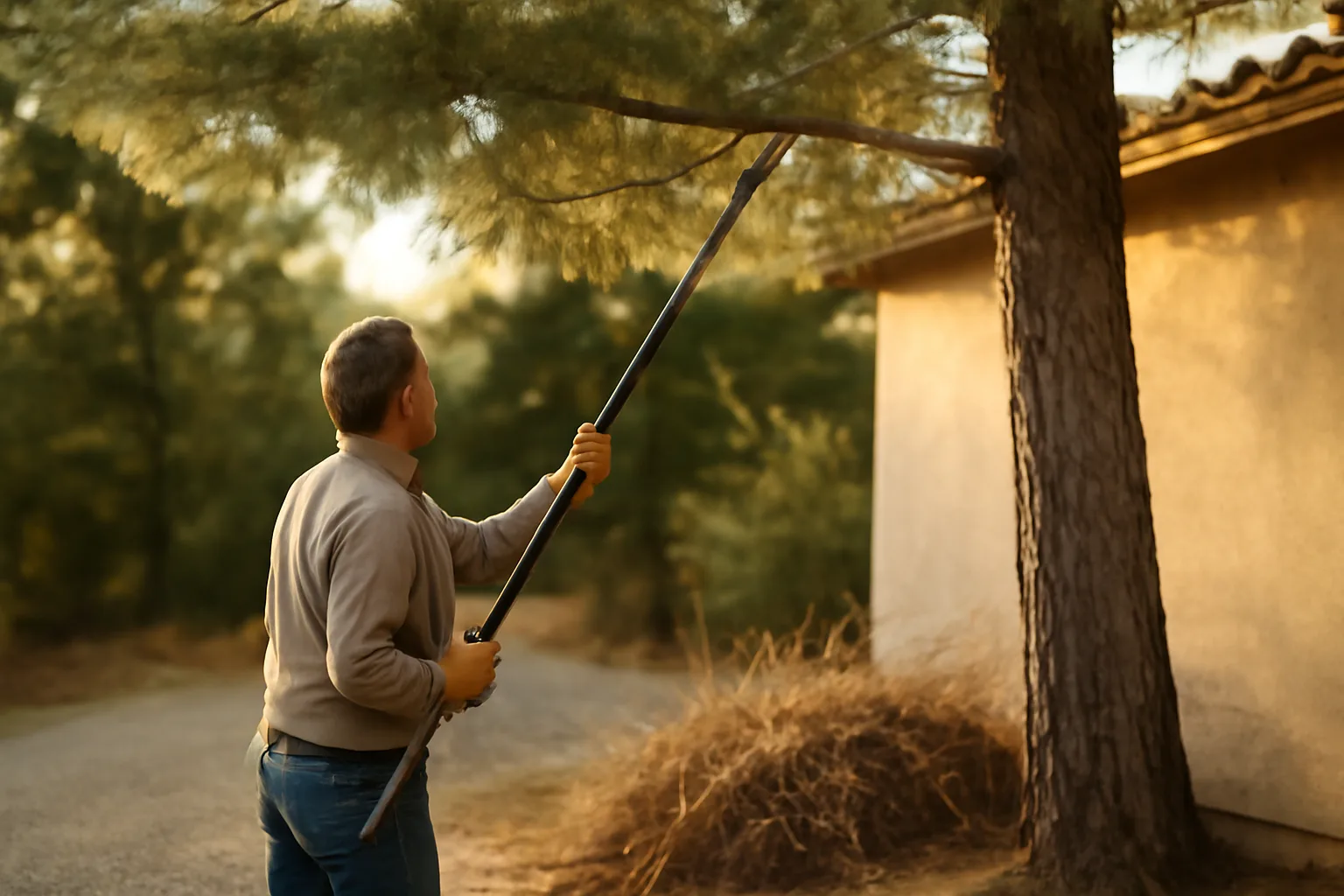
Small properties with manageable vegetation, a quarter acre or less with mostly shrubs and small trees, are often reasonable DIY projects if you're comfortable with a pole saw and basic pruning tools. Larger trees, anything near power lines, or steep slope work is where hiring a professional arborist or a licensed tree service stops being optional and starts being a safety requirement. Costs vary widely by region, tree size, and slope, so get at least two local quotes rather than relying on a national average, since a quote in a low-cost rural market can differ dramatically from one in a high-demand suburban interface area right before fire season. Ask specifically whether the quote includes debris hauling or chipping, since disposal is often priced separately and can be a meaningful chunk of the total bill. If cost is the barrier, check whether your county or fire safe council runs a chipper day program or cost-share grant. Many California counties run seasonal free chipping programs for residents who've done their own cutting, which meaningfully lowers the total cost of a DIY approach. Some CAL FIRE units and local Firewise USA-recognized communities also run cost-share grant programs for defensible space work; ask your local fire safe council whether one is active in your area, since availability and funding levels change year to year.
How does pruning connect to home hardening beyond the landscape
Pruning reduces fuel, but it doesn't address the parts of your home that catch embers directly: vents, roof valleys, gutters, and anything combustible touching the exterior wall. Embers can travel over a mile ahead of a fire front, according to research cited by the Insurance Institute for Business & Home Safety, which means a perfectly pruned yard can still lose the house if the vents aren't screened and the gutters are full of dry leaves . The two projects work together. Pruning stops fire from spreading structure to structure through continuous vegetation; hardening stops embers from finding an entry point once they've traveled ahead of the main fire. Doing one without the other leaves a real gap in your protection. If your pruning work is done, the next logical step is an ember-focused hardening pass: 1/8-inch metal mesh on vents, gutter guards or regular clearing, and non-combustible material in that same zone 0 area you just cleared of shrubs.
Frequently asked questions
When does the California defensible space law go into effect for zone 0?
The core defensible space statute (Public Resources Code 4291) has been in effect for years, but the specific zone 0 ember-resistant zone regulation created by AB 3074 (2020) is still moving through Board of Forestry rulemaking, with CAL FIRE guidance pointing to 2026 or later for final adoption. Confirm current status with your local fire marshal before assuming a specific date applies.
Why don't more Californians comply with the defensible space law?
Cost, inconsistent local enforcement, and reluctance to cut mature trees are the three biggest reasons. Professional clearing can cost several thousand dollars on larger or sloped properties, inspection capacity varies heavily between fire districts, and many homeowners value shade and privacy over compliance until they get a direct non-renewal notice or inspection order.
How far should tree branches be pruned from the ground for defensible space?
CAL FIRE recommends removing branches within roughly 6 feet of the ground on mature trees, scaled down for smaller trees. This limbing-up prevents ground fire from climbing into the canopy. Exact required height can vary by local fire district and slope, so check your specific jurisdiction's requirement.
How far apart should shrubs be spaced for defensible space?
CAL FIRE's rule of thumb is horizontal spacing of two to three times the shrub's height, measured edge to edge between plant clusters. A 4-foot shrub needs roughly 8 to 12 feet of clearance from the next one. This spacing prevents fire from spreading continuously through shrub cover toward your home.
How can I prevent wildfires around my own home?
Focus on ignition prevention (fully extinguish fires, maintain equipment, avoid outdoor burning on red flag days) and fuel reduction (prune trees up 6 feet, space shrubs 2-3 times their height apart, keep grass under 4 inches, maintain a clear 5-foot ember zone around your foundation). About 85% of wildfires nationally are human-caused, per National Park Service data.
What's the difference between preparing for a wildfire and preventing one?
Prevention focuses on stopping ignition and reducing fuel so fires don't start or spread as easily. Preparation assumes a fire may happen regardless and focuses on evacuation plans, go-bags, home hardening, and defensible space maintained specifically to give firefighters a defensible perimeter and your home a better survival chance.
Is Santa Barbara safe from wildfire risk?
No part of Santa Barbara County is fire-exempt. The area has a documented history of major fires including the 1990 Painted Cave Fire and 2017 Thomas Fire, and much of the foothill interface housing sits in CAL FIRE-designated high or very high fire hazard severity zones. Check your specific parcel on CAL FIRE's map viewer rather than relying on general reputation.
What new fire-safe home rules take effect in 2026 in California?
The zone 0 ember-resistant zone regulation (the 5-foot zone around structures) has been targeted for 2026 adoption by the Board of Forestry and Fire Protection, though the exact enforcement date has shifted during rulemaking. California's Sustainable Insurance Strategy also includes phased mitigation-credit provisions rolling out through the mid-2020s. Confirm current status locally before assuming a firm date.
How do I prevent forest fires when I don't own forested land?
Even non-forest landowners contribute by not burning debris on windy or red-flag days, maintaining vehicles and equipment that could spark ignitions, reporting unattended fires promptly, and supporting local fuel-reduction and prescribed burn programs. Individual homeowners primarily control their own property's defensible space, which limits how far a fire can spread once it starts nearby.
Do I need a permit to prune trees for defensible space in California?
Routine pruning for fire safety generally doesn't require a permit, but removing certain protected tree species (oaks in many counties, heritage trees) can require a local permit even for fire mitigation purposes. Check your county's tree ordinance before removing any oak, since some counties fine unpermitted removal even when the intent was fire safety.
What is the difference between zone 0, zone 1, and zone 2 pruning?
Zone 0 (0-5 feet from structures) calls for an ember-resistant area with minimal combustible plants. Zone 1 (5-30 feet) focuses on limbing trees, spacing shrubs, and removing dead wood. Zone 2 (30-100 feet) shifts to thinning and canopy spacing rather than elimination, reducing overall fuel density without clearing everything.
How often should I re-prune for defensible space maintenance?
Most fire districts expect annual maintenance at minimum, with a spring pass before fire season and spot checks after windy periods when leaf and needle litter accumulates. Fast-growing shrubs and irrigated landscaping may need a mid-season check too, since new growth can close spacing gaps within a single season.
Can pruning alone stop my home from burning in a wildfire?
No. Pruning reduces fuel and slows fire spread toward your home, but embers can travel over a mile ahead of a fire front and find entry through unscreened vents, clogged gutters, or combustible material touching the exterior. Defensible space works best paired with home hardening: ember-resistant vents, clear gutters, and non-combustible materials in the 5 feet closest to walls.
Sources
- California Legislative Information, Assembly Bill 3074 (2020): Statutory basis for the ember-resistant zone 0 requirement amending Public Resources Code 4291
- California Board of Forestry and Fire Protection, Zone 0 rulemaking: Zone 0 ember-resistant zone regulation development and target adoption timeline
- California Department of Insurance, Sustainable Insurance Strategy: Phased insurance mitigation-credit and FAIR Plan reform provisions tied to wildfire risk
- National Interagency Fire Center / CAL FIRE historical fire records, Thomas Fire: 2017 Thomas Fire was the largest wildfire in modern California history by acreage at the time
- CAL FIRE, Fire Hazard Severity Zone Viewer: Fire Hazard Severity Zone designations for specific parcels including Santa Barbara County foothill areas