Last updated 2026-07-23
TL;DR
Wildfire prevention means reducing ignition sources, hardening your home's vulnerable points (roof, vents, siding), and clearing vegetation in the zones closest to your house. CAL FIRE's defensible space law (PRC 4291) already requires 100 feet of clearance around structures in State Responsibility Areas, and new Zone 0 ember-resistant rules take effect for many California properties by 2026.
how to prevent wildfires: what actually reduces risk
Most wildfires that destroy homes aren't wall-of-flame events. They're ember storms. Embers can travel over a mile ahead of a fire front, landing on roofs, in gutters, under decks, and against siding, according to CAL FIRE's wildfire prevention research. So the honest answer to "how to prevent wildfires" splits into two different jobs: preventing ignitions in the first place, and preventing your specific structure from catching once a fire is nearby. On the ignition-prevention side, the numbers are almost boring. Roughly 85 to 90% of wildfires in the US are human-caused, per the National Interagency Fire Center and Forest Service data cited by Ready.gov. That means unattended campfires, dragging trailer chains, mowing dry grass with a metal blade, fireworks, and downed power lines account for the overwhelming majority of ignitions, not lightning. Preventing wildfires at the community level is mostly about behavior: don't burn on red flag days, keep vehicles off dry grass, maintain equipment, and report smoke early. On the structure side, prevention means defensible space plus home hardening. CAL FIRE's own guidance is blunt about it: create defensible space and harden your home, or accept that during an ember storm your house is the fuel. Neither piece works well alone. A perfectly cleared yard around a house with open eave vents and a wood shake roof still burns. A hardened house surrounded by dry brush against the walls also burns. If you want one sentence to remember: prevention is 40% what you clear, 60% what you build or retrofit. Insurers increasingly agree, which is why hardening details (vents, roof class, siding material) show up on inspection checklists now, more than brush distance.
when does the california defensible space law go into effect
California's defensible space law isn't new. It's been in effect for decades under Public Resources Code 4291, which requires 100 feet of defensible space clearance around habitable structures in State Responsibility Areas (SRA) and some Very High Fire Hazard Severity Zones within local jurisdictions. What's changing is enforcement detail and a new zone closest to the house. The law as it stands today requires two zones: Zone 1 (0 to 30 feet from the structure) needs the most aggressive vegetation reduction and no direct fuel contact with the house, and Zone 2 (30 to 100 feet) requires reduced fuel loads with more spacing between plants, per CAL FIRE's defensible space guidance. What people are actually asking about when they say "when does the law go into effect" is usually the new Zone 0 requirement. California's SB 63 (2025) and the state's evolving Zone 0 regulations, developed under direction from prior legislation including AB 3074 (2020), create an ember-resistant zone from 0 to 5 feet immediately around the structure. The Board of Forestry and Fire Protection has been working through the formal rulemaking process, and current guidance points to enforcement beginning in 2026 for many California properties in high hazard zones, though exact local timelines depend on your fire district and whether your jurisdiction has already adopted equivalent local ordinances. Because this rule is still moving through state rulemaking and local adoption, check directly with your county fire department or local building department for your enforcement date. [Fill in: local fire district Zone 0 enforcement date] before you assume a specific deadline applies to your address.
what fire-safe home rules take effect in 2026
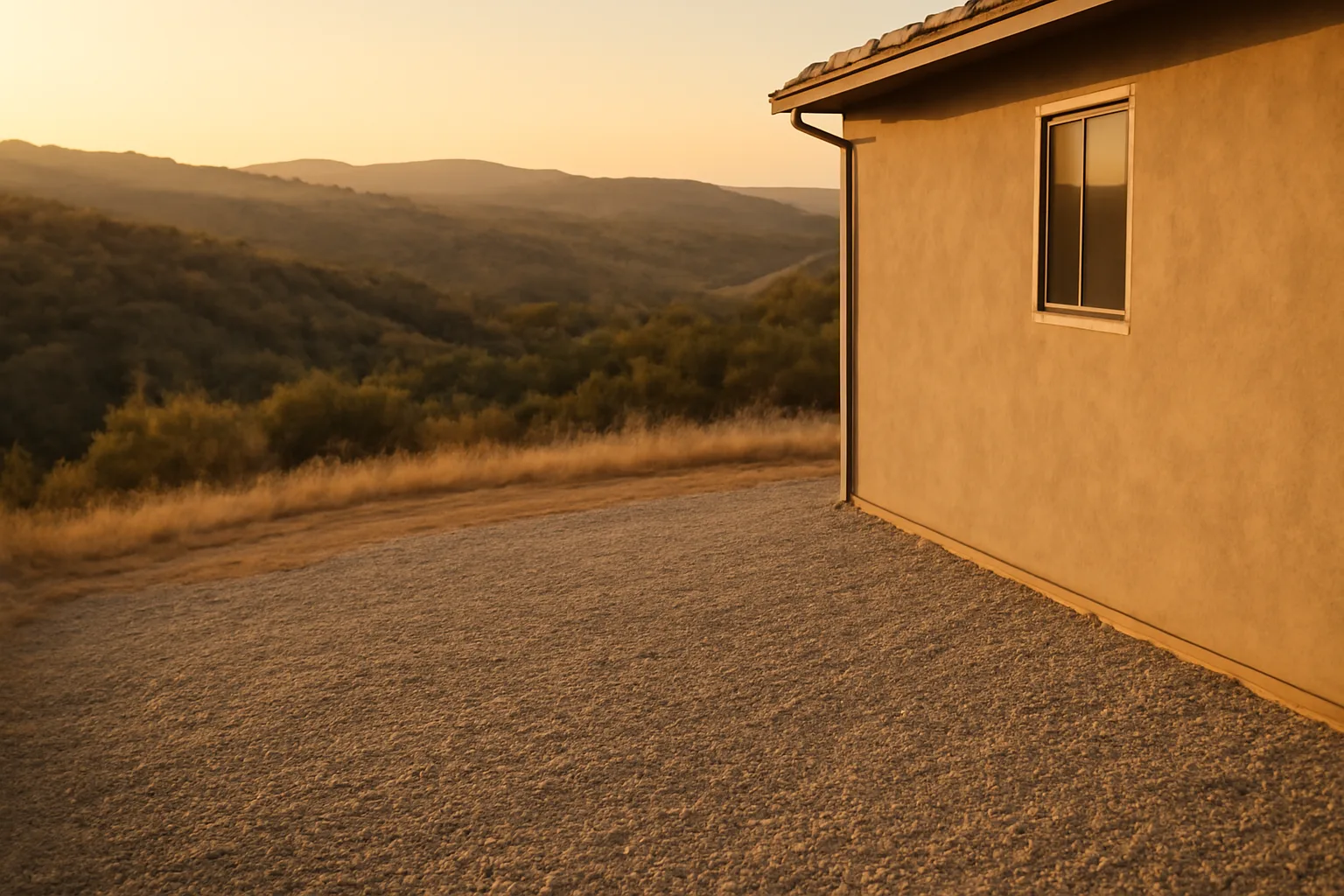
The centerpiece 2026 change is Zone 0: the 0 to 5 foot ember-resistant zone immediately touching your home's exterior walls, deck, and any attached structures. Under the developing Zone 0 standard, that strip should have no combustible mulch, no stored firewood, no plants touching the siding, and ideally hardscape (gravel, pavers, concrete) instead of vegetation. Here's the practical list of what Zone 0 compliance usually means once adopted in your area: - No wood mulch or bark within 5 feet of the foundation, use gravel, rock, or bare mineral soil instead
- No combustible fencing or gates attached directly to the house within that zone (metal or masonry connectors instead)
- Nothing stored under decks or against exterior walls, including firewood piles, propane tanks, or trash cans
- Trees and shrub canopies kept clear of the 5-foot zone, even if the trunk is farther away
- Outdoor furniture cushions and umbrellas removed or stored during red flag warnings Separately, California's building code (Chapter 7A of the California Building Code) already requires ignition-resistant construction materials for new construction and major remodels in Wildland-Urban Interface (WUI) fire hazard zones, covering roofing, vents, siding, windows, and decking. That code isn't new for 2026, but retrofit incentive programs and some local ordinances requiring existing-home compliance are expanding timelines into 2025 and 2026. [Fill in: your city/county's specific retrofit ordinance and compliance date]. For more detail on eaves, vents, and roofing choices, see fire safe landscaping California next to house.
why won't people follow the defensible space law in california
This is a fair question, and the honest answer is a mix of cost, confusion, and inspection capacity, more than stubbornness. Cost is real. Clearing 100 feet of defensible space on a sloped, brush-heavy lot can run into thousands of dollars, especially if it requires tree removal, chipping, or hauling. For lower-income and older homeowners, especially retirees on fixed incomes in fire-prone foothill communities, that's not a small ask. CAL FIRE and many local fire safe councils offer chipper programs and cost-share grants, but availability is spotty and often first-come, first-served. Confusion is also real. Defensible space rules involve two overlapping zones, exceptions for native oak woodlands, slope adjustments, and different rules depending on whether you're in a State Responsibility Area versus a Local Responsibility Area. Many homeowners genuinely don't know which zone they're in or which rules apply, and enforcement varies a lot by county. Then there's inspection capacity. CAL FIRE and local fire departments are required to conduct defensible space inspections, but staffing hasn't kept pace with the number of homes in high hazard zones. A property can go years without ever getting a formal inspection, which means noncompliance often isn't discovered until it's too late, either during a fire or during an insurance underwriting review. Finally, some homeowners resist because they value tree canopy, privacy screening, or aesthetic landscaping more than they weigh the fire risk, especially if they haven't personally experienced a close call. That calculus tends to change fast after a neighbor loses a home. For more on the friction of compliance and what enforcement actually looks like, see defensible.
how to prepare for a wildfire (before, during, after)
Preparing for a wildfire has three phases: the months before fire season, the hours before an evacuation, and the aftermath if you have to leave. Months before: this is when defensible space and home hardening actually happen. Clear Zone 1 and Zone 2 per CAL FIRE guidance, clean gutters and roof valleys of needles and leaves, screen attic and foundation vents with 1/8 inch metal mesh, and store an emergency kit. Ready.gov recommends a go-bag with water (one gallon per person per day for several days), medications, copies of insurance and identification documents, a battery radio, and a phone charger. Hours before: if you're under an evacuation warning, move your vehicle so it's facing out of the driveway, close all windows and doors (but leave them unlocked for firefighter access), remove flammable curtains, shut off gas at the meter if instructed, and turn on exterior lights so your house is visible in smoke. After: if you evacuated and can safely return, document everything before touching anything. Photograph and video the exterior, interior, roof, and any damage from every angle, and keep dated receipts for any temporary repairs or lodging. This is also the point where a documented home inventory matters most, since insurers move fast on claims and slow on payouts when documentation is thin. For readers building this kind of pre-loss documentation, DefensibleHome's $99 Wildfire Insurance Survival Kit walks through exactly what to photograph and log before a fire, not after, so you're not reconstructing your home's condition from memory during an evacuation. You can start one at /survival-kit-builder. We don't file claims or negotiate with insurers; the kit just helps you prepare your own documentation.
how to prevent forest fires (and how it's different from home defense)
Preventing forest fires at the landscape level is a different problem than protecting a single home, though the two connect at the WUI edge. At the landscape scale, prevention relies on fuel reduction (prescribed burns, mechanical thinning, and grazing programs), fire detection infrastructure, and public behavior campaigns. The US Forest Service and CAL FIRE both run prescribed fire programs designed to burn accumulated fuel under controlled conditions, reducing the intensity of future wildfires [1]. These programs are chronically underfunded relative to the backlog of fuel-loaded acres, and California alone has tens of millions of acres classified as some level of fire hazard severity zone. At the individual level, "how to prevent forest fires" mostly comes down to eliminating accidental ignition sources: fully extinguish campfires (drown, stir, drown again, until cold to the touch), don't park or idle vehicles on dry grass (catalytic converters can ignite vegetation), avoid outdoor burning during red flag warnings, maintain chainsaws and mowers to reduce sparking, and never leave fireworks or exploding targets unsupervised. Smokey Bear's long-running message, "Only you can prevent wildfires," exists because the data backs it up: the vast majority of ignitions are preventable human actions, not unavoidable natural events. For more on that specific messaging and its history, see only you can prevent wildfires.
how to avoid forest fires and prepare for forest fires as a resident
If you live near forested or wildland areas, avoiding forest fires (meaning: not causing one, and not getting caught by one) comes down to a short, unglamorous checklist. Don't cause one: check local burn bans before any outdoor fire, keep a shovel and water source at any campfire, never use fireworks in dry vegetation, and report unattended fires or suspicious smoke to 911 immediately rather than assuming someone else will. Don't get caught by one: sign up for your county's emergency alert system, know two evacuation routes from your home (more than one, since fire can block roads), keep your gas tank at least half full during fire season, and practice your evacuation route with your household at least once a year. Preparing for forest fires as a resident overlaps heavily with home wildfire prep, but adds a community layer: know your neighborhood's evacuation zone designation, keep a battery-powered NOAA weather radio since cell towers can fail, and if you have livestock or large animals, have a transport plan worked out before fire season, not during an evacuation order. Ready.gov's wildfire preparedness page has a downloadable checklist covering household plans, and it's worth doing this as a family exercise, more than reading it.
is santa barbara safe from fire?
No coastal California community is fully "safe" from fire, and Santa Barbara County has a documented history that argues against complacency. The 2017 Thomas Fire burned over 281,000 acres across Ventura and Santa Barbara counties, and the resulting January 2018 Montecito debris flow, triggered by rain on the burn scar, killed 23 people, according to CAL FIRE's incident records. That combination (fire followed by post-fire flooding and mudflow) is a specific risk pattern in steep coastal terrain with chaparral fuel. Santa Barbara sits in a Wildland-Urban Interface zone with dense chaparral, seasonal Santa Ana/sundowner wind events, and hillside development, all of which are classic wildfire risk factors. The Santa Barbara County Fire Department and CAL FIRE both designate significant portions of the county's foothill and mountain communities (Montecito, Mission Canyon, the Riviera, parts of Goleta) as Very High Fire Hazard Severity Zones. That doesn't mean every property in Santa Barbara faces equal risk. Homes right along the beach with no adjacent wildland vegetation have a materially lower wildfire exposure than homes backed up against undeveloped hillside chaparral. But "is Santa Barbara safe from fire" is the wrong frame; the better question is "what's my specific parcel's fire hazard severity zone designation," which you can check through CAL FIRE's FHSZ viewer or your county planning department. [Fill in: your specific Santa Barbara neighborhood's FHSZ designation and local fire district contact].
how can we prevent forest fires at a community level
Community-level wildfire prevention works best when it's coordinated, more than individual homeowners each doing their own thing on their own schedule. A single unmitigated lot in an otherwise well-cleared neighborhood can still be an ignition and spread point for the whole block. Firewise USA, a National Fire Protection Association program, recognizes communities that organize collective mitigation work, shared chipper days, and coordinated defensible space efforts [2]. These programs matter because insurers and some state programs increasingly look at community-level mitigation status, more than individual property compliance, when assessing area risk. Other community-level levers include: local Fire Safe Councils that coordinate grant funding for fuel reduction on shared or vacant lots, HOA-level enforcement of landscaping rules in fire hazard zones, utility company vegetation management around power lines (a major ignition source historically, including California's 2018 Camp Fire which was traced to PG&E transmission equipment per Cal Fire's investigation), and coordinated evacuation planning so one neighborhood's plan doesn't create a bottleneck for another's. If you're the one homeowner in a neighborhood trying to get things moving, the fastest lever is usually the local Fire Safe Council or your fire district's community wildfire protection plan (CWPP) office. They often have grant money sitting unused because not enough residents apply.
defensible space zones: what goes where
| Zone | Distance from structure | Key requirements | |
|---|---|---|---|
| Zone 0 (ember-resistant, new rule) | 0 to 5 feet | No combustible mulch, no plants touching structure, hardscape preferred, nothing stored against walls | |
| Zone 1 | 5 to 30 feet | Remove dead vegetation, space live plants, prune tree limbs 6+ feet up, no fuel ladders to roof | |
| Zone 2 | 30 to 100 feet | Reduce fuel volume, maintain horizontal/vertical spacing between plants and trees, mow grass to 4 inches or less | These distances are the California statewide baseline under PRC 4291. Your local fire district may require more, especially on steep slopes, where CAL FIRE guidance recommends extending clearance distances since fire moves faster uphill. Confirm your exact zone distances and any slope adjustments with [Fill in: your local fire district name and defensible space inspection contact]. For the planting choices that actually work inside Zone 2 without violating spacing rules, see fire safe landscaping California next to house. And for a broader look at what "defensible" actually means as a legal and practical standard, see defensible. |
documenting your home before a fire (the step most people skip)
Every fire prevention checklist tells you to clear brush and screen vents. Almost none of them tell you to document your home's condition before anything happens, and that gap costs people real money after a fire. Insurance claims after wildfire loss move fastest when you can show, with dates and photos, what your home and its contents actually were before the fire. That includes your roof material and age, your defensible space compliance (photos of cleared zones matter if your insurer questions mitigation credits), your home's built-in features, and a room-by-room inventory of belongings. This isn't a substitute for your insurance policy or a public adjuster, and it's not legal or claims advice. You still have to file your own claim and negotiate your own settlement, or hire a licensed professional if you want representation. What documentation does is put you in a stronger position to write your own accurate claim instead of reconstructing everything from memory weeks after a fire, when you're also dealing with housing, insurance calls, and possibly a non-renewal notice. This is the specific gap DefensibleHome's $99 Wildfire Insurance Survival Kit is built to close. It's a one-time structured process for photographing and logging your home, your mitigation work, and your belongings before you need any of it. Start one at /survival-kit-builder if you want that documentation done before fire season, not during it.
Frequently asked questions
When does the California defensible space law go into effect?
The core 100-foot defensible space law (PRC 4291) has been in effect for years already. New Zone 0 (0 to 5 foot ember-resistant zone) requirements are moving through state rulemaking with enforcement expected in many high hazard areas starting in 2026, but exact dates vary by local jurisdiction. Check with your county fire department for your specific deadline.
Why won't some homeowners follow California's defensible space law?
Cost, confusion about which zone applies to their property, and inconsistent fire department inspection capacity are the main reasons. Clearing 100 feet on a sloped, brush-heavy lot can cost thousands, and many areas go years without a formal inspection, so noncompliance often isn't caught until it matters.
What are the most effective ways to prevent wildfires?
At the ignition level: extinguish campfires fully, avoid burning on red flag days, and maintain equipment that can spark. At the structure level: clear defensible space in Zones 0 through 2, and harden your home's vents, roof, and siding against embers, which travel over a mile ahead of a fire front.
How do I prepare for a wildfire evacuation?
Build a go-bag with water, medications, documents, and a charger (per Ready.gov), know two evacuation routes, keep your gas tank half full during fire season, and photograph your home's condition and belongings before fire season starts, not during an active evacuation warning.
How can individuals help prevent forest fires?
Roughly 85 to 90% of wildfires are human-caused, so individual behavior matters a lot: fully extinguish fires, avoid parking on dry grass, skip fireworks in dry vegetation, and report unattended smoke immediately. These simple habits address the majority of ignition sources nationwide.
What new fire-safe home rules take effect in 2026?
California's Zone 0 rule, requiring an ember-resistant 0-to-5-foot zone around structures with no combustible mulch or plants touching the house, is expected to begin enforcement in many high hazard areas in 2026. Some local jurisdictions may adopt earlier or later timelines, so confirm with your local building department.
Is Santa Barbara safe from wildfire?
No coastal California area is fully safe from fire. Santa Barbara County has significant Very High Fire Hazard Severity Zone acreage in foothill communities, and the 2017 Thomas Fire and 2018 Montecito debris flow (23 deaths) show the compounded fire-then-flood risk in steep chaparral terrain.
What's the difference between defensible space and home hardening?
Defensible space is vegetation management around your house (Zones 0 through 2). Home hardening is retrofitting the structure itself with ember-resistant vents, Class A roofing, and non-combustible siding. CAL FIRE guidance says you need both, since a cleared yard doesn't stop embers landing on an unscreened attic vent.
How far should defensible space extend from a house in California?
California's statewide baseline under PRC 4291 requires 100 feet of defensible space where terrain allows, split into Zone 1 (5 to 30 feet, aggressive clearance) and Zone 2 (30 to 100 feet, reduced fuel volume), plus the newer Zone 0 (0 to 5 feet, ember-resistant zone).
What causes most wildfires?
Human activity causes an estimated 85 to 90% of wildfires in the US, according to Forest Service and National Interagency Fire Center data cited by Ready.gov. Common causes include unattended campfires, equipment sparks, downed power lines, fireworks, and vehicles parked on dry vegetation.
Do I need a permit to clear brush for defensible space?
It depends on your local jurisdiction, the size of vegetation being removed, and whether trees are protected species. Many counties exempt standard defensible space clearance from permitting requirements, but tree removal, especially of native oaks, may require a permit. Confirm with your local planning or fire department.
How do I know what fire hazard severity zone I'm in?
CAL FIRE maintains Fire Hazard Severity Zone maps covering Moderate, High, and Very High designations for both State and Local Responsibility Areas. You can look up your parcel through CAL FIRE's FHSZ viewer or by contacting your county planning or fire department directly.
What should go in a wildfire go-bag?
Ready.gov recommends water (one gallon per person per day for several days), a few days of medications, copies of ID and insurance documents, a battery-powered radio, a phone charger, sturdy shoes, and a change of clothes. Add pet supplies and any specific medical equipment your household needs.
Sources
- USDA Forest Service, Prescribed Fire: Prescribed burns and mechanical thinning reduce fuel loads to lower future wildfire intensity
- National Fire Protection Association, Firewise USA: Firewise USA recognizes communities for coordinated wildfire mitigation efforts
- CAL FIRE: Defensible space zones around a home reduce wildfire risk by creating buffer areas that slow or stop fire spread.
- California Legislative Information: California Assembly Bill 3074 establishes the ember-resistant zone requirement (Zone 0) within five feet of structures.
- California Office of the State Fire Marshal: California's fire hazard severity zone maps determine where defensible space and home hardening requirements apply.
- CAL FIRE: Defensible space law requires vegetation clearance around structures to reduce wildfire risk to homes.
- County of Santa Barbara: Local wildfire risk and fire safety information specific to Santa Barbara County residents.
- FEMA: Documenting home contents and structure before a disaster helps expedite insurance claims after a fire.