Last updated 2026-07-23
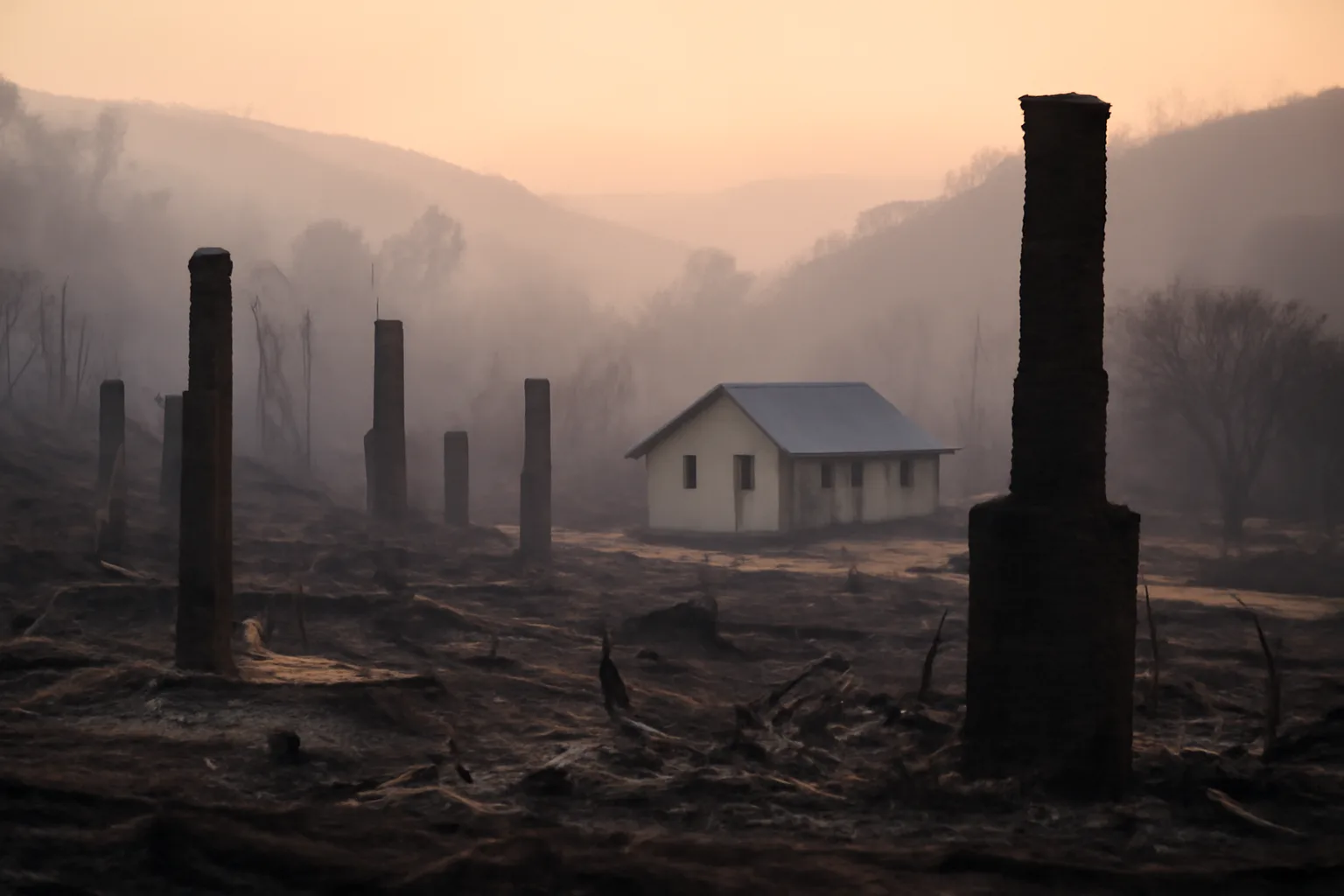
TL;DR
Defensible space didn't fail as a concept in the Palisades Fire. It was overwhelmed by 60-100 mph Santa Ana winds that drove wind-blown embers over a mile ahead of the flame front, igniting homes from the roof and vents inward, not from the yard. Clearing brush still matters, but ember-proofing your home's envelope matters just as much, if not more.
Why didn't defensible space stop the Palisades Fire?
Defensible space is built around a simple assumption: fire moves along the ground or through vegetation, and if you remove fuel near a structure, the fire has less to burn when it arrives. That assumption holds up fine in a lot of wildfires. It did not hold up in the Palisades Fire that started January 7, 2025, because the fire wasn't spreading mainly through vegetation contact by the time it hit dense neighborhoods. It was spreading through wind-driven embers, some of them landing on roofs and in gutters more than a mile from the active flame front. The National Weather Service recorded gusts up to 100 mph in the Santa Monica Mountains during the event, with widespread gusts in the 60-80 mph range across the fire area. CAL FIRE's incident summary lists the Palisades Fire at over 23,000 acres burned and more than 6,800 structures destroyed. When wind speeds get into that range, embers don't just drift, they fly. They land on wood shake roofs, in dry gutters full of leaves, under eaves, and against wood fences that touch the house. None of that is a defensible space problem in the classic sense of clearing brush 100 feet out. It's a home-hardening problem, and it's a different fight. So the honest answer is: defensible space rules are designed for a fire behavior model (surface fire, radiant heat, direct flame contact) that doesn't fully describe what happened in the Palisades. Ember cast at that wind speed can ignite a structure that has perfect 100-foot clearance around it, if the roof, vents, and siding aren't hardened. Research from the Insurance Institute for Business & Home Safety has found that in extreme wind-driven wildfires, ember intrusion into attic vents and crawlspace vents is one of the most common structure ignition pathways.
What actually destroys homes in extreme wind-driven fires like this?
Three things, mostly, and none of them require the main fire front to reach the house. Embers landing on or against combustible material is the biggest one. A wood fence that runs up to the house is basically a fuse. Vents without ember-resistant screens let embers inside the attic or crawlspace, where they ignite insulation, framing, or stored items nobody thinks about twice a year. The second big pathway is radiant heat from a burning neighbor. In dense subdivisions like parts of Pacific Palisades, homes sit 10 to 30 feet apart. If one house ignites and burns hot, the radiant heat alone can ignite the siding or window frames of the house next door, even with zero direct flame contact and good defensible space around that second house. This is why fire spread in dense urban-interior neighborhoods during extreme wind events often looks like a structure-to-structure fire, not a wildland fire, once it's inside the neighborhood. The third is direct flame contact from something that shouldn't have been flammable in the first place: mulch beds against the foundation, dry leaf litter in gutters, a wood deck, patio furniture cushions. CAL FIRE's home hardening guidance specifically flags the first 5 feet around a structure (Zone 0) as the highest-priority area precisely because these small, easily overlooked ignition sources are what let embers become house fires. If you want a fuller walkthrough of that Zone 0 standard, see defensible space zones.
When does the California defensible space law go into effect?
California's baseline defensible space law (Public Resources Code 4291) already requires 100 feet of defensible space clearance around structures in State Responsibility Areas and some Local Responsibility Areas, and it's been in effect in some form since the 1960s, with the 100-foot standard set by amendments effective January 1, 2005 [1]. That part isn't new. What is newer, and often confused with a single law, is the Zone 0 ember-resistant zone rule. California passed AB 3074 in 2020, which directs the Board of Forestry and Fire Protection to develop regulations requiring an ember-resistant zone within 5 feet of structures in the highest fire hazard areas [2]. As of early 2025, the Board of Forestry has been working through formal rulemaking on the specific Zone 0 regulations, and CAL FIRE's public guidance states the requirement is intended to take effect once that rulemaking finalizes, with the state's own materials describing a working target around 2025-2026 for enforcement to begin, pending completion of the regulatory process. Because the exact enforcement date has moved before and depends on your local fire district's adoption timeline, check with your county fire authority or CAL FIRE's Ready for Wildfire site for the current status in your area before assuming a specific date applies to you. Mitigation deadlines and enforcement also vary a lot by local fire district. Some Southern California fire departments already require and inspect for a 5-foot noncombustible zone ahead of the statewide rule finalizing. Check your specific fire district's current defensible space ordinance and inspection schedule before you plan work, because "the state rule" and "your city's rule" are sometimes not the same document.
What fire-safe home rules take effect in 2026?
This is the question a lot of homeowners are asking after the Palisades Fire, and the honest answer is: it depends which rule you mean, because there are several moving pieces on different timelines. The Zone 0 ember-resistant zone rule discussed above is the one most likely to have a 2025-2026 target for statewide enforcement, but the Board of Forestry and Fire Protection's rulemaking has to finalize first, and local jurisdictions then have their own adoption and enforcement windows [2]. Separately, California's Wildland-Urban Interface (WUI) building codes under Chapter 7A of the California Building Code already require ember-resistant vents, Class A roofing, and dual-paned or tempered glass windows for new construction and major remodels in designated fire hazard severity zones. These apply at time of permit, not on a single future date, so if you're rebuilding after a fire loss or doing a substantial remodel in a High or Very High Fire Hazard Severity Zone, Chapter 7A likely already applies to you now, regardless of what happens with Zone 0 rulemaking. The practical move here is not to wait for a specific date. If you're in a high-severity zone, do the Zone 0 style work now (noncombustible strip against the foundation, no wood fencing touching the house, ember-resistant vents) because it protects your home today and it's very likely to become the legal standard soon regardless of the exact effective date. For a broader comparison of hardening priorities against a checklist, see defensible.
Why won't people follow the defensible space law in California?
Cost is the most honest answer, and it's not a small factor. Clearing 100 feet of defensible space on a sloped, brush-covered lot can run from a few hundred dollars for a small flat yard to several thousand dollars for a large, steep, heavily vegetated property, according to typical vegetation management contractor pricing referenced by CAL FIRE and local fire safe councils. For homeowners already facing insurance non-renewal and rising premiums, that's a real financial squeeze, not a matter of not caring. Enforcement gaps are the second reason. CAL FIRE and local fire departments conduct defensible space inspections, but staffing is limited relative to the number of parcels in the wildland-urban interface, and inspections in many counties are complaint-driven or done on a multi-year rotation rather than annually for every property. A property can go years without an inspection, especially if it's a rental or an absentee-owned lot. A third reason, less discussed but real: people don't believe it will happen to them, or they've watched fires burn through neighborhoods with good clearance and concluded (not unreasonably, based on what they saw) that clearing brush didn't matter in that specific fire. The Palisades Fire actually reinforces this belief for some homeowners, even though the correct lesson is narrower: defensible space still matters for slower-moving fires and for reducing radiant heat exposure, but in extreme wind events it has to be paired with home hardening, or it won't be enough on its own. Finally, some homeowners genuinely don't know the specifics of what's required. The 100-foot rule has three different zones with different requirements (near-structure noncombustible zone, lean-and-green zone, and extended zone), and a lot of people have heard "clear your brush" without ever seeing the actual zone breakdown.
How to prevent wildfires from starting near your home
Most wildfires in the US are human-caused, not lightning-caused. Ready.gov and the National Interagency Fire Center both note that the large majority of wildfires nationally are started by human activity: unattended campfires, equipment sparks, downed power lines, and debris burning are the recurring categories. That means a meaningful share of ignition risk is within your control, even if the big destructive fires that make the news are often driven by power line failures or arson under extreme wind conditions. Practical steps that reduce ignition risk around your own property: keep any outdoor debris burning fully permitted and only on approved no-burn-restriction days, maintain a 10-foot clearance around barbecues and fire pits, don't park hot vehicles or run equipment like mowers and chainsaws over dry grass during peak fire season, and make sure any generator or outdoor electrical equipment is properly grounded and maintained. If you have a wood pile, keep it at least 30 feet from the structure and off the ground where possible. Report downed power lines immediately rather than assuming someone else already has. Utility equipment failure during high wind events is a documented ignition source in several major California fires investigated by CAL FIRE, and early reporting can matter for response time even if it doesn't change your personal risk that day.
How to prepare for a wildfire before it starts
Preparation splits into two buckets: making your house harder to ignite, and making sure you and your family can leave fast if you need to. Both matter, and a lot of homeowners over-invest in one and skip the other. On the house side, work outward from the structure. Ready.gov's wildfire preparedness guidance recommends starting with the "immediate zone" (0-5 feet from the house), removing all dead vegetation, keeping gutters clear, and using ember-resistant vent covers, before moving to the intermediate zone (5-30 feet) where spacing between plants and trees matters most. This mirrors CAL FIRE's Zone 0/Zone 1/Zone 2 model closely, which makes sense since both agencies are describing the same fire physics. On the evacuation side, build a go-bag with documents (copies of ID, insurance policy, deed or lease), medications, a change of clothes, and phone chargers, and keep it somewhere you can grab it in under two minutes. Photograph every room of your house and your yard, including serial numbers on major appliances and any visible upgrades you've made (new roof, new HVAC, defensible space clearing), because this kind of dated documentation is exactly what you'll want later if you ever need to show an insurer or adjuster what your property looked like before a loss. This is one place where a prebuilt organizing system helps: the $99 Wildfire Insurance Survival Kit walks you through photographing and logging your home and defensible space work into an organized, insurer-ready format, so you're not scrambling to reconstruct it from memory after a fire or a non-renewal notice. We don't file claims or handle communication with your insurer; the kit just helps you build the documentation you'd want to have ready either way. Sign up for your county's emergency alert system (more than relying on phone push notifications, which can lag), know two evacuation routes out of your neighborhood, and practice the drive at least once, since wildfire evacuations often happen in smoke and darkness with unfamiliar traffic patterns.
How to prevent forest fires and avoid forest fires when recreating
If you're the one lighting the fire, the rules are simple and mostly ignored anyway: fully drown and stir campfires until they're cold to the touch, never leave a fire unattended even for a few minutes, and check current fire restrictions before you go, since many public lands suspend all open flame during red flag conditions. The US Forest Service and CAL FIRE both publish current restriction maps by region, and a huge share of preventable wildfires start from campfires people thought were out but weren't. Equipment sparks are an underrated cause. Dragging trailer chains, mowing dry grass with metal blades, and using power tools that throw sparks near dry vegetation are all documented ignition sources, especially in late summer and fall in California, Colorado, Oregon, and Arizona when fuels are driest. If you're doing any of this work on your own property during high fire danger, do it in the morning when humidity is higher and wind is calmer, and keep a hose or extinguisher within reach. Discarded cigarettes and vehicle exhaust systems parked over dry grass round out the common list. None of this is exotic advice, it's just advice that gets skipped because people are in a hurry.
How can we prevent forest fires at the community and policy level?
Individual homeowner action matters, but it has limits when neighboring parcels, especially vacant lots, absentee-owned properties, and public land adjacent to neighborhoods, aren't maintained to the same standard. Community-level defensible space, sometimes called a "community fuel break" or "shaded fuel break," extends clearance across property lines and along evacuation routes, which is something no single homeowner can do alone. Fire Safe Councils, which exist in many California counties, coordinate exactly this kind of cross-property work, often with grant funding from CAL FIRE or the state's Fire Prevention Fund. If your neighborhood doesn't have one, starting one, or at minimum getting your HOA to coordinate a shared vegetation management schedule, is one of the highest-leverage things a group of homeowners can do together, because it closes the gap that individual defensible space compliance can't close on its own. Utility hardening (undergrounding lines, sectionalizing circuits so a single fault doesn't take down a whole feeder, and Public Safety Power Shutoffs during extreme wind) is a policy-level lever that individual homeowners can't control directly but can advocate for through local utility commissions. It's worth knowing that California's investor-owned utilities are now required to file wildfire mitigation plans with the California Public Utilities Commission, and those plans are public record if you want to see what's planned for your area.
Is Santa Barbara safe from fire?
No. No California coastal or foothill community is "safe" from fire in an absolute sense, and Santa Barbara County has a long documented history that argues against complacency. The Thomas Fire (2017) burned over 281,000 acres and was, at the time, the largest wildfire in modern California history, followed within weeks by the Montecito debris flow that killed 23 people when rain hit the Thomas Fire burn scar. The 1990 Painted Cave Fire and 2008 Tea Fire both burned into Santa Barbara neighborhoods directly. What Santa Barbara does have going for it is a long institutional memory of fire risk, active Fire Safe Council programs, and a county fire department with substantial wildland experience. That's a real advantage in terms of preparedness culture and inspection consistency, but it doesn't change the underlying fuel and wind conditions that make the South Coast and foothill communities a Very High Fire Hazard Severity Zone in CAL FIRE's official mapping. If you own property in Santa Barbara's foothills or wildland-urban interface, you're in the same risk category as Pacific Palisades in terms of fuel type and Santa Ana/sundowner wind exposure, and the same hardening priorities apply.
What should Palisades-area and similar high-risk homeowners actually do differently now?
Start with Zone 0, the 5 feet closest to your house, even if your local jurisdiction hasn't formally enforced it yet. Replace bark mulch against the foundation with gravel or pavers, remove wood fencing sections that touch the house (replace the last 5 feet with metal), and clear gutters of leaf litter, especially before wind season. This is the single area where CAL FIRE's post-incident research keeps pointing to the most preventable ignitions. Second, check your vents. Ember-resistant vent screens (1/8 inch mesh minimum, ideally a listed ember-resistant vent product meeting the State Fire Marshal's standard) cost far less than a roof and dramatically cut one of the most common ember entry points. If your home was built before Chapter 7A codes existed in your area, this is very likely a gap you have. Third, get your defensible space work documented, dated, and photographed, not because it guarantees anything with your insurer, but because insurers increasingly ask for proof of mitigation work when reviewing non-renewal appeals or new policy applications in wildfire-prone counties, and "I did the work" is a much weaker position than dated photos and a contractor invoice. For a state-by-state comparison of what documentation different mitigation and clearing contracts typically look like, see wildfire defensible space clearing contracts washington state dnr, and for landscaping specifics near the structure, see fire safe landscaping california next to house. Last, if you've already had a fire loss or a non-renewal letter, get organized before you need to be. The $99 Wildfire Insurance Survival Kit gives you a structured way to document your home's condition, mitigation work, and inventory so you have it ready if you ever need it for an insurance conversation, a FAIR Plan application, or simply your own records. It's not a claims service and it doesn't handle communication with your insurer for you; it just makes sure you're not starting from zero.
Frequently asked questions
When does the California defensible space law go into effect?
The core 100-foot defensible space requirement (PRC 4291) has been law since amendments took effect January 1, 2005. The newer Zone 0 ember-resistant 5-foot zone rule (from AB 3074, passed 2020) is still finalizing through Board of Forestry rulemaking, with enforcement widely expected around 2025-2026, but the exact date depends on your local fire district's adoption timeline.
Why didn't defensible space stop the Palisades Fire?
Sustained winds up to 100 mph carried embers over a mile ahead of the flame front, igniting homes through roofs, vents, and gutters rather than through direct contact with wildland vegetation. Defensible space reduces flame contact and radiant heat risk, but it doesn't stop wind-driven ember ignition on its own; that requires home hardening (vents, roofing, Zone 0 materials).
Why won't people follow the defensible space law in California?
Mainly cost, inconsistent enforcement, and disbelief that it will help. Clearing a large sloped lot can run from a few hundred to several thousand dollars, inspections are often complaint-driven rather than universal, and some homeowners have watched fires burn homes with good clearance and wrongly concluded clearing brush doesn't matter.
What fire-safe home rules take effect in 2026?
The most likely 2026-relevant rule is California's Zone 0 ember-resistant zone requirement within 5 feet of structures in high fire hazard zones, still moving through Board of Forestry rulemaking. Chapter 7A WUI building codes (ember-resistant vents, Class A roofing) already apply to new construction and major remodels in fire hazard zones now, independent of that date.
Is Santa Barbara safe from fire?
No. Santa Barbara County has burned repeatedly, including the 2017 Thomas Fire (281,000+ acres) and the 1990 Painted Cave and 2008 Tea fires, both of which reached city neighborhoods directly. Much of the county's foothill and wildland-urban interface area is mapped Very High Fire Hazard Severity Zone by CAL FIRE.
How can I prevent wildfires from starting on or near my property?
Keep debris burning fully permitted and legal, drown campfires cold before leaving, maintain 10 feet of clearance around fire pits and grills, avoid mowing dry grass with metal blades during high fire danger, and report downed power lines immediately. Most wildfires nationally are human-caused, so individual behavior genuinely reduces risk.
How do I prepare for a wildfire if I live in a high-risk zone?
Harden your home's immediate 5-foot zone, clear gutters, install ember-resistant vents, and build a two-minute go-bag with documents, medication, and chargers. Photograph your home and defensible space work for your records, sign up for county emergency alerts, and know two evacuation routes, practicing the drive at least once.
How do I prevent forest fires when camping or recreating?
Fully drown and stir campfires until cold, never leave fire unattended, and check current fire restrictions before your trip since red flag conditions often ban all open flame. Discarded cigarettes, dragging trailer chains, and mowing dry grass are also common preventable ignition sources worth avoiding during fire season.
How can communities prevent forest fires beyond individual homes?
Community fuel breaks that cross property lines, coordinated by Fire Safe Councils or HOAs, close gaps that individual defensible space compliance can't reach, especially near vacant or absentee-owned lots. Utility hardening like undergrounding lines and Public Safety Power Shutoffs during extreme wind is a policy-level lever homeowners can advocate for through utility commission filings.
What is Zone 0 and why does it matter more after the Palisades Fire?
Zone 0 is the 5 feet closest to a structure, where CAL FIRE and California's AB 3074 rulemaking require noncombustible materials (gravel, not mulch; no wood fencing touching the house). It matters because most ember ignitions in wind-driven fires like the Palisades happen in this zone, not from wildland fire reaching the yard.
Does clearing 100 feet of defensible space still matter if embers can travel a mile?
Yes, for most fires. Extreme ember-cast events like the Palisades Fire are the tail-risk scenario; the 100-foot zone still reduces flame contact and radiant heat exposure in the far more common slower-moving wildfires, and it remains required by California law (PRC 4291) regardless of wind speed on any given day.
Will defensible space or home hardening lower my insurance premium?
It depends entirely on your specific insurer and state; some California insurers offer discounts for documented mitigation under the state's Safer from Wildfires framework, but none guarantee reinstatement or a rate reduction. Ask your insurer directly what documentation they require, and keep dated photos and contractor invoices regardless of the answer.
Sources
- California Public Resources Code Section 4291: 100-foot defensible space clearance requirement around structures in State Responsibility Areas, effective January 1, 2005
- California Legislature, Assembly Bill 3074 (2020): AB 3074 directs the Board of Forestry and Fire Protection to develop an ember-resistant zone regulation within 5 feet of structures
- CAL FIRE: California's defensible space law under PRC 4291 requiring 100 feet of clearance around structures
- CAL FIRE: Fire Hazard Severity Zone maps designating high-risk areas including parts of Los Angeles County like Pacific Palisades
- CAL FIRE: Low-cost home hardening retrofits recommended for wildfire-prone homes
- National Fire Protection Association (NFPA): Home hardening measures such as ember-resistant vents and non-combustible roofing to prevent ignition
- Santa Barbara County: Santa Barbara County wildfire risk and preparedness information